H12-821_Part4
QUESTION 61
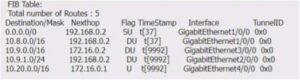
The FIB table of a router is shown below. When the router receives a packet destined for 10.9.1.2, which of the following interfaces will forward the packet?
A. GigabitEthernet4/0/0
B. Gigabit Ethernet1/0/0
C. GigabitEthernet2/0/0
D. GigabitEthernet3/0/0
Correct Answer: B
QUESTION 62
Routing protocols are rules used by routers to discover routes, create routes, and maintain routing tables for packet forwarding. Routes can be classified into which of the following types based on their source?
A. Dynamic routing
B. External route
C. Static route
D. Direct route
Correct Answer: ACD
QUESTION 63
OSPF has multiple types of routes with varying priorities. Which of the following types of routes has the lowest priority when they have the same prefix?
A. Type 1 external route
B. Intra-area route
C. Type 2 external route
D. Inter-area route
Correct Answer: C
QUESTION 64
On an OSPF network, the inter-area routing loop prevention mechanism requires that all non-backbone areas be directly connected to the backbone area. If a non-backbone area is not connected to the backbone area, you can configure a virtual link instead. Which of the following statements are true about virtual links?
A. Virtual links are configured in the OSPF view.
B. Virtual links can be used to optimize OSPF paths.
C. Virtual links can be used in scenarios where the backbone area is divided.
D. Virtual links comply with the rules for loop prevention between OSPF areas.
Correct Answer: AC
QUESTION 65
On an enterprise network, the directly connected interfaces of two OSPF routers are on different network segments and have different masks. To establish an OSPF neighbor relationship between the two interfaces, you can change their network types to which of the following?
A. Broadcast
B. Point-to-point
C. P2Mp
D. NBMA
Correct Answer: B
QUESTION 66
On an OSPF network, Type 7 LSAs can be generated only by ASBRS in NSSAs or stub areas and describe AS-external routes.
A. TRUE
B. FALSE
Correct Answer: A
QUESTION 67
OSPF has several types of special areas, which are used to reduce the LSDB size and improve device performance. Which of the following LSAs cannot be in a totally stub area?
A. Type 2 LSA
B. Type 3 specific LSA
C. Type 1 LSA
D. Type 3 LSA that describes a default route
Correct Answer: B
QUESTION 68
An OSPF AS-external LSA describes a route to an As external network. When the field in the LSA is 0.0.0.0, the traffic destined for the external network is sent to the ASBR that imports this external route. (Enter the acronym in uppercase.)
Correct Answer: FA
QUESTION 69
An enterprise network runs OSPF to implement network communication. Which of the following types of LSAs may be generated by an ABR?
A. AS External LSA
B. NSSA LSA
C. ASBR Summary LSA
D. Network Summary LSA
Correct Answer: CD
QUESTION 70
On an IS-IS network, all routers in the same Level-1 area must be configured with the same area address so that they can communicate with each other. Routers in the same Level-2 area, however, can communicate with each other even if they are configured with different area addresses.
A. TRUE
B. FALSE
Correct Answer: B
QUESTION 71
On an IS-IS network, each router can generate LSPs. Which of the following events trigger the generation of a new LSP?
A. Related IS-IS interfaces go up or down.
B. The IS-IS interface cost is increased.
C. Inter-area IP routes change.
D. Periodic updates occur.
Correct Answer: ACD
QUESTION 72
Which of the following values is the Reserved/Circuit Type field in the IIH packets sent by a Level-1-2 router on an IS-IS network?
A. 11
B. 01
C. 00
D. 10
Correct Answer: A
QUESTION 73
BGP is a vector protocol that implements route reachability between ASs and selects optimal routes. It uses TCP as its transport layer protocol (port 179) and periodically updates routes.
A. TRUE
B. FALSE
Correct Answer: B
QUESTION 74
On a BGP network, locally originated routes may be generated in multiple ways. Which of the following locally originated routes has the highest priority?
A. Routes imported using the network command
B. Routes imported using the import-route command
C. Routes obtained through automatic summarization
D. Routes obtained through manual summarization
Correct Answer: D
QUESTION 75
BGP routes have multiple path attributes. When a router advertises a BGP route to its peers, the route carries multiple path attributes. These attributes describe the characteristics of the BGP route and affect route selection in some scenarios. The attribute is Huawei-specific. It is valid only on the local device and is not transmitted to BGP peers. (Enter the attribute name in lowercase as it appears in the command output about the BGP routing table.)
Correct Answer: preferred-value
QUESTION 76
Which of the following statements are true about basic BGP concepts?
A. BGP running within an AS is called IBGP. To quickly transmit routes, a BGP device advertises the routes learned from an IBGP peer to other IBGP peers.
B. BGP running between ASs is called EBGP. To prevent routing loops between ASs, a BGP device discards the routes received from EBGP peers if they carry the local AS number.
C. The router ID of BGP is a 32-bit value used to identify a BGP device. Each BGP device must have a unique router ID. Otherwise, BGP connections cannot be established between peers.
D. The device that sends BGP messages is called a BGP speaker. It receives or generates new messages and advertises them to other BGP speakers.
Correct Answer: BCD
QUESTION 77
Route attributes are specific descriptions of BGP routes. Which of the following statements are true about BGP attributes?
A. Optional attributes must be identified by all BGP routers.
B. Well-known mandatory attributes must be included in each Update message.
C. The optional transitive attributes that cannot be identified by a BGP device are ignored by the device and are not advertised to other peers.
D. Well-known discretionary attributes may be included in some Update messages.
Correct Answer: BD
QUESTION 78
A non-client is an IBGP peer that functions as neither an RR nor a client. A non-client must establish fully meshed connections with the RR and all the other non-clients.
A. TRUF
B. FALSE
Correct Answer: A
QUESTION 79
Which of the following values is the default interval at which a device sends Keepalive messages to maintain a BGP connection after a BGP peer relationship is established?
A. 30
B. 60
C. 180
D. 10
Correct Answer: B
QUESTION 80
Route summarization is a mechanism that combines multiple routes. BGP supports automatic summarization and manual summarization on IPv6 networks.
A. TRUE
B. FALSE
Correct Answer: B