H12-821_Part3
QUESTION 41
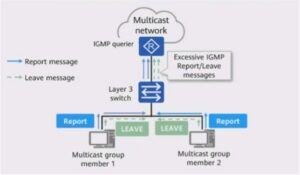
On the network shown in the figure, an IGMP querier may need to manage a large number of group members. When a large number of hosts frequently join or leave multicast groups, a large number of Report/Leave messages are generated, placing a burden on the IGMP querier. To reduce pressure on the IGMP querier, you can configure IGMP on the Layer 3 switch, so that the Layer 3 switch aggregates Report/Leave messages before sending them to the IGMP querier. (Use full spelling with the first letter capitalized.)
Correct Answer: Proxy
QUESTION 42
Without a prior version check, an engineer configures IGMP snooping on a device and the version of IGMP snooping is earlier than the IGMP versions on user hosts. In this case, which of the following situations will occur?
A. Users cannot receive multicast data because the device forwards received IGMP Report messages only to router ports and does not generate group member ports or forwarding entries.
B. The IGMP versions of the hosts are automatically upgraded, and users can receive multicast data properly.
C. Users cannot receive multicast data, but the device generates forwarding entries after receiving IGMP Report messages.
D. The IGMP snooping version of the device is automatically degraded, and users can receive multicast data properly.
Correct Answer: A
QUESTION 43
The Neighbor Discovery Protocol (NDP) is an important basic protocol in the IPv6 protocol suite and plays an important role. Which of the following functions and features does it support?
A. Address resolution
B. Redirection
C. Neighbor state tracing
D. Duplicate address detection
Correct Answer: ABCD
QUESTION 44
IPv6 defines multiple types of addresses. Which of the following statements is false about these addresses?
A. Each interface can have multiple global unicast addresses with different network prefixes.
B. Link-local addresses can be quickly generated using the EUI-64 method.
C. Anycast addresses can be used only as destination addresses.
D. Manually configured link-local addresses have a higher priority than automatically generated ones.
Correct Answer: B
QUESTION 45
When a packet passes through a firewall, the firewall creates a session connection for the packet to guide subsequent forwarding of the packet. However, the firewall does not create session entries for all packets. For which of the following packets does the firewall not create session entries when the packet reaches the firewall?
A. GRE packet
B. UDP packet
C. Subsequent fragment
D. ICMP ping packet
Correct Answer: C
QUESTION 46
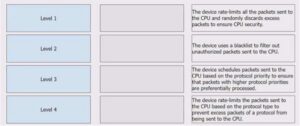
CPU attack defense uses a multi-level security mechanism to implement hierarchical device protection. Match the following levels with the corresponding protection functions.
Select and Place:
Correct Answer: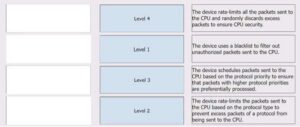
QUESTION 47
In IPsec, an SA is uniquely identified by 3-tuple information. Which of the following parameters does not belong to the 3-tuple information?
A. Key exchange protocol
B. Destination IP address
C. SFI
D. Security protocol ID
Correct Answer: A
QUESTION 48
By default, some security zones are created when Huawei firewalls are enabled. Which of the following security zones is created by users?
A. DMZ
B. Local
C. ISP
D. Trust
Correct Answer: C
QUESTION 49
Data encryption can effectively ensure VPN data security, but not all VPNs support this feature. Which of the following VPN technologies support data encryption and verification?
A. IPsec
B. L2TP
C. MPLS VPN
D. SSL
Correct Answer: AD
QUESTION 50
Hackers often obtain the login permissions of system administrators through various attacks. Which of the following measures can be taken to enhance the security of administrator accounts?
A. Encrypt passwords before transferring them. Whenever possible, transfer passwords by email.
B. Periodically check whether unnecessary administrator accounts exist in the system. If such accounts exist, delete them to reduce the attack surface.
C. To ensure security and make the password easier to remember, you can set the password to be valid for a long time.
D. Assign exclusive accounts for administrators with different maintenance roles to avoid account sharing.
Correct Answer: BD
QUESTION 51
VRRP has two versions: VRRPv2 and VRRPv3. Which of the following statements are true about VRRPv2?
A. By default, VRRP Advertisement packets are sent at an interval of 1 second.
B. The default device priority is 100.
C. VRRPv2 is applicable to both IPv4 and IPv6.
D. VRRPv2 supports authentication.
Correct Answer: ABD
QUESTION 52
Which of the following statements are true about VRRP Advertisement packets?
A. VRRP Advertisement packets contain the priority of the VRRP router.
B. The VRRP protocol number is 112.
C. VRRP Advertisement packets are broadcast.
D. VRRP Advertisement packets support the authentication function.
Correct Answer: ABD
QUESTION 53
BFD can quickly detect faults in channels at multiple network layers, ensuring high reliability. To which of the following layers does BFD belong?
A. Data link layer
B. Network layer
C. Physical layer
D. Application layer
Correct Answer: D
QUESTION 54
During routine maintenance, an enterprise administrator runs a command to check VRRP group information. Which of the following statements is false about the command output?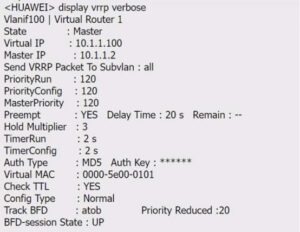
A. Preemption is enabled for the VRRP group.
B. Authentication is enabled for the VRRP group.
C. The ID of the VRRP group is 1.
D. This VRRP group is an mVRRP group.
Correct Answer: B
QUESTION 55
In VRRP networking, the source IP address in the ARP aging probe packet sent by a VRRP device is the interface IP address, not the virtual IP address.
A. TRUE
B. FALSE
Correct Answer: A
QUESTION 56
After the administrator of an enterprise deploys a DHCP server, employees complain that their clients cannot obtain IP addresses from the DHCP server. Which of the following may cause this problem?
A. STP is enabled on the DHCP server.
B. Multiple DHCP servers are configured .
C. The DHCP function is disabled by default, and the administrator forgets to enable the DHCP function.
D. DHCP clients and the DHCP server are on different network segments, and no DHCP relay agent is configured on the network.
Correct Answer: AD
QUESTION 57
iMaster NCE-Campus can be used as an authentication server on a WLAN to authenticate STAs.
A. TRUE
B. FALSE
Correct Answer: B
QUESTION 58
The figure shows the WLAN topology of an enterprise, where the direct forwarding mode is used. Which of the following is the data forwarding path after inter-AC Layer 2 roaming?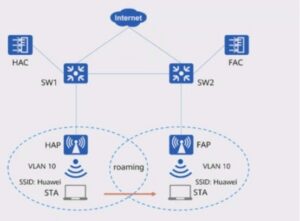
A. STA->FAP ->SW2->FAC->HAC->SW1 ->HAP->SW1 ->Internet
B. STA- >FAP ->SW2->FAC->HAC ->SW1 ->Internet
C. STA->FAP ->SW2->Internet
D. STA->FAP->SW2-> FAC ->HAC ->SW1 ->HAP-> HAC ->SW1 -> Internet
Correct Answer: C
QUESTION 59
On an enterprise WLAN where Portal authentication is deployed, an AC functions as an access device and communicates with a Portal server using the Portal protocol.
Which of the following statements are true about the Portal protocol?
A. By default, the device uses the destination port number 50100 to proactively send packets to the Portal server.
B. By default, the access device processes Portal protocol packets through port 2000.
C. The HTTP or HTTPS protocol can be used as the Portal access or authentication protocol.
D. Portal protocol packets are transmitted over TCP.
Correct Answer: ABC
QUESTION 60
As a next-generation wireless technology, Wi-Fi 6 greatly improves bandwidth rate and performance. Which of the following statements is false about the features of Wi-Fi 6?
A. Uses TWT technology to reduce terminal power consumption.
B. Provides high bandwidth, up to 9.6 Gbit/s.
C. Uses OFDMA technology to achieve high concurrency.
D. Realizes zero latency, ensuring efficient service running.
Correct Answer: D