H12-821_Part10
QUESTION 181
IGMP SSM mapping allows IGMPv1 and IGMPv2 group members to access the SSM network if a multicast source is manually bound to a multicast group. Which of the following statements are true about IGMP SSM mapping?
A. IGMP SSM mapping converts (*, G) information in IGMPV1 and IGMPV2 Report messages to (S, G) information according to static SSM mapping entries configured on a multicast switch.
B. IGMP SSM mapping does not apply to IGMPv3 Report messages. To provide SSM service to hosts running any IGMP version on a network segment, IGMPv3 must be enabled on the multicast router’s interface that is connected to the network segment.
C. If IGMP SSM mapping is disabled, IGMPv1 and IGMPv2 do not support multicast deployment in SSM mode.
D. The SSM group address ranges from 232.0.0.0 to 232.255.255.255.
Correct Answer: ABCD
QUESTION 182
Match the ranges and meanings of the following IPv4 multicast addresses.
Select and Place: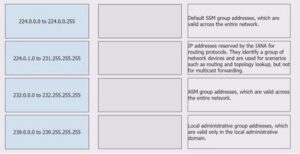
Correct Answer: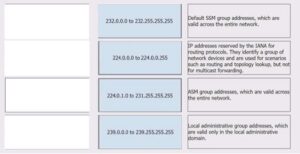
QUESTION 183
PIM-DM has many working mechanisms. Which of the following mechanisms are used to set up an SPT?
A. Neighbor discovery
B. Pruning
C. Graft
D. Flooding
Correct Answer: ABCD
QUESTION 184
The Neighbor Discovery Protocol (NDP) is an important basic protocol in the IPv6 protocol suite. Which of the following statements is false about NDP?
A. NDP can implement the ARP function in IPv4.
B. Request packets are sent in multicast mode, reducing the performance pressure on the Laver 2 network.
C. Address resolution is implemented at Layer 2. Different Laver 2 media use the same address resolution protocol.
D. Layer 3 security mechanisms can be used to prevent address resolution attacks.
Correct Answer: C
QUESTION 185
In IPv6, NDP uses multiple types of ICMPv6 packets. Which of the following functions are Rs packets used for?
A. Prefix readdressing
B. Redirection
C. Duplicate address detection
D. Address resolution
Correct Answer: A
QUESTION 186
In addition to numerous normal service packets, the CPUs of devices on a network may also receive large numbers of attack packets. To ensure that the CPUs can properly respond to normal services, the devices provide the local attack defense function. Which of the following statements are true about this function?
A. The device can schedule the protocol packets to be sent to the CPU in the attack defense policy based on the protocol priorities so that the packets with higher priorities are processed preferentially.
B. CPU attack defense can also take effect on the management interface of the device.
C. Regardless of the packet type, the same rate limit must be set to reduce the number of packets sent to the CPU.
D. To ensure that session-based application-layer data runs properly during an attack, you can configure the dynamic link protection function.
Correct Answer: AD
QUESTION 187
GRE is a VPN technology that can implement packet transmission over heterogeneous networks. Which of the following statements are true about GRE?
A. GRE enables encapsulated data packets to be transmitted over another network layer protocol, but cannot encapsulate multicast data.
B. GRE tunnels can work with IPsec to ensure the security of multicast services such as voice and video.
C. GRE is a Layer 2 VPN encapsulation technology.
D. GRE tunnels can extend the working range of network protocols with hop limits.
Correct Answer: BD
QUESTION 188
SSH is a secure protocol that establishes tunnels for users on insecure networks. Which of the following statements is false about SSH login?
A. When the SSH server function is enabled on a device, the socket obtaining service is also enabled on the device. This makes the device prone to scanning by attackers. As such, the SSH server function and the corresponding port can be disabled when the SSH server function is not required.
B. By default, the port number of the SSH server is 23. You can change the port number of the SSH server to a non-well-known port number to reduce the probability of being scanned and attacked.
C. The SSH server supports authentication. Only users who have passed authentication can log in to the device.
D. An ACL rule can be configured for each VTY channel to control the IP addresses of clients that are allowed to log in to the device.
Correct Answer: B
QUESTION 189
Typically, a protocol that occupies two ports during communication is called a multi-channel protocol. For such protocols, the ASPF function must be enabled on the firewall to ensure smooth setup of the data channel and reduce the risk of attacks. Which of the following protocols is not a multi-channel protocol?
A. FTP
B. H.323
C. SIP
D. SMTP
Correct Answer: D
QUESTION 190
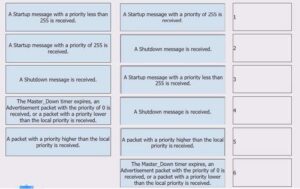
The figure shows the VRRP status switchover events. Match these events with their sequence numbers. (Token is reusable)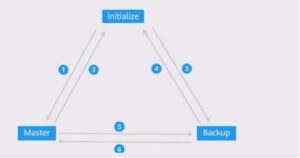
Select and Place: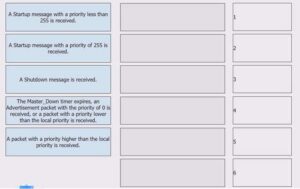
Correct Answer:
QUESTION 191
In VRRP networking, if VRRP is not configured to track an uplink interface and the uplink interface or link of the master device in a VRRP group fails, no switchover will be triggered. As a result, a traffic blackhole occurs.
A. TRUE
B. FALSE
Correct Answer: A
QUESTION 192
On a Layer 3 network, all routing protocols have their own fault detection mechanisms. However, if the response is slow, a large amount of data may be lost when a fault occurs.
A. TRUE
B. FALSE
Correct Answer: A
QUESTION 193
Telemetry-enabled devices sample data only from their forwarding planes. They can collect different types of statistics from the sampled data, such as interface traffic statistics, CPU usage, and memory usage.
A. TRUE
B. FALSE
Correct Answer: B
QUESTION 194
Roaming technology is typically used on a large WLAN to ensure that STA services are not interrupted when STAs move between coverage areas of different APs.
A. TRUE
B. FALSE
Correct Answer: A
QUESTION 195
On a WLAN where a VLAN pool is configured, network engineers create different VAPs on an AP to provide the wireless access service for users in different user groups. The figure shows the process of connecting a STA to a WLAN. In which step does the VLAN pool assign the STA to a VLAN?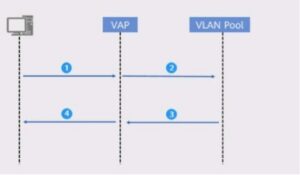
A. Step 4
B. Step 2
C. Step 1
D. Step 3
Correct Answer: D
QUESTION 196
The typical characteristics of the Al era are that it focuses on data, explores data value, and improves Al efficiency. Therefore, the core requirement of Al for data center networks is speed, meaning low latency.
A. TRUE
B. FALSE
Correct Answer: A
QUESTION 197
Which of the following routes can be imported by network engineers using the import-route command in the OSPF view?
A. Static routes
B. BGP routes
C. Direct routes
D. Routes of other OSPF processes
Correct Answer: ABC
QUESTION 198
OSPF has several types of special areas, which are used to reduce the LSDB size and improve device performance. Which of the following types of LSAs may exist in a totally NSSA?
A. Type 3 LSA
B. Type 7 LSA that describes a default route
C. Type 7LSA
D. Type 3 LSA that describes a default route
Correct Answer: ACD
QUESTION 199
The OSPF neighbor table stores important entries maintained by OSPF. Which of the following statements are true about the entries?
A. An OSPF neighbor relationship must be established before OSPF transmits LSAs.
B. The OSPF neighbor table stores state information about the links between OSPF routers.
C. You can run the display ospf peer command to view the OSPF neighbor table.
D. OSPF neighbor relationships are established by exchanging Hello packets.
Correct Answer: ABCD
QUESTION 200
On an OSPF network, which of the following multicast addresses is used by a DR Other to send DD packets to the DR or BDR?
A. 224.0.0.5
B. 224.0.0.2
C. 224.0.0.1
D. 224.0.0.6
Correct Answer: A