H12-821_Part1
QUESTION 1
On Huawei switches, which of the following planes provides network information and forwarding entries that are mandatory for data plane forwarding?
A. Forwarding plane
B. Monitoring plane
C. Data plane
D. Control plane
Correct Answer: B
QUESTION 2
When performing a lookup in its FIB table for a packet, a router performs a bitwise “OR” operation on the destination IP address of the packet and the mask of each entry in the FIB table. If the resulting address matches the corresponding network address in the FIB table, a matching route is found.
A. TRUE
B. FALSE
Correct Answer: B
QUESTION 3
On an OSPF network, both NSSAs and stub areas are used to reduce the number of LSAs. The main difference between the two types of areas is that NSSAs can import external routes and receive the external routes imported by other OSPF areas.
A. TRUE
B. FALSE
Correct Answer: B
QUESTION 4
On an OSPF network, the router ID of a router is incorrectly configured. To correct it to 1.1.1.1 in OSPF process 1, a network engineer can run the ospf 1 router-id
1.1.1.1 command in the system view of the device.
A. TRUE
B. FALSE
Correct Answer: B
QUESTION 5
On a campus network, OSPF is used to implement network communication, and the link layer protocol is Ethernet. Which of the following types of packets are unicast by default?
A. Hello packet
B. LSR packet
C. LSAck packet
D. DD packet
Correct Answer: BD
QUESTION 6
On an OSPF network, one router with P2P as the network type is directly connected to another router with P2MP as the network type. If the Hello intervals on the two routers are changed to be the same, neighbor relationship establishment and LSDB synchronization are not affected.
A. TRUE
B. FALSE
Correct Answer: B
QUESTION 7
Which of the following types of networks require that two ends reside on the same network segment and have the same mask to establish an OSPF neighbor relationship?
A. Broadcast
B. NBMA
C. P2MP
D. P2P
Correct Answer: ABC
QUESTION 8
The following figure shows the OSPF network of an enterprise and the OSPF configurations of R1. Which of the following statements is false about the network?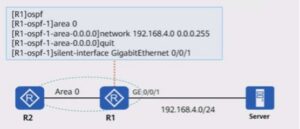
A. GE 0/0/1 of R1 cannot send OSPF packets.
B. The network segment to which GE 0/0/1 of R1 belongs cannot be advertised.
C. GE 0/0/1 of R1 cannot accept OSPF packets.
D. R2 can access the server.
Correct Answer: B
QUESTION 9
An enterprise uses OSPF to implement network communication. To ensure data validity and security, all authentication modes supported by OSPF are enabled on routers. In this case, interface authentication is preferentially used by the routers.
A. TRUE
B. FALSE
Correct Answer: A
QUESTION 10
On an OSPF network, LSDBs are used to store LSAs. Common LSAs include router LSAs and network LSAs. Which of the following items is not included in the 3-tuple that is used to uniquely identify an LSA?
A. LS Sequence Number
B. Advertising Router
C. LS Type
D. Link State ID
Correct Answer: A
QUESTION 11
On an OSPF network, an algorithm is used to prevent loops within an area, but loops may occur between areas. Therefore, OSPF defines a loop prevention mechanism for inter-area routes. Which of the following statements are true about the loop prevention mechanism?
A. Inter-area routes cannot be directly transmitted between non-backbone areas.
B. An ABR cannot inject Type 3 LSAs that describe routes to a network segment in an area back to the same area.
C. All non-backbone areas must be directly connected to area 0.
D. Inter-area routes need to be forwarded through area 0.
Correct Answer: ABCD
QUESTION 12
On the campus OSPF network shown in the following figure, the interfaces connecting the five routers are GE interfaces, and their costs are not changed. The import-route command is run on R1. After the network converges, the route to the server at 192.168.1.0/24 is queried on R2. Which of the following is the cost of this route?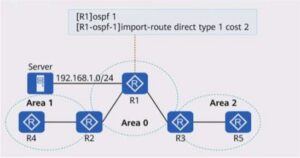
A. 4
B. 3
C. 2
D. 1
Correct Answer: A
QUESTION 13
On an IS-IS network, each router has at least one NET. If a router is configured with multiple NETs, ensure that these NETs have the same system ID.
A. TRUE
B. FALSE
Correct Answer: A
QUESTION 14
On an IS-IS network, the area address and router ID of a router are 49.0001 and 10.10.1.1, respectively. For easier management, you are advised to configure a system ID based on the router ID. In this case, the corresponding NET is . (Enter digits only and separate them with periods).
Correct Answer: 49.0001.0100.1000.1001.00
QUESTION 15
On an OSPF network, interfaces are classified into four types based on link layer protocols. Which of the following types can interfaces on an IS-IS network be classified into based on physical links?
A. NBMA
B. Broadcast
C. P2P
D. P2MP
Correct Answer: BC
QUESTION 16
On an IS-IS broadcast network, neighbor relationships are established between routers (including all non-DIs routers) of the same level on the same network segment.
A. TRUE
B. FALSE
Correct Answer: A
QUESTION 17
On an IS-IS network, a DIs is elected, similar to how a DR is elected on an OSPF network. Which of the following statements are false about the similarities between a DR and a DIS?
A. Both the DIS and DR have backup devices.
B. After the priorities of the DIS and DR are set to 0, they cannot participate in the election.
C. In both DIS election and DR election, devices first compare priorities. If the priorities are the same, they compare router IDs.
D. By default, the DIS and DR do not support preemption.
Correct Answer: ABCD
QUESTION 18
During BGP route summarization configuration, the keyword can be used to suppress all specific routes so that only the summary route is advertised. The summary route carries the Atomic-aggregate attribute rather than the community attributes of specific routes. (Enter the full name in lowercase.)
Correct Answer: detall-suppressed
QUESTION 19
An enterprise administrator views the following details about a BGP route during routine O&M.
<HUAWEI> display bgp routing-table 192.168.1.1 BGP local router ID : 10.1.1.1
Local AS number : 100
Paths: 2 available, 0 best, 0 select
BGP routing table entry information of 192.168.1.1/32:
From: 10.1.1.2 (10.1.1.2)
Route Duration: 00h01m31s Relay IP Nexthop: 0.0.0.0 Relay IP Out-Interface:
Original nexthop: 172.16.1.2 Qos information : 0x0
AS-path 200, origin incomplete, MED 0, localpref 100, pref-val 0, internal, pre 255, invalid for IP unreachable Not advertised to any peer yet
Which of the following statements are true about the BGP route?
A. The original next hop of the route is 172.16.1.2.
B. The local BGP router ID is 10.1.1.1.
C. The route is preferentially selected because its Local_Pref has a higher priority.
D. The local AS number is 100.
Correct Answer: ABD
QUESTION 20
Border Gateway Protocol (BGP) is a distance-vector routing protocol that implements route reachability between ASs. Which of the following protocol port numbers is used by BGP to establish BGP sessions?
A. TCP 170
B. UDP 170
C. UDP 179
D. TCP 179
Correct Answer: D