H12-821_Part2
QUESTION 21
Which of the following commonly used BGP routing policy tools can be used to match a given AS-Path attribute?
A. community-filter
B. ip as-path-filter
C. filter-policy
D. ip-prefix
Correct Answer: B
QUESTION 22
In BGP, the MED is used as a metric to notify external peers of the preferred path to the local AS. Which of the following statements are true about this attribute?
A. After the MED is transmitted to an EBGP peer, the peer retains the MED when transmitting the route within its AS.
B. By default, a router can compare the MEDs of routes from different ASs as long as the routes have the same destination.
C. The BGP route with the smallest MED value is preferred.
D. When routes are transmitted between IBGP peers, the MED value is retained and transmitted. Unless a policy is deployed, the MED value is not changed or discarded during transmission.
Correct Answer: CD
QUESTION 23
In addition to a route reflector, the confederation is another method that reduces the number of IBGP connections in an AS. Which of the following statements are true about the confederation technology?
A. All member devices in a confederation need to be reconfigured .
B. The logical topology does not need to be changed when a confederation is used.
C. This technology is applicable to large-scale networks.
D. Special EBGP connections are established among sub-ASs in a confederation, and the sub-ASs need to be fully meshed.
Correct Answer: AD
QUESTION 24
By default, the maximum number of hops allowed over an EBGP connection is 1. That is, an EBGP connection can be established only over a physical link between directly connected devices.
A. TRUE
B. FALSE
Correct Answer: B
QUESTION 25
Route attributes are specific descriptions of routes. BGP route attributes can be classified into four types. Which of the following are well-known discretionary attributes?
A. MED
B. Community
C. Atomic_Aggregate
D. Local_preference
Correct Answer: CD
QUESTION 26
BGP itself does not discover routes. Therefore, other types of routes need to be imported to the BGP routing table to implement inter-AS routing. IGP routes can be imported to BGP, but BGP routes cannot be imported to an IGP.
A. TRUE
B. FALSE
Correct Answer: B
QUESTION 27
In BGP, Keepalive messages are used to maintain BGP peer relationships. When a BGP router receives a Keepalive message from a peer, the BGP router sets the state of the peer to Established and periodically sends Keepalive messages to maintain the connection. By default, the device sends Keepalive messages
every seconds. (Enter only digits.)
Correct Answer: 60
QUESTION 28
ACLs are a common matching tool in routing policies. Which of the following parameters must be configured when a numbered ACL is configured on a Huawei router?
A. Action: permit or deny
B. source
C. rule-id
D. Wildcard character
Correct Answer: B
QUESTION 29
PBR is a mechanism for selecting routes based on user-defined policies. There are two types of PBR: interface-based PBR and local PBR. Which of the following statements is false about these two types of PBR?
A. Interface-based PBR takes effect only for forwarded packets.
B. Interface-based PBR is configured on an interface and takes effect only for incoming packets on the interface.
C. Local PBR is configured in the protocol view.
D. Local PBR takes effect only for locally originated packets.
Correct Answer: C
QUESTION 30
Which of the following statements is false about PBR and route-policy?
A. If multiple condition statements are configured for both of them, the relationship between the condition statements is AND.
B. If multiple nodes are configured for both of them, the relationship between the nodes is OR.
C. One or more nodes can be configured for both of them.
D. If multiple nodes are configured for both of them, the nodes are matched in descending order of ID.
Correct Answer: D
QUESTION 31
As shown in the figure, R1 imports the direct route 10.1.1.0/24 to OSPF. An engineer enables bidirectional route re-advertisements on R2 and R3. After the network becomes stable, which of the following is the Pre value of the route 10.1.1.0/24 in the routing table of R3?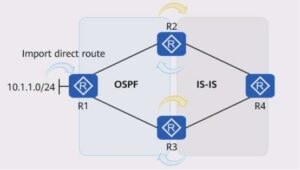
A. 0
B. 10
C. 150
D. 15
Correct Answer: D
QUESTION 32
An ACL can be used to match routes or data, but cannot be used to match both the IP address prefix length and mask length.
A. TRUE
B. FALSE
Correct Answer: A
QUESTION 33
When configuring an ACL on a router, you can specify a unique number or name to identity the ACL. Once a named ACL is created, it cannot be modified. You can only delete the named ACL and reconfigure it.
A. TRUE
B. FALSE
Correct Answer: A
QUESTION 34
In an MST region, MSTP independently calculates an MSTI for each VLAN based on mappings between VLANs and MSTIs. Which of the following statements is false about the characteristics of MSTIs?
A. Spanning trees of MSTIs can have different roots and topologies.
B. Each MSTI sends BPDUs only on its own spanning tree.
C. The spanning tree calculation method of each MSTI is similar to that in STP.
D. A port must have the same spanning tree parameter settings for different MSTIs.
Correct Answer: D
QUESTION 35
On an RSTP network, port roles are optimized to overcome the disadvantages of STP. Which of the following port roles are supported in RSTP?
A. Designated port
B. Backup port
C. Alternate port
D. Root port
Correct Answer: ABCD
QUESTION 36
A company has a stack consisting of three switches that are running properly. The master switch restarts due to a fault. Given this, which of the following statements are true?
A. After the original master switch restarts, it becomes the new master switch.
B. After the original master switch restarts, the original standby switch becomes a new slave switch.
C. Before the restart of the original master switch is complete, the original standby switch becomes the new master switch.
D. Before the restart of the original master switch is complete, the original slave switch is specified as the new standby switch.
Correct Answer: BC
QUESTION 37
Which of the following parameters are compared during designated port election on an STP network?
A. Peer BID
B. Peer PID and local PID
C. RPC
D. Local BID and local PID
Correct Answer: ABC
QUESTION 38
IGMP snooping is a key multicast protocol. Which of the following statements is false about IGMP snooping?
A. IGMP snooping is a Layer 2 multicast protocol.
B. After IGMP snooping is enabled on a device, the device processes different IGMP protocol packets in the same way.
C. IGMP snooping maintains the outbound interfaces of multicast packets by listening to multicast protocol packets that are exchanged between a Layer 3 multicast device and user hosts.
D. Multicast forwarding entries created based on IGMP snooping contain router ports and member ports.
Correct Answer: B
QUESTION 39
To reduce the number of IGMP messages on the network segment where user hosts reside, IGMP snooping proxy can be configured on a Layer 2 device. IGMP snooping proxy, however, processes received protocol messages in different ways. Which of the following statements is false about protocol message processing?
A. If an IGMP Report message is received, the message is directly discarded.
B. If an IGMP Group-and-Source-Specific Query message is received, the message is directly discarded.
C. If a General Query message is received, the message is sent to all interfaces except the interface that receives the message in the VLAN.
D. If an IGMP Group-Specific Query message is received, the message is directly discarded.
Correct Answer: A
QUESTION 40
A switch running a later IGMP version can identify Report messages of an earlier IGMP version, but the switch running an earlier IGMP version cannot identify Report messages of a later IGMP version. To ensure that IGMP runs properly, you are advised to set the IGMP version on the switch to be the same as or later than the IGMP version of member hosts.
A. TRUE
B. FALSE
Correct Answer: A