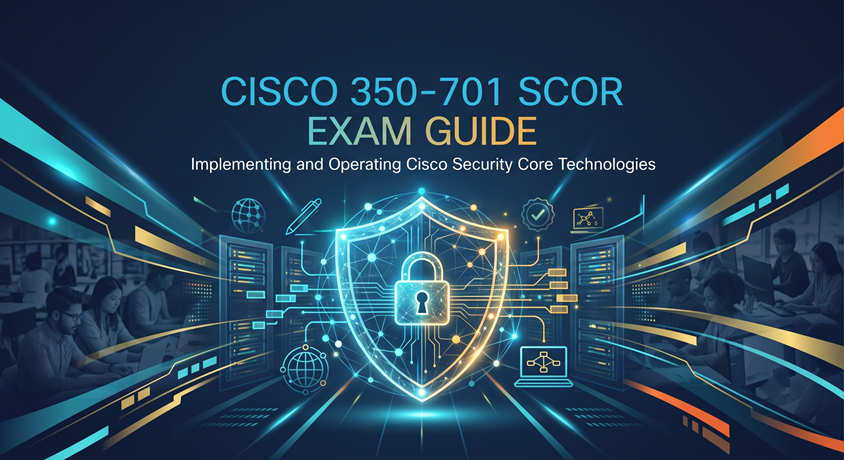
The Cisco 350-701 SCOR exam sits at an interesting point in the Cisco certification system. It is advanced enough to cover professional-level security architecture and implementation, but broad enough to serve as the common foundation for both CCNP Security and CCIE Security candidates.
That combination makes SCOR more than another product exam. It expects you to understand how firewalls, identity services, VPNs, endpoint protection, cloud controls, telemetry, automation and zero-trust principles work together inside a real enterprise security architecture.
For beginners, the exam can look intimidating. The blueprint moves between cryptography, Layer 2 attacks, Cisco Secure Firewall, cloud security, endpoint malware analysis, Cisco Identity Services Engine and Python APIs. However, the subjects become much easier to organize once you stop treating them as unrelated products and start viewing them as different layers of the same defense strategy.
Important exam update: Cisco has announced that 350-701 SCOR v2.0 launches on August 27, 2026. Candidates testing before that date should verify the current v1.1 blueprint. Candidates testing on or after that date should prepare with the v2.0 blueprint. Always confirm your version on the official Cisco exam page before booking.
What Is the Cisco 350-701 SCOR Exam?
SCOR stands for Implementing and Operating Cisco Security Core Technologies. Its exam code is 350-701.
The exam evaluates whether a candidate can understand, implement and operate core security technologies across enterprise networks, cloud services, remote-access environments and endpoint systems. It combines vendor-neutral security principles with practical knowledge of Cisco security platforms.
The word core is important. SCOR is not designed around one narrow technology. A firewall specialist may be comfortable with access control policies and intrusion prevention but still need to study identity, endpoint security and cloud architecture. A network engineer may understand VLANs and VPNs but need more experience with malware events, zero trust, SIEM platforms and API-based automation.
This broad scope reflects how security work is performed in practice. An incident rarely stays inside one product. A compromised account may begin with phishing, connect through a remote-access service, access an internal application, trigger endpoint telemetry and eventually appear in a SIEM or XDR investigation.
Cisco 350-701 SCOR Exam Facts
| Item | Details |
|---|---|
| Exam code | 350-701 |
| Exam name | Implementing and Operating Cisco Security Core Technologies |
| Common abbreviation | SCOR |
| Exam duration | 120 minutes |
| Official exam price | US$400 or Cisco Learning Credits |
| Available languages | English and Japanese |
| Certification earned by passing SCOR | Cisco Certified Specialist – Security Core |
| CCNP Security requirement | SCOR plus one concentration exam |
| CCIE Security path | SCOR is the qualifying core exam before the CCIE Security lab |
| Current major update | SCOR v2.0 launches August 27, 2026 |
Cisco describes exam grading as pass or fail. Candidates should be cautious about websites claiming to know a guaranteed passing score or an exact number of questions. Exam forms can vary, and Cisco does not present those unofficial numbers as fixed exam specifications.
How SCOR Fits into CCNP and CCIE Security
Passing SCOR by Itself
Passing 350-701 is already a certification achievement. You receive the Cisco Certified Specialist – Security Core certification.
This distinction matters because SCOR is not merely a preliminary test with no standalone value. It gives you a professional-level specialist credential that can be added to a résumé, professional profile or internal skills record.
Earning CCNP Security
To earn the full CCNP Security certification, you must pass:
- The 350-701 SCOR core exam.
- One CCNP Security concentration exam of your choice.
The concentration exam allows you to build depth in an area such as firewall security, identity management, secure cloud access or security infrastructure design. Cisco periodically updates the concentration portfolio, so candidates should use the current official list rather than relying on an old study chart.
Moving Toward CCIE Security
SCOR is also the qualifying exam for the CCIE Security path. After passing SCOR, a candidate can proceed toward the separate hands-on CCIE Security lab exam.
Passing SCOR does not make someone a CCIE. The expert-level credential requires successful completion of the lab. Still, the shared core exam creates a useful path: a candidate can earn the Security Core Specialist certification, complete a concentration for CCNP Security and later continue toward CCIE Security.
Is the Cisco SCOR Certification Worth It?
The honest answer is that SCOR can be highly valuable, but its value depends on what you build around it.
A certification cannot replace troubleshooting experience or the ability to explain a security design. What SCOR can do is give your learning a structured direction and provide evidence that you have studied a substantial range of enterprise security technologies.
Why Employers May Value It
SCOR covers technologies that appear across network engineering, security engineering, consulting, managed services and security operations roles. A candidate who studies the blueprint properly should become more comfortable discussing:
- Next-generation firewall and intrusion prevention policies.
- Site-to-site and remote-access VPN architecture.
- Identity-based access control and network admission.
- Endpoint protection, EDR and malware events.
- Cloud shared-responsibility models.
- SSE, SASE and zero-trust access.
- Security telemetry, XDR, SIEM and SOAR.
- APIs, Python and security automation.
This breadth is useful because many organizations do not separate networking and security as cleanly as certification diagrams suggest. A network engineer may be asked to troubleshoot authentication, investigate suspicious traffic or deploy segmentation. A security engineer may need to understand routing, switching, DNS, DHCP and VPN behavior before a security policy can be implemented correctly.
What SCOR Does Not Guarantee
Passing the exam does not automatically prove that you can deploy every Cisco security product in production. It also does not guarantee a job, promotion or specific salary.
The strongest candidate combines the certification with lab notes, configuration examples, troubleshooting experience and a clear explanation of design decisions. Being able to describe why a control is needed is usually more convincing than simply naming the product that provides it.
Cisco SCOR v2.0 Exam Blueprint
The v2.0 blueprint reorganizes the exam around six domains. Network Security remains the largest area, while cloud, endpoints, secure access and security analytics receive substantial attention.
| Domain | Weight | Main Areas |
|---|---|---|
| 1.0 Security Concepts | 20% | Threats, vulnerabilities, cryptography, VPN concepts, zero trust, AI security and APIs |
| 2.0 Network Security | 25% | Firewalls, IPS, telemetry, infrastructure hardening, AAA, secure management and VPNs |
| 3.0 Cloud Security | 15% | Shared responsibility, cloud controls, workload protection, Splunk, eBPF and DevSecOps |
| 4.0 Secure Service Edge | 10% | SSE, SASE, secure internet access, private access, DLP and AI guardrails |
| 5.0 Endpoint Protection and Detection | 15% | EPP, EDR, MDM, posture, Cisco Secure Endpoint and email threat defense |
| 6.0 Network Access, Visibility and Enforcement | 15% | ISE, 802.1X, MAB, CoA, exfiltration, XDR, SIEM, SOAR, Duo and Splunk |
These percentages should influence your study schedule, but they should not be treated as permission to ignore a smaller domain. A ten-percent area can still contain enough questions to change the result of an exam attempt.
What Changed in the v2.0 Direction?
The new blueprint reflects several changes in enterprise security:
- AI security is now explicit. Candidates must understand prompt injection, system-prompt leakage, weaknesses in vectors and embeddings, AI supply-chain risks and AI guardrails.
- Post-quantum cryptography appears in the blueprint. This connects traditional cryptography knowledge with the future impact of quantum computing.
- SSE and SASE receive a dedicated domain. Secure access is increasingly delivered through cloud-based services rather than only through an on-premises perimeter.
- Splunk has a larger role. Candidates should understand log ingestion, security information management, orchestration and event analysis.
- Cisco Duo is included in zero-trust architecture. Topics include MFA, device trust, health checks, adaptive policies and SSO.
- Cloud-native security is deeper. The blueprint includes eBPF, CI/CD security, Infrastructure as Code, container orchestration and secure software development.
- Modern encrypted transport appears. QUIC and MASQUE are included alongside TLS, IPsec and other cryptographic technologies.
The practical message is clear: SCOR is moving beyond traditional perimeter security. Candidates must understand identity, cloud-delivered controls, endpoint context, application workloads and security analytics.
Key Technologies You Need to Understand
1. Security Concepts and Threats
This domain provides the vocabulary used throughout the rest of the exam. You should understand common attacks such as phishing, malware, credential compromise, denial-of-service attacks, man-in-the-middle attacks and data breaches.
Do not study attacks only as definitions. For each attack, ask four questions:
- What weakness does the attack exploit?
- What evidence might appear in logs or network telemetry?
- Which preventive controls reduce the likelihood of success?
- Which detective or response controls limit the damage?
Vulnerability management is also important. Be comfortable with CVEs, CVSS scores and the difference between identifying a vulnerability and prioritizing it within a specific business environment.
2. Cryptography, PKI and VPNs
You should be able to distinguish hashing, symmetric encryption and asymmetric encryption. Understand the basic purpose of certificates, certificate authorities, public key infrastructure, TLS and IPsec.
For VPNs, memorizing protocol names is not enough. Learn the purpose and typical deployment model of site-to-site VPNs, remote-access VPNs, virtual tunnel interfaces, FlexVPN, DMVPN and GETVPN.
When troubleshooting a VPN, think in stages:
- Can the peers reach each other?
- Do the proposals and policies match?
- Is authentication successful?
- Are the protected networks defined correctly?
- Are routes and access-control policies allowing the traffic?
- Is NAT changing traffic that should enter the tunnel?
3. Cisco Secure Firewall
Cisco Secure Firewall is one of the most important product areas in SCOR. Candidates should understand the role of Firewall Threat Defense, access control policies, intrusion prevention, URL filtering, application visibility and control, malware protection and VPN services.
Pay attention to policy-processing logic. In a lab, follow a packet from ingress to egress and determine which rule, inspection engine, NAT policy and routing decision affect it.
Also learn the difference between management approaches. A security device may be managed locally, through an on-premises manager or through a cloud-based control platform. The right option depends on scale, operational requirements and architecture.
4. Layer 2 and Infrastructure Security
SCOR assumes that security engineers understand the network beneath the security products. Important controls include:
- VLAN segmentation.
- Security Group Tags.
- Port security.
- DHCP snooping.
- Dynamic ARP Inspection.
- Storm control.
- Protections against rogue DHCP, ARP spoofing and VLAN hopping.
- Spanning Tree Protocol security.
These subjects are especially important for candidates entering security from a server, cloud or software background. A firewall cannot compensate for every weakness inside the switching infrastructure.
5. AAA, Cisco ISE and Network Access Control
Authentication, authorization and accounting are central to secure access. Candidates should understand the roles of RADIUS and TACACS+, including why they are commonly used for different access scenarios.
Cisco Identity Services Engine adds policy and context. Important concepts include:
- 802.1X authentication.
- MAC Authentication Bypass.
- Endpoint profiling.
- Posture assessment.
- Guest access.
- Bring Your Own Device workflows.
- Change of Authorization.
- Identity-based policy enforcement.
A useful lab is to trace an authentication from the endpoint to the switch or wireless infrastructure, then to ISE and finally back to the enforcement device. Understand what happens when authentication succeeds, fails or falls back to another method.
6. Cloud Security
Cloud security questions often test architecture rather than command syntax. Begin with the shared-responsibility model: which controls belong to the cloud provider, and which remain the customer’s responsibility?
You should understand public, private, hybrid and community cloud models, as well as SaaS, PaaS and IaaS. Pay attention to how responsibility changes across those service models.
The v2.0 blueprint also expects knowledge of workload security, cloud logging, policy management and DevSecOps. Learn why infrastructure templates, container images, CI/CD pipelines and secrets must be secured before an application reaches production.
7. SSE, SASE and Zero Trust
Traditional designs often forced remote users to send traffic back through a central data center. Modern organizations increasingly connect users directly to cloud applications and private resources through cloud-delivered security services.
Security Service Edge focuses on cloud-delivered security capabilities. Secure Access Service Edge combines security services with wide-area networking capabilities.
Zero trust should not be reduced to the phrase “never trust, always verify.” In practical terms, a zero-trust design evaluates identity, device health, application context, location, risk and policy before granting access. That decision may be reevaluated as conditions change.
8. Endpoint Protection, EDR and Malware Events
Endpoint Protection Platforms focus primarily on preventing malicious activity. Endpoint Detection and Response adds deeper visibility, investigation and response capabilities.
For Cisco Secure Endpoint, study policy configuration as well as event interpretation. You should be comfortable distinguishing a detection from a confirmed compromise and understanding how file trajectory, device information and behavioral evidence help an analyst investigate an incident.
9. XDR, SIEM, SOAR and Splunk
Security teams collect data from firewalls, endpoints, identity systems, applications, cloud environments and network infrastructure. The challenge is turning that data into useful investigation context.
A SIEM centralizes and searches security data. SOAR platforms help orchestrate workflows and automate repetitive response actions. XDR correlates activity across multiple security layers to provide broader detection and investigation context.
For Splunk-related objectives, understand data ingestion, searches, fields, events, alerts and the role of dashboards. You do not need to become a full-time Splunk administrator, but you should understand how security data reaches the platform and how an analyst uses it.
10. APIs and Python
SCOR candidates should be able to interpret scripts that call security appliance APIs. The exam is not primarily a software-development test, but you should understand:
- HTTP methods such as GET, POST, PUT, PATCH and DELETE.
- Common HTTP status codes.
- JSON request and response structures.
- Authentication tokens and API headers.
- Variables, loops, conditions and functions in basic Python.
- Error handling and validation.
Practice reading a short script and answering three questions: What endpoint is being called? What data is sent? What does the script do with the response?
How Difficult Is the Cisco 350-701 Exam?
SCOR is difficult mainly because of its breadth. The exam moves between conceptual knowledge, configuration choices, troubleshooting and product behavior.
Many candidates are strong in only one part of the blueprint. A network engineer may be comfortable with VPNs and switching security but less familiar with EDR or DevSecOps. A security analyst may understand malware events and SIEM searches but struggle with AAA, NAT or IPsec negotiation.
The exam also uses verbs carefully. A blueprint item beginning with describe usually calls for conceptual understanding. Configure, implement, interpret and troubleshoot imply a deeper operational level.
Use those verbs to decide how to study. Reading may be enough for a high-level description objective. It is rarely enough for a troubleshooting objective.
Recommended Knowledge Before Starting
Cisco lists no formal prerequisite for CCNP Security. That does not mean SCOR is designed as a first networking exam.
A beginner will have a much smoother experience after learning:
- IPv4 addressing and subnetting.
- Basic IPv6 concepts.
- VLANs, trunks and Spanning Tree Protocol.
- Static routing and dynamic routing fundamentals.
- TCP, UDP, ICMP, DNS, DHCP, HTTP and HTTPS.
- Access control lists and NAT.
- Basic Linux and Windows administration.
- Fundamental cybersecurity terminology.
- Basic JSON, REST APIs and Python syntax.
CCNA-level networking knowledge is an excellent foundation, even though holding a CCNA certification is not mandatory.
Students with limited experience should not interpret this recommendation as a reason to delay indefinitely. Begin with the blueprint, identify missing fundamentals and study them as part of the SCOR journey.
A Practical Cisco SCOR Study Plan
A realistic preparation period depends on your experience and weekly study time. The following twelve-week outline works well for candidates who already understand basic networking and can study approximately eight to twelve hours per week. You can also use this 350-701 SCOR exam preparation resource as a supplementary reference while organizing your weekly review.
Weeks 1–2: Security Foundations
- Review common attacks and vulnerability types.
- Study CVE and CVSS concepts.
- Review hashing, encryption, PKI, TLS and IPsec.
- Learn zero-trust and defense-in-depth principles.
- Build a glossary in your own words.
Weeks 3–5: Network Security and Firewalls
- Study firewall and intrusion prevention deployment models.
- Review Cisco Secure Firewall architecture and policy processing.
- Practice access-control, URL-filtering and intrusion-policy concepts.
- Review VLAN security, DHCP snooping and Dynamic ARP Inspection.
- Study secure management with SNMPv3, syslog, NTP authentication, NETCONF, RESTCONF and APIs.
Week 6: VPNs and AAA
- Compare site-to-site and remote-access VPN designs.
- Review IKE, IPsec, NAT traversal and certificate authentication.
- Practice a structured VPN troubleshooting process.
- Compare RADIUS and TACACS+.
Week 7: Cloud and DevSecOps Security
- Review cloud deployment and service models.
- Study shared-responsibility boundaries.
- Learn workload and application security concepts.
- Review eBPF, container security, CI/CD security and Infrastructure as Code.
Week 8: Secure Service Edge
- Compare SSE and SASE.
- Study secure internet access and private application access.
- Review DLP, cloud access controls and AI guardrails.
- Connect these concepts to zero-trust architecture.
Week 9: Endpoint and Email Security
- Compare EPP and EDR.
- Study endpoint posture and device-management concepts.
- Review Cisco Secure Endpoint policies and malware events.
- Learn the role of modern email threat protection.
Week 10: ISE, Duo and Access Control
- Study 802.1X, MAB, profiling and posture.
- Review Change of Authorization.
- Map endpoint identity to policy enforcement.
- Study Duo MFA, device trust, adaptive access and SSO.
Week 11: Visibility, Splunk and Automation
- Review SIEM, SOAR and XDR.
- Practice interpreting security events.
- Study Splunk ingestion and basic searches.
- Read and modify simple Python API scripts.
Week 12: Final Review
- Complete timed 350-701 SCOR practice questions.
- Review every blueprint item and assign a confidence score.
- Repeat labs for weak configuration objectives.
- Explain major technologies aloud without notes.
- Review errors instead of memorizing practice-test answers.
Use the Blueprint as a Checklist
Create a spreadsheet with one row for every official exam objective. Add columns for:
- Concept understood.
- Documentation reviewed.
- Lab completed.
- Practice questions completed.
- Confidence from one to five.
- Final review date.
This simple method prevents a common problem: repeatedly studying familiar subjects while avoiding difficult ones.
Hands-On Lab Recommendations
SCOR preparation should include hands-on work whenever possible. A lab does not need to reproduce a large enterprise network. Even a small topology can teach packet flow, policy logic and troubleshooting discipline.
Suggested Lab Tasks
- Create VLANs and test segmentation between user and server networks.
- Configure DHCP snooping and Dynamic ARP Inspection in a supported environment.
- Build a basic site-to-site IPsec VPN.
- Capture IKE and IPsec negotiation messages.
- Create and test firewall access-control rules.
- Send syslog events to a logging server.
- Use RADIUS or TACACS+ in a small AAA lab.
- Review sample ISE authentication logs.
- Investigate sample endpoint malware events.
- Send JSON data to or retrieve data from a REST API.
- Ingest sample security logs into Splunk and run basic searches.
Build a Troubleshooting Journal
For every lab failure, record:
- The observed symptom.
- Your first assumption.
- The commands or logs used to test that assumption.
- The real cause.
- The final fix.
- How you would detect the same problem faster next time.
This journal is often more valuable than a collection of perfect configurations. Real security work is full of incomplete information and misleading symptoms.
Cisco SCOR Exam-Day Strategy
Read the Final Sentence First
Long questions may contain several correct technical facts but ask for one specific action, design or explanation. Identify exactly what the question is requesting before analyzing the scenario.
Watch for Scope
Words such as most secure, most scalable, least administrative effort and best troubleshooting step change the answer. Two solutions may work technically, but only one may satisfy the stated requirement.
Use Elimination
Remove answers that operate at the wrong layer, use the wrong authentication protocol, conflict with the deployment model or fail to address the actual symptom.
Do Not Spend Too Long on One Question
The exam covers many domains. Protect your time. Make the best decision you can and continue rather than allowing one unfamiliar question to consume several minutes.
Expect Product-Neutral and Cisco-Specific Questions
Some questions test general principles such as cryptography, zero trust or cloud responsibility. Others require familiarity with Cisco products and workflows. Prepare for both.
Common SCOR Preparation Mistakes
Studying Only from Video Courses
Video courses can provide structure, but they often simplify details or fall behind blueprint changes. Compare every course against the official exam topics and use product documentation to fill gaps.
Memorizing Without Building Packet-Flow Knowledge
Firewall, NAT and VPN questions become easier when you can trace what happens to traffic. Memorized interface screenshots are less useful when the scenario changes.
Ignoring Non-Cisco Fundamentals
SCOR includes Cisco products, but it also expects a solid understanding of standard protocols and industry concepts. Weaknesses in DNS, TLS, IPsec, HTTP, AAA or cloud models will affect several domains.
Avoiding Automation
You do not need to become a professional Python developer. You do need to be comfortable reading structured data and understanding an API workflow. Start with short scripts instead of postponing automation until the final week.
Using Exam Dumps
Question dumps are unreliable, may violate certification agreements and encourage memorization without understanding. They also leave candidates unprepared for real troubleshooting work.
Use legitimate practice exams to identify weak areas, then return to the blueprint, documentation and labs.
Booking the Wrong Blueprint Version
This is especially important during the 2026 transition. Confirm whether your exam date uses SCOR v1.1 or v2.0. Do not assume that a book or course automatically covers the version you will take.
Career Relevance of the SCOR Skill Set
The knowledge developed through SCOR can support several career paths:
- Network security engineer.
- Firewall engineer.
- Security consultant.
- Network engineer with security responsibilities.
- Identity and access engineer.
- Security operations engineer.
- Infrastructure security engineer.
- Cloud security engineer.
- Managed security services engineer.
Entry-level candidates should be realistic about job titles. Many organizations will not hire a new graduate directly into a senior security-engineering position based only on a certification. However, SCOR can help a junior engineer build the technical language and structured knowledge needed to work with more experienced teams.
A useful portfolio can make the certification more credible. Consider publishing sanitized network diagrams, lab write-ups, Python examples and troubleshooting notes. Never publish employer configurations, customer information, credentials or proprietary data.
Frequently Asked Questions
Is Cisco 350-701 SCOR an entry-level exam?
No. SCOR is a professional-level core exam. There is no formal prerequisite, but candidates benefit from solid networking fundamentals and practical exposure to security technologies.
Do I need CCNA before taking SCOR?
No formal CCNA requirement exists. However, CCNA-level knowledge of IP networking, switching, routing, access control, NAT and network services is strongly recommended.
Does passing SCOR give me CCNP Security?
Not by itself. Passing SCOR earns the Cisco Certified Specialist – Security Core certification. To earn CCNP Security, you must also pass one eligible concentration exam.
Does passing SCOR make me eligible for the CCIE Security lab?
Yes. SCOR serves as the qualifying core exam for the CCIE Security certification path. You must still pass the separate CCIE Security lab exam to earn CCIE Security.
How long is the 350-701 SCOR exam?
Cisco lists the exam duration as 120 minutes.
How much does the SCOR exam cost?
The official listed price is US$400, although taxes, currency conversion and local purchasing conditions may affect the final amount.
What languages are available?
Cisco lists English and Japanese as the available exam languages.
What is the passing score?
Cisco describes the result as pass or fail and does not present the unofficial fixed scores commonly repeated by third-party websites. Concentrate on consistent performance across the complete blueprint instead of targeting a rumored number.
How long should I study for SCOR?
A candidate with CCNA-level networking and some security experience may need approximately three to four months of consistent study. A beginner may need longer because networking, cloud and security foundations must be developed alongside product knowledge.
Can I pass SCOR without hands-on experience?
It may be possible to answer some questions through study alone, but avoiding labs is a poor preparation strategy. Configuration and troubleshooting objectives are much easier when you have worked through actual packet flows, policies, logs and failures.
Should I study SCOR v1.1 or v2.0?
Use the blueprint associated with your scheduled exam date. Cisco has announced that SCOR v2.0 launches on August 27, 2026. Verify the active version on Cisco’s official website before purchasing training or scheduling the exam.
Is SCOR useful outside a Cisco-only environment?
Yes. Product-specific configuration is part of the exam, but many subjects are broadly applicable, including PKI, TLS, IPsec, zero trust, cloud responsibility, endpoint detection, SIEM, identity management, network segmentation and secure API use.
Final Thoughts
The Cisco 350-701 SCOR exam is valuable because it forces candidates to connect technologies that are often studied separately. Firewalls depend on routing and identity. Zero trust depends on users, devices and policy context. Endpoint alerts become more useful when correlated with network and cloud telemetry. Automation becomes safer when the engineer understands both the API and the security policy being changed.
For beginners, the best approach is not to race through a large question bank. Build the foundations, follow the official blueprint, use well-organized Cisco SCOR study materials, configure what you can and document what goes wrong.
The goal should be larger than passing an exam. By the end of your preparation, you should be able to look at an enterprise security design and explain how its controls prevent, detect and contain an attack. That ability is what gives the certification its real value.
Official Cisco References
- Cisco 350-701 SCOR Exam Page
- CCNP Security Exams and Training
- Official 350-701 SCOR v2.0 Exam Topics
- Cisco Announcement Covering the SCOR v2.0 Launch
Cisco, CCNP and CCIE are trademarks or registered trademarks of Cisco Systems, Inc. This independent article is not affiliated with or endorsed by Cisco. Exam prices, topics and certification policies may change. Always verify current details with Cisco before scheduling an exam.