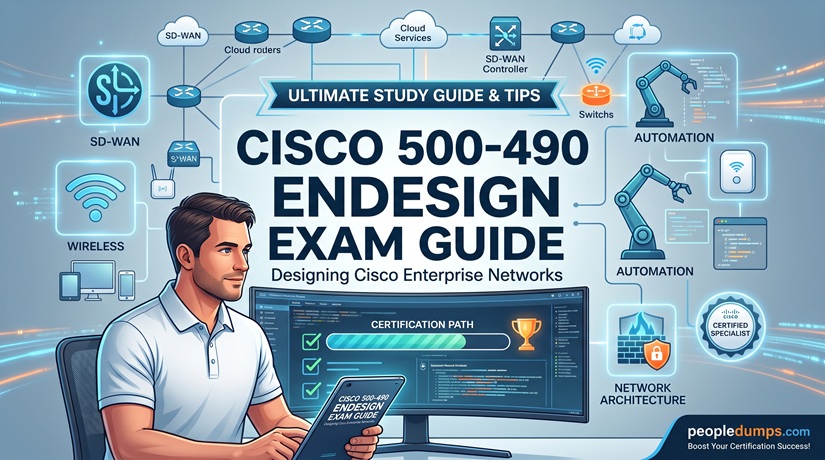
If you are learning enterprise networking, the first Cisco certifications you probably hear about are CCNA and CCNP. The Cisco 500-490 ENDESIGN exam tends to receive much less attention, even though it covers an interesting combination of enterprise network design, software-defined networking, identity-based security, and customer-facing engineering.
Officially titled Designing Cisco Enterprise Networks for Field Engineers, the 500-490 ENDESIGN exam is aimed at engineers who need to understand not only how Cisco enterprise networking technologies work, but also how to translate customer requirements into a technical solution. Candidates looking for additional preparation material can also review this Cisco 500-490 ENDESIGN exam preparation resource alongside Cisco’s official exam objectives.
That distinction is important. ENDESIGN is not simply a test of whether you can configure a router or memorize command syntax. Its perspective is closer to that of a field engineer or solution-oriented network professional: discover the problem, design an architecture, demonstrate why the solution works, and defend the design when technical or business questions appear.
For students and junior network engineers, that makes the exam particularly interesting. Even if you are not yet working in a presales or field-engineering role, the technologies behind the exam provide a useful introduction to how modern enterprise networks are actually designed.
Cisco 500-490 ENDESIGN Exam at a Glance
Table of Contents
Toggle| Item | Details |
|---|---|
| Exam Code | 500-490 |
| Exam Name | Designing Cisco Enterprise Networks for Field Engineers |
| Common Exam Name | ENDESIGN |
| Duration | 60 minutes |
| Language | English |
| Primary Audience | Field engineers and professionals involved in Cisco enterprise solution design |
| Core Methodology | Discovery, Design, Demonstrate, and Defend |
| Key Technology Areas | SD-Access, SD-WAN, Cisco ISE, segmentation, assurance, security, and enterprise network architecture |
| Certification Context | Advanced Enterprise Networks Architecture Specialization |
Cisco can update exam objectives, terminology, products, and registration details over time. Before scheduling the test, always compare your study plan with the latest exam information published by Cisco. It can also be useful to compare your knowledge against a focused 500-490 ENDESIGN study resource after you have completed the official blueprint.
What Is the Cisco 500-490 ENDESIGN Exam?
The easiest way to understand ENDESIGN is to look at the job role behind it.
A traditional network operations engineer may receive a completed design and then configure, monitor, and troubleshoot it. A field engineer often becomes involved earlier. The engineer may need to understand what the customer is trying to achieve, identify weaknesses in the current network, recommend an architecture, explain the technology, demonstrate capabilities, and answer objections about cost, complexity, migration, security, or scalability.
That is why the 4D methodology is central to the exam:
- Discovery: Understand the customer’s environment, requirements, problems, constraints, and business drivers.
- Design: Translate those requirements into an appropriate network architecture.
- Demonstrate: Show how the proposed technology solves the identified problems.
- Defend: Explain and justify the design when faced with technical concerns, competing solutions, migration risks, or operational questions.
This creates a different learning experience from a configuration-heavy certification. You still need solid technical knowledge, but the exam encourages you to think about why a technology should be used instead of only asking how to configure it.
What Technologies Should You Know for 500-490?
The ENDESIGN topic structure revolves primarily around three major Cisco enterprise technologies:
- Cisco Software-Defined Access (SD-Access)
- Cisco SD-WAN, now commonly branded Cisco Catalyst SD-WAN
- Cisco Identity Services Engine (ISE)
The published exam-topic structure combines these technologies with different parts of the Discovery, Design, Demonstration, and Defend process. In other words, you should not study each product as an isolated box. You should understand the problem it solves, its architecture, how it integrates with other Cisco technologies, and how you would explain its value to a customer.
When preparing for the Cisco 500-490 exam, organize your notes around these architectural relationships rather than simply memorizing isolated product features.
1. Cisco SD-Access: From VLAN-Centric Networks to Intent-Based Campus Design
For a beginner, Cisco SD-Access can initially seem complicated because several technologies are combined into a single architecture. A good way to approach it is to separate the architecture into layers and planes.
Traditional campus networks often depend heavily on VLANs, IP subnets, access control lists, Spanning Tree design, and manual device-by-device configuration. Those technologies are still important, but large enterprises can find them difficult to scale when thousands of users, devices, buildings, wireless clients, IoT systems, and security policies are involved.
Software-Defined Access introduces a fabric-based approach designed to simplify policy, segmentation, automation, and network operations.
Important SD-Access Concepts
- Underlay and overlay networking
- Fabric sites
- Fabric edge and border roles
- Control-plane functions
- Virtual Networks (VNs)
- Identity-based segmentation
- Security Group Tags (SGTs)
- Cisco TrustSec
- Catalyst Center automation and assurance
- Cisco ISE integration
Understand the Four Main Planes
A particularly useful study technique is to associate each plane with its main technology:
| Plane | Technology / Function |
|---|---|
| Management Plane | Cisco Catalyst Center for automation, orchestration, visibility, and assurance |
| Control Plane | LISP |
| Data Plane | VXLAN |
| Policy Plane | Cisco TrustSec and identity/group-based policy |
Do not stop at memorizing the table. Ask what each component actually contributes.
For example, VXLAN allows an overlay to operate across the physical campus infrastructure, while group-based policy allows access decisions to depend less on a user’s IP address and more on identity or role. That is a major architectural change from traditional networks where security rules are frequently tied directly to subnets and ACLs.
Cisco DNA Center vs. Catalyst Center
This is one terminology issue that can confuse certification candidates.
Older Cisco training material and exam references may use the name Cisco DNA Center. Current Cisco documentation uses Cisco Catalyst Center. They refer to the same product lineage; Cisco renamed DNA Center to Catalyst Center.
For exam preparation, recognize both terms. If an older question mentions DNA Center and a current technical document says Catalyst Center, do not assume they describe two unrelated management platforms.
2. Cisco Catalyst SD-WAN: Designing the Modern Enterprise WAN
Wide-area networking has changed significantly because enterprise applications are no longer located only in a private data center. Users may need to reach SaaS platforms, public cloud environments, private applications, internet services, and resources hosted in several geographic regions.
A traditional WAN built primarily around fixed MPLS connectivity can still work, but enterprises increasingly want more flexible use of multiple transports, centralized policy, direct cloud connectivity, better application visibility, and automated path selection.
That is the design problem SD-WAN addresses.
Core SD-WAN Ideas to Understand
- Transport-independent overlay networking
- Centralized management and policy
- Separation of control and data-plane functions
- WAN Edge devices
- Application-aware routing
- Segmentation
- Secure overlay connectivity
- Multiple WAN transports
- High availability and resiliency
- Cloud and branch connectivity
One of the most important concepts is that the SD-WAN overlay can operate across different underlying transports. The design can therefore focus more on application requirements and policy rather than treating a single carrier circuit as the entire WAN architecture.
Application-Aware Routing
Imagine that an enterprise has both MPLS and internet connectivity at a branch office. A traditional design may prefer one path primarily because of routing metrics.
With application-aware routing, the network can evaluate characteristics such as:
- Latency
- Jitter
- Packet loss
- Application requirements
The network can then steer traffic toward a path that satisfies the required service level.
This is the type of feature you should understand from a design perspective. A field engineer should be able to explain why dynamic path selection matters to voice, video, SaaS, or other latency-sensitive applications instead of simply knowing that the feature exists.
Know OMP at a Conceptual Level
Overlay Management Protocol (OMP) is an important part of Cisco SD-WAN’s control plane. It exchanges routing, policy, and related information between SD-WAN control components and edge devices.
For an ENDESIGN candidate, the architectural role is more important than memorizing every possible protocol detail. Understand why a centralized control architecture needs a mechanism to distribute routes and policies throughout the overlay.
Old and New SD-WAN Product Names
Cisco has also updated SD-WAN branding. Depending on the age of your study material, you may see both generations of terminology:
| Older Name | Current Cisco Branding |
|---|---|
| vManage | Cisco Catalyst SD-WAN Manager |
| vSmart | Cisco Catalyst SD-WAN Controller |
| vBond | Cisco Catalyst SD-WAN Validator |
| Cisco SD-WAN | Cisco Catalyst SD-WAN |
Again, knowing both names is useful. Certification material does not always change terminology at exactly the same speed as product documentation.
3. Cisco ISE: Identity Becomes Part of Network Design
Cisco Identity Services Engine is another major technology associated with ENDESIGN, and it introduces an important security idea: network access should not depend only on an IP address or switch port.
Enterprises need to know who is connecting, what device they are using, how they are connecting, and what resources they should be allowed to access.
Cisco ISE acts as an identity-based network access control and policy platform that can bring this context into network decisions.
ISE Topics Worth Studying
- AAA concepts
- RADIUS
- 802.1X
- MAC Authentication Bypass (MAB)
- Endpoint profiling
- Authorization policies
- Guest access
- BYOD
- Posture and compliance
- TrustSec
- Security Group Tags
- Network segmentation
802.1X vs. MAB
This is a useful example of the kind of technical reasoning a network designer needs.
802.1X provides standards-based port access control and is commonly used to authenticate users or endpoints. However, not every network device supports an 802.1X supplicant. Printers, cameras, industrial systems, and some IoT devices may require another approach.
MAC Authentication Bypass can provide an alternative for such devices, although it does not offer the same authentication strength because MAC addresses can potentially be spoofed.
A good network design therefore does not simply say, “Use MAB.” It asks which devices require it, how they will be profiled, what authorization they receive, how the network limits their access, and what additional security controls reduce risk.
Why SD-Access, SD-WAN, and ISE Belong Together
The real value of studying these technologies is seeing how they fit together.
Consider a company with a headquarters campus, dozens of branch offices, remote workers, cloud applications, contractors, employees, guest users, and a growing number of IoT devices.
No single feature solves all of those requirements.
- SD-Access can provide automated campus fabric services and segmentation.
- SD-WAN can provide policy-driven connectivity among branches, data centers, internet services, and cloud resources.
- ISE can provide identity and endpoint context for access-control decisions.
That combination illustrates a broader lesson in enterprise networking: architecture is about systems, not isolated products.
A technically impressive switch does not automatically create a secure campus. A fast WAN circuit does not automatically provide application resilience. An authentication server does not automatically create an effective segmentation strategy.
The engineer has to connect those technologies to an overall design.
Understanding the 4D Methodology
The technical products may attract most of your study time, but the 4D framework is what gives ENDESIGN its distinctive character.
1. Discovery: Ask Before You Design
Discovery should happen before selecting products.
A useful discovery conversation might investigate:
- How many campuses, branches, data centers, and remote users exist?
- What applications are business-critical?
- Which applications are hosted in private data centers, SaaS platforms, or public clouds?
- What WAN transports exist today?
- Where are the current performance bottlenecks?
- How are users and endpoints authenticated?
- Does the company have IoT, guest, contractor, or BYOD requirements?
- How is network segmentation implemented?
- What security or compliance requirements apply?
- What growth is expected over the next several years?
- Which operational tasks consume the most engineering time?
- What does the migration window look like?
This stage is easy to underestimate. A technically correct design can still be a poor design if it solves the wrong problem.
2. Design: Convert Requirements into Architecture
After discovery, the engineer can map requirements to architecture.
Suppose a customer says:
- Branch application performance is inconsistent.
- The company wants to use both broadband and private WAN links.
- Guest and IoT traffic must be isolated from corporate systems.
- The networking team spends too much time maintaining ACLs.
- Operations wants better visibility into user and application experience.
A design conversation could now evaluate SD-WAN for WAN path selection, SD-Access for campus segmentation and automation, and ISE for identity-based policy.
Notice the order: requirement first, technology second.
That is one of the most useful habits ENDESIGN can teach a junior engineer.
3. Demonstrate: Turn Architecture into Evidence
A customer does not always want another slide showing a perfect architecture diagram. Sometimes the customer needs evidence.
A demonstration could show:
- How Catalyst Center provides client and network assurance information
- How SD-WAN reacts when WAN path quality changes
- How application-aware policy affects traffic selection
- How ISE identifies and profiles an endpoint
- How a Security Group Tag influences access policy
- How segmentation limits communication between different user or device groups
For exam preparation, practice explaining what a demo proves. Clicking through a dashboard is not enough. You should know which customer concern each capability addresses.
4. Defend: Explain the Trade-Offs
No enterprise architecture exists without trade-offs.
A customer may ask:
- Why should we replace our existing WAN design?
- Why is this better than traditional VLAN and ACL segmentation?
- How difficult is migration?
- What happens if a controller becomes unavailable?
- How does the solution integrate with the infrastructure we already own?
- What new operational skills will our team need?
- How do licensing and lifecycle costs affect the project?
- What happens to existing applications during migration?
Defending a design does not mean pretending the solution has no disadvantages. A professional engineer should be able to discuss constraints and risks clearly while explaining why the proposed design remains appropriate for the customer’s requirements.
A Simple ENDESIGN-Style Scenario
Imagine a company with 40 branch offices.
Each office currently uses a private WAN circuit, but employees increasingly depend on Microsoft 365, video conferencing, cloud applications, and public internet services. The company also has corporate laptops, contractors, printers, cameras, and IoT devices. Access control is managed through a large collection of VLANs and ACLs.
How might the 4D process work?
Discovery
You identify application dependencies, existing circuits, SLA requirements, user groups, endpoint types, identity infrastructure, security policies, growth expectations, and migration limitations.
Design
You evaluate a Catalyst SD-WAN architecture using multiple WAN transports, identity-based access through ISE, and segmentation for different device and user groups. For larger campus environments, SD-Access may become part of the solution.
Demonstrate
You demonstrate application-aware path selection, endpoint profiling, segmentation behavior, and network assurance.
Defend
You explain migration stages, resiliency, operational changes, security implications, licensing considerations, and why the architecture is preferable to continuing with a growing collection of manually maintained network policies.
This is much closer to solution engineering than memorizing ten CLI commands, and that is exactly why ENDESIGN can be useful to someone who wants to move toward network architecture or technical consulting.
How Valuable Is the Cisco 500-490 ENDESIGN Certification?
The answer depends heavily on your career direction.
ENDESIGN is relatively specialized. It should not be treated as a replacement for broad certifications such as CCNA or CCNP Enterprise.
If you are applying for a general junior network administrator, NOC engineer, or routing-and-switching role, employers are more likely to recognize CCNA or CCNP immediately. Those certifications cover a broader set of operational networking skills and have a clearer position in Cisco’s mainstream career-certification structure.
However, 500-490 becomes more interesting for professionals working with:
- Cisco partners
- Enterprise networking projects
- Field engineering
- Presales engineering
- Solution architecture
- Network modernization projects
- SD-Access and Catalyst Center
- Catalyst SD-WAN
- Identity-based access and Cisco ISE
Its strongest value is therefore role-specific rather than universal.
An engineer who can configure OSPF is useful. An engineer who can also sit in a customer meeting, discover the real requirement, design a scalable architecture, demonstrate the solution, and explain its trade-offs can contribute at a different stage of a networking project.
That solution-oriented way of thinking is arguably the most valuable part of studying ENDESIGN.
500-490 ENDESIGN vs. 300-420 ENSLD
These two exams are easy to confuse because both involve Cisco enterprise network design, but they serve different purposes.
| Area | 500-490 ENDESIGN | 300-420 ENSLD |
|---|---|---|
| Primary Orientation | Field engineering and solution engagement | Advanced enterprise network design |
| Exam Duration | 60 minutes | 90 minutes |
| Certification Context | Advanced Enterprise Networks Architecture Specialization | CCNP Enterprise concentration and Cisco Certified Specialist – Enterprise Design |
| Major Emphasis | 4D methodology, SD-Access, SD-WAN, ISE, customer solution design | Advanced addressing, routing, campus design, WAN, network services, security services, SDA and related design technologies |
| Best Fit | Cisco partner, field engineer, solution-focused roles | Network designers and engineers pursuing advanced Cisco enterprise design expertise |
If your goal is specifically to earn CCNP Enterprise, 300-420 ENSLD is one of the concentration-exam options associated with that certification path. Passing 500-490 ENDESIGN should not be viewed as an alternative way to complete CCNP Enterprise.
If your job is closely tied to Cisco enterprise solution engagements or partner specialization requirements, ENDESIGN may be the more directly relevant exam.
What Should You Know Before Studying ENDESIGN?
A student can certainly begin reading about ENDESIGN technologies early, but having a basic networking foundation will make the material significantly easier.
I would recommend being comfortable with at least the following concepts:
- IPv4 addressing and subnetting
- Basic IPv6 concepts
- VLANs and trunking
- Spanning Tree fundamentals
- Layer 2 vs. Layer 3 forwarding
- Static and dynamic routing concepts
- OSPF fundamentals
- BGP fundamentals
- ACLs
- DHCP and DNS
- AAA
- RADIUS
- Basic network security principles
- VPN and tunneling concepts
CCNA-level knowledge is a very reasonable foundation even when a specific career certification is not formally required for your study path.
How to Prepare for Cisco 500-490 ENDESIGN
A good 500-490 Cisco ENDESIGN exam preparation strategy should combine architecture study, Cisco documentation, hands-on practice, scenario analysis, and targeted review of the exam objectives.
Step 1: Learn the Architecture Before Memorizing Features
Start by drawing simplified architectures.
For SD-Access, be able to explain:
- What the underlay does
- What the overlay does
- Where Catalyst Center fits
- What LISP does
- Why VXLAN is used
- How TrustSec and SGTs relate to policy
- Where ISE fits into identity-based segmentation
For SD-WAN, understand:
- Management components
- Control components
- WAN Edge devices
- OMP
- Transport networks
- Overlay tunnels
- Centralized policy
- Application-aware routing
Step 2: Study ISE as a Policy System, Not Just an Authentication Server
Many beginners hear “ISE” and think only about 802.1X authentication.
That is too narrow.
Study how authentication, endpoint profiling, authorization, segmentation, guest access, device context, TrustSec, and policy can work together.
Step 3: Build a Requirement-to-Solution Mindset
Create two columns in your notes.
On the left, write customer problems:
- Too many manually maintained ACLs
- Poor branch application performance
- No visibility into connected IoT devices
- Complex guest access
- Inconsistent campus configuration
- Expensive WAN bandwidth
- Difficult troubleshooting
On the right, write technologies or architectural approaches that could address those problems.
This is much more useful than memorizing marketing phrases.
Step 4: Practice Explaining Technologies in Plain English
If you cannot explain a technology simply, you probably do not understand it well enough for a customer-facing engineering role.
Try answering questions such as:
- What problem does SD-WAN solve?
- Why would an enterprise use SD-Access?
- What does ISE know that a traditional router ACL does not?
- Why is identity-based segmentation useful?
- What is the benefit of an overlay?
- What does application-aware routing improve?
- What is the difference between authentication and authorization?
Step 5: Learn Both Legacy and Current Cisco Product Names
This matters more than it may seem.
Your study notes may say DNA Center while a new Cisco document says Catalyst Center. An older SD-WAN diagram may say vManage, vSmart, and vBond while current documentation uses Catalyst SD-WAN Manager, Controller, and Validator.
Do not waste time treating these naming changes as entirely new architectures. Build a simple old-name/new-name mapping sheet.
Step 6: Use Scenario-Based Review
Instead of asking only, “What is VXLAN?”, ask questions such as:
A customer wants multiple logical networks across the same physical campus infrastructure. Which part of the SD-Access architecture helps create that separation, and how is policy applied between different groups?
Or:
A branch has two WAN transports. Voice quality becomes poor when latency and packet loss increase on one circuit. Which SD-WAN capability can help select a better-performing path?
Scenario-based study forces you to connect technical definitions to design decisions.
After working through these scenarios, you can use 500-490 ENDESIGN practice and exam review material to identify topics that still need additional study rather than relying on memorization alone.
Common Preparation Mistakes
Mistake 1: Studying ENDESIGN Like a Pure Routing Exam
You need networking fundamentals, but the goal is not to become a walking command reference. Architecture, customer requirements, design reasoning, and solution capabilities matter heavily.
Mistake 2: Memorizing Cisco Marketing Terms Without Understanding the Network
Knowing that a product provides “automation” is not enough. Ask what is being automated, which component performs the function, and why that reduces operational complexity.
Mistake 3: Ignoring ISE Because It Looks Like a Security Product
Identity-based access is deeply connected to enterprise campus design. Modern network architecture and security architecture increasingly overlap.
Mistake 4: Using Only Old Study Material
The fundamental architecture may still be valid, but Cisco product naming and platform capabilities evolve. Cross-check older training with current Cisco documentation.
Mistake 5: Depending on Exam Dumps
Memorizing unauthorized question collections may produce short-term recall without producing engineering ability. It can also leave large knowledge gaps because you learn an answer without understanding the architecture behind it.
For better preparation, use official Cisco documentation and legitimate study resources to understand why an answer is correct. A structured Cisco ENDESIGN 500-490 study resource can be most useful when it is treated as a knowledge-checking tool alongside genuine technical study.
Where Can ENDESIGN Knowledge Lead?
The knowledge behind 500-490 can support several career directions:
- Enterprise network engineer
- Field engineer
- Presales systems engineer
- Network consultant
- Solutions engineer
- Network architect
- SD-WAN engineer
- Campus network specialist
- Network access control engineer
- Cisco partner technical engineer
You should not expect one exam by itself to qualify you for a senior architecture position. Network architecture requires experience with implementation failures, migrations, capacity planning, outages, security incidents, operational constraints, and real customer requirements.
But learning how SD-Access, SD-WAN, and ISE fit into a broader enterprise architecture is a strong step beyond thinking about networking only one router or switch at a time.
Is Cisco 500-490 ENDESIGN Worth Taking?
Yes, for the right candidate.
It makes particular sense if you:
- Work for or plan to work with a Cisco partner
- Support enterprise networking solution engagements
- Want to move toward field engineering or presales
- Work with SD-Access, Catalyst Center, Catalyst SD-WAN, or ISE
- Want to strengthen your network-design mindset
It may not be the first certification I would recommend to a complete beginner whose immediate goal is a general network support position. In that case, building a strong CCNA-level foundation is usually more useful first.
Once the fundamentals are comfortable, ENDESIGN becomes much easier to appreciate because you can focus on architectural decisions instead of struggling with basic networking terminology.
Frequently Asked Questions About Cisco 500-490 ENDESIGN
Is Cisco 500-490 ENDESIGN still available?
Cisco currently lists the 500-490 Designing Cisco Enterprise Networks for Field Engineers exam in its exam catalog. Candidates should still verify the latest exam page before registering because Cisco can change or retire exams.
How long is the Cisco 500-490 exam?
Cisco currently lists the ENDESIGN exam duration as 60 minutes.
What language is the 500-490 ENDESIGN exam available in?
Cisco currently lists English as the exam language.
What are the main technologies covered by ENDESIGN?
The major technology themes associated with the exam include Software-Defined Access, SD-WAN, and Cisco Identity Services Engine, considered within Discovery, Design, Demonstration, and Defend scenarios.
Is ENDESIGN the same as 300-420 ENSLD?
No. The exams both involve enterprise networking and design but have different purposes. ENDESIGN is aimed at the Field Engineer and Cisco enterprise solution-engagement context, while 300-420 ENSLD is a CCNP Enterprise concentration exam focused on advanced enterprise network design.
Does 500-490 replace CCNA or CCNP?
No. It is better viewed as specialized knowledge that complements a broader networking foundation. CCNA and CCNP cover mainstream Cisco career-certification paths, while ENDESIGN has a more targeted enterprise solution and field-engineering focus.
Do I need hands-on experience?
Hands-on experience is extremely helpful even when the exam emphasizes design concepts. Seeing network assurance, endpoint profiling, segmentation, SD-WAN policy, and routing behavior in a lab or demonstration environment makes architectural concepts much easier to understand.
Should beginners study 500-490?
Beginners can learn a great deal from the material, but a basic understanding of routing, switching, VLANs, IP addressing, network security, AAA, and enterprise architecture is strongly recommended before going deeply into the exam topics.
Where can I find additional Cisco 500-490 preparation material?
Start with Cisco’s current exam objectives and technical documentation, then reinforce your study with labs, architecture diagrams, and scenario-based questions. For additional focused review, see this Cisco 500-490 ENDESIGN preparation material.
Final Thoughts
The most interesting part of Cisco 500-490 ENDESIGN is not the exam number or even the individual Cisco products. It is the change in perspective the material encourages.
At the beginning of a networking career, most of us naturally focus on questions such as:
- Which command configures this?
- Why is this OSPF neighbor down?
- Which VLAN is this port using?
- Why can this host not reach the gateway?
Those questions remain essential. Good architects still need strong fundamentals.
But enterprise design introduces another set of questions:
- What problem are we actually trying to solve?
- Which requirement is most important?
- How will the architecture scale?
- How will users and devices be segmented?
- How will the WAN respond to application requirements?
- How difficult will migration be?
- How will operations troubleshoot the new environment?
- How can we demonstrate that the design works?
- How do we justify the trade-offs?
That is the mindset behind Discovery, Design, Demonstrate, and Defend.
For a student, ENDESIGN can therefore be more than another Cisco exam. It can be an introduction to the way network engineers evolve from configuring individual devices to designing complete enterprise systems.
Learn the fundamentals first, understand the architecture instead of memorizing product names, and always connect technology back to a real business or technical requirement. If you can do that, you will gain something much more useful than a passing score: you will start thinking like a network designer.
If the Cisco 500-490 ENDESIGN exam is part of your next certification goal, you can continue with the 500-490 Cisco ENDESIGN exam preparation page for additional study and review resources.
Official References and Further Reading
For candidates preparing for the Cisco 500-490 ENDESIGN exam, the following official Cisco and authoritative industry resources provide additional information about enterprise network design, Cisco Software-Defined Access (SD-Access), Catalyst SD-WAN, Cisco Identity Services Engine (ISE), Catalyst Center, network segmentation, LISP, VXLAN, identity-based security, and solution engineering.
- Cisco 500-490 ENDESIGN – Official Exam Page
– Cisco’s official page for the Designing Cisco Enterprise Networks for Field Engineers exam, including exam information, duration, language, certification context, and the Discovery, Design, Demonstrate, and Defend methodology. - Cisco Software-Defined Access Solution Design Guide
– Cisco’s comprehensive design reference for SD-Access, covering underlay and overlay networks, fabric architecture, Catalyst Center, LISP, VXLAN, TrustSec, segmentation, shared services, scalability, and migration strategies. - SD-Access Deployment Using Cisco Catalyst Center
– An official Cisco Validated Solution Profile explaining how to design, deploy, and operate SD-Access networks using Catalyst Center, including fabric sites, virtual networks, IP pools, border nodes, control-plane nodes, edge nodes, ISE integration, and assurance. - Cisco Catalyst SD-WAN Design Guide
– Cisco’s authoritative architecture and design guide covering SD-WAN control and data planes, WAN Edge devices, routing, onboarding, redundancy, security, NAT, policies, and enterprise deployment considerations. - Cisco Catalyst SD-WAN – Technical Documentation
– Cisco’s central documentation portal for current Catalyst SD-WAN releases, including routing, policies, security, Cloud OnRamp, application optimization, monitoring, high availability, and configuration guides. - Cisco Identity Services Engine (ISE) – Technical Documentation
– Cisco’s official ISE documentation portal covering network access control, 802.1X, RADIUS, endpoint profiling, authorization, guest access, BYOD, posture, TrustSec, Security Group Tags, pxGrid, scalability, and troubleshooting. - Cisco DevNet – Software-Defined Access APIs
– Official Cisco developer documentation demonstrating how Catalyst Center APIs can automate SD-Access fabrics, virtual networks, IP pools, authentication profiles, control-plane nodes, border nodes, edge nodes, and endpoint ports. - RFC 7348 – Virtual eXtensible Local Area Network (VXLAN)
– The authoritative IETF specification for VXLAN, the overlay encapsulation technology used in SD-Access to transport endpoint traffic across an IP underlay. - RFC 9300 – Locator/ID Separation Protocol (LISP)
– The current IETF Standards Track specification for the LISP data plane, explaining Endpoint Identifiers (EIDs), Routing Locators (RLOCs), mappings, overlay networking, and LISP packet forwarding. - RFC 2865 – Remote Authentication Dial-In User Service (RADIUS)
– The authoritative IETF specification for RADIUS, an important protocol for authentication and authorization in Cisco ISE-based enterprise network access designs.