The way organizations build networks has changed significantly over the past several years. Traditional routers and switches are still important, but modern engineers also need to understand wireless networking, cloud-managed infrastructure, centralized management, security, and hybrid network operations.
The Cisco 500-560 OCSE exam, officially named Cisco Networking: On-Premise and Cloud Solutions, focuses on this broader networking environment. Rather than testing only command-line configuration skills, the exam evaluates whether candidates understand how different Cisco technologies and product families can be used to support networking requirements, particularly for smaller business customers.
For students and networking professionals who want to develop a broader understanding of Cisco’s switching, routing, wireless, Meraki, and security portfolio, preparing for the Cisco 500-560 OCSE exam can provide a useful structured learning path.
This guide explains what the Cisco 500-560 exam covers, why the certification can be valuable, which technologies deserve the most attention, and how to create a realistic study strategy.
What Is the Cisco 500-560 OCSE Exam?
Table of Contents
Toggle500-560 OCSE is Cisco’s exam for Cisco Networking: On-Premise and Cloud Solutions. It is associated with the Cisco Networking Express Specialization and is designed around the knowledge an engineer needs when supporting networking solutions for business customers.
The scope is broader than traditional routing and switching. Candidates are expected to understand how several networking technologies work together, including:
- Enterprise and business switching
- IP routing solutions
- Wireless LAN technologies
- Cisco Meraki cloud-managed networking
- Network security solutions
- Cloud-based management and visibility
This makes the exam particularly interesting for candidates who want to move beyond individual protocols and begin thinking about networking from a solution architecture and product selection perspective.
Before starting your study plan, it can be useful to review a dedicated Cisco 500-560 OCSE preparation resource alongside the official Cisco exam topics so that you can identify the areas that deserve the most attention.
Cisco 500-560 OCSE Exam at a Glance
| Exam Detail | Information |
|---|---|
| Exam Code | 500-560 |
| Exam Acronym | OCSE |
| Official Exam Name | Cisco Networking: On-Premise and Cloud Solutions |
| Vendor | Cisco |
| Certification / Specialization | Cisco Networking Express Specialization |
| Available Languages | English and Japanese |
| Main Technology Areas | Switching, Routing, Wireless, Meraki, Cloud and Security |
| Recommended Audience | Network engineers, systems engineers, Cisco partners and networking professionals |
Important: Cisco exam information can change. Candidates should always verify the latest timing, registration requirements, policies, and exam details through Cisco before scheduling the test.
Who Should Consider the Cisco 500-560 Exam?
The Cisco OCSE exam is not designed exclusively for experienced network architects. Candidates with fundamental networking knowledge can also use the certification as a way to explore how Cisco networking solutions are positioned and combined.
The exam may be particularly relevant for:
- Junior network engineers
- Network support engineers
- Systems engineers
- Pre-sales engineers
- Cisco partner technical staff
- IT infrastructure engineers
- Students studying enterprise networking
- Professionals working with Cisco Meraki environments
If you already understand concepts such as Ethernet switching, IP addressing, VLANs, routing, WLANs, and basic network security, you have a useful foundation for starting your Cisco 500-560 OCSE exam preparation.
Is Cisco 500-560 the Same Type of Certification as CCNA?
Not exactly, and understanding this distinction is important.
CCNA is primarily a broad career certification that validates foundational networking knowledge across areas such as network access, IP connectivity, IP services, security fundamentals, and automation. The 500-560 OCSE, in contrast, has a stronger solution and Cisco portfolio orientation and is associated with the Networking Express Specialization.
Therefore, candidates should not automatically think of OCSE as a replacement for CCNA or CCNP.
A better way to view the certifications is:
- CCNA: builds broad technical networking fundamentals.
- CCNP: develops deeper professional-level networking expertise.
- 500-560 OCSE: focuses on understanding and supporting Cisco on-premise, cloud-managed, wireless, routing, switching, and security solutions within the Express networking portfolio.
For someone working in the Cisco partner ecosystem, the knowledge tested by OCSE can be especially relevant because engineers often need to understand not only how technologies work, but also which solution makes sense for a particular customer environment.
Cisco 500-560 OCSE Exam Topics
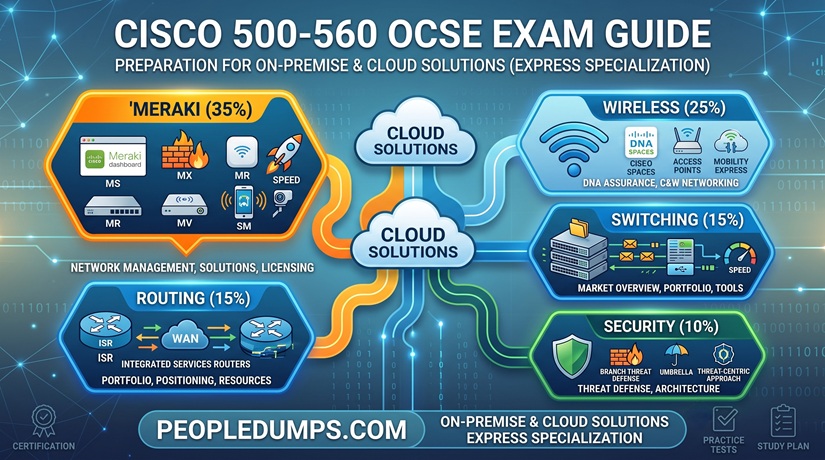
The Cisco 500-560 exam is organized around five major technology areas. Understanding their relative importance can help you prioritize your study time.
| Exam Domain | Weight |
|---|---|
| Switching Overview and Features | 15% |
| Routing Overview and Features | 15% |
| Wireless Overview and Features | 25% |
| Meraki Overview and Products | 35% |
| Security Overview and Features | 10% |
The percentages immediately reveal something important: Meraki and wireless technologies represent a major part of the exam. Candidates who spend all their preparation time reviewing traditional routing and switching may therefore leave significant gaps in their knowledge.
1. Switching Overview and Features – 15%
Ethernet switching remains one of the foundations of business networking. For the switching portion of the Cisco 500-560 OCSE exam, you should understand both basic switching principles and the role of Cisco’s switching portfolio in business network designs.
Important concepts to review include:
- Layer 2 Ethernet switching
- Access and trunk ports
- VLAN concepts
- Inter-VLAN connectivity
- Spanning Tree Protocol concepts
- Link aggregation
- Power over Ethernet
- Switch stacking
- Quality of Service
- Switch management and monitoring
- Cisco switching product positioning
You do not need to treat every switch as an isolated device. Think about why a customer might require a particular switching capability.
For example, a small office deploying IP phones, security cameras, and wireless access points may care about PoE capacity, uplink performance, centralized management, redundancy, and ease of deployment more than advanced service-provider routing functionality.
This customer-focused mindset is useful throughout the OCSE exam.
2. Routing Overview and Features – 15%
Routing connects different IP networks and provides the path traffic uses to reach remote destinations. Even when the exam focuses on products and solutions, understanding basic routing behavior remains essential.
Candidates should be comfortable with concepts such as:
- IPv4 addressing and subnetting
- Default gateways
- Static routing
- Dynamic routing fundamentals
- Routing tables
- Route selection
- WAN connectivity
- VPN connectivity
- Branch network design
- Cisco routing portfolio positioning
For beginners, one of the best ways to study routing is to stop memorizing definitions in isolation and instead follow an actual packet.
Ask yourself:
- What is the source IP address?
- What is the destination IP address?
- Is the destination local or remote?
- Which default gateway will be used?
- Which route matches the destination?
- What happens if multiple paths are available?
This approach builds reasoning skills that remain useful long after the certification exam is complete.
3. Wireless Overview and Features – 25%
Wireless networking is one of the most important areas of the 500-560 OCSE exam. Modern offices depend heavily on Wi-Fi for laptops, smartphones, collaboration devices, IoT systems, and guest connectivity.
Your preparation should include an understanding of:
- Wireless access points
- Wireless LAN controllers
- SSID concepts
- Wireless authentication
- 2.4 GHz and 5 GHz fundamentals
- Radio interference
- Channel planning
- Coverage and capacity
- Wireless roaming
- Centralized WLAN management
- Wireless security
- Location and network assurance concepts
A common beginner mistake is assuming that good Wi-Fi simply means installing more access points. In reality, wireless performance depends on RF conditions, client density, channel utilization, interference, authentication design, wired uplink capacity, and many other factors.
For the Cisco OCSE exam, concentrate on understanding the purpose and benefits of Cisco wireless solutions rather than memorizing only individual product specifications.
Why Wireless Knowledge Matters Beyond the Exam
Wireless skills are valuable because Wi-Fi has effectively become the primary access network in many modern workplaces. Even engineers who spend most of their time managing routers and switches eventually troubleshoot issues that appear to be wireless problems.
Understanding how wired infrastructure, access points, controllers, DHCP, DNS, authentication services, and Internet connectivity interact can make troubleshooting much faster.
4. Meraki Overview and Products – 35%
The largest individual domain in the Cisco 500-560 OCSE blueprint focuses on Cisco Meraki. This makes Meraki one of the highest-priority subjects for candidates.
Cisco Meraki is built around a cloud-managed networking model. Instead of individually managing every network device primarily through a local CLI, administrators can use centralized cloud management to configure, monitor, and troubleshoot distributed infrastructure.
Major Meraki product families relevant to the exam include:
- Meraki MX – security and SD-WAN appliances
- Meraki MS – cloud-managed switches
- Meraki MR – wireless access points
- Meraki Systems Manager – endpoint and device management concepts
- Meraki MV – smart camera solutions
You should understand what each product family is designed to accomplish and how multiple Meraki products can form a centrally managed network.
Understanding the Meraki Cloud-Managed Model
The most important thing is not simply memorizing that Meraki is “managed from the cloud.” You should understand why organizations choose this operating model.
Potential benefits include:
- Centralized configuration
- Remote monitoring
- Simplified multi-site administration
- Zero-touch or simplified provisioning workflows
- Centralized visibility
- Policy consistency
- Reduced operational complexity
- Faster troubleshooting across distributed locations
Imagine a company with fifty small branches. Sending an engineer to manually configure every device at every branch would be expensive and difficult to maintain.
A cloud-managed architecture can allow administrators to manage policies, configurations, monitoring, and troubleshooting from a centralized platform. This type of operational scenario explains why Meraki receives considerable attention in 500-560 OCSE exam preparation.
Do Not Ignore Meraki Licensing and Support Concepts
Candidates should also understand the general role of licensing, support, warranties, and lifecycle management in a cloud-managed network.
This part of the exam can feel less technical than routing or switching, but it matters because a solution engineer needs to understand the complete operational model of the products being proposed or deployed.
5. Security Overview and Features – 10%
Security represents a smaller percentage of the OCSE blueprint, but it should not be ignored. Every modern network design requires some level of security architecture.
Useful concepts to understand include:
- Firewall fundamentals
- Branch security
- VPN concepts
- Secure Internet access
- Threat protection
- DNS-layer security
- Identity-based access
- Network segmentation
- Security policies
- Threat-centric security concepts
Rather than viewing security as a separate appliance at the edge of the network, modern engineers should think in terms of multiple layers of protection.
A branch network, for example, may combine endpoint controls, identity, segmentation, secure DNS, firewall policies, VPN connectivity, and cloud-delivered security services.
On-Premise Networking vs. Cloud-Managed Networking
The title Cisco Networking: On-Premise and Cloud Solutions reflects an important change in the networking industry.
Traditional networks are often administered directly through locally managed routers, switches, wireless controllers, and other appliances. Cloud-managed environments introduce centralized platforms that provide configuration and visibility across geographically distributed devices.
| Area | Traditional / On-Premise | Cloud-Managed |
|---|---|---|
| Management | Often device or controller based | Centralized cloud dashboard |
| Deployment | May require more local configuration | Can simplify remote provisioning |
| Multi-Site Operations | May require separate management workflows | Centralized visibility across sites |
| Monitoring | Depends on local or external management platforms | Integrated centralized monitoring |
| Scalability | Depends heavily on architecture and management tools | Designed for centralized management at scale |
Neither model should automatically be considered superior in every situation. Engineers need to evaluate business requirements, existing infrastructure, security policies, operational capabilities, application requirements, budget, and scalability.
That ability to match technology with customer requirements is one of the useful lessons behind the OCSE learning path.
How Valuable Is the Cisco 500-560 OCSE Certification?
The value of a certification always depends on your role and career direction.
For someone working in a Cisco partner environment or supporting small and midsize business customers, the Cisco 500-560 certification can be particularly relevant because the exam covers several parts of the Cisco networking portfolio instead of concentrating on one narrow technology.
Preparing for the exam can help you develop a better understanding of:
- How Cisco networking products fit into different business environments
- When cloud-managed networking may be appropriate
- How switching, routing, wireless, and security interact
- How Cisco Meraki solutions are structured
- How to think about networking from a customer requirements perspective
However, candidates should maintain realistic expectations. Passing 500-560 does not automatically make someone an advanced network architect, and it does not replace real troubleshooting or deployment experience.
The strongest professional profile normally combines certification knowledge with practical experience.
How Difficult Is the Cisco 500-560 OCSE Exam?
The difficulty depends heavily on your existing background.
If you already work with Cisco networking and understand Meraki, the exam may feel relatively approachable. If your knowledge is limited to basic routing and switching, the wireless and Meraki sections may require significantly more preparation.
For beginners, the biggest challenge is often the breadth of the exam.
You may understand VLANs and routing but know very little about Meraki licensing. Or perhaps you work with wireless networks every day but have limited experience with Cisco’s switching and security portfolio.
Before studying deeply, perform a simple knowledge assessment across all five domains. This prevents you from spending too much time reviewing familiar material while ignoring weaker areas.
Recommended Cisco 500-560 Study Strategy
Step 1: Start With the Exam Topics
Use the current Cisco exam topics as the foundation of your preparation. Certification exams evolve, so avoid building an entire study plan around an old blog post or an outdated product list.
Create five study categories:
- Switching
- Routing
- Wireless
- Meraki
- Security
Step 2: Build Networking Fundamentals First
If you are relatively new to networking, make sure you understand:
- OSI and TCP/IP models
- Ethernet
- MAC addresses
- IPv4 addressing
- Subnetting
- Default gateways
- VLANs
- Routing fundamentals
- DHCP
- DNS
- NAT
- Basic WLAN concepts
Without these fundamentals, memorizing individual Cisco products will produce shallow knowledge that is difficult to apply to exam scenarios.
Step 3: Give Meraki Extra Study Time
Because Meraki represents a substantial part of the exam blueprint, it deserves a significant portion of your study schedule.
Do not simply memorize abbreviations such as MX, MS, and MR. Make sure you can answer questions such as:
- Which product category would solve a particular customer requirement?
- What is the role of the Meraki Dashboard?
- Why would an organization choose cloud-managed networking?
- How can centralized management simplify multi-site operations?
- What are the major Meraki product families?
Step 4: Study Wireless as a System
Wireless should not be studied as a list of access point models.
Understand how a complete WLAN operates:
Client → Access Point → Wired LAN → Network Services → Applications
Then add authentication, RF conditions, controllers or management platforms, security, monitoring, and roaming to the picture.
This systems-based approach makes wireless questions much easier to understand.
Step 5: Use Hands-On Practice Where Possible
Certification theory becomes much easier to remember when you can connect it to actual network behavior.
If you have access to lab equipment or appropriate simulation and management environments, practice tasks such as:
- Creating VLANs
- Configuring access and trunk ports
- Reviewing routing tables
- Creating basic static routes
- Understanding WLAN configuration
- Exploring centralized network dashboards
- Reviewing client connectivity information
- Interpreting network topology diagrams
You do not need a huge enterprise lab. Even small exercises can transform an abstract concept into something memorable.
Step 6: Use Practice Questions as a Diagnostic Tool
High-quality Cisco 500-560 practice questions and study materials can help identify weak areas and improve your ability to recognize scenario-based requirements.
The goal should not be to memorize answers. After every practice session, review:
- Why the correct answer is correct
- Why each incorrect answer is wrong
- Which technology concept the question is testing
- Whether you could explain the concept without seeing the answer choices
This transforms practice testing into active learning instead of simple repetition.
A Practical 4-Week Cisco 500-560 Study Plan
| Week | Study Focus |
|---|---|
| Week 1 | Networking fundamentals, switching and routing |
| Week 2 | Wireless technologies and Cisco wireless solutions |
| Week 3 | Cisco Meraki products, architecture, management and licensing concepts |
| Week 4 | Security, full-topic review, practice questions and weak-area revision |
If you are completely new to networking, four weeks may be too aggressive. Extending the plan to six or eight weeks can provide more time for labs and deeper understanding.
During the final phase of preparation, combining Cisco documentation with a structured 500-560 OCSE study resource can make it easier to review your weaker domains systematically instead of repeatedly studying topics you already know well.
Common Cisco 500-560 Preparation Mistakes
1. Studying Only Routing and Switching
Traditional networking knowledge is important, but the OCSE blueprint gives significant attention to wireless and Meraki. Do not prepare as though this were simply another routing and switching exam.
2. Memorizing Product Names Without Understanding Use Cases
You should know more than the name of a product family. Understand what problem it solves and the type of environment where it might be deployed.
3. Ignoring Cloud-Managed Networking Concepts
The transition from locally managed infrastructure to centralized cloud management is an important theme of modern networking and the OCSE exam.
4. Treating Wireless as an Easy Topic
Wireless networking involves RF behavior, interference, authentication, coverage, capacity, roaming, management, and security. Give it the same level of attention you would give routing.
5. Depending Entirely on Memorization
Memorization may help with terminology, but understanding architecture and use cases is far more valuable when questions describe customer scenarios.
Technical Concepts Worth Reviewing Before Exam Day
As your exam date approaches, make sure you can explain the following concepts without relying heavily on notes:
- VLANs and trunking
- Spanning Tree fundamentals
- PoE and switch access infrastructure
- IPv4 addressing and subnetting
- Static and dynamic routing concepts
- WAN and branch connectivity
- Wireless access points and controllers
- SSID and wireless authentication
- Wireless coverage versus capacity
- Centralized cloud management
- Meraki MX, MS, MR, SM and MV product roles
- Meraki licensing concepts
- Firewall and VPN fundamentals
- DNS-layer security concepts
- Network segmentation
What Skills Can You Gain From Studying for 500-560?
Certification preparation is most valuable when the knowledge remains useful after the exam.
A well-structured Cisco 500-560 OCSE study plan can help you improve several practical skills.
Solution Thinking
You begin asking which combination of technologies best addresses a business requirement instead of automatically choosing the technology you already know.
Product Awareness
You gain a clearer understanding of how switching, routing, wireless, Meraki, and security products fit into a complete networking portfolio.
Hybrid Network Understanding
You become more comfortable with environments where traditional on-premise networking and cloud-managed services coexist.
Troubleshooting Perspective
Understanding how different layers interact makes it easier to determine whether a problem originates from the client, access network, wireless infrastructure, routing, security policy, or upstream connectivity.
These are transferable skills that remain useful even as individual products change.
Is the Cisco 500-560 OCSE Exam Worth Taking?
The answer depends on your goals.
The exam makes the most sense if your work involves Cisco networking solutions, Cisco partners, smaller business customers, Meraki environments, or technical solution design.
It can also be useful for students who already have basic networking knowledge and want to understand how Cisco technologies are assembled into complete solutions.
If your primary objective is becoming a traditional network engineer and you have not yet built strong networking fundamentals, a career certification such as CCNA may deserve priority. OCSE can then complement those skills by expanding your understanding of Cisco’s broader solution portfolio.
Certification should be viewed as one component of professional development rather than the final objective. Combine exam preparation with documentation, lab work, troubleshooting exercises, and exposure to real network designs whenever possible.
Frequently Asked Questions About Cisco 500-560 OCSE
What does 500-560 OCSE stand for?
500-560 is the exam code for Cisco Networking: On-Premise and Cloud Solutions, commonly identified by the acronym OCSE.
What certification is associated with Cisco 500-560?
The exam is associated with the Cisco Networking Express Specialization.
What topics are covered on the Cisco 500-560 exam?
The main areas include switching, routing, wireless networking, Cisco Meraki products and cloud-managed networking, and network security.
Is Meraki important for the 500-560 OCSE exam?
Yes. Meraki is one of the most important areas in the exam blueprint. Candidates should understand major Meraki product families, their roles, cloud management concepts, and related licensing and support concepts.
Do I need routing and switching experience before taking 500-560?
There is no reason beginners cannot start learning the material, but basic networking knowledge will make preparation considerably easier. Understanding IP addressing, VLANs, switching, routing, DHCP, DNS, and wireless fundamentals is strongly recommended.
Is Cisco 500-560 harder than CCNA?
They focus on different objectives, so a direct comparison is not particularly useful. CCNA emphasizes broad networking fundamentals, while 500-560 has a stronger Cisco solution portfolio, wireless, Meraki, and Express Specialization focus.
How should beginners prepare for Cisco 500-560?
Start with networking fundamentals, review the official exam topics, allocate extra study time to Meraki and wireless networking, use hands-on exercises where possible, and use Cisco 500-560 exam preparation materials to identify knowledge gaps rather than simply memorizing answers.
Can Cisco 500-560 help a network engineer’s career?
It can be valuable for professionals working with Cisco networking solutions, particularly in partner, systems engineering, technical sales, Meraki, and small-to-midsize business networking environments. Its value is strongest when combined with practical networking skills and broader career certifications.
Final Thoughts
The Cisco 500-560 OCSE exam is an interesting certification path because it reflects how networking is actually evolving. Engineers are no longer responsible only for routers and switches. They increasingly work with wireless infrastructure, cloud-based management platforms, security services, distributed branches, and centrally managed networks.
Preparing for Cisco Networking: On-Premise and Cloud Solutions therefore requires a broader perspective than traditional routing and switching study alone.
Build your foundation in switching and routing, spend serious time learning wireless technologies, become comfortable with the Cisco Meraki portfolio, and understand how security fits into the overall network architecture.
If you are preparing for the certification now, you can also review this Cisco 500-560 OCSE study and exam preparation page as part of your broader revision strategy.
Most importantly, avoid preparing only to recognize the correct option on an exam question. Try to understand why a technology exists, what problem it solves, and when you would recommend it to a customer.
That mindset will not only improve your chances on the 500-560 OCSE certification exam; it will also make the knowledge far more useful when you begin working with real Cisco networking environments.
Official References and Further Reading
For candidates preparing for the Cisco 500-560 OCSE exam, the following official Cisco, Cisco Meraki, and authoritative industry resources provide additional information about switching, routing, wireless networking, cloud-managed infrastructure, Meraki products, network security, licensing, and small-to-midsize business networking solutions.
- Cisco 500-560 OCSE – Official Exam Page
– Cisco’s official page for the Cisco Networking: On-Premise and Cloud Solutions exam, including current exam information, supported languages, certification context, preparation resources, and registration details. - Cisco Small Business – Official Technical Support
– Cisco’s official resource center for small and midsize business networking products, including switches, routers, wireless access points, network management platforms, configuration guides, troubleshooting information, and firmware resources. - Cisco Business 350 Series Managed Switches Documentation
– Official Cisco technical documentation covering VLANs, Spanning Tree, link aggregation, PoE, switch management, security, configuration, firmware, troubleshooting, and other switching technologies relevant to business networks. - Cisco Business Wireless Access Points – Technical Documentation
– Cisco’s official wireless documentation covering business Wi-Fi access points, wireless configuration, mesh networking, security, deployment, management, firmware, and WLAN best practices. - Cisco Meraki Dashboard Administration
– Official Cisco Meraki documentation covering organizations, networks, device inventory, administrators, centralized configuration, monitoring, reporting, troubleshooting, and management of cloud-managed networks. - Cisco Meraki Product Information
– Cisco Meraki’s official product documentation covering MX security and SD-WAN appliances, MS switches, MR wireless access points, MV cameras, Systems Manager, cellular gateways, licensing, firmware, and platform capabilities. - Cisco Meraki MX – Security and SD-WAN Documentation
– Official documentation for Meraki MX appliances, including firewall functionality, AutoVPN, SD-WAN, traffic management, security services, distributed deployment, remote administration, and branch network connectivity. - Cisco Meraki Licensing Documentation
– Cisco’s official reference for Meraki licensing models, including Subscription Licensing, Co-Termination Licensing, license compliance, product licensing, and lifecycle considerations. - Cisco Meraki Dashboard Organizational Structure
– An official guide explaining how Meraki organizations and networks are structured and how administrators centrally manage devices, configurations, client information, licensing, and access permissions. - IEEE 802.11 Wireless LAN Working Group
– The authoritative IEEE resource for 802.11 wireless LAN standards, providing useful technical background for Wi-Fi technologies, wireless network operation, and modern WLAN deployments. - RFC 1918 – Address Allocation for Private Internets
– An authoritative IETF reference describing private IPv4 address space, an important networking concept for branch offices, NAT, routing, VPNs, and small-to-midsize business network designs.