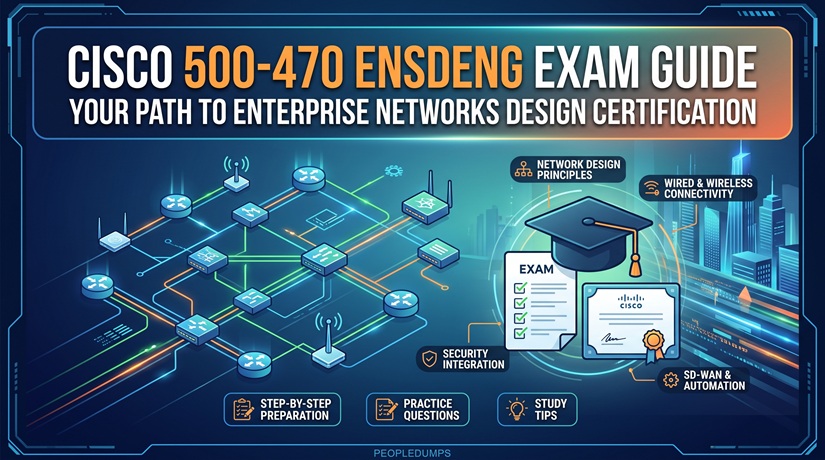
If you have spent some time around Cisco enterprise networking, you have probably heard plenty about CCNA, CCNP Enterprise, SD-WAN, Cisco ISE, and Software-Defined Access. The Cisco 500-470 ENSDENG exam sits in a slightly different part of that ecosystem.
Officially called the Cisco Enterprise Networks SDA, SDWAN and ISE Exam for System Engineers, the 500-470 ENSDENG exam is designed primarily for system engineers who need to understand not only how Cisco enterprise technologies work, but also how they fit into a customer solution.
That distinction matters. This is not simply another routing-and-switching exam. It brings together campus networking, WAN transformation, identity-based security, solution design, product positioning, and Cisco’s Discovery, Design, Demonstrate, and Defend methodology.
For a student or junior network engineer, that makes the exam interesting even if you are not currently working for a Cisco partner. It provides a useful view of how technologies such as Cisco SD-Access, Catalyst SD-WAN, Cisco Identity Services Engine, and Catalyst Center are used to solve real enterprise problems.
This article was reviewed against Cisco information available in August 2026. Cisco can change exam topics, product names, licensing, and program requirements, so candidates should always check the official Cisco exam page before scheduling an exam.
What Is the Cisco 500-470 ENSDENG Exam?
Table of Contents
ToggleThe 500-470 ENSDENG exam is a Cisco enterprise networking exam intended for system engineers. Cisco describes it as an examination of the skills required to understand the 4D sales methodology:
- Discovery — understanding the customer’s environment, problems, business requirements, and technical constraints.
- Design — mapping those requirements to an appropriate network architecture.
- Demonstrate — showing how the proposed technology or architecture solves the problem.
- Defend — explaining the technical and business value of the design and addressing objections, limitations, or competing solutions.
This approach makes ENSDENG noticeably different from exams that focus almost entirely on configuration commands and troubleshooting.
A system engineer may certainly need strong technical knowledge, but technical knowledge alone is not enough. You also need to understand why one architecture is appropriate for a particular customer, what trade-offs exist, and how several Cisco products work together.
Cisco 500-470 ENSDENG Exam Quick Facts
| Item | Details |
|---|---|
| Exam Code | 500-470 |
| Exam Name | Cisco Enterprise Networks SDA, SDWAN and ISE Exam for System Engineers |
| Short Name | ENSDENG |
| Duration | 60 minutes |
| Language | English |
| Primary Audience | System Engineers and technical professionals working with Cisco enterprise solutions |
| Main Technologies | SD-Access, SD-WAN, Cisco ISE, network segmentation, identity and policy |
| Methodology | Discovery, Design, Demonstrate, Defend |
| Related Cisco Specialization | Advanced Enterprise Networks Architecture Specialization |
One detail worth emphasizing is the exam’s position in Cisco’s portfolio. The 500-470 exam is associated with Cisco’s partner and specialization ecosystem. It should therefore not be treated as a direct replacement for CCNA or CCNP Enterprise.
Is Cisco 500-470 a Real Cisco Certification?
This question often causes confusion because people use the words exam, certification, and specialization interchangeably.
Cisco currently associates 500-470 ENSDENG with the Advanced Enterprise Networks Architecture Specialization. At the same time, Cisco lists the exam among its channel, partner, and other exams rather than placing it in the normal CCNA/CCNP career-certification path.
That means its value is highly dependent on your role.
If you work for a Cisco partner, especially in presales engineering, systems engineering, solution architecture, or enterprise networking, the exam can be directly relevant to your job and your organization’s specialization requirements.
If your goal is simply to become a network administrator and you are still learning VLANs, routing protocols, subnetting, and access control lists, CCNA is normally a more logical starting point.
This does not make 500-470 less technical. It simply validates a different type of knowledge.
How Valuable Is the Cisco ENSDENG Certification?
The value of the Cisco 500-470 ENSDENG exam is strongest when your work involves explaining, designing, or positioning enterprise network architectures.
Traditional network training often begins with individual technologies. You learn how OSPF works, how VLAN tagging works, how an ACL processes packets, or how DHCP assigns an address.
Enterprise architecture requires another layer of thinking.
Instead of asking only, “How do I configure this switch?”, you begin asking questions such as:
- How should thousands of users and devices be segmented?
- How can policy follow a user instead of being tied permanently to an IP subnet?
- How can branch offices use Internet, MPLS, and other transports more intelligently?
- How can network access decisions depend on user identity, device type, security posture, and business role?
- How can a network team automate repetitive campus deployment tasks?
- How should a company migrate from a traditional campus or WAN without replacing everything at once?
Those are architecture questions, and they sit close to the heart of ENSDENG.
For this reason, I would describe 500-470 as particularly useful for someone moving from a device-focused networking mindset toward a solution-focused networking mindset.
The Three Technology Pillars of Cisco 500-470
Although the 4D methodology provides the business and solution framework, the technical core of the exam revolves around three major areas:
- Cisco Software-Defined Access
- Cisco Catalyst SD-WAN
- Cisco Identity Services Engine
These are easier to understand when you stop thinking of them as three unrelated products.
SD-Access is primarily concerned with the enterprise campus. SD-WAN addresses connectivity between sites, branches, data centers, cloud environments, and applications. ISE supplies identity and policy information that can be used to make access and segmentation decisions.
Together, they illustrate an important direction in modern enterprise networking: moving from device-by-device configuration toward centralized intent, identity, segmentation, policy, automation, and assurance.
1. Cisco SD-Access: More Than Automated Switching
Cisco Software-Defined Access, or SD-Access, is one of the most important technologies to understand for the 500-470 ENSDENG exam.
At a high level, SD-Access creates a fabric-based enterprise campus architecture. Instead of manually building every VLAN, routing boundary, and access policy device by device, organizations can use centralized automation and policy to operate the campus.
Underlay and Overlay Networks
A useful way to begin is with the distinction between the underlay and the overlay.
The underlay is the IP network that provides basic connectivity between fabric devices. Think of it as the transportation infrastructure that allows the fabric nodes to reach one another.
The overlay is built on top of that IP connectivity. In a LISP-based SD-Access fabric, Cisco uses technologies including VXLAN for the data plane and LISP for endpoint-location information in the control plane.
This separation is important because users and devices are no longer forced to depend entirely on traditional VLAN and physical-topology boundaries.
Fabric Edge Nodes
A fabric edge node is typically where endpoints connect to the SD-Access fabric.
For a beginner, the easiest mental model is to compare it with an access-layer switch in a traditional campus network. The edge node connects devices such as PCs, phones, access points, printers, and other endpoints to the fabric.
It also participates in endpoint registration and fabric forwarding.
Control Plane Nodes
The control plane node maintains information about where endpoints are located in the fabric.
Rather than relying purely on conventional destination-prefix routing, the fabric can associate endpoint identities with their current locations. This is one reason technologies such as LISP are important to SD-Access architecture.
Border Nodes
A border node connects the SD-Access fabric to external networks.
That external environment might include a data center, traditional campus network, WAN, shared services, Internet edge, or another routing domain.
If you are studying for ENSDENG, make sure you can explain the difference between an edge node, control plane node, and border node without relying on memorized definitions.
Catalyst Center and SD-Access
Older 500-470 training material frequently refers to Cisco DNA Center. Cisco later renamed the platform Cisco Catalyst Center.
They refer to the same product lineage, so candidates need to recognize both names.
Catalyst Center provides centralized design, provisioning, automation, policy integration, assurance, and lifecycle-management capabilities for enterprise networks.
An important architecture detail is that Catalyst Center is not itself the SD-Access forwarding plane. If Catalyst Center becomes temporarily unavailable, existing fabric traffic does not simply stop forwarding. However, management, provisioning, assurance, and policy-change workflows can be affected.
That is the kind of distinction a system engineer should understand.
Virtual Networks and Security Group Tags
Segmentation is another major SD-Access concept.
Virtual Networks, or VNs, can provide larger-scale logical separation of traffic. You can think of this as macrosegmentation.
Security Group Tags, or SGTs, allow policy to be associated with groups of users or devices. This helps create more granular group-based access policies without depending entirely on source and destination IP addresses.
This is where Cisco ISE becomes particularly important.
2. Cisco Catalyst SD-WAN: Changing How Enterprises Think About the WAN
The second major technology area is Cisco Catalyst SD-WAN.
A traditional enterprise WAN might rely heavily on manually configured routers and private WAN circuits. Modern enterprises, however, may have hundreds or thousands of branches using combinations of MPLS, broadband Internet, cellular connectivity, cloud services, and SaaS applications.
Managing that environment router by router quickly becomes difficult.
SD-WAN introduces centralized control and policy so that organizations can make smarter decisions about how applications use available WAN transports.
Know Both the Old and New Cisco SD-WAN Names
This is another area where older exam material can be confusing.
| Older Name | Current Cisco Name | Basic Function |
|---|---|---|
| vManage | Catalyst SD-WAN Manager | Centralized management and operations |
| vSmart | Catalyst SD-WAN Controller | Control-plane and policy functions |
| vBond | Catalyst SD-WAN Validator | Initial authentication, validation, and orchestration functions |
| WAN Edge | WAN Edge | Site connectivity and data-plane forwarding |
If you encounter old documentation or practice questions, mentally translate the legacy component name into the current architecture.
What Should You Understand About SD-WAN?
For ENSDENG, memorizing every possible CLI command is less useful than understanding what SD-WAN is trying to accomplish.
You should be comfortable discussing topics such as:
- centralized WAN management;
- secure overlay connectivity;
- multiple transport options;
- WAN segmentation;
- centralized control and data policies;
- application-aware routing;
- resiliency and failover;
- cloud and SaaS connectivity;
- WAN security;
- operational visibility;
- migration from traditional WAN architectures.
A typical design discussion might involve an organization that has both MPLS and Internet circuits. Rather than treating one link as permanently primary and the other as a basic backup, an SD-WAN architecture can apply policy based on application requirements, path quality, business intent, and security requirements.
The technology becomes much easier to remember once you understand the business problem it solves.
3. Cisco ISE: Identity Becomes Part of the Network Policy
Cisco Identity Services Engine, or Cisco ISE, is the third major pillar of the Cisco 500-470 ENSDENG exam.
Traditional network security often relies heavily on addresses, VLANs, and static access control rules. That becomes increasingly difficult when users connect with several devices, employees move between locations, contractors require limited access, IoT endpoints appear on the network, and wireless access becomes the default.
ISE helps the network answer a more useful question:
Who or what is connecting, and what should that identity be allowed to do?
Important Cisco ISE Concepts
A good ENSDENG study plan should cover at least the following ISE concepts:
- AAA and network access control;
- RADIUS-based authentication and authorization;
- 802.1X;
- MAC Authentication Bypass;
- endpoint profiling;
- guest access;
- BYOD;
- posture and compliance concepts;
- TrustSec;
- Security Group Tags;
- pxGrid and context sharing;
- policy design;
- ISE deployment and scalability.
ISE Node Personas
At a high level, distributed Cisco ISE deployments can include several important personas.
The Policy Administration Node provides centralized administrative and configuration functions.
The Policy Service Node handles policy-related runtime services such as network access, profiling, guest access, and authorization decisions.
The Monitoring and Troubleshooting Node collects operational information, logs, and reports.
ISE can also provide pxGrid services for exchanging context and policy information with other systems.
You do not need to approach ENSDENG as if it were a deep ISE implementation exam, but you should understand the architectural purpose of these components.
How SD-Access and ISE Work Together
One of the most useful concepts in the entire exam is the relationship between SD-Access and Cisco ISE.
Imagine a university network with students, instructors, administrators, IP cameras, laboratory devices, printers, and guest users.
A traditional design might create separate VLANs and ACLs for many of these groups. As the environment grows, the number of VLANs, subnets, ACL entries, and exceptions can become difficult to manage.
With identity-based policy, the network can make decisions based on group membership rather than only physical location or IP subnet.
For example, an authenticated employee could receive an appropriate Security Group Tag, while an IoT camera could receive a different tag. Group-based policy can then define which groups are permitted to communicate.
This is one of the reasons ISE appears so prominently alongside SD-Access in the ENSDENG blueprint.
Understanding the 4D Methodology
Students sometimes make the mistake of studying only the product architecture for 500-470. That misses a major part of the exam’s purpose.
The technologies need to be understood through the 4D methodology.
Discovery
Discovery means learning about the customer before proposing a solution.
For an SD-WAN project, for example, you would want to understand the current WAN topology, circuit types, application requirements, cloud usage, security requirements, branch count, operational problems, downtime concerns, and cost pressures.
The wrong approach would be to begin with a product and search for a problem that justifies it.
The better approach is to understand the problem first.
Design
Design translates discovered requirements into architecture.
For SD-Access, this may involve fabric-site design, node roles, migration strategy, segmentation, external connectivity, branch considerations, data-center integration, and policy architecture.
For SD-WAN, design considerations may include topology, WAN transports, redundancy, segmentation, application policies, security, and cloud connectivity.
For ISE, the discussion can include deployment architecture, access control, profiling, guest services, BYOD, TrustSec, and scalability.
Demonstrate
A demonstration should prove that the solution addresses an actual customer requirement.
A good demonstration is not simply a long tour of menus.
If the customer is concerned about application performance, demonstrate path selection or application visibility. If the concern is unauthorized devices, demonstrate identification and policy enforcement. If campus operations are too manual, demonstrate automation and assurance.
The demonstration should connect a feature to an outcome.
Defend
Defend does not mean blindly arguing that Cisco is always better.
A competent system engineer should understand competitive positioning, product limitations, design caveats, licensing considerations, roadmap issues, migration challenges, and the reasons a particular architecture is appropriate.
This requires more maturity than simply memorizing a product data sheet.
Cisco 500-470 ENSDENG Exam Topic Breakdown
At the time of writing, the commonly published 500-470 blueprint is organized around the following areas. Cisco may revise exam topics, so always compare your study plan with the current official blueprint before the exam.
| Domain | Approximate Weight |
|---|---|
| SD-Access Discovery | 6% |
| SD-Access Design | 20% |
| SDA Defend | 8% |
| SD-WAN Discover | 8% |
| SD-WAN Design | 12% |
| SD-WAN Demonstration | 12% |
| ISE Discover | 6% |
| ISE Design | 12% |
| ISE Demonstration | 8% |
| ISE Defend | 8% |
The first thing I would notice in this table is the weight assigned to SD-Access Design. At around one-fifth of the blueprint, it deserves serious study time.
The second observation is that this is not simply a product-identification test. Design-oriented topics make up a substantial part of the exam.
500-470 ENSDENG vs. CCNA vs. CCNP Enterprise
Students often ask whether they should take ENSDENG instead of CCNA or CCNP Enterprise.
They serve different purposes.
| Exam Path | Main Purpose | Typical Focus |
|---|---|---|
| CCNA | Build foundational networking knowledge | Networking fundamentals, IP connectivity, switching, routing, services, security, automation |
| CCNP Enterprise | Validate advanced enterprise networking skills | Enterprise infrastructure, advanced routing, SD-WAN, design, assurance, automation and related technologies |
| 500-470 ENSDENG | Develop and validate system-engineering knowledge around Cisco enterprise architectures | SD-Access, SD-WAN, ISE, design, customer requirements, demonstrations and solution positioning |
If you are completely new to networking, I would build a CCNA-level foundation first.
If you already understand basic routing, switching, VLANs, IP addressing, security fundamentals, and enterprise network architecture, the ENSDENG material becomes much easier to absorb.
What Knowledge Should You Have Before Studying for 500-470?
Cisco’s exam positioning does not mean every candidate must hold another certification first, but several foundational skills will make your preparation far more productive.
You should ideally understand:
- IPv4 addressing and subnetting;
- basic IPv6 concepts;
- VLANs and trunks;
- Layer 2 versus Layer 3 forwarding;
- basic routing;
- VRFs;
- ACL concepts;
- AAA fundamentals;
- 802.1X at a conceptual level;
- campus LAN architecture;
- traditional WAN connectivity;
- basic network security concepts.
You do not need CCIE-level knowledge of these technologies. You simply need enough networking foundation to understand why Cisco’s software-defined architectures exist.
A Practical Six-Week Cisco 500-470 Study Plan
Week 1: Understand the Exam and Strengthen the Fundamentals
Begin by reading the official exam topics from start to finish. Do not immediately memorize them. Instead, identify every term you cannot explain clearly.
Review basic campus design, routing, VRFs, segmentation, AAA, 802.1X, and WAN architecture.
Also spend time understanding the 4D framework. This will prevent you from approaching every question as a configuration problem.
Week 2: Focus on SD-Access
Study the SD-Access architecture carefully.
Make sure you understand the underlay, overlay, VXLAN, LISP, fabric edge nodes, border nodes, control plane nodes, virtual networks, Security Group Tags, Catalyst Center, and ISE integration.
Draw the architecture yourself rather than repeatedly looking at Cisco diagrams. If you can draw it from memory and explain each component, you are making progress.
Week 3: Focus on Catalyst SD-WAN
Study the current Catalyst SD-WAN architecture along with the legacy terminology that may still appear in older material.
Understand Manager/vManage, Controller/vSmart, Validator/vBond, WAN Edge devices, transport networks, overlay tunnels, segmentation, application-aware routing, centralized policy, and resiliency.
Then move from architecture to customer use cases.
Ask yourself why a business would migrate to SD-WAN in the first place.
Week 4: Focus on Cisco ISE
Review ISE architecture, node personas, 802.1X, MAB, profiling, guest services, BYOD, TrustSec, Security Group Tags, policy enforcement, and pxGrid.
Do not study ISE as a completely isolated security product. Continuously connect it back to SD-Access and enterprise segmentation.
Week 5: Combine the Technologies
This week is where your preparation begins to look like system engineering rather than certification memorization.
Build simple customer scenarios.
For example, imagine a company with 100 branches, two data centers, SaaS applications, guest wireless, IoT devices, and a traditional campus network.
Ask:
- What information should be collected during discovery?
- Where could SD-WAN help?
- Where could SD-Access help?
- What role would ISE play?
- How would you segment users and devices?
- What would you demonstrate in a proof of value?
- What migration risks would need to be discussed?
If you can answer those questions confidently, you are learning the architecture rather than merely learning an exam.
Week 6: Review, Practice, and Fix Weak Areas
Return to the exam blueprint and rate each topic from one to five.
A score of five means you could explain the topic to another student without notes. A score of one means you recognize the term but cannot explain it.
Spend the final week primarily on the one-, two-, and three-point topics.
Practice answering scenario questions quickly, because the official exam duration is only 60 minutes.
Should You Build a Lab for ENSDENG?
Hands-on experience is always helpful, but I would not treat 500-470 like a deep implementation lab exam.
The exam’s system-engineering orientation means architecture, use cases, design choices, product capabilities, and solution positioning matter greatly.
Still, even a small amount of hands-on exposure can make abstract concepts much easier to understand.
If you have access to Cisco learning labs, Cisco U., partner enablement resources, virtual labs, or appropriate sandbox environments, use them to explore interfaces and workflows.
For SD-Access, seeing how fabric sites, virtual networks, device roles, and policy appear in Catalyst Center can help enormously.
For SD-WAN, spend time understanding the relationship between the manager, controllers, WAN Edge devices, policies, tunnels, and application visibility.
For ISE, seeing authentication logs, endpoint profiling, authorization policies, and policy sets makes the technology far less theoretical.
Do Not Let Old Product Names Confuse You
Cisco enterprise networking has changed its branding considerably over the last several years.
This creates a special problem for anyone preparing for 500-470 because older documentation, training slides, discussion threads, and practice questions may use terminology that differs from current Cisco documentation.
Two translations are particularly important:
- Cisco DNA Center is now called Cisco Catalyst Center.
- vManage, vSmart, and vBond are now generally referred to as Catalyst SD-WAN Manager, Catalyst SD-WAN Controller, and Catalyst SD-WAN Validator.
Do not assume the underlying architecture changed simply because a product name changed.
At the same time, be careful with licensing information. Cisco licensing models can evolve, and old exam-preparation websites often preserve pricing or license tiers long after Cisco has changed them.
For licensing questions, current Cisco documentation and current partner training should take priority over old practice material.
How to Approach Questions in the Cisco ENSDENG Exam
One useful technique is to determine what type of question you are actually reading before looking at the answer choices.
If the question describes customer pain points and asks what information matters, think Discovery.
If it describes technical requirements and asks how components should fit together, think Design.
If it asks what capability should be shown to prove value, think Demonstrate.
If it deals with objections, competitive positioning, caveats, product fit, or solution justification, think Defend.
This simple classification helps because several answer choices may all be technically true while only one fits the stage of the customer engagement.
Common Mistakes When Preparing for Cisco 500-470
1. Treating It Like a Pure Routing and Switching Exam
ENSDENG contains real networking technology, but its purpose is broader. If you study only protocols and configurations, you will miss the architecture and solution-engineering perspective.
2. Memorizing Product Names Without Understanding the Architecture
Knowing that vSmart became Catalyst SD-WAN Controller is useful. Understanding what the controller actually does is far more valuable.
3. Ignoring ISE Because You Prefer Routing
Modern enterprise networking increasingly combines connectivity and security policy. ISE is therefore not an optional side topic in this exam.
4. Studying Old Licensing Tables Too Aggressively
Licensing changes faster than architectural principles. Verify current licensing information rather than building your entire preparation strategy around years-old screenshots.
5. Using Exam Dumps as the Main Study Method
A dump may encourage you to memorize an answer without understanding why it is correct. It may also contain obsolete terminology, outdated licensing, or simply incorrect answers.
A better strategy is to use legitimate practice questions to identify weak topics and then return to Cisco documentation to understand the technology.
Recommended Study Resources
For this exam, I would prioritize sources in roughly this order:
- The official Cisco 500-470 ENSDENG exam page and exam-topic blueprint — use these to define the scope.
- Cisco SD-Access design and deployment documentation — especially fabric roles, LISP, VXLAN, segmentation, and Catalyst Center.
- Cisco Catalyst SD-WAN documentation — learn both current and legacy component names.
- Cisco ISE documentation — focus on architecture, access control, profiling, guest, BYOD, TrustSec, and policy.
- Cisco U. and authorized Cisco partner training — particularly valuable if your organization provides access.
- Hands-on labs and legitimate practice questions — use them to validate understanding rather than replace it.
Who Should Take the Cisco 500-470 ENSDENG Exam?
The exam makes the most sense for:
- Cisco partner system engineers;
- presales network engineers;
- enterprise networking solution architects;
- technical consultants working with Cisco enterprise products;
- network engineers moving toward architecture or customer-facing roles;
- engineers supporting SD-Access, SD-WAN, or ISE solution discussions.
Students can also benefit from the material, particularly if they already have CCNA-level knowledge and want to understand what modern Cisco enterprise architecture looks like beyond traditional routing and switching.
Who Should Probably Study Something Else First?
If terms such as VLAN, default gateway, OSPF, ACL, RADIUS, 802.1X, VRF, and Layer 3 routing are still unfamiliar, I would not make ENSDENG your first serious networking course.
Start with networking fundamentals or CCNA-level material.
Once the basics are comfortable, SD-Access and SD-WAN stop looking like mysterious collections of Cisco products. You begin to see them as architectures built on familiar networking principles.
Frequently Asked Questions About Cisco 500-470 ENSDENG
Is Cisco 500-470 ENSDENG suitable for beginners?
It can be studied by motivated beginners, but it is much easier with basic routing, switching, security, and enterprise networking knowledge. For a completely new student, CCNA-level study is usually a better first step.
Does Cisco 500-470 replace CCNA?
No. CCNA is a broad foundational networking certification, while 500-470 focuses on system-engineering knowledge around Cisco enterprise architectures, SD-Access, SD-WAN, ISE, and the 4D methodology.
Does passing 500-470 give me CCNP Enterprise?
No. The ENSDENG exam is not a CCNP Enterprise core or concentration exam. It belongs to a different Cisco exam and specialization context.
What are the most important technologies for the 500-470 exam?
The three central areas are Cisco SD-Access, Cisco Catalyst SD-WAN, and Cisco Identity Services Engine. Candidates should also understand Catalyst Center, segmentation, identity-based policy, and the Discovery-Design-Demonstrate-Defend methodology.
Is Cisco DNA Center still relevant to the exam?
Yes, because older ENSDENG material may use the Cisco DNA Center name. Cisco renamed DNA Center to Cisco Catalyst Center, so candidates should recognize both terms.
What happened to vManage, vSmart, and vBond?
Cisco’s current Catalyst SD-WAN terminology uses Catalyst SD-WAN Manager, Catalyst SD-WAN Controller, and Catalyst SD-WAN Validator respectively. Older training and exam material may still use the legacy names.
Is 500-470 mainly a configuration exam?
No. Although technical knowledge is required, the exam is strongly oriented toward system engineering, architecture, design considerations, solution capabilities, customer requirements, demonstrations, and positioning.
How long should I study for the Cisco 500-470 exam?
For someone with CCNA-level networking knowledge, four to eight weeks of focused study can be a reasonable target. Someone already working with SD-Access, SD-WAN, or ISE may require less time, while a newer student may need longer to build the necessary foundation.
What is the hardest part of ENSDENG?
For many candidates, the difficulty is not a single protocol. It is learning to connect technical architecture with business requirements. SD-Access design also deserves particular attention because it represents a significant portion of the commonly published exam blueprint.
Is Cisco 500-470 worth taking if I do not work for a Cisco partner?
Its formal value is strongest in Cisco partner and system-engineering environments. However, the technical material can still be useful for network engineers who want to understand software-defined campus networking, SD-WAN, identity-based access control, and enterprise solution design.
Final Thoughts: Is Cisco 500-470 ENSDENG Worth It?
The Cisco 500-470 ENSDENG exam occupies an unusual but useful position in Cisco’s training ecosystem.
It is not simply a junior networking certification, and it is not a substitute for CCNP Enterprise. Instead, it sits at the intersection of network engineering, enterprise architecture, security policy, automation, and technical solution consulting.
That is exactly why the material can be valuable.
SD-Access teaches you to think about the campus as a policy-driven fabric rather than a collection of individual switches. Catalyst SD-WAN teaches you to think about the WAN in terms of applications, transports, centralized policy, and business intent. Cisco ISE teaches you that identity and context can be fundamental parts of network access and segmentation.
The 4D methodology then forces you to connect those technologies to a real customer’s requirements.
If you are preparing for the exam, do not make your goal simply to memorize enough facts to pass 500-470. Make sure you can explain why these architectures exist, what problems they solve, where their components fit, and what trade-offs a customer should understand.
That knowledge will remain useful long after the exam is over.
Official References and Further Reading
For candidates preparing for the Cisco 500-470 ENSDENG exam, the following official Cisco and authoritative technical resources provide additional information about Software-Defined Access (SD-Access), Cisco Catalyst SD-WAN, Cisco Identity Services Engine (ISE), Catalyst Center, network segmentation, identity-based policy, enterprise network design, and solution engineering.
- Cisco 500-470 ENSDENG – Official Exam Page
– Cisco’s official page for the Cisco Enterprise Networks SDA, SDWAN and ISE Exam for System Engineers, including current exam details, duration, language, specialization information, and the Discovery, Design, Demonstrate, and Defend methodology. - Cisco Software-Defined Access Solution Design Guide
– A comprehensive Cisco design reference covering SD-Access architecture, underlay and overlay networks, Catalyst Center, Cisco ISE, LISP, VXLAN, TrustSec, fabric roles, segmentation, shared services, scalability, and migration strategies. - SD-Access Deployment Using Cisco Catalyst Center
– Cisco’s validated deployment guidance for designing, deploying, and operating SD-Access networks with Catalyst Center, including fabric sites, virtual networks, IP pools, border nodes, control plane nodes, fabric edge nodes, ISE integration, and assurance. - Cisco Design Zone – Campus and Branch Networks
– Cisco’s collection of validated designs and technical guidance for enterprise campus and branch architectures, including SD-Access, Catalyst Center, segmentation, wireless automation, and enterprise network modernization. - Cisco Catalyst SD-WAN Design Guide
– Cisco’s authoritative design guide covering Catalyst SD-WAN architecture, Manager, Controller, Validator, WAN Edge devices, control and data planes, routing, onboarding, redundancy, security, NAT, and deployment considerations. - Cisco Identity Services Engine – Technical Documentation
– Cisco’s central documentation portal for ISE, including current administrator guides, installation and upgrade documentation, configuration references, compatibility information, troubleshooting resources, and API documentation. - Cisco Identity Services Engine Administrator Guide
– Detailed Cisco documentation covering ISE deployment, network access control, guest access, BYOD, endpoint visibility, segmentation, compliance, pxGrid, integrations, monitoring, and troubleshooting. - Cisco DevNet – Catalyst Center SD-Access API
– Official Cisco developer documentation demonstrating how Catalyst Center APIs can automate SD-Access fabrics, virtual networks, IP pools, control plane nodes, border nodes, edge nodes, and endpoint-facing ports. - RFC 7348 – Virtual eXtensible Local Area Network (VXLAN)
– The authoritative IETF specification for VXLAN, the overlay encapsulation technology used in Cisco SD-Access to transport endpoint traffic across the fabric. - RFC 6830 – Locator/ID Separation Protocol (LISP)
– An important IETF reference for understanding LISP concepts, endpoint identifiers, routing locators, mapping systems, and the architectural principles behind the SD-Access control plane. - IEEE 802.1X – Port-Based Network Access Control
– The authoritative IEEE reference for 802.1X network access control, an important foundation for identity-based authentication and Cisco ISE deployments.