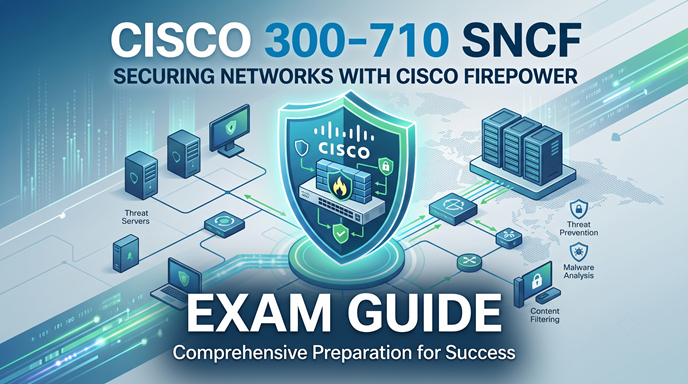
The Cisco 300-710 SNCF exam is one of the most practical concentration exams in the CCNP Security certification track. Rather than testing security as a broad theoretical subject, SNCF focuses on the technologies that security engineers use to deploy, manage, and troubleshoot Cisco firewalls in production networks.
Its official name is Securing Networks with Cisco Firewalls. The exam covers Cisco Secure Firewall Threat Defense, Cisco Secure Firewall Management Center, security policy configuration, platform deployment, integrations, operational management, and troubleshooting.
You may also see older books and training courses refer to Cisco Firepower, Firepower Threat Defense, or Firepower Management Center. Cisco has renamed these products, but the underlying technologies remain closely related. In current terminology, Firepower Threat Defense is generally called Cisco Secure Firewall Threat Defense, while Firepower Management Center is now Cisco Secure Firewall Management Center.
Important 2026 exam update: SNCF v1.1 remains available through August 26, 2026. SNCF v1.2 becomes the active exam on August 27, 2026. Candidates testing after that date should build their study plan around the v1.2 blueprint.
What Is the Cisco 300-710 SNCF Exam?
The Cisco SNCF exam validates your ability to work with Cisco’s enterprise firewall platform. It is not limited to memorizing product features or identifying buttons in a graphical interface. A well-prepared candidate should understand how traffic moves through the firewall, how policies interact, how events are generated, and how to diagnose a configuration that does not behave as expected.
The exam is particularly relevant to engineers working with the following technologies:
- Cisco Secure Firewall Threat Defense
- Cisco Secure Firewall Management Center
- Cisco Security Cloud Control
- Access control and intrusion prevention policies
- Network address translation
- Security Intelligence and reputation-based filtering
- URL, DNS, file, and malware inspection
- TLS and SSL decryption
- Identity-based security policies
- High availability and resilient firewall deployment
- Logging, monitoring, packet analysis, and troubleshooting
- Security platform integrations and event forwarding
This makes SNCF more specialized than the 350-701 SCOR core exam. SCOR introduces a broad range of security domains, while SNCF goes much deeper into firewall design, implementation, policy behavior, and operations.
Cisco 300-710 SNCF Exam Details
| Item | Details |
|---|---|
| Exam code | 300-710 SNCF |
| Official name | Securing Networks with Cisco Firewalls |
| Certification level | Professional concentration exam |
| Exam duration | 90 minutes |
| Exam price | US$300 or Cisco Learning Credits |
| Associated certification | Cisco Certified Specialist – Securing Networks with Cisco Firewalls |
| CCNP Security requirement | Counts as one CCNP Security concentration exam |
| Exam delivery | Pearson VUE testing center or available online-proctored options |
| Scoring | Pass or fail |
Cisco does not list a guaranteed number of questions on the public SNCF exam page. Candidates should therefore avoid building a time-management strategy around an unofficial question count. The safer approach is to work steadily, flag difficult questions, and preserve enough time to review incomplete answers.
Always verify pricing, language availability, testing policies, and scheduling options on the official Cisco website before registering. Regional taxes and currency conversion may affect the final cost.
SNCF v1.1 and v1.2: What Is Changing?
The SNCF exam is moving from version 1.1 to version 1.2 in August 2026:
- Last date to take SNCF v1.1: August 26, 2026
- First date to take SNCF v1.2: August 27, 2026
The core purpose of the exam remains the same: validating practical knowledge of Cisco Secure Firewall managed through Cisco Secure Firewall Management Center. However, the updated blueprint reflects the way modern security teams manage firewall environments and analyze security data.
Notable areas introduced or expanded in the v1.2 update include:
- Cisco Security Cloud Control management
- Integration with Splunk and security analytics workflows
- AI-assisted threat detection and investigation concepts
- Newer Cisco Secure Firewall management capabilities
- Updated terminology and product architecture
This does not mean traditional firewall skills are becoming less important. Access rules, NAT, intrusion policies, traffic inspection, high availability, routing, logging, and troubleshooting still form the technical foundation of the exam.
Candidates using an older course or certification guide should compare every chapter against the current official blueprint. Older resources can still explain core concepts well, but they may not cover newer management and integration topics.
How SNCF Fits into the CCNP Security Certification
Passing the 300-710 SNCF exam produces two possible outcomes.
1. A Standalone Cisco Specialist Certification
Passing SNCF earns the Cisco Certified Specialist – Securing Networks with Cisco Firewalls certification. You receive this specialist credential even when you have not yet passed the CCNP Security core exam.
This is useful for firewall administrators and network security engineers who want a focused credential without immediately completing the entire CCNP Security track.
2. Progress Toward CCNP Security
To earn the full CCNP Security certification, candidates must pass:
- One core exam: 350-701 SCOR
- One concentration exam: such as 300-710 SNCF
The order does not have to match the list above. You can pass SNCF first and SCOR later, or complete SCOR before beginning your firewall specialization.
SCOR provides broad coverage of network security, cloud security, endpoint protection, secure access, visibility, content security, and enforcement. SNCF then demonstrates deeper ability in a specific technical area.
Main Technologies Covered by the SNCF Exam
The current SNCF blueprint organizes the exam around five broad areas:
- Policy configurations
- Integrations
- Deployments
- Management
- Troubleshooting
The blueprint should be treated as a checklist rather than a complete textbook. A single line in the blueprint may require knowledge of several configuration steps, dependencies, verification commands, and troubleshooting methods.
1. Cisco Secure Firewall Architecture
Before studying individual policies, you need to understand the platform architecture.
Cisco Secure Firewall Threat Defense is the firewall software that processes traffic and applies security decisions. Depending on the deployment model, devices can be managed centrally by Cisco Secure Firewall Management Center or through supported cloud-based management capabilities.
A candidate should understand:
- The roles of the managed firewall and management platform
- Device registration and manager communication
- Interface configuration and security zones
- Routed and transparent firewall modes
- Inline and passive security use cases
- Single-device, high-availability, and scalable deployments
- Licensing and feature dependencies
- Configuration deployment from the manager to the firewall
This architecture matters because many troubleshooting problems occur between the policy defined in the management system and the configuration running on the managed device.
2. Access Control Policies
The access control policy is one of the most important areas in Cisco Secure Firewall. It determines which connections are allowed, blocked, trusted, monitored, or inspected.
You should know how rules can match traffic by:
- Source and destination security zone
- Source and destination network
- Port and protocol
- Application
- URL category or reputation
- User identity
- Security Intelligence data
Rule order is critical. A technically correct rule can fail to match because an earlier rule has already processed the connection. Candidates must understand both explicit rules and default actions.
It is also important to distinguish between allowing traffic and inspecting traffic. A connection may be permitted by an access rule while still being subject to intrusion, file, malware, DNS, or TLS inspection.
3. Intrusion Prevention
Cisco Secure Firewall includes next-generation intrusion prevention capabilities. For the exam, you should understand how intrusion policies and variable sets affect traffic inspection.
Important concepts include:
- Intrusion rule actions
- Rule states and policy layers
- Network variables and protected networks
- Event generation
- False-positive handling
- Policy tuning
- Security updates and rule updates
- The relationship between an access rule and an intrusion policy
Do not study intrusion prevention only as a list of signatures. The more valuable skill is understanding where an intrusion policy is attached, when traffic is inspected, and what evidence appears when a rule triggers.
4. File and Malware Protection
File policies allow the firewall to identify, monitor, or block selected file types. Malware protection adds reputation and advanced file analysis capabilities where the correct licenses and services are available.
Candidates should understand:
- File inspection and blocking
- Malware disposition
- File trajectory concepts
- Cloud lookup dependencies
- File and malware event analysis
- The order in which access and file controls are applied
5. Security Intelligence, DNS, and URL Filtering
Security Intelligence can block or monitor traffic using reputation-based data before deeper inspection takes place. URL and DNS controls help enforce acceptable-use policies and reduce access to known malicious destinations.
Study the difference between:
- Network-based reputation filtering
- DNS-layer policy decisions
- URL category matching
- URL reputation matching
- Application identification
- Manual allowlists and blocklists
These controls may appear similar in a simple diagram, but they operate at different stages and use different information to make a decision.
6. Network Address Translation
NAT remains a common source of operational problems. Candidates should understand how Cisco Secure Firewall processes manual NAT and auto NAT rules, including rule order and traffic direction.
Recommended areas of study include:
- Static NAT
- Dynamic NAT
- Port address translation
- Identity NAT
- Source and destination translation
- Twice NAT
- NAT exemption scenarios
- NAT rule precedence
- How NAT affects access-control matching and troubleshooting
Memorizing the configuration screens is not enough. Practice predicting the original and translated source, destination, and port values for a connection.
7. TLS and SSL Decryption
Encrypted traffic reduces visibility unless the security platform can decrypt and inspect it. At the same time, decryption introduces certificate, privacy, performance, and application-compatibility considerations.
Study the following:
- Inbound and outbound decryption use cases
- Decrypt-resign and decrypt-known-key concepts
- Certificate trust
- Decryption bypass rules
- Unsupported or undecryptable traffic
- Application behavior after decryption
- Troubleshooting certificate warnings
8. Identity-Based Security
Identity policies allow firewall rules to use user information rather than relying only on IP addresses. This is useful in networks where many users share address ranges or move between devices.
Candidates should understand the general purpose of active and passive authentication, identity source integration, user-to-IP mapping, realm configuration, and identity-based access rules.
9. High Availability and Resiliency
Enterprise firewalls are often deployed as high-availability pairs. You should understand active and standby roles, failover communication, state synchronization, interface monitoring, health conditions, and common reasons for an unhealthy pair.
It is also useful to understand the operational effect of upgrades, configuration deployments, and failover events.
10. Integrations, Security Cloud Control, and Splunk
Modern firewall administration is no longer isolated to a single management console. Security teams need to move events into analytics platforms, coordinate policy management, and investigate threats across multiple tools.
For SNCF v1.2, pay particular attention to:
- The role of Cisco Security Cloud Control
- Cloud-based firewall management concepts
- Event and log integration with Splunk
- Data required by security analytics platforms
- Integration authentication and connectivity
- Operational use cases for centralized visibility
- AI-assisted investigation and threat prioritization concepts
You do not need to treat every integration as a separate product certification. Focus on why the systems are integrated, what information moves between them, and how you would verify that the integration is functioning.
11. Management and Troubleshooting
Troubleshooting is where the SNCF exam becomes genuinely professional-level. A candidate may know how to create a policy but still struggle to explain why production traffic is being dropped.
Build confidence with:
- Connection and security events
- Health monitoring
- Configuration deployment status
- Packet capture
- Packet-tracer-style traffic analysis
- Firewall and management-center logs
- Interface and routing verification
- NAT verification
- Policy rule hit analysis
- Device registration problems
- Upgrade and software compatibility problems
- Backup and restore procedures
A good troubleshooting process starts with the packet path. Determine where the traffic enters, which route and NAT rule apply, which access rule matches, whether additional inspection occurs, and where the final decision is logged.
How Valuable Is the Cisco SNCF Certification?
The value of a certification depends on the environment in which you plan to work. SNCF is especially valuable when an employer, service provider, or customer uses Cisco Secure Firewall.
It Validates a Recognizable Technical Specialization
“Cybersecurity” can describe many different jobs. The SNCF credential communicates a more specific skill set: deploying, configuring, managing, and troubleshooting Cisco firewall technology.
That specialization can help employers distinguish between someone who has studied general security concepts and someone who has prepared for firewall-focused operational work.
It Supports Practical Job Roles
The knowledge covered by SNCF is relevant to roles such as:
- Network security engineer
- Firewall administrator
- Security infrastructure engineer
- Network engineer with security responsibilities
- Security operations engineer
- Managed security service engineer
- Security support or escalation engineer
It Can Complete the CCNP Security Path
For candidates who have passed 350-701 SCOR, SNCF can provide the remaining concentration requirement for CCNP Security. This gives the exam more strategic value than an isolated product test.
It Encourages Hands-On Firewall Skills
A responsible SNCF study plan requires more than reading. Candidates need to work with security zones, objects, access policies, intrusion settings, NAT, events, and diagnostic tools.
That practical study process may be more valuable than the badge itself. It develops a structured way to think about packet processing and security-policy enforcement.
It Is Still Vendor-Specific
The certification should not be presented as proof that someone can operate every firewall platform. Cisco Secure Firewall has its own architecture, policy workflow, terminology, and management tools.
However, many underlying skills transfer to other platforms:
- Stateful traffic inspection
- Application control
- Intrusion prevention
- Network address translation
- High availability
- Encrypted traffic inspection
- Event analysis
- Rule optimization
- Packet-path troubleshooting
The strongest candidate learns both the Cisco implementation and the general networking principles behind it.
Who Should Take the 300-710 SNCF Exam?
SNCF is a good choice for:
- CCNA-level learners moving toward network security
- Students who already understand routing, switching, TCP/IP, and subnetting
- Network engineers beginning to manage enterprise firewalls
- Security engineers working in Cisco environments
- Firewall administrators who want a formal Cisco credential
- SCOR candidates choosing a practical CCNP Security concentration
Cisco does not require a formal prerequisite certification for CCNP Security. You do not need to hold CCNA before attempting SNCF.
That does not make SNCF a beginner-level exam. A new student should ideally understand:
- IPv4 addressing and subnetting
- TCP, UDP, and ICMP
- Routing tables and default routes
- VLANs and basic switching
- Access control lists
- NAT and port address translation
- DNS, HTTP, HTTPS, and TLS
- Public-key infrastructure basics
- Common attack and malware concepts
- Basic Linux or network-device command-line navigation
A learner who cannot comfortably explain a TCP connection, routing decision, or NAT translation should strengthen those fundamentals before concentrating on the firewall interface.
A Practical 8-to-12-Week SNCF Study Plan
The ideal preparation time depends on your existing experience. The following plan is a suggested structure rather than an official Cisco schedule.
Weeks 1–2: Build the Foundation
- Review TCP/IP, routing, NAT, and stateful firewall concepts.
- Learn the roles of Secure Firewall Threat Defense and Firewall Management Center.
- Study interfaces, zones, objects, platform settings, and device registration.
- Compare routed, transparent, active, and passive deployment models.
Weeks 3–4: Master Access and NAT Policies
- Create access control policies and ordered rules.
- Practice network, port, application, URL, and identity matching.
- Configure static NAT, dynamic NAT, PAT, identity NAT, and twice NAT.
- Verify which access and NAT rules process test traffic.
Weeks 5–6: Add Advanced Inspection
- Apply intrusion policies to access rules.
- Configure file and malware policies.
- Study Security Intelligence, DNS, and URL controls.
- Review TLS decryption and certificate requirements.
- Analyze the events created by each security feature.
Weeks 7–8: Deployment and Operations
- Study high availability and failover behavior.
- Practice backups, updates, health monitoring, and policy deployment.
- Review platform licensing and feature dependencies.
- Study supported management and integration models.
Weeks 9–10: Troubleshooting
- Use captures and packet-analysis tools.
- Troubleshoot routing, NAT, access-policy, and inspection problems.
- Investigate device registration and deployment failures.
- Practice reading connection, intrusion, file, and malware events.
Weeks 11–12: Exam Review
- Map your notes to every line of the official blueprint.
- Review weak subjects rather than rereading everything.
- Complete timed practice questions.
- Repeat troubleshooting labs without following instructions.
- Review the differences between v1.1 and v1.2 resources.
Essential Hands-On Labs for SNCF Candidates
Hands-on practice is strongly recommended. A graphical interface can make a configuration appear simple, but exam questions often test the relationships between objects, rules, inspection engines, and traffic flow.
Your lab environment should allow you to practice as many of the following tasks as possible:
- Register a Secure Firewall Threat Defense device with Firewall Management Center.
- Configure interfaces, security zones, routing, DNS, and time settings.
- Create network, port, URL, and application objects.
- Build an access control policy with several ordered rules.
- Attach intrusion, file, and malware policies to permitted traffic.
- Configure static NAT, dynamic PAT, identity NAT, and twice NAT.
- Create a TLS decryption policy and test certificate behavior.
- Configure or review identity-based access control.
- Deploy policy changes and verify their status.
- Generate connection and intrusion events.
- Use packet capture and traffic-path analysis to diagnose a failed connection.
- Review health alerts and device communication status.
- Perform a configuration backup and understand restoration considerations.
- Study high-availability status and failover conditions.
- Review Security Cloud Control and Splunk integration workflows for v1.2.
You do not necessarily need physical firewall hardware. Cisco-provided training labs, employer lab environments, authorized virtual appliances, and suitable cloud labs can provide useful experience. Make sure any virtual image or license is obtained through an authorized source.
Cisco SNCF Exam Preparation Tips
Use the Official Blueprint as Your Master Checklist
Courses and books organize information for teaching, but the blueprint defines the scope of the exam. Create a spreadsheet or checklist containing every blueprint item and mark each one as:
- Not studied
- Understood conceptually
- Configured in a lab
- Troubleshot without instructions
The last level is the best indicator of exam readiness.
Learn the Packet-Processing Logic
Do not treat access control, NAT, intrusion prevention, and decryption as unrelated chapters. They all affect the same connection.
For each lab scenario, ask:
- Where does the packet enter?
- Which route is selected?
- Which NAT rule applies?
- Which access rule matches?
- Is the traffic decrypted?
- Which inspection policies are applied?
- Which event or log confirms the decision?
Practice Both Configuration and Verification
Creating a rule is only half of the task. You must know how to confirm that the rule was deployed and whether traffic is actually matching it.
After each configuration change, verify:
- Deployment status
- Rule hit information
- Connection events
- Translation behavior
- Routing decisions
- Interface counters
- Relevant security events
Do Not Depend Entirely on Exam Dumps
Question dumps may be inaccurate, outdated, or obtained in violation of Cisco testing policies. They also encourage candidates to memorize answers without understanding the technology.
A firewall engineer who cannot troubleshoot a basic traffic failure will struggle professionally even after passing an exam. Use legitimate practice questions to identify weak areas, not to replace technical learning.
Check the Version of Every Resource
This is especially important during the 2026 transition. A course labeled SNCF may still teach v1.0 or v1.1 terminology.
Older material can remain useful for access control, NAT, intrusion prevention, deployment, and troubleshooting. Supplement it with the v1.2 blueprint and updated material on Security Cloud Control, Splunk integration, and newer threat-management workflows.
Is the Cisco 300-710 SNCF Exam Difficult?
SNCF is challenging because it combines product knowledge with networking fundamentals and operational troubleshooting. The graphical interface can create the impression that the exam is mainly about menu navigation, but many difficult questions depend on understanding policy interaction and packet flow.
The exam becomes much more manageable when you can:
- Predict which access rule will match a connection
- Determine which NAT rule takes precedence
- Explain where an inspection policy is attached
- Interpret connection and security events
- Identify why a deployment or registration failed
- Choose the correct diagnostic tool for a traffic problem
For experienced Cisco firewall administrators, the main challenge may be filling gaps in features they do not use regularly. For students, the challenge is usually connecting networking theory to a real firewall workflow.
Is Cisco 300-710 SNCF Worth It?
The Cisco 300-710 SNCF exam is worth considering when your career plans involve Cisco firewalls, enterprise network security, managed security services, or the CCNP Security certification.
It is particularly useful when:
- Your current or target employer operates Cisco Secure Firewall.
- You want to move from general networking into security engineering.
- You have passed SCOR and need a concentration exam.
- You manage firewall policy but lack a formal security credential.
- You want a structured reason to improve troubleshooting skills.
It may be less valuable when your target role has no connection to network security or primarily uses a different vendor’s platform. In that situation, a vendor-neutral security certification or a credential aligned with the employer’s firewall technology may provide a more direct return.
The best way to view SNCF is not as a guaranteed path to a job, but as credible evidence of a focused technical skill set. It becomes significantly more valuable when supported by labs, work experience, documentation skills, and the ability to explain a troubleshooting process during an interview.
Frequently Asked Questions
Does passing 300-710 SNCF give me CCNP Security?
Not by itself. Passing SNCF earns the Cisco Certified Specialist – Securing Networks with Cisco Firewalls certification. To earn CCNP Security, you must also pass the 350-701 SCOR core exam.
Do I need CCNA before taking the SNCF exam?
No formal prerequisite certification is required. However, CCNA-level networking knowledge is strongly recommended because the exam assumes that you understand IP addressing, routing, NAT, TCP/IP, and basic network security.
What is the difference between Cisco Firepower and Cisco Secure Firewall?
Cisco Secure Firewall is the current product-family name. Older resources commonly use Firepower Threat Defense and Firepower Management Center. Current Cisco terminology generally uses Secure Firewall Threat Defense and Secure Firewall Management Center.
Should I study SNCF v1.1 or v1.2?
Study v1.1 only when your exam is scheduled on or before August 26, 2026. Candidates testing on or after August 27, 2026 should use the SNCF v1.2 blueprint.
Is hands-on firewall experience necessary?
Cisco does not require documented work experience, but practical lab experience is strongly recommended. Many exam objectives are easier to understand after you have configured policies, deployed changes, generated events, and troubleshot traffic.
How long should I study for the Cisco 300-710 exam?
A learner with solid networking knowledge but limited Secure Firewall experience may need approximately 8 to 12 weeks of consistent study and lab work. An experienced firewall administrator may require less time, while a complete beginner may need additional time for networking fundamentals.
What score is required to pass SNCF?
Cisco does not publish a permanent fixed passing score on the public SNCF exam page. Exam scoring and question composition may change, so candidates should focus on mastering the complete blueprint rather than targeting an unofficial score.
Can I take SNCF before SCOR?
Yes. You may take the concentration exam before the core exam. Passing SNCF first earns the associated Specialist certification, and passing SCOR later can complete the exam requirements for CCNP Security.
Final Thoughts
The Cisco 300-710 SNCF exam is a strong choice for learners who want to move beyond basic network security concepts and develop a practical firewall specialization. It covers the complete operational lifecycle of a Cisco firewall environment: deployment, policy configuration, integration, management, monitoring, and troubleshooting.
For beginners, the most effective approach is to build from the packet upward. Understand routing, NAT, TCP sessions, and security-policy logic before trying to memorize every option in Firewall Management Center. Once those fundamentals are clear, advanced features such as intrusion prevention, malware inspection, identity policies, decryption, cloud management, and analytics integration become much easier to understand.
The credential has the greatest professional value when it is supported by hands-on ability. Passing the exam may help you get an interview, but being able to explain why a connection was blocked—and prove it using routes, NAT rules, policy matches, captures, and event data—is what makes you useful on a real security team.
Official Cisco Resources
- Official Cisco 300-710 SNCF Exam Page
- Official SNCF v1.2 Exam Topics
- SNCF v1.1 Exam Topics and Transition Notice
- CCNP Security Exams and Training
Exam prices, blueprints, product names, and certification policies may change. Check the official Cisco website before purchasing training or scheduling an exam.