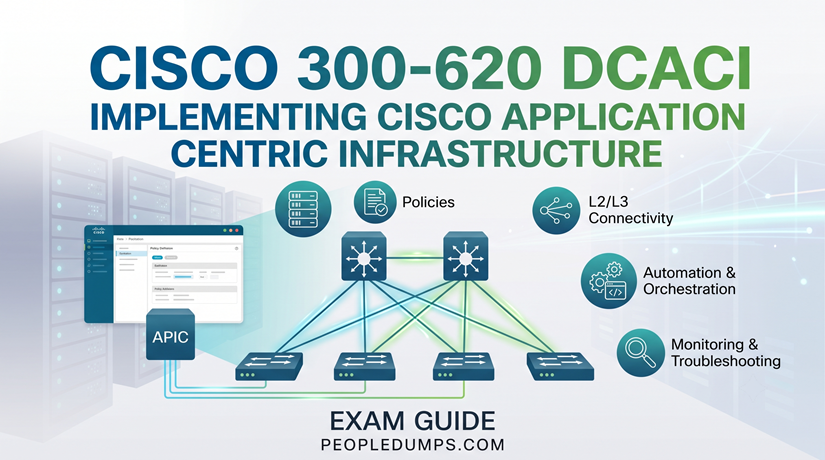
The Cisco 300-620 DCACI exam, officially named Implementing Cisco Application Centric Infrastructure, is one of the most technically focused concentration exams in the CCNP Data Center certification track.
It is designed for engineers who need to configure, integrate, operate, and manage Cisco Application Centric Infrastructure rather than simply describe what ACI is. For students and junior network engineers, DCACI can initially feel difficult because traditional networking is usually taught through interfaces, VLANs, routing protocols, and device-by-device configuration, while ACI introduces a policy-driven model in which administrators define application requirements and the fabric applies those policies across its leaf-and-spine infrastructure.
This change in perspective is the real challenge of the exam. You still need solid Layer 2 and Layer 3 knowledge, but you must also learn to express networking and security requirements through ACI objects such as tenants, VRFs, bridge domains, endpoint groups, contracts, and external networks.
What Is the Cisco 300-620 DCACI Exam?
The 300-620 DCACI exam validates knowledge of Cisco Nexus switches operating in ACI mode, with an emphasis on configuration, implementation, integration, and management. It is not a general data center networking exam. Its scope is specifically centered on the Cisco ACI architecture, policy model, packet-forwarding behavior, external connectivity, system integrations, management functions, and distributed ACI designs.
| Item | Detail |
|---|---|
| Exam code | 300-620 DCACI |
| Official name | Implementing Cisco Application Centric Infrastructure |
| Exam duration | 90 minutes |
| Exam language | English |
| Specialist certification | Cisco Certified Specialist – Data Center ACI Implementation |
| CCNP pathway | Counts as a concentration exam for CCNP Data Center |
Exam prices, policies, and topic versions can change, so candidates should check the official Cisco DCACI exam page before scheduling the test. Candidates who are beginning their preparation can also review a structured 300-620 DCACI exam preparation resource alongside the official exam blueprint. Structured study material can help organize the technologies by domain, but it should always be combined with Cisco documentation, hands-on labs, and a clear understanding of ACI traffic flows.
How DCACI Fits into the Cisco Certification Path
Passing 300-620 gives you the Cisco Certified Specialist – Data Center ACI Implementation credential. This certification can stand on its own, which is useful for engineers whose work is specifically focused on Cisco ACI deployments. The exam also satisfies the concentration requirement for the CCNP Data Center certification.
To earn the complete CCNP Data Center credential, a candidate must pass the 350-601 DCCOR core exam and one eligible concentration exam. The 300-620 DCACI exam can be selected as that concentration exam. A practical sequence for an engineer who is new to enterprise data center technologies is to study DCCOR fundamentals first and then focus on DCACI. However, an engineer who already supports an ACI environment may choose to pass DCACI first, earn the specialist certification, and complete the broader CCNP path later.
Is the Cisco DCACI Certification Worth It?
The value of DCACI depends heavily on the type of infrastructure you expect to support. It is a specialized certification rather than a universal networking credential, and that specialization is both its strength and its limitation.
Where DCACI Provides Strong Value
DCACI is especially relevant for engineers working in enterprise data centers, financial institutions, telecommunications environments, public-sector infrastructure, managed service providers, and Cisco partner organizations that deploy or maintain Nexus 9000 fabrics in ACI mode. The certification can help demonstrate that you understand more than basic ACI terminology. Its exam scope covers policy construction, packet forwarding, external connectivity, virtualization integration, service insertion, monitoring, access control, software upgrades, and multi-fabric designs.
Where Its Value Is More Limited
DCACI is less useful when your target role is focused entirely on campus networking, small-business infrastructure, public cloud networking, or a data center built around another vendor’s software-defined networking platform. Certification should therefore support a clear career direction rather than replace one. It is most valuable when combined with strong networking fundamentals and practical experience using APIC.
A strong DCACI candidate should be able to translate an application requirement into ACI policy, predict how the fabric will forward the traffic, and verify that the resulting configuration is operating correctly.
Cisco 300-620 DCACI Exam Topics
The DCACI blueprint is divided into six major technical domains. The percentages indicate the approximate emphasis of each section, but candidates should not completely ignore a lower-weighted topic because many exam scenarios combine several domains.
| Domain | Approximate Weight | Main Skills |
|---|---|---|
| ACI Fabric Infrastructure | 20% | Architecture, hardware, APIC, object model, fabric discovery, access policies, logical constructs, contracts, and endpoint security groups |
| ACI Packet Forwarding | 15% | Endpoint learning and bridge-domain forwarding behavior |
| External Network Connectivity | 20% | Layer 2 connectivity, STP and MCP fundamentals, EPG bindings, routing, and L3Out |
| Integrations | 15% | VMware integration, Nutanix integration, policy deployment, and service graphs |
| ACI Management | 20% | Management connectivity, monitoring, backups, AAA, RBAC, operational visibility, and upgrades |
| ACI Anywhere | 10% | Multi-Pod, Multi-Site, and Remote Leaf |
The exact wording and current topic version should always be checked in Cisco’s official exam topics document. Implementation-oriented domains account for most of the exam, so passive reading alone is unlikely to produce the configuration confidence required for DCACI.
Core Cisco ACI Technologies You Must Understand
1. Leaf-and-Spine Fabric Architecture
An ACI fabric is normally built with leaf and spine switches. Endpoints, servers, firewalls, routers, and other external devices connect to leaf switches, while spine switches provide high-speed connectivity between the leaves. A key design principle is that leaf switches connect to spine switches and spine switches do not directly connect to endpoints. Candidates should understand the role of each node, how APIC controllers interact with the fabric, and how new switches are discovered and registered.
The Cisco Application Policy Infrastructure Controller, or APIC, provides the centralized policy and management plane. APIC should not be described as a device that forwards every data packet. Traffic continues to be forwarded by the fabric switches according to the policy and forwarding information programmed into them.
2. The ACI Object Model
ACI configuration is organized as a managed object model. This is one of the biggest conceptual changes for engineers coming from traditional CLI-based networking. Important logical objects include tenants, VRFs, bridge domains, application profiles, endpoint groups, contracts, filters, subjects, and endpoint security groups.
- Tenant: A policy container used to separate administrative or organizational resources.
- VRF: The Layer 3 routing and forwarding context.
- Bridge domain: A Layer 2 forwarding domain containing important forwarding, subnet, and gateway settings.
- Application profile: A container that organizes application EPGs.
- Endpoint group: A collection of endpoints that receive the same policy treatment.
- Contract: A policy object that controls communication between groups.
- Filter: The traffic-matching component used by a contract.
- Endpoint security group: A policy grouping mechanism that can classify endpoints independently of their forwarding domain.
Do not memorize these objects as isolated definitions. Practice building the dependency chain between them. For example, an EPG is associated with a bridge domain, the bridge domain belongs to a VRF, and communication between EPGs may require a contract.
3. Access Policies and Interface Configuration
ACI access configuration can appear complicated because a usable interface policy is assembled from multiple reusable objects. Candidates should understand the purpose and relationship of interface policy groups, switch profiles, interface profiles, selectors, VLAN pools, physical domains, attachable access entity profiles, and static port bindings.
Rather than memorizing a series of APIC clicks, ask what each object contributes: which switch and interface are being selected, which link-level policies are being applied, which VLAN range is available, which domain can use that VLAN pool, and how the EPG is attached to the physical interface. When these relationships are clear, both configuration and troubleshooting become much easier.
4. Endpoint Learning and Packet Forwarding
ACI is policy-driven, but it still has to learn where endpoints are located and make forwarding decisions. Study how local and remote endpoints are learned, what information is stored for an endpoint, and how movement between leaf switches affects the fabric.
Bridge-domain settings deserve special attention. Candidates should understand unicast routing, Layer 2 unknown-unicast behavior, ARP flooding, subnet and default-gateway configuration, and endpoint learning. These settings should be studied as forwarding decisions rather than as simple checkboxes in the APIC interface.
5. Contracts and Policy Enforcement
Contracts are central to the ACI policy model. In a typical relationship, one EPG provides a contract and another consumes it. The contract contains subjects and filters that define the permitted traffic. Candidates should also understand the purpose of preferred groups and vzAny. These features provide alternatives to configuring many individual provider-and-consumer relationships, but they must be applied with a clear understanding of the resulting security policy.
When practicing, create a simple three-tier application consisting of web, application, and database EPGs. Then define only the communication paths that the application requires. This makes the policy model much easier to understand than studying abstract diagrams alone.
6. External Layer 2 and Layer 3 Connectivity
An ACI fabric rarely operates in isolation. It must connect to existing networks, firewalls, load balancers, WAN routers, and other services. For Layer 2 connectivity, review static EPG bindings, spanning-tree considerations, and Mis-Cabling Protocol fundamentals. For routed connectivity, learn the components of an L3Out, including the logical node profile, logical interface profile, routing configuration, external EPG, and contract relationships.
Do not stop after learning how to create an L3Out. You should be able to explain how routes enter the ACI fabric, how ACI advertises internal networks externally, how the external EPG classifies outside destinations, why contracts may be required for traffic crossing the external boundary, and how to verify routing peers, learned routes, and advertised prefixes.
7. Virtual Machine Manager Integration
VMM integration connects APIC policy with a virtualization platform. Candidates should study the relationship between a VMM domain, VLAN pool, attachable access entity profile, virtual switch, and EPG. You should also understand resolution immediacy and deployment immediacy because these settings influence when policy is resolved and when it is programmed into the fabric.
8. Service Graphs
Service graphs allow Layer 4 through Layer 7 services, such as firewalls and load balancers, to be inserted into an application traffic path. Candidates should understand the purpose of the service graph, device package concepts, function nodes, connectors, and the relationship between the graph and a contract. A useful way to study service insertion is to draw the traffic flow before looking at the APIC configuration. Identify the consumer, provider, service device, interfaces, and expected return path.
9. Monitoring, Administration, and Upgrades
ACI administration is not limited to creating policies. The management domain includes in-band and out-of-band connectivity, faults, events, audit records, health scores, syslog, SNMP, operational analytics, backups, AAA, role-based access control, and software upgrades. Candidates should learn the difference between a fault, an event, and an audit entry. A fault represents a condition requiring attention, an event records a state change, and the audit log helps identify administrative actions.
Also practice configuration exports and snapshots. An engineer responsible for a production fabric must know how to preserve configuration data and approach an upgrade without treating it as a routine reboot.
10. ACI Anywhere
The ACI Anywhere domain covers Multi-Pod, Multi-Site, and Remote Leaf. These technologies extend ACI in different ways and should not be treated as interchangeable designs.
- Multi-Pod: Extends a single ACI fabric across multiple pods while maintaining a common APIC cluster and policy domain.
- Multi-Site: Coordinates policy across separate ACI fabrics, with each site retaining its own controllers and fabric identity.
- Remote Leaf: Extends leaf connectivity to a remote location while keeping the leaf associated with the main fabric.
Focus on architecture, use cases, control relationships, and the differences between these deployment models.
Recommended Background Knowledge
DCACI is not intended to teach basic networking from the beginning. Cisco’s associated training recommends familiarity with routing, switching, Ethernet switching products, data center architecture, and virtualization fundamentals. Before beginning serious DCACI preparation, you should be comfortable with the following topics:
- Ethernet switching and VLANs
- 802.1Q trunks and link aggregation
- Spanning Tree Protocol fundamentals
- IPv4 subnetting and default gateways
- Static routing and dynamic routing concepts
- OSPF and BGP fundamentals
- Access control and traffic classification
- VRFs and route separation
- Virtual switches, hypervisors, and virtual machines
- Basic data center leaf-and-spine architecture
CCNA-level knowledge is a reasonable starting point, although the depth of DCACI is clearly professional-level. Candidates with traditional Nexus experience may progress faster, but they still need to adjust to ACI’s object model and policy-driven workflow.
An Eight-Week Cisco 300-620 DCACI Study Plan
The following schedule assumes approximately seven to ten hours of study each week. Candidates who are new to data center networking may need additional time. The plan can be used together with Cisco DCACI study resources to organize revision by blueprint domain and identify topics that require more lab practice.
Week 1: Architecture and Fabric Discovery
- Learn the roles of APIC, leaf switches, and spine switches.
- Review ACI topology and Nexus 9000 hardware roles.
- Study fabric discovery, switch registration, and controller functions.
- Navigate the APIC interface and locate faults, events, and audit records.
Week 2: ACI Policy and Object Model
- Create tenants, VRFs, bridge domains, and application profiles.
- Create EPGs and map them to bridge domains.
- Build filters, contracts, subjects, providers, and consumers.
- Review preferred groups,
vzAny, and endpoint security groups.
Week 3: Access Policies and Endpoint Connectivity
- Build VLAN pools, domains, and attachable access entity profiles.
- Configure interface policies, policy groups, profiles, and selectors.
- Practice static EPG port bindings.
- Configure vPC-related access policies and verify endpoint attachment.
Week 4: Packet Forwarding
- Study local and remote endpoint learning.
- Trace traffic within an EPG and between EPGs.
- Compare Layer 2 and Layer 3 forwarding behavior.
- Test unicast routing, unknown-unicast behavior, and ARP flooding settings.
Week 5: External Connectivity
- Configure external Layer 2 connectivity.
- Review STP and MCP behavior at the ACI boundary.
- Build an L3Out and establish a routing relationship.
- Configure external EPGs, contracts, route controls, and advertisements.
- Verify routing and data-plane traffic.
Week 6: VMM Integration and Service Graphs
- Review VMware vCenter integration.
- Study Nutanix VMM integration concepts.
- Compare resolution immediacy and deployment immediacy.
- Build or carefully analyze a service graph workflow.
Week 7: Management and ACI Anywhere
- Configure or review in-band and out-of-band management.
- Study syslog, SNMP, faults, health scores, and operational analytics.
- Review configuration backups, snapshots, AAA, and RBAC.
- Learn the upgrade workflow and preparation checks.
- Compare Multi-Pod, Multi-Site, and Remote Leaf.
Week 8: Review and Scenario Practice
- Revisit every item in the official blueprint.
- Create ACI architecture and traffic-flow diagrams from memory.
- Repeat weak labs without following step-by-step instructions.
- Practice identifying incorrect object relationships.
- Use timed practice questions to improve decision speed.
Hands-On Lab Checklist for DCACI
Hands-on practice is the difference between recognizing an ACI term and understanding how a complete configuration works. A useful DCACI lab environment should allow you to complete most of the following tasks:
- Validate fabric discovery and switch registration.
- Configure NTP and basic fabric settings.
- Create access policies for physical interfaces.
- Configure vPC connectivity.
- Create a tenant, VRF, bridge domain, and application profile.
- Create EPGs and static port bindings.
- Configure inter-EPG communication with contracts.
- Compare forwarding settings in a bridge domain.
- Verify learned endpoints and endpoint locations.
- Configure external Layer 2 connectivity.
- Configure and verify an L3Out.
- Integrate APIC with a virtualization manager.
- Review faults, events, audit records, and health information.
- Create a configuration export or snapshot.
- Configure local users, roles, security domains, and access privileges.
Cisco’s official DCACI training includes guided labs covering fabric discovery, NTP, access policies, vPC, EPG connectivity, bridge-domain forwarding, external Layer 2 connectivity, L3Out, and virtualization integration. These tasks provide a useful baseline when evaluating a training course or lab platform. After completing the labs, use a 300-620 DCACI practice resource to test whether you can recognize configuration relationships and troubleshoot scenario-based questions without relying only on memorized APIC menu paths.
Common DCACI Preparation Mistakes
Memorizing the APIC Menu Structure
Interface navigation is useful, but menus can change between software versions. Concentrate on object relationships and configuration intent. An engineer who understands the model can usually find the correct menu, while an engineer who only memorized clicks may become lost when the interface changes.
Ignoring Traditional Networking
ACI does not eliminate routing, switching, VLANs, port channels, or routing protocols. It changes how those functions are defined and managed. Weak networking fundamentals make packet forwarding and external connectivity unnecessarily difficult.
Studying Definitions Without Traffic Flows
For every policy, draw the expected traffic path. Identify the source EPG, destination EPG, contract, bridge domain, VRF, ingress leaf, egress leaf, and any external device. This habit turns abstract ACI objects into a working network.
Skipping Troubleshooting and Verification
A configuration is not complete until it has been verified. Practice checking endpoint tables, faults, policy deployment, interface status, route exchange, contract relationships, and traffic behavior.
Using Only One Type of Study Material
No single resource should be your entire preparation strategy. A balanced plan combines official documentation, structured training, lab exercises, personal notes, and scenario-based review. A focused Cisco 300-620 DCACI preparation page can support revision, but it is most effective when you understand why each answer is technically correct.
Using Outdated Exam Material
Older DCACI resources can still explain core ACI concepts, but the blueprint evolves. Compare every study resource with the current official exam topics before deciding what to prioritize.
Exam-Day Strategy
The 90-minute duration makes time management important. Read each question carefully, but avoid spending too long trying to reconstruct every possible configuration detail.
- Identify whether the question is testing architecture, policy, forwarding, integration, or operations.
- Eliminate answers that break the ACI object hierarchy or policy relationship.
- Pay attention to words such as best, most appropriate, first, and required.
- Distinguish a configuration task from a verification or troubleshooting task.
- Base answers on the stated design rather than assumptions about an unstated environment.
During final review, focus on relationships and workflows rather than attempting to memorize every field in APIC. You should be able to explain why an object is required, where it belongs, and how it changes the resulting traffic behavior.
Final Thoughts
Cisco 300-620 DCACI is a demanding exam because it combines networking fundamentals with a policy-driven data center operating model. It asks candidates to understand not only individual ACI objects but also the way those objects work together to deliver connectivity, segmentation, external routing, virtualization integration, service insertion, and operational visibility.
For beginners, the best approach is to build knowledge in layers. Begin with the fabric architecture, learn the object model, build a small application policy, trace packet forwarding, and then add external connectivity and integrations. Once the foundation is clear, management and ACI Anywhere topics become much easier to place in context.
Passing the exam can provide a meaningful specialist credential, but the larger benefit is learning how to operate an application-centric data center fabric with confidence. When you are ready to consolidate your revision, review the Cisco 300-620 DCACI exam study page and compare its coverage with the official blueprint. Use any remaining weak areas to guide your final lab sessions and technical review.
Frequently Asked Questions About Cisco 300-620 DCACI
What certification do I receive after passing 300-620 DCACI?
You earn the Cisco Certified Specialist – Data Center ACI Implementation certification. The exam also satisfies the concentration requirement for CCNP Data Center.
Does passing DCACI alone give me CCNP Data Center?
No. To earn CCNP Data Center, you must also pass the required core exam. DCACI serves as the concentration exam.
Is Cisco 300-620 suitable for beginners?
A motivated beginner can study for it, but the exam assumes professional-level networking knowledge. Routing, switching, VLAN, VRF, data center, and virtualization fundamentals should be learned before concentrating on ACI.
Do I need hands-on ACI experience?
Hands-on experience is strongly recommended. The blueprint includes implementation tasks that are much easier to understand after creating policies and verifying traffic in APIC.
How long does it take to prepare for DCACI?
An engineer with solid networking fundamentals and some ACI exposure may prepare in approximately eight to twelve weeks. A candidate who is new to data center networking may need several additional months to build the required foundation.
Is the DCACI exam only about APIC configuration?
No. APIC configuration is important, but the exam also covers architecture, endpoint learning, packet forwarding, external routing, virtualization, service graphs, monitoring, administration, upgrades, Multi-Pod, Multi-Site, and Remote Leaf.
Should I take the core exam or DCACI first?
Taking the core exam first is a logical path for candidates who need broader data center knowledge. Engineers already working with Cisco ACI may choose DCACI first to earn the specialist certification and then complete the core exam later.
What is the most important topic for the DCACI exam?
The ACI object model is the foundation. Tenants, VRFs, bridge domains, EPGs, contracts, domains, and access policies appear across multiple topic areas. Understanding their relationships improves performance throughout the exam.