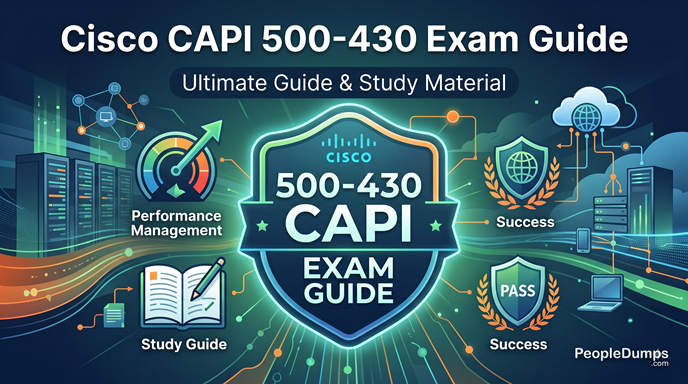
At first glance, the Cisco CAPI 500-430 looks like another Cisco certification exam. If your picture of a Cisco exam is dominated by VLANs, OSPF, BGP, access lists, routers, and switches, however, CAPI takes you into a very different part of the technology stack.
The 500-430 exam is built around application performance monitoring, observability, platform deployment, agents, End User Monitoring, high availability, security, and APIs. In other words, it sits at the intersection of networking, systems administration, application architecture, and DevOps.
That makes the Cisco AppDynamics Professional Implementer certification interesting for network engineers who want to move beyond packet forwarding and understand what happens after an application packet successfully reaches the server. A network can have perfect routing and zero packet loss while an application is still painfully slow. CAPI is concerned with understanding and deploying the technology that helps explain why.
This guide explains what the Cisco 500-430 CAPI exam is, what technologies you need to understand, how valuable the certification is, and how a beginner can build a realistic preparation plan.
What Is Cisco CAPI 500-430?
CAPI is the exam code used for the Cisco AppDynamics Professional Implementer certification. The qualifying exam is 500-430 CAPI.
The emphasis is on implementation rather than simply looking at monitoring dashboards. A candidate is expected to understand how the AppDynamics platform is planned, installed, secured, connected to applications, verified, upgraded, and extended through APIs.
That distinction matters.
A monitoring analyst might spend most of the day investigating slow business transactions, error rates, response times, or database calls. An implementer has a different question:
How do we build the monitoring platform correctly in the first place?
This means thinking about Controllers, Events Services, End User Monitoring components, agents, certificates, deployment models, infrastructure requirements, high availability, access control, and API integration.
The certification therefore fits naturally into jobs such as systems engineering, application monitoring, observability engineering, technical consulting, platform engineering, DevOps, and Site Reliability Engineering.
Cisco 500-430 CAPI Exam Quick Facts
| Item | Current Information |
|---|---|
| Exam Code | 500-430 CAPI |
| Certification | Cisco AppDynamics Professional Implementer |
| Exam Duration | 90 minutes |
| Exam Price | US$300 |
| Delivery | Pearson VUE, online or at a testing center |
| Formal Prerequisites | None |
| Certification Validity | 3 years |
| Primary Language | English; Cisco’s current exam list also shows Japanese availability, so verify options when scheduling |
| Primary Technology | AppDynamics / application performance monitoring and observability |
Cisco does not require you to hold a CCNA, CCNP, or another AppDynamics certification before attempting CAPI. That does not mean the exam is designed for someone with no technical background. Cisco itself describes typical candidates as people who already have technical AppDynamics experience.
Cisco AppDynamics or Splunk AppDynamics? A 2026 Naming Note
Students researching this exam in 2026 will probably encounter two names: Cisco AppDynamics and Splunk AppDynamics.
This is not two completely unrelated technologies.
Following Cisco’s acquisition of Splunk, AppDynamics became part of the Splunk Observability portfolio, and current product material increasingly uses the name Splunk AppDynamics. At the same time, Cisco Learning currently continues to list the certification as Cisco AppDynamics Professional Implementer and the exam as 500-430 CAPI.
For exam preparation, the safest rule is simple: follow the current Cisco exam blueprint first. Product documentation is essential for understanding the technology, but certification objectives determine what Cisco expects you to know for the exam.
Is Cisco CAPI 500-430 a Networking Exam?
Not in the traditional CCNA or CCNP sense.
You will not spend the exam calculating subnet ranges or selecting OSPF path attributes. Routing and switching are not the core objectives of CAPI.
However, calling CAPI “not a networking exam” can also be misleading because application monitoring depends heavily on networks.
Consider a simple AppDynamics deployment. An application agent has to locate and communicate with its Controller. That immediately brings several familiar networking concepts into the picture:
- DNS resolution
- IP connectivity
- TCP sessions
- HTTP and HTTPS
- TLS certificates
- Firewalls and access policies
- Proxies
- Load balancers
- High-availability architecture
- Latency and packet loss
If an agent cannot communicate with the monitoring platform, the problem may not be the agent at all. It could be DNS, a certificate chain, a blocked TCP port, an outbound proxy, a load balancer, or a routing problem.
This is where a network engineer has a genuine advantage. CAPI provides a useful bridge between network infrastructure and application-level observability.
Cisco 500-430 CAPI Exam Blueprint
The current Cisco CAPI v1.0 exam topics divide the exam into five major domains.
| Domain | Weight |
|---|---|
| Pre-Deployment Planning | 25% |
| Platform Installation and Administration | 25% |
| Agent Configuration and Installation | 25% |
| Post-Deployment Verification | 5% |
| APIs | 20% |
The weighting tells you something important about the character of this certification. Three quarters of the blueprint is directly related to planning, installing, and configuring the platform and its agents. Another 20 percent is devoted to APIs.
This is an implementation-oriented certification.
1. Pre-Deployment Planning — 25%
A good implementation starts before the installer is launched.
This section tests whether you can think about an AppDynamics deployment as a system rather than a collection of software packages. Topics include hardware requirements, Controller deployment models, EUM deployment choices, Events Service planning, Controller requirements, and custom correlation.
For beginners, this section introduces an important professional habit: architecture decisions come before installation commands.
You should understand why one deployment model is appropriate for a particular environment, what resources the platform needs, where monitoring components should be located, and what dependencies need to be available.
2. Platform Installation and Administration — 25%
This is one of the most practical sections of the exam.
The blueprint includes Controller installation, Controller self-monitoring, SSL configuration, high availability, Events Service installation, and upgrades of multiple platform components.
For network students, the SSL and high-availability topics are especially useful because they force you to think beyond individual devices.
A production monitoring platform needs secure communication, resilient services, predictable DNS behavior, certificate management, sufficient compute resources, and a failure strategy. Knowing where to click in an interface is not enough.
3. Agent Configuration and Installation — 25%
Agents are one of the most important concepts in application performance monitoring.
The official blueprint includes installation and upgrade tasks involving technologies such as:
- Java Agent
- .NET Agent
- Standalone Machine Agent
- Database Agent
- Browser End User Monitoring
- Mobile monitoring components
- On-premises end-user monitoring components
You do not need to become a Java developer or a .NET developer to understand the exam, but you should understand what a runtime is, where an agent operates, what it communicates with, and what can prevent the agent from functioning correctly.
Installation is only half the problem. In a real environment, you also need to understand upgrades, compatibility, configuration files, service permissions, environment variables, connectivity, and logs.
4. Post-Deployment Verification — 5%
This is the smallest blueprint domain, but it should not be ignored.
Once a deployment is running, an implementer must confirm that it is healthy and properly controlled. The blueprint includes role-based access control, platform health checks, and Controller administration.
Think of this as the difference between saying “the installation completed” and saying “the platform is production-ready.”
5. APIs — 20%
The API domain is large enough that candidates should treat it as a core subject, not a bonus topic.
The blueprint includes using AppDynamics APIs and extensions to work with events, alerts, health-rule violations, application objects, tiers, nodes, business transactions, and metric data.
If you are new to APIs, start with the fundamentals:
- REST concepts
- HTTP methods
- HTTP status codes
- Authentication
- JSON and XML
- Request parameters
- Structured responses
- Error handling
- Automation workflows
You do not need to turn yourself into a full-time software developer. You do need to be comfortable treating a monitoring platform as something that can be automated and integrated rather than managed entirely through a GUI.
Core Technologies Behind the CAPI Exam
Application Performance Monitoring
Application Performance Monitoring, usually shortened to APM, attempts to answer questions that traditional infrastructure monitoring cannot answer on its own.
A switch can tell you that an interface is up. A server can tell you that CPU utilization is 35 percent. APM tries to tell you why a customer clicking “Checkout” waited eight seconds for a response.
That may involve tracing a request across an application server, API, database, and external service while collecting timing and error information along the way.
The Controller
A useful beginner mental model is to think of the Controller as a central management and analysis point in the AppDynamics architecture.
Agents collect telemetry from monitored systems and applications, while the Controller provides the platform used to organize, analyze, visualize, and manage that information.
From an implementation perspective, that creates immediate questions:
Where will the Controller run? How will agents reach it? How will communication be secured? What happens if a component fails? How much capacity is required? How will it be upgraded?
Those are exactly the kinds of questions CAPI emphasizes.
Application Agents
An application agent provides visibility inside an application runtime.
This is one of the biggest conceptual jumps for students coming from networking. Traditional network monitoring observes traffic from the outside. An APM agent can observe what is happening inside the software that generates and processes that traffic.
For example, a transaction may reach a web server in 20 milliseconds but then spend several seconds waiting for a database query. From a pure network perspective, connectivity looks fine. From an application perspective, the user still has a performance problem.
End User Monitoring
End User Monitoring (EUM) shifts the perspective toward what the actual user experiences.
Browser and mobile monitoring can provide insight into page performance, application responsiveness, and user-side behavior. This is important because server-side measurements alone cannot always explain what happens between an application and the person using it.
Events and Analytics
Monitoring platforms generate large amounts of telemetry. Event and analytics components help process information that can be used to identify abnormal behavior, performance degradation, and business-impacting conditions.
The exact packaging and architecture can vary across AppDynamics versions and deployment models, which is another reason candidates should learn concepts rather than memorize screenshots from a single release.
High Availability
Monitoring systems become surprisingly important once an organization depends on them for incident response.
If your observability platform disappears during a production outage, you lose visibility exactly when you need it most.
High availability therefore matters to a CAPI implementer. You should be comfortable with the general ideas behind resilient architecture, failure domains, redundant services, network paths, certificates, load balancing, and health verification.
REST APIs
APIs turn AppDynamics into a platform that other systems can interact with.
An operations team might retrieve metrics automatically, feed monitoring information into another system, create events from an automation workflow, or integrate alerting with incident-management processes.
This API component also makes CAPI a useful certification for engineers who want to move toward infrastructure automation or DevOps.
Networking Skills That Matter for Cisco CAPI
For a networking student, one of the best ways to approach CAPI is to map familiar network concepts to an application monitoring environment.
| Networking Concept | Why It Matters to AppDynamics |
|---|---|
| DNS | Agents and platform components must reliably resolve service names. |
| TCP/IP | Monitoring components depend on network connectivity between agents, Controllers, and supporting services. |
| HTTP/HTTPS | Web interfaces, APIs, agents, and integrations commonly depend on HTTP-based communication. |
| TLS/PKI | Controller SSL configuration requires an understanding of certificates, trust, and secure sessions. |
| Firewalls | A technically correct application configuration still fails if required traffic is blocked. |
| Proxy Servers | Enterprise environments frequently control outbound communication through proxies. |
| Load Balancing | Resilient and scalable services often depend on correctly designed traffic distribution. |
| Latency | Network delay can influence application behavior and must be separated from server-side processing delay. |
| NAT | Address translation can affect how systems communicate and how endpoints are represented. |
| Network Troubleshooting | Being able to isolate DNS, routing, TCP, TLS, and application problems is extremely valuable during deployment. |
Basic Linux network troubleshooting skills are especially useful. Tools such as curl, ss, nslookup or dig, and openssl can tell you much more than repeatedly restarting an agent and hoping it connects.
For example:
nslookup controller.example.com
curl -vk https://controller.example.com/
openssl s_client -connect controller.example.com:443 -servername controller.example.com
These are not “AppDynamics commands.” They are general troubleshooting tools. That is precisely why they are valuable: they allow you to separate a platform problem from a basic network or TLS problem.
How Difficult Is the Cisco 500-430 CAPI Exam?
The difficulty depends heavily on where you are starting.
If you already deploy AppDynamics, work comfortably in Linux and Windows, understand Java or .NET application environments, and regularly use REST APIs, the exam objectives should feel logical.
If your entire background is entry-level routing and switching, CAPI will probably feel more difficult at first because you are crossing several technology boundaries at the same time.
You may need to learn:
- basic Linux administration
- Windows services
- application runtimes
- APM terminology
- TLS certificates
- REST APIs
- JSON and XML
- high-availability concepts
- AppDynamics architecture
None of those topics is impossible for a beginner. The challenge is that CAPI combines them.
For that reason, I would describe 500-430 as a specialized technical exam rather than an ideal first-ever IT certification.
How Valuable Is the Cisco CAPI Certification?
The value of CAPI is different from the value of a broad certification such as CCNA.
CCNA has broad recognition because networking fundamentals apply almost everywhere. CAPI is narrower. Its strongest value appears when AppDynamics, application monitoring, or enterprise observability is already relevant to your job or the job you want.
Where CAPI Has Strong Value
The certification can be particularly relevant for:
- AppDynamics implementation projects
- enterprise monitoring teams
- observability engineering
- technical consulting
- systems engineering
- platform engineering
- DevOps teams
- Site Reliability Engineering
- application support and performance engineering
Where Its Value Is More Limited
If your goal is purely traditional routing and switching, CAPI should probably not be your first priority.
A student who does not yet understand IP addressing, DNS, HTTP, Linux, or basic troubleshooting will usually gain more immediate benefit from building those foundations first.
CAPI becomes more compelling when you want to answer a broader question than “Is the network up?”
You begin asking:
Is the application healthy, what is the user experiencing, where is the delay occurring, and how can the monitoring system prove it?
That shift is increasingly important in environments where networks, applications, cloud services, APIs, databases, containers, and user experience are interconnected.
Who Should Take Cisco CAPI 500-430?
Cisco lists typical learner profiles including administrators, architects, consultants, systems engineers, and systems implementers.
In practical terms, CAPI makes sense if at least one of these statements sounds like you:
- You already work with AppDynamics and want formal validation of your implementation skills.
- You are a network or systems engineer moving into observability.
- You support enterprise applications and want deeper visibility beyond infrastructure metrics.
- You work in DevOps or SRE and need to understand commercial APM platforms.
- You are a consultant responsible for deploying monitoring solutions for customers.
- You are a student who specifically wants to specialize in application monitoring and observability.
If you are completely new to IT and simply want your first Cisco certification, CCNA or another foundational path will normally provide a broader starting point.
Recommended Knowledge Before Studying for CAPI
Although Cisco does not impose formal certification prerequisites, its AppDynamics implementation training recommends technical skills that give a useful picture of the expected background.
You should try to become comfortable with:
- Linux and Unix command-line navigation
- file and directory permissions
- process and service management
- basic Windows administration
- XML
- REST APIs
- basic Java, .NET, PHP, Node.js, or Python concepts
- general system administration
- software troubleshooting
You do not need expert-level knowledge in every programming language. The goal is to understand the environment in which application agents operate.
For a networking student, I would add a few fundamentals of my own to that list: DNS, HTTP/HTTPS, TCP ports, TLS certificates, firewalls, proxy behavior, and basic load balancing.
A Practical Six-Week Cisco CAPI Study Plan
The following is not an official Cisco schedule. It is a practical structure for 500-430 CAPI exam preparation if you already have basic networking or systems knowledge and can study several hours each week.
| Week | Main Focus | Practical Goal |
|---|---|---|
| 1 | APM fundamentals and AppDynamics architecture | Be able to explain Controllers, agents, EUM, Events Services, business transactions, and basic data flow. |
| 2 | Pre-deployment planning and platform architecture | Understand deployment choices, infrastructure requirements, and component relationships. |
| 3 | Agent installation and configuration | Practice application, machine, and database agent concepts and learn where to find logs. |
| 4 | SSL, high availability, upgrades, and troubleshooting | Practice diagnosing connectivity and certificate problems instead of memorizing installation screens. |
| 5 | REST APIs and post-deployment verification | Retrieve structured data, understand API responses, and review RBAC and platform health concepts. |
| 6 | Integrated review | Work through the complete blueprint, identify weak domains, and repeat practical tasks without following step-by-step notes. |
Practical Lab Ideas for 500-430 Preparation
CAPI is one of those exams where hands-on work changes the quality of your understanding.
If you have access to Cisco U. labs, an authorized training environment, an AppDynamics environment at work, or a legitimate trial environment, try to turn blueprint objectives into small experiments.
Lab 1: Trace Agent-to-Controller Connectivity
Identify the Controller hostname used by an agent. Verify DNS resolution, TCP connectivity, HTTPS behavior, and certificate trust. Then deliberately break one layer and observe how the failure appears.
This is much more educational than memorizing a list of possible agent errors.
Lab 2: Install an Agent and Read Its Logs
Install an application or machine agent in a test environment. Before looking at the monitoring dashboard, inspect the configuration files and logs.
Ask yourself:
- Where is the Controller address configured?
- How is the application identified?
- What happens during startup?
- What does a successful connection look like?
- What does an authentication or connectivity failure look like?
Lab 3: Break TLS
If your lab allows it, test what happens when a certificate is not trusted or the expected hostname does not match.
This develops a very transferable skill. Certificate problems appear everywhere: APIs, load balancers, web servers, monitoring systems, VPNs, cloud platforms, and automation tools.
Lab 4: Work with an API
Use the supported AppDynamics API documentation for your environment and practice retrieving structured information.
Do not stop when you receive a successful response. Read the JSON or XML. Understand the hierarchy. Change a parameter. Generate an error intentionally and examine the HTTP response.
Lab 5: Create a Failure-Mode Checklist
Choose a simple problem such as “agent data is not appearing” and divide possible causes into layers:
- Application/runtime problem
- Agent configuration problem
- DNS problem
- Network connectivity problem
- Firewall or proxy problem
- TLS/certificate problem
- Authentication/account problem
- Controller/platform problem
This is the kind of thinking that turns certification knowledge into engineering ability.
Cisco CAPI vs. CAAA vs. CAAPA
Cisco currently maintains three AppDynamics certification paths that can look similar when you first encounter them.
| Exam | Certification | Main Emphasis |
|---|---|---|
| 500-420 CAAPA | Cisco AppDynamics Associate Performance Analyst | Monitoring performance and identifying, analyzing, and resolving performance problems |
| 500-425 CAAA | Cisco AppDynamics Associate Administrator | Configuring, managing, and optimizing AppDynamics capabilities |
| 500-430 CAPI | Cisco AppDynamics Professional Implementer | Planning and deploying platform components and agents, plus implementation-related APIs |
A simple way to remember the difference is:
CAAPA asks, “What is going wrong with performance?”
CAAA asks, “How do I administer and optimize the monitoring environment?”
CAPI asks, “How do I deploy and integrate the monitoring platform?”
There is naturally some overlap, but the job perspectives are different.
How I Would Approach the 500-430 Exam Blueprint
1. Do Not Study Every Domain Equally
The percentages matter. Pre-deployment, platform installation, and agent configuration are each worth 25 percent, while APIs account for another 20 percent.
That is where most of your preparation time should go.
Do not ignore the 5 percent post-deployment section, but spending half your study time on RBAC while barely touching APIs would be poor preparation.
2. Learn Why, Not Just How
Installation guides tell you which button to click. Certification questions are more useful when they test whether you understand why a particular deployment choice is appropriate.
Whenever you learn a configuration step, ask three questions:
- What problem does this solve?
- What dependency does it have?
- What would failure look like?
3. Become Comfortable with the Command Line
If every Linux shell feels intimidating, fix that early in your preparation.
You should be comfortable navigating directories, editing files, checking processes and services, viewing logs, testing DNS, and verifying network connections.
4. Do Not Avoid APIs
Many infrastructure engineers postpone API study because it feels like programming. That is a mistake for CAPI.
Twenty percent of the blueprint is substantial.
You do not have to build a large Python application. Start with HTTP concepts and simple API requests. Once you understand requests, responses, authentication, and structured data, the subject becomes much less mysterious.
5. Think Like a Troubleshooter
When something fails, avoid immediately blaming the product.
Move through the layers methodically:
Application → Agent → Operating System → DNS → Network → TLS → Authentication → Controller.
That approach is useful both in an exam and in a production environment.
6. Watch the Version Boundary
The official CAPI blueprint is currently labeled v1.0, while AppDynamics itself continues to evolve and current product material increasingly uses Splunk AppDynamics branding.
Do not assume every new feature in the latest product documentation automatically becomes an exam objective. Review Cisco’s current blueprint shortly before scheduling the exam.
What Career Skills Does CAPI Actually Build?
The most interesting part of studying CAPI may not be the certificate itself. It is the combination of skills required to prepare for it.
A serious CAPI candidate touches several disciplines:
- Networking: DNS, TCP/IP, HTTPS, proxies, firewalls, load balancing
- Security: SSL/TLS, certificates, access control
- Systems: Linux, Windows, services, files, processes
- Applications: Java, .NET, application runtimes, business transactions
- Databases: database monitoring and performance dependencies
- Automation: REST APIs and integration
- Operations: monitoring, health checks, troubleshooting
- Architecture: capacity planning, deployment models, high availability
That combination is useful because modern outages rarely respect organizational boundaries.
A “network problem” may actually be an overloaded database. An “application problem” may be DNS. A “monitoring problem” may be a TLS certificate. A “server problem” may be an upstream API responding slowly.
Observability engineers have to follow the evidence across those boundaries.
Cisco CAPI 500-430 FAQ
What certification do I earn by passing 500-430?
Passing the 500-430 CAPI exam is the requirement for the Cisco AppDynamics Professional Implementer certification.
How long is the Cisco 500-430 exam?
The current Cisco exam page lists a duration of 90 minutes.
How much does the 500-430 CAPI exam cost?
Cisco currently lists the exam price as US$300.
Do I need CCNA before taking CAPI?
No. Cisco lists no formal prerequisite for the certification. Basic networking knowledge is still extremely useful because AppDynamics components rely on DNS, IP connectivity, HTTP/HTTPS, TLS, firewalls, and other network services.
Is 500-430 mainly a routing and switching exam?
No. Its focus is AppDynamics implementation: deployment planning, platform installation, agents, verification, and APIs. Traditional routing and switching protocols are not the central exam domains.
Is Cisco AppDynamics now Splunk AppDynamics?
Product branding has moved toward Splunk AppDynamics as AppDynamics is part of the Splunk Observability portfolio. Cisco Learning currently continues to use the certification name Cisco AppDynamics Professional Implementer for the 500-430 CAPI exam.
Is the CAPI exam good for beginners?
It can be, but it is easier if you already understand basic networking, Linux or Windows administration, HTTP, and application architecture. For someone completely new to IT, a broader foundational certification may be a better first step.
Do I need programming experience?
You do not need to be a professional developer, but basic familiarity with application runtimes and REST APIs is highly beneficial. Being able to read simple Java, .NET, Python, or similar code can also make application-monitoring concepts easier to understand.
Should I build a lab for 500-430?
Yes, whenever possible. Hands-on work with agents, connectivity, TLS, logs, platform components, and APIs makes the implementation concepts much easier to retain than reading documentation alone.
How long should I study for CAPI?
There is no universal answer. Someone who already manages AppDynamics may only need focused blueprint review, while a networking student who is new to Linux, APM, and APIs may need several weeks or a few months. The six-week plan in this guide is a reasonable framework, not an official Cisco recommendation.
Is Cisco CAPI 500-430 worth it?
It is most valuable when your career involves AppDynamics, observability, application monitoring, systems engineering, consulting, DevOps, or SRE. It is a specialized credential, so its value depends more heavily on your target role than a broad certification such as CCNA.
Final Thoughts: Is Cisco CAPI Worth Studying?
The Cisco CAPI 500-430 exam occupies an interesting place in the Cisco certification ecosystem.
It is not a traditional networking certification, but network knowledge makes you better at it. It is not a programming certification, but API literacy matters. It is not purely a systems administration exam, but Linux, Windows, services, files, and troubleshooting are part of the job.
That combination is exactly what makes the certification useful.
Modern infrastructure engineers increasingly need to understand the path from the user, through the network, into an application, across APIs and databases, and back again. AppDynamics exists to provide visibility into that path, while CAPI focuses on whether you can deploy the platform that collects and presents that visibility.
For a beginner, the best approach is not to memorize AppDynamics terminology as quickly as possible. Build the underlying foundation first. Learn DNS. Learn HTTPS. Understand certificates. Get comfortable with Linux. Make a few REST API calls. Understand what Java and .NET runtimes actually are. Then study how AppDynamics connects those pieces together.
If you do that, preparing for 500-430 becomes more than an exercise in passing a certification exam. It becomes a practical introduction to application observability, production troubleshooting, and modern infrastructure engineering.
Official References
Exam details and objectives can change. Always check Cisco’s current information before purchasing or scheduling an exam.
- Cisco AppDynamics Professional Implementer Certification
- Cisco 500-430 CAPI Exams and Training
- Cisco CAPI 500-430 Official Exam Topics PDF
- Cisco Current Exams List
- Install Application and Machine Agents for Cisco AppDynamics (IMP862)
- SaaS Implementation Workshop for Cisco AppDynamics (IMP875)
- Splunk AppDynamics Branding and Observability Portfolio Information
Disclaimer: Exam pricing, objectives, product names, training availability, and certification policies may change. This article is an independent study guide and is not affiliated with or endorsed by Cisco or Splunk. Cisco, AppDynamics, Splunk, and other trademarks belong to their respective owners.