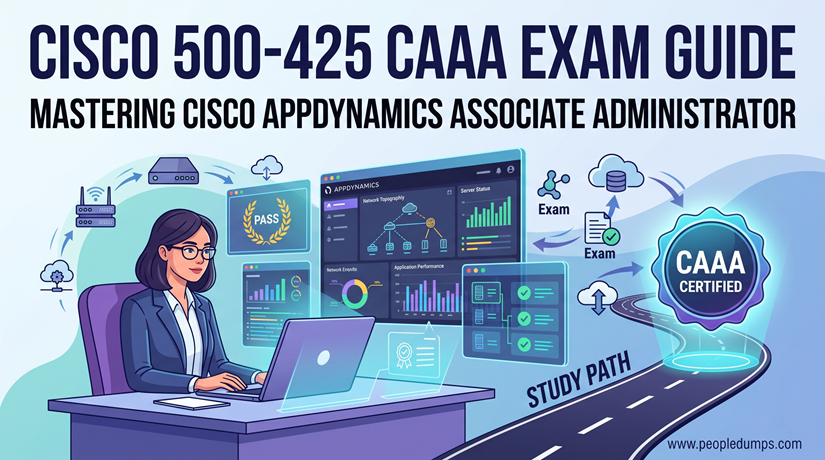
The Cisco 500-425 CAAA exam is an interesting certification exam because it sits outside what many beginners think of as traditional Cisco networking. You will not spend most of your study time configuring VLANs, memorizing routing protocols, or troubleshooting OSPF neighbor relationships. Instead, 500-425 focuses on Cisco AppDynamics administration, Application Performance Monitoring (APM), monitoring data, alerting, troubleshooting, and access control.
That distinction matters. Modern IT infrastructure is no longer divided neatly into “the network,” “the server,” and “the application.” When an application becomes slow, the cause might be excessive database response time, an overloaded application node, a failed monitoring agent, a backend dependency, a configuration problem, or network latency somewhere between services.
AppDynamics gives operations teams a way to investigate those relationships, which is why the knowledge behind the CAAA certification can be useful for network engineers, system administrators, application support engineers, cloud engineers, and students moving toward observability or DevOps-related roles.
Exam information in this guide was reviewed against Cisco’s official certification pages in August 2026. Cisco may update certification requirements and exam topics, so always verify the latest blueprint before scheduling your exam.
What Is the Cisco 500-425 CAAA Exam?
Table of Contents
Toggle500-425 CAAA stands for the Cisco AppDynamics Associate Administrator exam. Passing the required core exam earns the corresponding Cisco AppDynamics Associate Administrator certification.
The certification is designed to validate your ability to configure, manage, and optimize AppDynamics technologies in both cloud and on-premises environments. Cisco specifically identifies areas such as Application Performance Monitoring, Business iQ, End User Monitoring, platform administration, dashboards, monitoring, and data collection as relevant skills.
| Exam Item | Current Information |
|---|---|
| Exam Code | 500-425 |
| Exam Name | Cisco AppDynamics Associate Administrator |
| Exam Acronym | CAAA |
| Duration | 90 minutes |
| Exam Cost | US$300 |
| Languages | English and Japanese |
| Formal Prerequisites | None |
| Delivery | Pearson VUE, online or testing center |
| Certification Validity | 3 years under Cisco’s current certification policy |
There are no formal prerequisite certifications. In other words, you do not need a CCNA, CCNP, or another AppDynamics certification before attempting 500-425. That said, “no prerequisite” should not be interpreted as “no technical background required.” Familiarity with application architecture, operating systems, databases, HTTP, and basic networking makes the material much easier to understand.
Students who are planning their preparation can also review this 500-425 CAAA exam preparation resource alongside the official blueprint to become more familiar with the structure and terminology associated with the exam.
Is 500-425 a Networking Exam?
Not in the traditional routing-and-switching sense.
This is probably the most important point for students coming from a Cisco networking background. The CAAA exam is primarily an AppDynamics administration and application-monitoring exam. You should not approach it as a smaller version of CCNA.
However, networking knowledge is still extremely useful.
Consider a typical web application. A user connects through DNS and HTTPS, traffic may cross a firewall or load balancer, the request reaches a web or application server, the application communicates with other services, and those services may query one or more databases.
If that transaction suddenly takes five seconds instead of 300 milliseconds, an administrator needs to determine where the delay occurred. Possible causes include:
- Network latency between application tiers
- DNS resolution problems
- TLS or proxy configuration issues
- Slow application code
- High CPU or memory utilization
- A slow SQL query
- Database resource contention
- An unavailable backend service
- An AppDynamics agent that has stopped reporting
- An incorrectly configured health rule or monitoring policy
This is where traditional networking and modern observability begin to overlap.
What Is Application Performance Monitoring?
Application Performance Monitoring, or APM, is the practice of measuring and analyzing the behavior and performance of software applications.
Traditional network monitoring might tell you that an interface is up, a server responds to ICMP, or a link is using 80 percent of its available bandwidth. That information is useful, but it does not necessarily tell you whether a customer can successfully complete a checkout transaction or why a particular API call has become slow.
APM adds application-level visibility.
With an APM platform such as AppDynamics, administrators work with concepts such as application agents, business transactions, application tiers and nodes, performance metrics, transaction snapshots, health rules, policies, actions, errors, exceptions, databases, and dashboards.
For a networking student, a useful mental shift is this:
Network monitoring asks whether the infrastructure is working. APM asks how the application is behaving while running on that infrastructure.
The two disciplines increasingly need each other.
Cisco 500-425 CAAA Exam Topics and Weighting
The current Cisco 500-425 exam blueprint divides the exam into six major domains.
| Domain | Weight |
|---|---|
| 1.0 Agents | 15% |
| 2.0 Dashboards | 15% |
| 3.0 Data Collectors | 20% |
| 4.0 Alerts and Responses | 15% |
| 5.0 Errors and Exceptions | 25% |
| 6.0 System Access and Security | 10% |
The percentages immediately tell you something about how to prioritize your preparation. Errors and Exceptions plus Data Collectors account for 45 percent of the published blueprint. Those areas deserve serious attention.
1. Agents — 15%
Agents are fundamental to AppDynamics monitoring. They collect application or infrastructure information and make that information available to the monitoring platform.
According to the Cisco blueprint, candidates should understand how to:
- Install and configure agents
- Upgrade agents
- Manage agent logs
- Verify agent functionality
- Monitor agent performance and connectivity
Do not learn agent installation as a sequence of screenshots alone. Try to understand what is happening operationally.
Ask questions such as: What does the agent monitor? Where does it send information? What happens if communication is interrupted? Which logs would you inspect? How would you determine whether an agent is installed but not reporting correctly?
This is also where basic network troubleshooting becomes valuable. DNS, TCP connectivity, firewalls, proxies, certificates, and routing can all affect communication between monitoring components.
2. Dashboards — 15%
A monitoring platform becomes much less useful if administrators cannot turn collected data into understandable operational information.
The dashboard domain covers areas including:
- Monitoring events
- Managing health rules, policies, and actions
- Using reports and dashboards
- Capturing snapshots
- Triaging health rule violations
- Evaluating server performance metrics
For exam preparation, learn more than the location of buttons in the interface. Understand what information a dashboard is communicating and which metrics would help you investigate a real problem.
A dashboard full of graphs is not automatically useful. A good administrator knows which measurements matter, what normal behavior looks like, and when a change deserves investigation.
3. Data Collectors — 20%
Data Collectors receive a significant 20 percent weighting in the current exam blueprint.
They allow AppDynamics to enrich monitoring information with additional application or database data. Cisco expects candidates to understand subjects such as:
- Creating backend system configurations
- Monitoring backend system behavior
- Defining and configuring Data Collectors
- Updating Data Collectors
- Understanding Data Collector security risks
- Configuring and testing Database Collectors
- Managing database credentials and security
The security portion should not be treated as an afterthought. Monitoring systems frequently require access to sensitive operational data, and database monitoring may involve credentials with access to production systems.
A technically functional configuration is not necessarily a secure configuration. Candidates should be comfortable thinking about least privilege, credential handling, permissions, and the risk of collecting sensitive data unnecessarily.
4. Alerts and Responses — 15%
Collecting data is only the first part of monitoring. A useful monitoring system also needs to recognize abnormal behavior and tell the appropriate people or systems what to do next.
This domain includes:
- Analyzing Business Transaction metrics
- Selecting useful performance metrics
- Identifying KPIs
- Configuring alerts
- Publishing KPI data through dashboards
- Maintaining dashboards
Three AppDynamics concepts are especially important here: health rules, policies, and actions.
A health rule defines conditions representing acceptable or unacceptable behavior. A policy determines what should happen when relevant events or health-rule violations occur. An action performs a response, such as generating a notification or initiating another operational process.
Understanding the relationship is more useful than simply memorizing definitions:
Condition changes → health rule violation → policy is triggered → action is executed.
In real operations, alert design also requires judgment. If thresholds are too sensitive, engineers receive constant noise. If they are too relaxed, important failures may not generate useful warnings.
5. Errors and Exceptions — 25%
At 25 percent, Errors and Exceptions is the largest domain in the current 500-425 blueprint.
This should influence how you spend your study time.
The objectives include:
- Responding to dashboard indications
- Creating and monitoring health rules
- Creating actions and policies
- Using Server Monitoring
- Creating and maintaining Error and Exception configurations
- Filtering Errors and Exceptions during troubleshooting
- Locating transaction snapshots
This domain is where monitoring becomes troubleshooting.
It is relatively easy to look at a dashboard and notice a red indicator. The more valuable skill is determining why that indicator is red and identifying the evidence that points toward the underlying cause.
Transaction snapshots are particularly useful as a concept because performance problems are not always visible from aggregate statistics alone. An average response time may look acceptable while a specific transaction is failing or taking significantly longer than normal.
When studying, practice following a troubleshooting path rather than memorizing isolated features:
- Notice an abnormal metric or health-rule violation.
- Identify the affected application, business transaction, tier, or node.
- Review relevant performance metrics.
- Inspect errors and exceptions.
- Use snapshots when deeper transaction-level evidence is required.
- Check backend dependencies and databases.
- Determine whether the problem is application, infrastructure, database, or connectivity related.
That troubleshooting mindset is valuable well beyond the certification exam.
6. System Access and Security — 10%
The final domain represents 10 percent of the blueprint and focuses on administrative governance.
You should know how to:
- Establish standards and policies
- Monitor and manage licenses
- Create and manage users
- Create and manage roles
- Create and manage groups
- Assign permissions
This is essentially the administrative control plane of the platform.
If you already understand technologies such as Active Directory groups, cloud IAM, Linux permissions, or network device role-based access control, the general principle should feel familiar: users should receive the permissions required for their responsibilities without being granted unnecessary access.
Business Transactions: A Concept Worth Understanding Early
Students new to AppDynamics should spend time understanding the concept of a Business Transaction.
A Business Transaction represents an important flow of activity through an application. Depending on the application, examples could include logging in, searching for a product, submitting an order, requesting account information, or calling an API endpoint.
Thinking in terms of transactions changes the troubleshooting question.
Instead of asking only:
“Is server A healthy?”
you can start asking:
“Is the checkout transaction healthy, and which component in its execution path is responsible for the delay?”
That is a much more application-centric approach to operations.
What Are Business iQ and End User Monitoring?
Business iQ
Business iQ connects application-performance information with business-related transaction data. The idea is that a technical problem is easier to prioritize when teams can understand its business impact.
For example, two application errors might look similar from an infrastructure perspective, but one may affect an internal low-volume tool while the other affects a customer-facing transaction responsible for significant revenue.
This illustrates an important trend in modern operations: technical metrics are most valuable when they can be connected to user and business outcomes.
End User Monitoring (EUM)
Backend application metrics tell only part of the story. End User Monitoring extends visibility toward the experience seen by users of web and mobile applications.
A server can appear healthy while customers still experience slow page rendering, browser-side problems, mobile crashes, or poor response times.
For students coming from networking, this resembles the difference between proving that the network interface is operational and proving that the service delivered across that network actually provides an acceptable user experience.
Which Networking Skills Help With the CAAA Exam?
You do not need advanced routing knowledge for 500-425, but several networking fundamentals are extremely helpful.
TCP/IP
Understand how applications communicate across IP networks and what happens when connectivity between monitoring components fails.
DNS
Many application and monitoring components depend on name resolution. DNS problems can easily appear to be application or agent problems.
HTTP and HTTPS
Modern applications rely heavily on web protocols and APIs. Understanding request/response behavior, status codes, ports, and TLS gives you useful context when analyzing application transactions.
Firewalls and Proxies
Monitoring agents and platform components may need to communicate across security boundaries. A configuration can be correct at the application level and still fail because traffic is blocked or incorrectly proxied.
Latency
Application response time is affected by more than CPU and code execution. Network delay between distributed application components can contribute directly to transaction performance.
Load Balancers
Enterprise applications frequently distribute traffic across multiple servers or application nodes. Understanding load balancing helps you interpret why one node might behave differently from another.
Cloud and Hybrid Connectivity
Because AppDynamics can operate across cloud and on-premises environments, basic knowledge of cloud networking, private networks, security controls, and hybrid connectivity is increasingly useful.
How Valuable Is the Cisco AppDynamics Associate Administrator Certification?
The value of the CAAA certification depends heavily on the type of job you want.
It is a specialized certification, not a general networking certification. If your goal is an entry-level network engineer position working mainly with switches, routers, VLANs, wireless networks, and IP routing, CCNA is usually more directly aligned with that job description.
CAAA becomes more interesting if you are moving toward roles such as:
- Application Performance Monitoring administrator
- Application support engineer
- Systems administrator
- Operations engineer
- Site Reliability Engineering support
- Cloud operations
- Observability engineer
- Technical consultant
- Infrastructure monitoring engineer
It can also complement networking skills surprisingly well. Enterprises increasingly expect infrastructure engineers to troubleshoot services across multiple layers rather than stopping at Layer 3 or Layer 4.
An engineer who understands routing and switching and can interpret application transactions, server metrics, backend dependencies, database behavior, and monitoring alerts has a broader troubleshooting toolkit.
CAAA vs. CCNA: Which One Should a Beginner Choose?
For most students starting from zero, these certifications solve different problems.
| CCNA | 500-425 CAAA |
|---|---|
| Broad networking foundation | Specialized AppDynamics administration |
| Routing and switching concepts | Application performance monitoring |
| IP connectivity and services | Agents and collectors |
| Network access | Dashboards and KPIs |
| Network security fundamentals | Health rules, policies, and actions |
| Automation fundamentals | Application troubleshooting |
| Good general networking starting point | Best when AppDynamics is relevant to your role |
If you want to become a network engineer and have no networking background, building foundational networking knowledge first makes sense.
If you already work with AppDynamics, application monitoring, infrastructure operations, or an organization that uses AppDynamics extensively, the 500-425 certification exam may provide much more immediate value.
They should not really be viewed as competing certifications. In the right career path, they can be complementary.
How Difficult Is the Cisco 500-425 Exam?
The difficulty depends less on advanced networking knowledge and more on your familiarity with AppDynamics administration.
A candidate who has regularly installed agents, configured dashboards, created health rules, worked with database monitoring, investigated application errors, and managed user permissions will recognize many of the objectives.
A student who has never used AppDynamics has a different challenge: almost every major term is new at the same time.
That is why hands-on practice matters. Reading documentation can teach you what a health rule is, but configuring one and then watching what happens when its conditions are violated makes the relationship between metrics, events, policies, and actions much easier to remember.
A Practical Study Strategy for 500-425 CAAA
Step 1: Learn the AppDynamics Architecture and Vocabulary
Before trying to memorize individual configuration procedures, become comfortable with the major concepts:
- Controller
- Agents
- Applications
- Tiers
- Nodes
- Business Transactions
- Backends
- Metrics
- Health rules
- Policies
- Actions
- Transaction snapshots
- Data Collectors
- Database Collectors
- Errors and exceptions
- EUM
- Business iQ
If these terms are not clear, later configuration topics will feel much harder than they actually are.
Step 2: Study Agents as an Administrator
Learn installation, configuration, upgrades, logs, connectivity, and validation. Practice answering one question repeatedly:
“How do I prove that this agent is working correctly?”
That question naturally pushes you toward useful troubleshooting knowledge.
Step 3: Build Dashboards and Monitoring Logic
Create dashboards and explore metrics. Then work with health rules, policies, and actions until you clearly understand how they interact.
Do not simply create a rule and move on. Trigger a condition deliberately if your lab allows it, observe the violation, and follow the resulting events.
Step 4: Spend Extra Time on Data Collectors
This domain is worth 20 percent of the blueprint. Practice configuration and testing, and pay attention to database connectivity, credentials, and security.
Step 5: Make Troubleshooting Your Highest Priority
Errors and Exceptions carries the largest weighting at 25 percent.
Practice moving from a dashboard symptom to health rules, metrics, errors, exceptions, server information, backend dependencies, and transaction snapshots.
The goal is to build an investigation process rather than memorize disconnected menu locations.
Step 6: Review Access Control and Licensing
Do not ignore the 10 percent security and access domain. User, role, group, permission, licensing, and policy questions may be relatively straightforward points if you have prepared properly.
Step 7: Review According to Blueprint Weight
A simple final-review allocation could look like this:
- 25% of review time: Errors and Exceptions
- 20%: Data Collectors
- 15%: Agents
- 15%: Dashboards
- 15%: Alerts and Responses
- 10%: System Access and Security
This is not a replacement for hands-on experience, but it prevents the common mistake of spending equal time on domains that do not have equal exam weighting.
Before the final review stage, candidates may also find it useful to compare their knowledge against a dedicated Cisco CAAA 500-425 study resource so they can identify areas that need additional attention before scheduling the test.
Common Preparation Mistakes
1. Memorizing the Interface Instead of Understanding the Workflow
User interfaces change. Concepts are more durable. Understand why you would configure a feature, what data it uses, and how you would validate that it is working.
2. Ignoring Troubleshooting
The blueprint places substantial emphasis on Errors and Exceptions. Being able to create a dashboard is not enough; you need to use monitoring information to investigate problems.
3. Treating Security as Pure Memorization
Permissions, credentials, roles, and collected application data have real security implications. Understanding the underlying principle makes individual settings easier to remember.
4. Studying Only APM Theory
Knowing the definition of APM will not replace AppDynamics product knowledge. Spend time with actual administration workflows whenever possible.
5. Ignoring Basic Networking
The exam is not a routing exam, but AppDynamics components still depend on networks. When an agent cannot communicate, basic knowledge of DNS, ports, proxies, TLS, firewalls, and connectivity can make troubleshooting dramatically easier.
Who Should Consider Taking 500-425?
The certification makes the most sense for people who either use AppDynamics today or expect to work with it professionally.
Good candidates include administrators, systems engineers, implementation engineers, consultants, application support professionals, and students interested in the intersection of infrastructure and application observability.
For a student, the strongest reason to study CAAA is not simply to add another Cisco logo to a resume. The real benefit is learning to think about infrastructure from the application’s point of view.
That skill transfers.
Even when you later work with another monitoring or observability platform, concepts such as telemetry, application dependencies, transactions, baselines, alerts, dashboards, access control, and structured troubleshooting remain useful.
Is Cisco 500-425 CAAA Worth It?
If AppDynamics is relevant to your current or target environment, yes, the 500-425 CAAA certification can be a useful role-focused credential.
Its value is strongest when paired with practical experience. A certification proves that you have studied a defined body of knowledge; being able to troubleshoot a real application under pressure proves that you can apply it.
For network engineers, CAAA can also be a useful bridge toward application observability. Traditional network skills remain important, but troubleshooting increasingly crosses the boundaries between networks, compute, cloud services, databases, and application code.
Learning AppDynamics gives you a structured way to examine that larger picture.
Frequently Asked Questions About Cisco 500-425 CAAA
What certification do I earn by passing 500-425?
The 500-425 CAAA exam is the required core exam for the Cisco AppDynamics Associate Administrator certification.
Do I need CCNA before taking 500-425?
No. Cisco currently lists no formal prerequisites for the Cisco AppDynamics Associate Administrator certification. Basic networking knowledge is still useful, particularly when troubleshooting agent connectivity and distributed applications.
How long is the 500-425 exam?
Cisco currently lists the CAAA exam duration as 90 minutes.
How much does Cisco 500-425 cost?
The current Cisco-listed price is US$300. Always verify the latest pricing when registering because certification pricing and local taxes can change.
What is the largest section of the 500-425 exam?
According to the current Cisco blueprint, Errors and Exceptions is the largest domain at 25 percent, followed by Data Collectors at 20 percent.
Is 500-425 mainly about networking?
No. It is primarily an AppDynamics administration and Application Performance Monitoring exam. Networking knowledge supports the troubleshooting process but routing and switching are not the main focus.
Is hands-on AppDynamics experience necessary?
There is no formal experience prerequisite, but practical AppDynamics experience can make preparation significantly more effective. Cisco itself notes that typical learners have previous experience working with AppDynamics in a technical role.
How long is the certification valid?
Cisco currently states that its AppDynamics certification is valid for three years after passing the qualifying exam, with renewal options available through Cisco’s recertification program.
Final Thoughts
The easiest way to misunderstand the Cisco 500-425 CAAA exam is to approach it as another conventional Cisco networking test. It is better viewed as an introduction to a different layer of infrastructure operations: understanding what applications are doing on top of the network.
For beginners, that makes the certification particularly educational. You are forced to connect several disciplines that are often studied separately: networking, application architecture, servers, databases, monitoring, security, and operational troubleshooting.
If you decide to prepare for 500-425, use the official blueprint as your map, give extra attention to Errors and Exceptions and Data Collectors, and spend as much time as possible working with real AppDynamics workflows rather than memorizing definitions.
For additional preparation, you can review the site’s 500-425 Cisco CAAA exam resource together with the official Cisco documentation and your own hands-on lab practice.
The exam is product-specific. The troubleshooting mindset behind it is not.