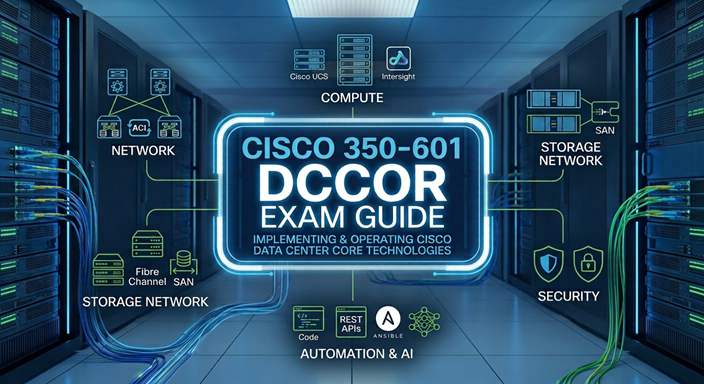
Modern data centers are no longer built around switching alone. A data center engineer may be expected to understand routing, overlay networking, storage fabrics, compute platforms, automation, security, telemetry, and increasingly, infrastructure designed for artificial intelligence workloads.
The Cisco 350-601 DCCOR exam, officially named Implementing and Operating Cisco Data Center Core Technologies, is designed around this broader technical landscape. It is the core examination for Cisco’s professional-level Data Center certification path and also serves as the qualifying core exam for candidates pursuing CCIE Data Center.
For students and junior network engineers, DCCOR can initially appear overwhelming because it combines technologies that are often studied separately. However, the exam also provides a structured roadmap for understanding how networking, servers, storage, security, and automation operate together inside an enterprise data center.
What Is the Cisco 350-601 DCCOR Exam?
Table of Contents
ToggleThe 350-601 DCCOR exam validates a candidate’s knowledge of implementing and operating core Cisco data center technologies. It covers five major technical areas:
- Data center networking
- Compute infrastructure
- Storage networking
- Automation and artificial intelligence
- Data center security
Passing the exam earns the Cisco Certified Specialist – Data Center Core certification. It also satisfies the core exam requirement for both CCNP Data Center and CCIE Data Center.
This makes DCCOR more than an individual specialist exam. It is a central milestone for engineers who plan to build a long-term career around Cisco Nexus switching, Cisco UCS, storage area networks, Application Centric Infrastructure, automation, and large-scale data center operations.
Cisco 350-601 DCCOR Exam Details
| Exam Item | Details |
|---|---|
| Exam code | 350-601 DCCOR |
| Official name | Implementing and Operating Cisco Data Center Core Technologies |
| Current blueprint | Version 1.2 |
| Exam duration | 120 minutes |
| Reference price | US$400 |
| Certification level | Professional-level core exam |
| Specialist certification earned | Cisco Certified Specialist – Data Center Core |
| Certification paths | CCNP Data Center and CCIE Data Center |
Exam pricing, available languages, delivery policies, and certification requirements can change. Candidates should verify the current information on Cisco’s official certification website before scheduling an exam.
How DCCOR Fits into the Cisco Certification Path
CCNP Data Center
To earn the full CCNP Data Center certification, a candidate must pass:
- The 350-601 DCCOR core exam
- One Data Center concentration exam
The concentration exam allows candidates to specialize in a particular area, such as data center design, infrastructure troubleshooting, Cisco ACI implementation, automation, or another concentration currently offered by Cisco.
This structure is useful because it combines broad foundational knowledge with a more focused technical specialization. DCCOR proves that the candidate understands the major components of a data center, while the concentration exam demonstrates deeper expertise in a selected domain.
CCIE Data Center
The 350-601 DCCOR exam also serves as the core exam for CCIE Data Center. Candidates pursuing the expert-level certification must pass DCCOR and then complete the CCIE Data Center hands-on lab examination.
Passing DCCOR does not automatically make someone a CCIE candidate with expert-level operational ability. However, it establishes the theoretical and implementation foundation needed before progressing toward the much more demanding lab exam.
Cisco DCCOR Exam Topics and Domain Weights
The current DCCOR v1.2 blueprint is divided into five domains. Understanding the weighting is important because it helps candidates distribute their study time more effectively.
| Domain | Weight |
|---|---|
| 1.0 Network | 25% |
| 2.0 Compute | 25% |
| 3.0 Storage Network | 20% |
| 4.0 Automation and Artificial Intelligence | 15% |
| 5.0 Security | 15% |
Network and Compute together account for half of the examination, but Storage Network, Automation, AI, and Security should not be treated as secondary topics. A weak understanding of Fibre Channel, UCS policies, REST APIs, or role-based access control can significantly affect overall exam performance.
1. Network: 25%
The Network domain covers the protocols and platforms used to transport traffic through a data center. Candidates need more than a basic understanding of Ethernet switching. They must understand how traditional Layer 2 and Layer 3 technologies interact with modern overlay architectures.
Routing and Multicast
Important routing technologies include:
- OSPFv2 and OSPFv3
- Multiprotocol BGP
- Protocol Independent Multicast
- First-Hop Redundancy Protocols
Candidates should understand adjacency formation, route advertisement, path selection, failure behavior, and the role each protocol plays inside a data center design.
Switching, LACP, and vPC
The blueprint includes technologies such as Rapid Spanning Tree, Link Aggregation Control Protocol, and Cisco Virtual Port Channel.
vPC is particularly important in Cisco Nexus environments because it allows a downstream device to form a port channel across two separate Nexus switches. This improves link utilization and device-level redundancy while reducing dependence on Spanning Tree blocking.
It is important to understand the vPC peer link, peer-keepalive connection, consistency parameters, orphan ports, failure scenarios, and traffic-forwarding behavior.
VXLAN EVPN
VXLAN EVPN is one of the most important technologies in modern data center networking. VXLAN provides a scalable overlay encapsulation, while EVPN commonly supplies the control plane used to distribute endpoint and reachability information.
Candidates should understand the roles of the underlay and overlay networks, Virtual Tunnel Endpoints, VNIs, route types, anycast gateways, BGP control-plane operation, and traffic forwarding between endpoints.
Memorizing definitions is not enough. A strong DCCOR candidate should be able to follow a packet from a source host through the VXLAN fabric to its destination.
Cisco ACI
Cisco Application Centric Infrastructure introduces a policy-based approach to data center networking. The exam includes ACI concepts such as:
- Fabric initialization
- Access policies
- Application profiles
- Endpoint groups
- Bridge domains
- VRFs
- Contracts
- Virtual Machine Manager integration
For beginners, ACI terminology can feel unfamiliar because the configuration model is different from traditional VLAN-by-VLAN networking. The best approach is to map each ACI object to its operational purpose and then study how those objects combine to create application connectivity.
Monitoring and Assurance
The network section also includes operational technologies such as NetFlow, SPAN, streaming telemetry, configuration management, software updates, and Cisco Nexus Dashboard.
These topics reflect the fact that data center engineering includes more than deploying a network. Engineers must also monitor it, perform upgrades, identify abnormal behavior, and maintain service availability during operational changes.
2. Compute: 25%
The Compute domain focuses primarily on the Cisco Unified Computing System. This is an area where traditional network engineers may need to expand their knowledge beyond switches and routers.
Cisco UCS Rack and Blade Servers
Candidates should understand Cisco UCS C-Series rack servers, blade server chassis, Fabric Interconnects, I/O modules, network connectivity, storage connectivity, and centralized infrastructure management.
Key UCS concepts include:
- Service profiles
- Service profile templates
- Server pools
- UUID, MAC address and WWN pools
- VLAN and VSAN configuration
- Boot policies
- LAN and SAN connectivity policies
- Firmware management
- Backup and restoration
Service profiles are especially significant. They abstract server identity and configuration into a policy-based object, allowing settings to be moved or reassigned without manually rebuilding each server configuration.
UCS-X and Intersight Managed Mode
The current DCCOR blueprint also includes Cisco UCS X-Series operating in Intersight Managed Mode.
Cisco Intersight provides cloud-based infrastructure management and policy control for supported compute environments. Candidates should understand the general architecture, the role of profiles and policies, and how Intersight differs from traditional UCS Manager-based administration.
Compute Operations
Compute questions may also involve firmware upgrades, infrastructure monitoring, SPAN, backup procedures, restoration, and the operational impact of software changes.
A good study method is to follow a server through its complete lifecycle: discovery, policy assignment, network connectivity, SAN connectivity, boot, monitoring, firmware maintenance, and recovery.
3. Storage Network: 20%
Storage networking is often the most unfamiliar DCCOR area for candidates with a routing and switching background. However, it represents 20% of the official exam blueprint and should not be postponed until the end of the study plan.
Fibre Channel Fundamentals
DCCOR candidates should understand the major components and control mechanisms of a Fibre Channel fabric, including:
- Fabric initialization
- Fibre Channel IDs
- Fibre Channel Name Server
- VSANs
- Zoning
- Device aliases
- Port channels
- Cisco Fabric Services
- NPV and NPIV
Fibre Channel uses terminology and addressing mechanisms that differ from Ethernet. Instead of trying to memorize every acronym independently, candidates should study the sequence through which an endpoint logs in to the fabric, receives an FCID, registers with the name server, and gains access to permitted storage targets.
Zoning and Segmentation
Zoning controls which initiators and targets can communicate inside a Fibre Channel fabric. Candidates should understand the purpose of zones, zone sets, aliases, activation, and common zoning practices.
The relationship between VSANs and zones should also be clear. A VSAN provides a logical fabric boundary, while zoning controls communication between devices within that fabric.
NFS and iSCSI
The exam also covers storage concepts outside native Fibre Channel, including NFS and iSCSI.
NFS provides file-level storage access over an IP network, while iSCSI transports SCSI commands over TCP/IP for block-level storage access. Candidates should understand their basic use cases and how they differ from Fibre Channel-based SAN designs.
4. Automation and Artificial Intelligence: 15%
Automation is now a core skill rather than an optional specialization. Large data center environments contain too many devices, endpoints, policies, and operational events to manage efficiently through manual CLI configuration alone.
On-Box Automation
The exam includes several automation and scripting capabilities available on Cisco NX-OS platforms:
- Embedded Event Manager
- Scheduler
- Bash Shell
- Guest Shell
- NX-API
- JSON and XML data encodings
- On-box Python
Candidates should understand what each tool is designed to accomplish. For example, EEM can respond to local events, while NX-API allows external applications to interact programmatically with a Nexus device.
Automation and Orchestration Platforms
The blueprint also references technologies such as:
- Ansible
- Python
- Power-On Auto Provisioning
- Terraform CLI
- PowerShell
- Cisco Nexus Dashboard
- Cisco Intersight
The exam is not purely a programming test. Candidates should still understand variables, data structures, API operations, authentication, structured data, idempotency, and the difference between imperative and declarative automation.
AI Data Center Infrastructure
The updated blueprint includes high-performance networking technologies that enable artificial intelligence workloads in data center environments.
AI clusters can generate intensive east-west traffic between compute nodes, accelerators, and storage systems. This places greater emphasis on high bandwidth, low latency, predictable performance, congestion management, visibility, and scalable fabric design.
DCCOR candidates do not need to become data scientists, but they should understand how AI workloads influence network, compute, storage, and automation requirements.
5. Security: 15%
Security is integrated across the network, compute, and storage domains rather than treated as a separate appliance-focused subject.
Network Security
Important topics include:
- Authentication, Authorization, and Accounting
- Role-Based Access Control
- ACI contracts
- Microsegmentation
- First-hop security features
- Keychain authentication
- MACsec
Candidates should understand how administrative access is controlled, how infrastructure protocols are protected, and how application communication can be restricted according to policy.
Compute and Storage Security
Compute security includes AAA and RBAC within Cisco UCS environments. Storage security includes administrative access control, port security, and Fibre Channel fabric binding.
A useful way to study this domain is to ask three questions for each platform:
- Who is allowed to administer the system?
- Which devices or endpoints are allowed to connect?
- Which workloads or storage devices are allowed to communicate?
Is Cisco DCCOR Suitable for Beginners?
DCCOR is not an entry-level networking exam. A complete beginner may struggle because the blueprint assumes familiarity with Ethernet, TCP/IP, routing, switching, server architecture, virtualization, SAN concepts, and Fibre Channel.
However, students should not assume that years of production data center experience are required before beginning to learn the material. A motivated learner can approach the exam successfully by building the necessary foundation in stages.
Before starting serious DCCOR preparation, candidates should be comfortable with:
- IPv4 and IPv6 addressing
- VLANs and trunking
- Spanning Tree Protocol
- EtherChannel and LACP
- OSPF and BGP fundamentals
- Access control and AAA concepts
- Basic Linux and Python
- Server and virtualization fundamentals
- Basic storage terminology
CCNA-level networking knowledge is a reasonable starting point, but it should be supplemented with data center-specific study and hands-on practice.
How to Prepare for the 350-601 DCCOR Exam
1. Start with the Official Blueprint
Download the current exam topic document and use it as the central checklist for your study plan. Every course, book, video, lab, and practice assessment should map back to an official blueprint objective.
The wording used by Cisco is important. Terms such as describe, explain, apply, implement, and analyze indicate different expected levels of knowledge.
2. Build a Domain-Based Study Plan
A practical study sequence is:
- NX-OS switching and routing fundamentals
- vPC, VXLAN EVPN, and ACI
- Cisco UCS architecture and policies
- Fibre Channel and SAN concepts
- Automation, APIs, Python, and Ansible
- Security, monitoring, and operations
For someone with CCNA-level fundamentals but limited data center experience, a study period of approximately 12 to 16 weeks may be a reasonable starting plan. The actual timeline depends on existing experience and access to lab equipment.
Candidates who want to organize their review around the official objectives can also consult this 350-601 DCCOR study resources page alongside Cisco documentation, training courses, and hands-on labs.
3. Use Hands-On Labs
DCCOR preparation should include practical configuration and verification wherever possible. Useful lab activities include:
- Configuring VLANs and port channels on NX-OS
- Building a basic vPC domain
- Examining OSPF and BGP neighbor relationships
- Following VXLAN EVPN control-plane information
- Exploring ACI tenants, EPGs, bridge domains, and contracts
- Creating UCS pools, policies, and service profiles
- Configuring Fibre Channel VSANs, aliases, zones, and zone sets
- Using NX-API to retrieve device information
- Managing Nexus configuration with Ansible
- Parsing JSON output with Python
Physical hardware is helpful, but it is not always required. Cisco learning platforms, virtual labs, sandboxes, simulators, and demonstration environments can provide valuable practice when real Nexus, MDS, or UCS equipment is unavailable.
4. Practice Troubleshooting, Not Just Configuration
Real data center work frequently involves finding why a system is not behaving as expected. Candidates should practice interpreting show commands, interface states, routing tables, endpoint information, fabric databases, logs, API responses, and policy relationships.
For each technology, study both the normal state and common failure states. For example, do not only learn how to configure vPC. Learn what happens when the peer link fails, a consistency parameter does not match, or an orphan port loses connectivity.
5. Connect the Technologies
The exam domains should not be studied as isolated subjects. A virtual machine may depend on UCS compute resources, ACI or VXLAN networking, SAN connectivity, security policy, monitoring, and automated provisioning at the same time.
The strongest candidates can describe the complete service path rather than only one device configuration.
Common DCCOR Study Mistakes
Ignoring Storage Networking
Network engineers sometimes delay Fibre Channel study because it feels unfamiliar. Since Storage Network represents 20% of the blueprint, this can create a major knowledge gap.
Memorizing Without Following Packet Flow
Memorizing commands may help with simple questions, but it does not build the reasoning required to analyze overlay networks, ACI contracts, SAN access, or failure scenarios.
Studying Only Traditional Networking
Strong knowledge of OSPF and BGP is valuable, but it is not enough. DCCOR also requires serious preparation in compute, storage, automation, operations, and security.
Avoiding Automation
Candidates sometimes assume that automation questions will be limited to basic terminology. A better approach is to practice API requests, structured data, simple Python scripts, and Ansible playbooks.
Depending Exclusively on Practice Questions
Practice assessments can help identify weak areas and improve time management, but they should not replace technical study and hands-on work. The objective is to understand the technology well enough to solve unfamiliar scenarios.
A balanced preparation strategy should combine the official blueprint, Cisco documentation, lab exercises, technical reading, and a structured Cisco DCCOR exam preparation page for reviewing the major knowledge areas.
Career Value of the Cisco 350-601 DCCOR Exam
The value of DCCOR comes from the technical scope it represents. The exam connects networking with compute, storage, security, automation, and operational management.
These skills are relevant to roles such as:
- Data center network engineer
- Data center infrastructure engineer
- Cisco Nexus engineer
- Cisco UCS administrator
- Network automation engineer
- Systems engineer
- Technical consultant
- Solutions architect
- Data center operations engineer
A certification does not replace production experience. Employers still expect engineers to troubleshoot real systems, communicate clearly, document changes, assess risk, and understand business requirements.
However, earning the Data Center Core Specialist certification can provide a credible way to demonstrate structured knowledge, particularly for engineers moving from campus networking, server administration, or virtualization into a dedicated data center role.
Is the Cisco 350-601 DCCOR Exam Worth It?
DCCOR is worth considering when your career goals involve Cisco-based data center infrastructure or when you need a structured path into enterprise data center technologies.
It is particularly relevant for professionals working with or planning to work with:
- Cisco Nexus switching
- Cisco MDS storage networking
- Cisco UCS compute platforms
- Cisco ACI
- VXLAN EVPN fabrics
- Cisco Intersight
- Nexus Dashboard
- Data center automation
The certification may be less relevant for someone whose work is exclusively focused on public cloud development with no responsibility for networking or physical infrastructure. Even in hybrid environments, however, the architectural concepts covered by DCCOR remain useful.
Frequently Asked Questions
What certification do I receive after passing 350-601 DCCOR?
Passing the exam earns the Cisco Certified Specialist – Data Center Core certification. It also completes the core exam requirement for CCNP Data Center and CCIE Data Center.
Is DCCOR enough to earn CCNP Data Center?
No. To earn CCNP Data Center, you must pass the 350-601 DCCOR core exam and one qualifying Data Center concentration exam.
How long is the Cisco DCCOR exam?
The official exam duration is 120 minutes.
How much does the 350-601 exam cost?
The official reference price is US$400. Taxes, regional pricing, Cisco Learning Credits, and future pricing changes may affect the final cost.
Does DCCOR include Cisco ACI?
Yes. The Network domain includes ACI concepts such as fabric setup, access policies, and Virtual Machine Manager integration. ACI security concepts, including contracts and microsegmentation, also appear in the Security domain.
Does DCCOR include automation and Python?
Yes. The exam includes Python, Ansible, REST APIs, NX-API, JSON, XML, EEM, Guest Shell, PowerShell, Terraform CLI, POAP, Cisco Intersight, and Cisco Nexus Dashboard.
Does the exam cover artificial intelligence?
The current blueprint includes automation and artificial intelligence as a dedicated domain. Candidates should understand high-performance networking technologies that support AI infrastructure in the data center.
Do I need Fibre Channel knowledge?
Yes. Fibre Channel is a major part of the Storage Network domain. Candidates should understand fabric initialization, FCIDs, zoning, VSANs, device aliases, NPV, NPIV, port channels, and related operational concepts.
Can a student prepare for DCCOR without production experience?
Yes, but the candidate should first build strong networking fundamentals and complete substantial hands-on practice. Virtual labs, Cisco learning environments, documentation, and structured exercises can help compensate for limited access to production equipment.
Where can I review the main 350-601 exam objectives?
Start with Cisco’s official exam blueprint and documentation. You can then use this 350-601 Cisco DCCOR preparation page to support a structured review of the exam domains.
Final Thoughts
The Cisco 350-601 DCCOR exam is challenging because it tests an integrated data center skill set rather than a single technology. Candidates must move comfortably between routing, switching, overlays, Cisco ACI, Cisco UCS, Fibre Channel, automation, monitoring, AI infrastructure, and security.
That breadth is also what makes the exam valuable. DCCOR provides a practical framework for understanding how modern enterprise data centers are designed, implemented, secured, automated, and operated.
For students and junior engineers, the best strategy is to focus on fundamentals, build a lab-driven study plan, and connect each technology to real packet flows and operational scenarios. Passing the exam should be treated as evidence of a strong technical foundation—not as the end of the learning process.