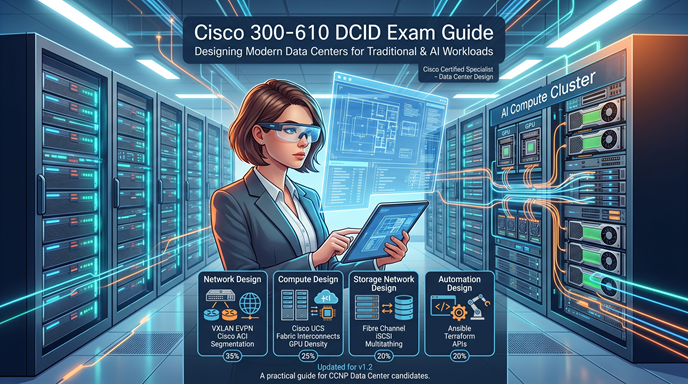
The Cisco 300-610 DCID exam is designed for networking professionals who want to develop expertise in modern data center infrastructure design. Rather than focusing only on device configuration, the exam asks candidates to understand why one architecture may be more suitable than another based on availability, scalability, performance, storage, automation, and business requirements.
The current exam is officially named Designing Cisco Data Center Infrastructure for Traditional and AI Workloads v1.2. The updated title reflects an important change in the data center industry: network architects are no longer designing only for conventional enterprise applications. They must also consider GPU clusters, high-performance Ethernet, lossless transport, remote direct memory access, AI training, AI inference, and other demanding workloads.
For students and junior network engineers, DCID can provide a structured introduction to professional data center design. For experienced engineers, it offers a way to validate design knowledge across networking, computing, storage, and automation.
What Is the Cisco 300-610 DCID Exam?
Table of Contents
ToggleDCID stands for Designing Cisco Data Center Infrastructure. It is one of the concentration exams available within the CCNP Data Center certification track.
| Exam Detail | Current Information |
|---|---|
| Exam code | 300-610 |
| Exam name | Designing Cisco Data Center Infrastructure for Traditional and AI Workloads |
| Current version | v1.2 |
| Exam duration | 90 minutes |
| Exam language | English |
| Exam price | US$300 |
| Associated certification | CCNP Data Center |
| Specialist credential | Cisco Certified Specialist – Data Center Design |
Passing the 300-610 exam earns the Cisco Certified Specialist – Data Center Design certification. It also fulfills the concentration exam requirement for CCNP Data Center.
To earn the complete CCNP Data Center certification, a candidate must pass:
- 350-601 DCCOR: Implementing and Operating Cisco Data Center Core Technologies
- One qualifying concentration exam, such as 300-610 DCID
Passing DCID alone does not award the full CCNP Data Center certification. However, the Specialist credential can still be valuable because it demonstrates focused knowledge of data center architecture and design. Candidates preparing for this credential can review a structured 300-610 DCID certification preparation course alongside Cisco documentation and hands-on lab practice.
Why Is the Cisco DCID Certification Valuable?
Data center design is a multidisciplinary field. A designer must understand how network, server, storage, security, and automation components interact. A technically valid design can still fail if it does not meet application latency, availability, operational, or growth requirements.
The Cisco 300-610 DCID exam is valuable because it develops the ability to evaluate these requirements as a complete system. It is not simply a test of Cisco commands. It requires candidates to compare design choices, identify trade-offs, and select technologies that support a specific business or workload objective.
It validates architecture-level knowledge
Many network engineers begin their careers by configuring VLANs, routing protocols, access control lists, or switch ports. Those skills are essential, but design work requires a different perspective.
A data center designer must ask questions such as:
- How much redundancy does the application require?
- Should the environment use Layer 2 extension or Layer 3 boundaries?
- How should workloads be segmented?
- Which storage transport is appropriate?
- How much oversubscription is acceptable?
- Does the design need lossless Ethernet?
- How will configuration consistency be maintained?
- Can the architecture support future AI or high-performance workloads?
DCID helps candidates move from configuration-oriented thinking toward architecture-oriented decision-making.
It supports several professional roles
The knowledge covered by the exam is relevant to roles such as:
- Data center network engineer
- Network designer
- Systems engineer
- Data center consultant
- Infrastructure architect
- Pre-sales solutions engineer
- Cisco UCS engineer
- Storage network administrator
- Cloud and hybrid infrastructure engineer
Not every role requires the same level of expertise in networking, compute, storage, and automation. However, understanding how these domains fit together can make an engineer more effective when working with server, virtualization, cloud, security, and application teams.
Cisco 300-610 DCID Exam Topics
The current 300-610 DCID v1.2 blueprint is divided into four major domains.
| Exam Domain | Weight |
|---|---|
| Network Design | 35% |
| Compute Design | 25% |
| Storage Network Design | 20% |
| Automation Design | 20% |
The percentages show that network design remains the largest part of the exam. However, compute, storage, and automation together represent most of the blueprint. Candidates who study only Nexus switching and routing are unlikely to be fully prepared.
1. Network Design: 35%
Network Design is the largest DCID domain. It includes traditional data center networking technologies as well as new requirements created by artificial intelligence and high-performance computing.
AI and machine learning fundamentals
The updated exam expects candidates to understand basic AI and machine learning concepts. You do not need to become a data scientist, but you should understand the infrastructure differences between AI training and inference.
Training generally involves processing large datasets to build or refine a model. This can create intensive communication between GPUs and requires high bandwidth, low latency, predictable performance, and efficient traffic handling.
Inference uses an existing model to generate an output or prediction. Its infrastructure requirements vary depending on the model size, response-time target, and number of users.
Candidates should also understand the roles of:
- Graphics processing units, or GPUs
- Data processing units, or DPUs
- SmartNICs
- High-speed network adapters
- AI compute clusters
- Sustainable infrastructure design
High-performance networking
AI clusters and high-performance computing environments can generate large east-west traffic flows. Traditional best-effort Ethernet may not always provide the required behavior without additional design considerations.
Important technologies include:
- RDMA: Remote Direct Memory Access allows data to move between systems with reduced CPU involvement.
- RoCEv2: RDMA over Converged Ethernet version 2 carries RDMA traffic across routable Ethernet networks.
- Lossless Ethernet: Uses appropriate quality-of-service and congestion-management mechanisms to minimize packet loss for sensitive traffic.
- InfiniBand: A high-performance interconnect commonly associated with demanding compute and AI environments.
For the exam, focus on design requirements and trade-offs. Understand where each technology may be appropriate and what the network must provide to support it.
Layer 2 connectivity
Layer 2 design topics include endpoint mobility, convergence, redundancy, service insertion, virtual PortChannels, and Link Aggregation Control Protocol.
You should be able to evaluate:
- When Layer 2 adjacency is required
- How vPC provides multi-chassis connectivity
- How LACP negotiates bundled links
- How failure domains affect availability
- How large Layer 2 domains influence operational risk
- How traffic should pass through firewalls and load balancers
Layer 3 connectivity
Layer 3 data center design requires an understanding of routing scalability, convergence, high availability, traffic engineering, and segmentation.
Relevant topics include:
- IP mobility
- Graceful restart
- Nonstop forwarding
- VRF Lite
- Load-balancer and firewall insertion
- Routing protocol convergence
A good candidate should be able to compare Layer 2 and Layer 3 design options instead of assuming that one approach is always better.
VXLAN EVPN and Cisco ACI
Modern data centers frequently use an underlay-and-overlay architecture. The physical underlay provides IP connectivity, while the overlay creates logical networks and segmentation across the fabric.
VXLAN provides scalable network virtualization by encapsulating Layer 2 frames inside UDP packets. EVPN can provide the control plane used to advertise endpoint and network reachability information.
Candidates should understand how VXLAN EVPN can support:
- Scalable segmentation
- Workload mobility
- Distributed default gateways
- Multi-tenant environments
- Data center interconnection
Cisco ACI approaches data center networking through a policy-based fabric. DCID candidates should understand how ACI and VXLAN-based architectures can meet segmentation, automation, application, and operational requirements.
Management and resiliency
Network design also includes management-plane and site-level decisions. Candidates should compare in-band and out-of-band management and understand the importance of centralized monitoring.
You should also consider:
- Active-active and active-standby architectures
- Disaster recovery sites
- Failure-domain isolation
- Nexus Dashboard management
- Operational visibility
- Configuration consistency
2. Compute Design: 25%
Compute Design focuses heavily on Cisco Unified Computing System technologies. This section may be unfamiliar to candidates whose experience is limited to traditional routing and switching.
Cisco UCS architecture
Cisco UCS combines computing, networking, management, and storage access into an integrated architecture. Instead of managing every server independently, administrators can apply policies and logical identities through centralized management systems.
Important components and concepts include:
- Cisco UCS Fabric Interconnects
- Cisco Virtual Interface Cards
- Service profiles
- Service profile templates
- vNICs and vHBAs
- Ethernet adapter policies
- Fibre Channel adapter policies
- UCS-X design options
Fabric Interconnect operating modes
Candidates should understand the difference between switch mode and end-host mode. The selected operating model affects forwarding behavior, upstream connectivity, loop prevention, and the overall network design.
The objective is not simply to memorize definitions. You should understand how each mode changes the relationship between the UCS domain and the upstream LAN or SAN.
Ethernet and storage connectivity
Compute design requires sufficient bandwidth and redundancy for both production network traffic and storage traffic. A designer must evaluate how many links are required, how traffic will be distributed, and what happens during a component failure.
Storage connectivity options may include:
- Fibre Channel
- Fibre Channel over Ethernet
- iSCSI
- Direct-attached storage
- Storage appliances
UCS-X and AI compute requirements
The updated exam also includes UCS-X design and compute requirements for AI and machine learning applications.
When evaluating an AI-ready compute platform, designers should consider:
- GPU density
- Network adapter performance
- East-west bandwidth
- Storage throughput
- Power and cooling
- Scalability
- Operational management
The best design is not necessarily the one with the largest number of GPUs. It is the design that balances compute, network, storage, power, cooling, and cost according to the workload.
3. Storage Network Design: 20%
Storage networking is one of the areas that frequently challenges candidates from a pure Ethernet background. A storage design must deliver predictable access to data while maintaining resiliency, performance, and fault isolation.
iSCSI design
iSCSI transports SCSI commands across IP networks. Because it uses Ethernet and IP, it can integrate with existing network infrastructure, but it still requires careful design.
Key considerations include:
- IP addressing
- Multipathing
- Path redundancy
- Bandwidth
- Quality of service
- Failure isolation
Multipathing is particularly important because it can provide both redundancy and traffic distribution between hosts and storage systems.
Fibre Channel design
Fibre Channel remains important in enterprise storage area networks. Candidates should understand common interface types, inter-switch links, fabric design, and oversubscription.
Topics to review include:
- N ports
- F ports
- E ports
- Inter-switch links
- VSAN segmentation
- Dual-fabric designs
- Oversubscription ratios
- Storage path redundancy
A common design principle is to maintain independent storage fabrics so that a failure in one fabric does not remove all access to the storage system.
Traditional and high-performance storage
The updated blueprint asks candidates to evaluate storage deployment options for both traditional and high-performance networks.
Workloads such as virtualization, databases, analytics, and AI training may have very different I/O patterns. A design must account for throughput, latency, burst behavior, capacity, availability, and the relationship between compute nodes and storage resources.
4. Automation Design: 20%
Automation is no longer an optional skill in large data center environments. Manual configuration can become slow, inconsistent, and difficult to audit as the infrastructure grows.
APIs and programmability
The DCID blueprint includes REST APIs, NX-API, JSON, XML, and model-driven programmability.
Candidates should understand:
- Why APIs are used for infrastructure management
- How structured data is exchanged
- The basic purpose of JSON and XML
- How programmatic workflows differ from manual CLI configuration
- How automation improves repeatability and consistency
You do not need to be a professional software developer, but you should be comfortable reading basic API requests, structured data, and simple automation logic.
Python, Ansible, and Terraform
The exam includes three widely used automation technologies:
- Python can be used to create custom scripts, interact with APIs, validate data, and automate operational tasks.
- Ansible provides agentless automation through playbooks and reusable modules.
- Terraform uses a declarative infrastructure-as-code model to define and deploy infrastructure resources.
Focus on the strengths and typical use cases of each tool. A design exam is more likely to test why a tool should be selected than to require extensive application development.
Cisco Intersight and Nexus Dashboard
Cisco Intersight provides cloud-based infrastructure management and orchestration capabilities. The blueprint includes Intersight Cloud Orchestrator workflows and compute automation concepts.
Nexus Dashboard provides a centralized platform for managing and operating Cisco data center network environments. Candidates should understand how centralized platforms can improve visibility, lifecycle management, policy consistency, and automated deployment.
How Difficult Is the Cisco 300-610 DCID Exam?
The Cisco 300-610 DCID exam can be difficult because it covers several technical disciplines. A candidate may understand routing and switching well but have limited experience with Fibre Channel, UCS service profiles, storage multipathing, AI transport, or infrastructure automation.
The exam also uses design-oriented language. Words such as evaluate, determine, and plan indicate that candidates must compare options and apply technical knowledge to a scenario.
Memorizing product descriptions is not enough. You should be able to explain:
- Why a design option is suitable
- What problem the technology solves
- What limitations or risks it introduces
- How it affects availability and scalability
- How it integrates with the rest of the data center
Using scenario-based Cisco DCID practice questions can help you identify whether you truly understand the design trade-offs or have only memorized isolated terminology.
Recommended Knowledge Before Studying DCID
Cisco does not position the course as requiring a formal prerequisite, but candidates will benefit from having a foundation in enterprise networking and data center technologies.
Recommended background knowledge includes:
- IPv4 and IPv6 fundamentals
- VLANs, trunks, and EtherChannels
- Spanning Tree Protocol
- OSPF and BGP fundamentals
- First-hop redundancy
- Virtualization concepts
- Basic storage terminology
- Cisco Nexus switching
- Cisco UCS fundamentals
- Basic Python and API concepts
Students who have completed CCNA-level networking should be able to begin studying DCID, but they may need additional time for UCS, Fibre Channel, storage design, automation, and AI infrastructure topics.
A Practical Cisco 300-610 DCID Study Plan
A structured study plan is usually more effective than reading random documents or memorizing isolated facts. The following eight-week outline can be adjusted according to your current experience.
Weeks 1 and 2: Build the design foundation
- Review common data center topologies
- Study availability, redundancy, and failure domains
- Compare Layer 2 and Layer 3 design models
- Review vPC, LACP, OSPF, BGP, and VRF Lite
- Learn underlay and overlay terminology
Weeks 3 and 4: Study advanced network design
- Study VXLAN and EVPN operation
- Review Cisco ACI architecture and segmentation
- Compare data center interconnect options
- Study lossless Ethernet and quality of service
- Learn RDMA, RoCEv2, and high-performance transport concepts
Week 5: Study Cisco UCS and compute design
- Review Fabric Interconnect architecture
- Compare end-host mode and switch mode
- Study service profiles and templates
- Review VIC, vNIC, and vHBA policies
- Study UCS-X and AI compute requirements
Week 6: Study storage networking
- Review Fibre Channel terminology and port types
- Study VSANs, ISLs, and dual-fabric designs
- Learn iSCSI addressing and multipathing
- Review FCoE design
- Practice calculating and evaluating oversubscription
Week 7: Study automation and orchestration
- Review REST API fundamentals
- Practice reading JSON and XML
- Compare Python, Ansible, and Terraform
- Study Cisco Intersight workflows
- Review Nexus Dashboard and automated fabric deployment
Week 8: Review and scenario practice
- Revisit the official exam blueprint
- Create comparison tables for similar technologies
- Practice design scenarios
- Review weak domains
- Complete timed practice questions
Prepare for the Cisco 300-610 DCID Exam
A strong preparation strategy should combine the official Cisco exam blueprint, technical documentation, hands-on labs, and realistic question practice. Explore the 300-610 Cisco DCID exam preparation resources to reinforce key concepts and evaluate your readiness across networking, compute, storage, and automation.
How to Study Design Questions Effectively
Design exams require a different preparation method from configuration exams. Use the following process when reviewing a technology:
- Identify the business or technical requirement.
- List the available design options.
- Compare advantages and disadvantages.
- Identify dependencies and failure scenarios.
- Select the option that best satisfies the stated requirement.
For example, do not study VXLAN only by memorizing that it uses a 24-bit segment identifier. Also study why VXLAN is used, how it improves segmentation scale, what role EVPN provides, and how the underlay and overlay interact.
Similarly, do not memorize only the names of Fibre Channel port types. Understand where each port appears in the topology and how the design behaves when a link, switch, host bus adapter, or storage controller fails.
Common Mistakes to Avoid
Studying only networking
Network Design is the largest domain, but it represents only 35% of the blueprint. Compute, storage, and automation account for the remaining 65%.
Ignoring AI-related updates
The v1.2 exam includes AI and machine learning concepts, AI hardware, high-performance networks, RoCEv2, RDMA, InfiniBand, lossless Ethernet, and AI compute requirements. Candidates using older study materials should compare them carefully with the current blueprint.
Memorizing without understanding trade-offs
A design decision is rarely based on a single feature. Availability, cost, complexity, scalability, operational skill, security, and performance may all influence the correct choice.
Avoiding storage technologies
Fibre Channel and iSCSI may initially feel unfamiliar, but Storage Network Design represents 20% of the exam. It should not be treated as an optional subject.
Learning tools without learning their purpose
Knowing a few Python commands or Ansible keywords is useful, but DCID preparation should also address when APIs, scripts, playbooks, templates, or infrastructure-as-code workflows are appropriate.
Is Cisco 300-610 DCID Right for You?
The DCID exam is a strong choice for candidates who enjoy architecture, planning, and technical decision-making. It is particularly relevant if you want to understand how networking interacts with servers, storage systems, automation platforms, and modern AI workloads.
You may prefer DCID when your interests include:
- Designing scalable data center fabrics
- Building highly available infrastructure
- Planning Cisco UCS deployments
- Designing Fibre Channel or IP storage networks
- Using VXLAN EVPN or Cisco ACI for segmentation
- Automating infrastructure deployment
- Supporting GPU and AI compute environments
Candidates focused primarily on troubleshooting may find the 300-615 DCIT concentration more aligned with their work. Those focused on Cisco ACI implementation may prefer 300-620 DCACI, while automation specialists may consider 300-635 DCNAUTO.
Frequently Asked Questions
Does passing 300-610 DCID earn the full CCNP Data Center certification?
No. Passing DCID earns the Cisco Certified Specialist – Data Center Design credential and satisfies the concentration exam requirement. You must also pass the 350-601 DCCOR core exam to earn CCNP Data Center.
Is the Cisco 300-610 exam suitable for beginners?
It is possible for a motivated beginner to prepare for DCID, but it is not generally an ideal first networking exam. Candidates should first understand basic routing, switching, virtualization, and data center concepts.
Does the current DCID exam include artificial intelligence?
Yes. The v1.2 blueprint includes AI and machine learning concepts, GPU and DPU hardware, AI networking requirements, RDMA, RoCEv2, InfiniBand, operational sustainability, and AI compute design.
Do I need hands-on lab experience?
DCID is a design-focused exam, but hands-on experience is still useful. Configuring or exploring Nexus switches, UCS platforms, automation tools, and virtual lab environments can make architectural concepts easier to understand.
How long does it take to prepare for Cisco 300-610?
Preparation time depends on your existing experience. A network engineer familiar with Nexus, UCS, storage, and automation may need several weeks. A student who is new to data center technologies may require several months of consistent study.
Is programming required for DCID?
Advanced software development is not required, but candidates should understand APIs, structured data, Python, Ansible, Terraform, model-driven programmability, and the role of automation in data center design.
Should I study DCCOR before DCID?
The DCCOR curriculum provides a useful foundation because it covers core data center networking, compute, storage, security, and automation. However, DCID requires additional emphasis on architecture, technology comparison, and design trade-offs.
Final Thoughts
The Cisco 300-610 DCID exam is more than a test of individual technologies. It evaluates whether a candidate can combine networking, compute, storage, and automation into an infrastructure design that meets real operational requirements.
The addition of traditional and AI workloads makes the current exam particularly relevant. Modern data centers must support virtualization, cloud connectivity, policy-based networking, high-speed storage, automated operations, GPU clusters, and high-performance traffic patterns. Engineers who understand these requirements can contribute beyond routine configuration tasks and participate in larger architecture discussions.
To prepare effectively, follow the current blueprint, study every domain, and focus on design reasoning. For each technology, learn what it does, what problem it solves, where it fits, and what trade-offs it introduces. You can also use a focused Cisco 300-610 DCID study resource to review the exam domains and strengthen your ability to apply technical knowledge to design scenarios.
Official References and Further Reading
For candidates preparing for the Cisco 300-610 DCID exam, the following official Cisco resources provide authoritative information about the exam objectives, data center network design, compute and storage infrastructure, automation, VXLAN EVPN, Cisco ACI, and AI-ready data center architectures.
- Cisco 300-610 DCID – Official Exam Page
– Cisco’s official page for the Designing Cisco Data Center Infrastructure exam, including exam information, certification paths, preparation resources, and scheduling details.
Cisco Nexus 9000 VXLAN BGP EVPN Design and Implementation Guide
– A detailed Cisco technical guide covering VXLAN BGP EVPN data center fabrics, leaf-spine architecture, underlay and overlay design, vPC, routing, and Nexus Dashboard Fabric Controller. - Cisco Application Centric Infrastructure (ACI) Design Guide
– Cisco’s comprehensive ACI design reference covering fabric architecture, Nexus 9000 platforms, APIC, leaf-spine topology, redundancy, connectivity, and enterprise data center design considerations. - Cisco Data Center Networking Blueprint for AI/ML Applications
– An authoritative Cisco design resource explaining networking requirements for AI and machine learning workloads, including low-latency and lossless Ethernet, congestion management, telemetry, automation, and high-performance data center fabrics. - Cisco Nexus 9000 Series Design Guides
– Cisco’s collection of implementation and design documentation for Nexus 9000 Series switches, covering modern data center networking architectures and technologies.