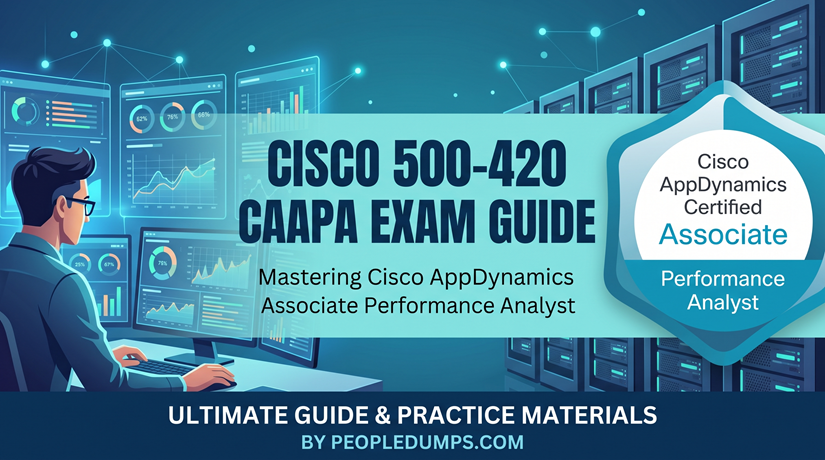
When most students hear the words Cisco certification, they immediately think about routing, switching, VLANs, OSPF, BGP, firewalls, or perhaps automation. The Cisco 500-420 CAAPA exam is different. It sits much closer to application performance monitoring, troubleshooting, and observability than to traditional router and switch configuration.
CAAPA stands for Cisco AppDynamics Associate Performance Analyst. The certification is designed around using AppDynamics to understand how applications behave, recognize performance problems, investigate the source of those problems, and determine what part of an application or supporting system is responsible.
For a network student, that makes CAAPA an interesting certification. Modern troubleshooting rarely stops at Layer 3 or Layer 4. A user simply says, “The application is slow.” The actual problem might be network latency, an overloaded application server, a slow database query, a memory issue, an unhealthy backend service, or a poorly performing application transaction. A good operations engineer needs a way to separate these possibilities.
That is where the Cisco 500-420 CAAPA exam becomes useful. It teaches you to look at performance from the application’s point of view rather than only from the network’s point of view.
Cisco 500-420 CAAPA Exam Quick Facts
Table of Contents
Toggle| Item | Current Information |
|---|---|
| Exam Code | 500-420 CAAPA |
| Certification | Cisco AppDynamics Associate Performance Analyst |
| Exam Duration | 90 minutes |
| Exam Price | US$300 |
| Languages | English and Japanese |
| Delivery | Pearson VUE, online or at a testing center |
| Formal Prerequisites | None |
| Certification Validity | 3 years |
| Primary Technology | Cisco AppDynamics / AppDynamics APM |
| Main Skill Area | Application performance monitoring and troubleshooting |
Exam prices, policies, and blueprints can change, so always check Cisco’s current certification information before registering.
What Is the Cisco CAAPA Certification?
The Cisco AppDynamics Associate Performance Analyst certification validates your ability to work with AppDynamics as a performance monitoring and troubleshooting platform.
The important word here is analyst.
You are not primarily being tested on installing a large AppDynamics deployment from scratch. You are being tested on whether you can look at application performance data, understand what the platform is showing you, recognize abnormal behavior, and investigate the cause.
That means the exam combines several skills that are increasingly important in modern IT operations:
- Application Performance Monitoring, or APM
- Performance metric analysis
- Application dependency awareness
- Business transaction monitoring
- Health and alert analysis
- Server and backend troubleshooting
- Transaction-level diagnostics
- Application and infrastructure correlation
For someone who has only studied traditional networking, these topics may initially feel unfamiliar. But the troubleshooting logic is actually very similar to good network troubleshooting: identify the symptom, narrow the scope, collect evidence, locate the failing component, and verify your conclusion.
Where CAAPA Fits for Network Engineers
One point I would make to anyone coming from a CCNA-style background is that 500-420 is not a routing and switching exam.
You should not approach CAAPA expecting subnetting questions, VLAN configuration, spanning tree calculations, OSPF neighbor troubleshooting, or BGP policy design. Those are not the focus of the CAAPA blueprint.
Instead, CAAPA deals with the question that often arrives after the network team has already confirmed basic connectivity:
“The network is reachable, so why is the application still slow?”
Imagine an online store where the checkout page takes five seconds to complete. A traditional network check might show that the server is reachable and that basic latency is acceptable. That does not tell you whether:
- the checkout application code is taking too long;
- the application is waiting on a database;
- an external payment API is responding slowly;
- a backend service is returning errors;
- a JVM or server process is under memory pressure; or
- one particular application tier is responsible for most of the response time.
An APM platform gives you another layer of visibility. Instead of looking only at packets and interfaces, you can follow the application request through its processing path.
This is why CAAPA can complement networking knowledge nicely. It moves your troubleshooting perspective upward from pure infrastructure into the application layer.
Cisco 500-420 CAAPA Exam Topics and Weighting
Cisco divides the current CAAPA blueprint into five major domains. Understanding these domains should be one of the first steps in your 500-420 CAAPA exam preparation, because the weighting helps you decide where to spend the most study time.
| Exam Domain | Weight |
|---|---|
| Agents and Application Performance | 20% |
| Troubleshooting | 15% |
| Business Transactions | 20% |
| Health Rules, Dashboards, and Snapshots | 20% |
| Collectors, Information Points, and Service Endpoints | 25% |
The weighting immediately tells us something important about the exam. CAAPA is not simply an “open a dashboard and read a graph” certification.
A full quarter of the blueprint deals with collectors, information points, and service endpoints. Another 20 percent focuses on Business Transactions, while 20 percent covers Health Rules, dashboards, and snapshots.
In other words, you need to understand how AppDynamics organizes application data, not just where buttons are located in the interface.
1. Agents and Application Performance — 20%
This domain starts with the foundation of application monitoring: the agent and the performance data it provides.
You should understand how to verify that an agent is functioning and communicating correctly, how to recognize performance trends, how alerts relate to performance conditions, and how application behavior can be correlated with system-level metrics.
A useful mindset is to ask three questions:
- Is AppDynamics receiving trustworthy data?
- What does normal performance look like?
- What changed when performance became abnormal?
If the agent itself is not working properly, every conclusion made from missing or incomplete telemetry can be wrong.
2. Troubleshooting — 15%
Although troubleshooting represents 15 percent of the official blueprint, it is really a skill that runs through almost every other domain.
You need to be comfortable using dashboards, diagnostic sessions, health rule violations, server metrics, backend performance data, and transaction behavior to investigate issues.
Pay particular attention to situations involving slow, failed, or stalled Business Transactions, backend delays, memory problems, and abnormal server performance.
3. Business Transactions — 20%
Business Transactions are one of the most important concepts in AppDynamics and one of the easiest concepts for a beginner to misunderstand.
A Business Transaction is not the same thing as a database transaction.
In AppDynamics, a Business Transaction represents the processing path associated with a meaningful application request. Depending on the application, examples might include:
- user login;
- product search;
- add item to shopping cart;
- checkout;
- submit payment; or
- retrieve customer profile.
You should understand Business Transaction discovery, scope, detection logic, configuration rules, transaction preview, metrics, cleanup, split configuration, and asynchronous transaction behavior.
4. Health Rules, Dashboards, and Snapshots — 20%
This domain brings together monitoring and diagnosis.
Dashboards provide visibility. Health Rules tell you when monitored behavior has moved outside acceptable conditions. Transaction Snapshots give you deeper diagnostic information about individual application requests.
You need to know more than how to create these objects. You should understand when each one is useful.
5. Collectors, Information Points, and Service Endpoints — 25%
This is the largest section of the Cisco 500-420 CAAPA exam.
Expect to spend serious study time understanding the differences between data collectors, database collectors, Information Points, Service Endpoints, Business Transaction split configuration, and asynchronous transactions.
These features can sound similar when you first encounter them, so the exam may become much easier once you understand what problem each feature is designed to solve.
Key AppDynamics Technologies You Need to Understand
AppDynamics Agents
An AppDynamics agent instruments or monitors an application environment and provides telemetry that allows the platform to understand application behavior.
From an exam perspective, do not think only about installation. Think about operational questions such as:
- Is the agent reporting?
- Is connectivity working?
- Are the expected nodes and tiers visible?
- Are metrics arriving?
- Does the observed behavior make sense?
If your monitoring data disappears, the first problem may be visibility rather than application performance.
Business Transactions
A Business Transaction, commonly shortened to BT, represents an end-to-end processing path for an application request.
Suppose a customer clicks Place Order. That request might travel through a web tier, an application service, an inventory service, a payment service, and a database. Looking at each server individually can make troubleshooting difficult. A Business Transaction gives you a transaction-oriented view of that activity.
For CAAPA preparation, make sure you understand the difference between automatically discovered transactions and transactions that require custom detection rules.
Health Rules
Health Rules evaluate application or infrastructure behavior against defined conditions.
For example, you might care about average response time, error behavior, CPU utilization, memory utilization, or another monitored metric. A Health Rule provides a structured way to identify when the monitored entity is no longer behaving as expected.
The key exam concept is that a Health Rule is more than a red status indicator. You should understand its scope, conditions, monitored entity, resulting events, and how a violation leads you into troubleshooting.
Dashboards
A dashboard helps operators turn large amounts of telemetry into an operational view.
A poorly designed dashboard can show a great deal of data without answering a useful question. A good dashboard should help you identify health, trends, anomalies, and areas that require investigation.
For the exam, think about dashboards as the place where you may first notice a problem rather than the place where every root cause is discovered.
Transaction Snapshots
Transaction Snapshots take troubleshooting deeper.
If a dashboard tells you that a Business Transaction is slow, a snapshot can help you investigate what occurred during specific transaction executions. Depending on the available data, this may expose timing information, call behavior, errors, downstream activity, and code-level execution context.
A useful way to remember the relationship is:
Dashboard = “Something is wrong.”
Business Transaction = “This application activity is affected.”
Snapshot = “Here is what happened inside a transaction.”
Diagnostic Sessions
Diagnostic sessions are important when you need deeper troubleshooting data for a Business Transaction.
You should understand the relationship between diagnostic sessions and transaction snapshots, particularly when deeper investigation is required for a performance problem that is difficult to reproduce or analyze using only high-level metrics.
Data Collectors
Data Collectors allow AppDynamics to capture additional application data in context. Depending on the collector type, this can include code-related information such as method arguments, variables, or return values.
For exam preparation, the important point is not to memorize a vague definition of “collector.” Understand why you would collect additional data and how that collected information differs from a normal performance metric.
Information Points
Information Points allow you to create custom metrics around configured application methods.
This is one of the distinctions worth memorizing conceptually:
Data Collectors provide application data in the context of Business Transactions, while Information Points can represent method-level data across invocations independently of a particular Business Transaction.
If an exam scenario asks what you would use to monitor a meaningful code-level metric across method executions, Information Points should be part of your thinking.
Service Endpoints
A Service Endpoint gives you a focused performance view of a specific service or entry point.
Business Transactions and Service Endpoints overlap conceptually, but they are not interchangeable.
A Business Transaction is designed to represent and analyze an end-to-end application request path. A Service Endpoint is useful when you want to focus on the performance of a particular service or API entry point without treating every view as a full end-to-end Business Transaction.
This distinction is particularly important because the official blueprint dedicates significant weight to Service Endpoints.
Database Collectors
Applications frequently become slow because they are waiting on a database.
AppDynamics Database Visibility uses database collectors to gather performance information about monitored database instances. You should understand the role of database collectors well enough to recognize when a database-related performance problem should be investigated from the database monitoring side rather than only from application transaction metrics.
How AppDynamics Troubleshooting Works
The best way to prepare for CAAPA is to stop treating every topic as an isolated feature.
Instead, learn a repeatable troubleshooting workflow.
- Detect the symptom. A dashboard, event, Health Rule violation, or performance trend indicates abnormal behavior.
- Identify the affected application activity. Determine which Business Transaction, service, tier, node, or backend is affected.
- Check the trend. Decide whether the issue is sudden, intermittent, or part of a longer degradation.
- Inspect transaction-level evidence. Use snapshots and diagnostic information where appropriate.
- Follow the dependency chain. Determine whether the delay is inside the application tier, a downstream backend, a database, or another service.
- Correlate infrastructure metrics. Review CPU, memory, and other system behavior rather than assuming every slow transaction is a code issue.
- Verify the conclusion. The evidence should support the suspected cause before remediation is considered complete.
This troubleshooting flow is worth practicing until it feels natural.
A common beginner mistake is to jump directly from “the application is slow” to “the server needs more CPU.” Performance analysis should be evidence-driven. High CPU may be the cause, the result, or completely unrelated.
Is the Cisco CAAPA Certification Worth It?
The answer depends heavily on your career direction.
I would describe CAAPA as a specialized certification rather than a universal networking certification.
If you are trying to build basic networking knowledge from zero, CAAPA should probably not be your first and only Cisco credential. Routing, switching, IP addressing, DNS, TCP/IP behavior, and basic infrastructure troubleshooting are still foundational skills.
On the other hand, the certification becomes much more valuable if you work in or want to enter an environment where application monitoring and observability matter.
Where CAAPA Has Strong Value
- Organizations already using AppDynamics
- Application support teams
- Operations and NOC teams moving toward application-aware monitoring
- Performance engineering teams
- SRE and DevOps environments
- Systems engineers responsible for application health
- Consultants supporting AppDynamics customers
- Network engineers who want stronger application-layer troubleshooting skills
Where Its Value Is More Limited
If your job is exclusively focused on configuring routers and switches and your organization has no AppDynamics deployment, the certification may not provide the same immediate return as a broader networking credential.
That is not a weakness of the certification. It simply reflects its specialization.
A vendor-specific APM certification is most valuable when its skills line up with the tools and responsibilities you actually expect to encounter.
Who Should Take the 500-420 Exam?
CAAPA makes sense for several types of learners.
- Network students expanding beyond infrastructure: You already understand connectivity and want to learn what happens after the packet reaches the application.
- Junior systems engineers: You need to troubleshoot application and server behavior rather than only operating infrastructure.
- Application support engineers: You regularly investigate slow pages, errors, failed transactions, or backend problems.
- NOC and operations engineers: You want to move from alarm monitoring toward real performance analysis.
- SRE and DevOps students: You want practical exposure to APM and observability concepts.
- AppDynamics users: You already use the platform and want a certification that validates your practical knowledge.
Cisco lists no formal prerequisite for CAAPA. However, hands-on familiarity with AppDynamics can make a very large difference because many of the exam objectives are operational rather than purely theoretical.
A Practical Four-Week Cisco 500-420 CAAPA Study Plan
Before starting the four-week plan, it can be useful to organize your official documentation, lab notes, and other Cisco 500-420 CAAPA study materials in one place. The goal is to use practice resources to reinforce concepts while keeping the official exam blueprint as your main checklist.
Week 1: Learn the AppDynamics Monitoring Model
Start by understanding how an application is represented inside AppDynamics.
Focus on:
- applications;
- tiers and nodes;
- agents;
- application flow;
- performance metrics;
- backends;
- Business Transactions; and
- transaction discovery.
At the end of the first week, you should be able to look at an application and explain how a request moves through the monitored environment.
Week 2: Health Rules, Dashboards, Snapshots, and Troubleshooting
Now move from visibility to diagnosis.
Practice answering questions such as:
- What does this Health Rule monitor?
- Which entity is unhealthy?
- What metric triggered the condition?
- Which Business Transaction is affected?
- Where would I look next?
- When would a Transaction Snapshot help?
- When would I use a diagnostic session?
Do not memorize the interface mechanically. Learn the troubleshooting sequence.
Week 3: Collectors, Information Points, and Service Endpoints
This deserves an entire week because it is the highest-weighted exam domain.
Create a comparison sheet containing:
- Data Collector
- Database Collector
- Information Point
- Service Endpoint
- Business Transaction
For each item, write down:
- what it monitors;
- what type of data it provides;
- why you would use it; and
- how it differs from the other objects.
Also review Business Transaction split configurations and asynchronous transaction behavior.
Week 4: Integrated Troubleshooting and Blueprint Review
Your last week should not be spent reading the same notes again.
Create troubleshooting scenarios.
For each scenario, ask:
- What is the initial symptom?
- Which AppDynamics view should I use first?
- What evidence would confirm the problem?
- Which object should I inspect next?
- What would rule out an alternative cause?
Finally, go through every item in the official 500-420 exam blueprint. If there is an objective that you cannot explain in your own words, it is not finished.
Hands-On Lab Scenarios for CAAPA
If you have access to an AppDynamics environment, I recommend practicing problems instead of simply browsing dashboards.
Scenario 1: Slow Checkout Transaction
A checkout Business Transaction suddenly becomes slower than normal. Find the affected transaction, compare its performance trend, inspect relevant snapshots, and determine whether the delay comes from an application tier or a backend dependency.
Scenario 2: Database Performance Problem
An application appears healthy at the infrastructure level, but one Business Transaction has a high response time. Investigate whether database activity is contributing to the delay and determine what additional database visibility would help.
Scenario 3: Memory Pressure
Users report intermittent slowness. Server metrics show unusual memory behavior. Determine how you would correlate system performance with Business Transaction degradation rather than assuming the two events are automatically related.
Scenario 4: Backend Service Failure
A downstream service begins returning errors. Determine which application requests are affected and how you would use transaction and backend data to show the relationship.
Scenario 5: A Noisy Health Rule
A Health Rule repeatedly generates violations even though users do not seem to experience a problem. Review the scope, conditions, monitored metrics, and normal performance pattern before deciding whether the rule needs adjustment.
Scenario 6: Monitor a Specific API
You want focused performance visibility for a particular API or service operation without treating every observation as a full end-to-end transaction investigation. Decide whether a Service Endpoint is appropriate and explain why.
These exercises build the reasoning style that is much more useful on a performance analysis exam than simple memorization.
Cisco 500-420 CAAPA Exam Preparation Tips
1. Study the Verbs in the Blueprint
Cisco uses verbs such as identify, analyze, configure, create, determine, monitor, and troubleshoot.
Those verbs matter.
If the blueprint says “analyze snapshots,” being able to define a snapshot is not enough. You need to understand what information inside a snapshot helps you reach a conclusion.
2. Do Not Memorize Screenshots
Product interfaces change.
Learn concepts and workflows instead. Understand why you are opening a particular screen and what question you expect that screen to answer.
3. Know the Similar-Sounding Objects
Spend extra time on distinctions such as:
- Business Transaction vs. Service Endpoint
- Data Collector vs. Information Point
- Dashboard vs. Transaction Snapshot
- Health Rule condition vs. observed performance symptom
- Application problem vs. backend problem
These differences are easy to blur together when you study only definitions.
4. Think Like a Troubleshooter
When reading a scenario, do not immediately choose the most complicated tool.
Ask what information you already have and what information you still need.
The correct next step is usually the one that reduces uncertainty most efficiently.
5. Give the 25% Domain Enough Time
Collectors, Information Points, and Service Endpoints represent the largest individual section of the blueprint. Do not leave them until the night before the exam.
6. Use Cisco’s Official Training as a Blueprint Companion
Cisco currently provides several AppDynamics training options relevant to CAAPA preparation, including Application Performance Monitoring Essentials, Managing Business Transactions and Data Configuration, Monitoring Your Application, and Troubleshooting Scenarios. Cisco also offers instructor-led AppDynamics courses.
Even if you use third-party study material, keep the official exam topics beside you. Your study source should follow the blueprint, not replace it.
7. Use Practice Material to Test Understanding
Once you have covered the official objectives, use 500-420 Cisco CAAPA exam practice material to identify weak areas. Practice is most useful when you review why an answer is correct, connect it back to the AppDynamics concept being tested, and revisit the related blueprint topic when you make a mistake.
The objective should be to understand why one troubleshooting action is better than another. That reasoning will help you both on the certification exam and in real application performance troubleshooting.
CAAPA vs. CAAA vs. CAPI: Which AppDynamics Certification Fits You?
Cisco maintains multiple certifications around AppDynamics, and their names can be confusing to beginners.
| Certification | Main Orientation | Best Fit |
|---|---|---|
| CAAPA Cisco AppDynamics Associate Performance Analyst |
Monitoring, performance analysis, Business Transactions, and troubleshooting | Analysts, support engineers, operations staff, and AppDynamics users |
| CAAA Cisco AppDynamics Associate Administrator |
Configuration, administration, management, and optimization | AppDynamics administrators and platform operators |
| CAPI Cisco AppDynamics Professional Implementer |
Deployment and implementation of AppDynamics platform components and agents | Implementation engineers and experienced AppDynamics specialists |
These should be viewed primarily as role-aligned certifications, not as a mandatory linear ladder.
If your daily question is, “Why is this application slow?”, CAAPA is the natural match.
If your daily question is, “How should I configure and manage this AppDynamics environment?”, CAAA may be more relevant.
If your work centers on deploying the AppDynamics platform and its components, CAPI is closer to that responsibility.
A Note About the Cisco AppDynamics and Splunk AppDynamics Names
While studying, you may notice that current product documentation increasingly uses the name Splunk AppDynamics, while Cisco’s certification pages continue to refer to Cisco AppDynamics and the Cisco AppDynamics certification track.
Do not let the naming difference distract you from the technical objectives.
For exam preparation, follow the current Cisco 500-420 blueprint and learn the AppDynamics concepts behind the objectives. Product branding and UI terminology can evolve faster than the underlying performance-monitoring concepts.
Cisco 500-420 CAAPA Frequently Asked Questions
Is Cisco 500-420 CAAPA a networking exam?
Not in the traditional routing-and-switching sense. The exam focuses on AppDynamics, application performance monitoring, Business Transactions, dashboards, Health Rules, snapshots, collectors, Service Endpoints, and performance troubleshooting.
Do I need CCNA before taking the CAAPA exam?
No. Cisco lists no formal prerequisite for the Cisco AppDynamics Associate Performance Analyst certification. General networking, systems, and application knowledge can still make the troubleshooting concepts easier to understand.
How long is the Cisco 500-420 exam?
The current exam duration is 90 minutes.
How much does the 500-420 CAAPA exam cost?
Cisco currently lists the exam price as US$300. Always verify the current price before registration because certification pricing can change.
Can the CAAPA exam be taken online?
Yes. Cisco currently allows AppDynamics certification exams to be taken online or in person through Pearson VUE.
How long is the CAAPA certification valid?
Cisco states that its AppDynamics certifications are valid for three years after passing the qualifying exam and can be renewed using applicable recertification options.
Is CAAPA difficult for beginners?
The terminology can be challenging if you have never used an APM platform. The hardest part is usually not memorizing definitions but understanding how Business Transactions, Health Rules, snapshots, collectors, Information Points, backends, and Service Endpoints work together during troubleshooting.
A beginner who gets hands-on practice can make the exam much more manageable.
Is the Cisco CAAPA certification worth it for students?
It can be, especially for students interested in application support, systems engineering, observability, DevOps, SRE, or application-aware network operations.
For someone interested only in traditional routing and switching, a broader networking certification will normally provide more immediately applicable foundational knowledge.
What should I study first for 500-420 CAAPA?
Start with the AppDynamics application model, agents, tiers, nodes, metrics, and Business Transactions. Once those concepts are clear, move into Health Rules, dashboards, snapshots, troubleshooting, collectors, Information Points, and Service Endpoints.
What is the most heavily weighted CAAPA exam domain?
Collectors, Information Points, and Service Endpoints represent 25 percent of the current blueprint, making this the largest individual domain.
Final Thoughts
The Cisco 500-420 CAAPA exam is an unusual Cisco certification in a good way. It pushes you beyond thinking only about devices, interfaces, and packets and asks you to understand whether the application itself is delivering acceptable performance.
For a network engineer, that broader perspective is valuable. Real users do not care whether a router is healthy if the application still takes six seconds to complete a transaction. They care about the service.
CAAPA teaches a framework for investigating that service from the application side: monitor the right metrics, understand Business Transactions, use Health Rules intelligently, recognize backend and infrastructure problems, and drill into transaction evidence when high-level monitoring is not enough.
The certification is not a replacement for foundational networking knowledge, nor is it the right credential for every Cisco learner. It is a specialized qualification whose value increases significantly when your work touches AppDynamics, application support, performance engineering, SRE, observability, or modern operations.
If that is the direction you want to take, prepare for the exam as a troubleshooting practitioner rather than a vocabulary student. Learn what each AppDynamics object is for, practice moving from symptom to evidence to root cause, and use the official blueprint as your final checklist.
For additional review before exam day, you can also revisit your Cisco 500-420 CAAPA exam review resources and use them to check whether you can explain each topic without relying on memorization.
Official References and Further Reading
For candidates preparing for the Cisco 500-420 CAAPA exam, the following official Cisco and AppDynamics resources provide authoritative information about application performance monitoring (APM), business transactions, agents, troubleshooting, health rules, dashboards, transaction snapshots, performance metrics, and reporting.
- Cisco AppDynamics – Application Monitoring Overview
– Official AppDynamics documentation explaining application performance monitoring, application topology, performance metrics, agents, transaction monitoring, and troubleshooting concepts. - Cisco AppDynamics – Business Transactions
– Official documentation covering Business Transactions (BTs), transaction discovery, end-to-end request monitoring, application flow, performance analysis, and service triage. - Cisco AppDynamics – Health Rules
– A detailed technical reference for configuring and understanding health rules, performance thresholds, warning and critical conditions, policies, alerts, and automated remediation. - Cisco AppDynamics – Dashboards and Reports
– Official documentation describing dashboards, custom dashboards, performance visualization, reports, and other tools used to analyze application and infrastructure performance. - Cisco AppDynamics – Reports and Scheduled Reports
– Technical documentation covering application reports, business transaction and server health data, transaction scorecards, performance graphs, audit reports, and scheduled reporting.