Network monitoring used to mean checking whether a router was reachable, reviewing interface counters, and waiting for an alert when something failed. Modern enterprise networks are far more complicated. Applications may run across several cloud platforms, employees may connect through home networks and VPN services, and critical traffic may cross infrastructure that the enterprise does not directly control.
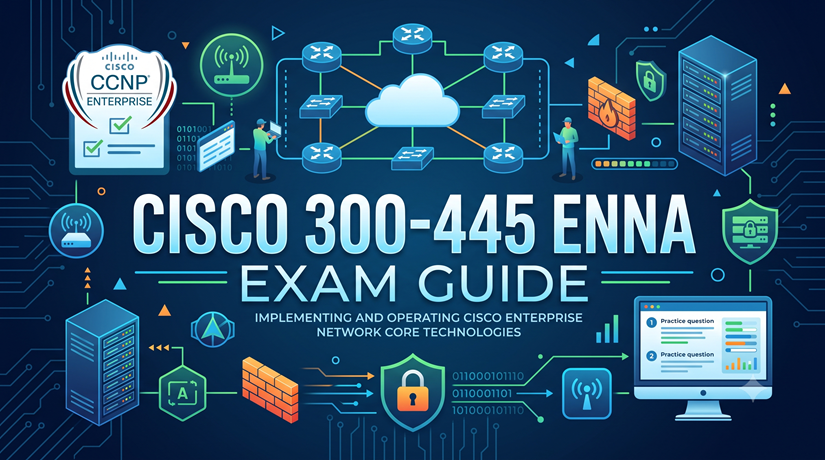
This is the environment addressed by the Cisco 300-445 ENNA exam, formally titled Designing and Implementing Enterprise Network Assurance. Rather than concentrating only on routers and switches, ENNA examines how engineers collect, correlate, and interpret data across users, applications, networks, cloud services, and the public internet.
The exam is particularly relevant to network engineers who want to move beyond traditional device monitoring and develop practical skills in network observability, digital experience monitoring, proactive troubleshooting, and performance assurance.
What Is the Cisco 300-445 ENNA Exam?
Table of Contents
ToggleThe Cisco 300-445 ENNA exam is a professional-level concentration exam associated with the CCNP Enterprise certification. It evaluates a candidate’s ability to design and implement enterprise network assurance solutions, collect operational data, diagnose performance problems, and turn technical information into useful alerts and recommendations.
| Exam Detail | Information |
|---|---|
| Exam code | 300-445 ENNA |
| Official title | Designing and Implementing Enterprise Network Assurance |
| Exam level | Professional concentration |
| Duration | 90 minutes |
| Language | English |
| Certification earned | Cisco Certified Specialist – Enterprise Network Assurance |
| CCNP pathway | Qualifies as a CCNP Enterprise concentration exam |
Passing the exam provides value in two ways. First, it earns the standalone Cisco Certified Specialist – Enterprise Network Assurance certification. Second, it can be combined with the 350-401 ENCOR core exam to meet the examination requirements for CCNP Enterprise.
ENNA is therefore useful both for candidates working toward a broader professional certification and for experienced engineers who want to demonstrate a focused specialization in network assurance.
What Does Enterprise Network Assurance Mean?
Enterprise network assurance is the practice of continuously verifying that users, applications, devices, and network services are operating as expected. It is not limited to asking whether a device is online. A network may be technically available while still providing a poor user experience because of latency, packet loss, DNS delays, unstable routing, wireless interference, or slow application components.
A mature assurance strategy attempts to answer questions such as:
- Can users reach a business-critical application?
- Is the problem inside the local network, the ISP, the cloud provider, or the application?
- Is DNS resolution contributing to a slow page load?
- Are packet loss and jitter affecting voice or video traffic?
- Did a BGP route change alter the path to a service?
- Is an alert showing a genuine service problem or normal variation?
- What data should be presented to network operations, application teams, executives, or service providers?
This broader perspective is what separates network assurance from basic infrastructure monitoring. The goal is not simply to collect more metrics. The goal is to collect the right evidence, understand its context, and use it to protect the end-user experience.
Why Is the Cisco ENNA Certification Valuable?
The value of the Cisco ENNA certification comes from its alignment with the way enterprise applications are now delivered. Many organizations depend on SaaS platforms, hybrid-cloud infrastructure, SD-WAN, remote access, collaboration services, and third-party internet providers. Traditional monitoring tools may provide excellent visibility into owned devices while offering limited insight into external paths and cloud-hosted services.
ENNA introduces a more complete operational model. Candidates are expected to understand infrastructure data, synthetic testing, endpoint visibility, internet routing, application behavior, dashboards, alerting, and platform integrations.
These skills are useful for professionals working in roles such as:
- Enterprise network engineer
- Network operations center engineer
- Network performance analyst
- Digital experience monitoring engineer
- SD-WAN operations engineer
- Network reliability engineer
- Infrastructure or observability specialist
- Technical support and escalation engineer
The certification does not replace strong routing, switching, DNS, TCP/IP, and application fundamentals. Instead, it builds on those foundations and applies them to modern assurance and observability platforms.
Cisco 300-445 ENNA Exam Topics
The official 300-445 ENNA exam topics are organized into four major domains. Candidates beginning their preparation should use the official blueprint as their main checklist and supplement it with structured 300-445 ENNA study resources, practical labs, and scenario-based exercises.
| Domain | Weight |
|---|---|
| 1.0 Platforms and Architecture | 20% |
| 2.0 Data Collection Implementation | 25% |
| 3.0 Data Analysis | 30% |
| 4.0 Insights and Alerts | 25% |
The blueprint is relatively balanced, although Data Analysis receives the largest individual weighting. Candidates should therefore avoid spending all of their preparation time memorizing product features. The ability to interpret evidence and identify the likely cause of a problem is equally important.
Domain 1: Platforms and Architecture — 20%
The first domain covers the architectural decisions behind an enterprise network assurance solution. Before collecting data, an engineer must decide what needs to be observed, where tests should run, which agents are appropriate, and how the resulting information will be consumed.
Agent Types and Placement
Candidates should understand the purposes of different agent types, including synthetic user agents, scripting agents, local collection agents, enterprise agents, and endpoint agents. More importantly, they should understand how agent placement affects visibility.
An agent deployed in a data center provides a different perspective from one running on an employee laptop. A cloud-based agent may verify public availability, while an internal agent can test private applications and corporate services. The correct location depends on the business question being investigated.
Active and Passive Monitoring
Active monitoring generates controlled traffic or transactions to measure service behavior. Examples include sending probes, resolving a DNS record, establishing a TCP connection, loading a webpage, or simulating a user workflow.
Passive monitoring observes traffic and events that already exist. Examples include flow records, device counters, logs, packet captures, and telemetry streams.
Both approaches are useful. Active monitoring provides repeatable tests and can detect problems before users report them. Passive monitoring shows what happened to real traffic. A well-designed assurance solution often combines the two.
Baselines and Integrations
The exam also expects candidates to understand metric baselines. A fixed threshold is not always enough because normal performance may differ by location, time of day, network type, or application. A baseline provides context for deciding whether a measurement represents expected behavior or a meaningful deviation.
Integration choices may include APIs, alerting systems, OpenTelemetry, IT service management platforms, webhooks, and operational dashboards. Candidates should be able to select an integration method based on who needs the data and what action should follow.
Cisco Assurance Platforms
ENNA includes several Cisco technologies and integrations, including:
- Cisco ThousandEyes
- Cisco Catalyst SD-WAN Manager
- Cisco Catalyst Center
- Webex Control Hub
- Cisco Meraki
- Cisco Secure Client
- ThousandEyes WAN Insights
You do not need to treat each product as an isolated subject. Focus on how the platforms exchange data and provide different views of application, network, internet, and user experience.
Domain 2: Data Collection Implementation — 25%
The second domain moves from design to implementation. It covers the deployment of agents and the configuration of tests used to collect network and application performance information.
Enterprise and Endpoint Agents
Enterprise agents are commonly placed on application servers, network devices, virtual infrastructure, or dedicated systems. They provide a controlled location from which tests can be executed.
Endpoint agents provide visibility from the user’s device. This is especially important for remote and hybrid workers because their experience may be influenced by Wi-Fi quality, local gateways, VPN paths, proxies, DNS servers, and internet providers that are invisible to traditional data-center monitoring.
Candidates should understand deployment considerations for Windows, macOS, and supported collaboration endpoints, as well as methods for scaling agent deployment across an organization.
Network, DNS, Voice and Web Tests
The exam blueprint includes the configuration of tests for several service types:
- TCP and UDP connectivity
- Packet loss, latency, and jitter
- Network path and routing behavior
- DNS server and domain resolution
- Voice service performance
- HTTP and web application availability
- Page loading and browser behavior
Do not learn these as a list of menu options. Understand what each test measures and when it should be selected. For example, a successful ICMP test does not prove that an HTTPS application is working correctly. A DNS test may succeed even when the web server is unavailable. A page-load test can reveal dependencies that a simple server availability check will miss.
Synthetic Web Testing
Synthetic web tests reproduce controlled user actions. A basic test may request a URL, while a more advanced scripted test may log in, navigate through several pages, submit a form, or verify that a specific element appears.
Candidates should understand both the benefits and limitations of synthetic testing. A synthetic transaction is consistent and repeatable, but it does not always represent every real user, browser, device, or geographic condition.
The blueprint also covers authentication methods that may be required when testing protected applications, including:
- Basic and digest authentication
- Bearer tokens
- OAuth
- SAML
- Single sign-on
This is an area where practical experience is valuable. Authentication problems can easily be mistaken for application or network failures when the test itself has not been configured correctly.
Domain 3: Data Analysis — 30%
Data Analysis is the largest domain in the Cisco 300-445 ENNA exam. It tests whether candidates can turn collected measurements into a defensible technical diagnosis.
Network Problem Diagnosis
Candidates should be able to recognize evidence of:
- Packet loss
- Network congestion
- Excessive latency
- Jitter
- Routing changes
- Unstable network paths
- Application reachability problems
A useful troubleshooting habit is to separate the location of the symptom from the location of the cause. A user may experience a slow application, but the cause could be a local wireless network, a DNS server, an ISP path, a cloud service, or the application itself.
Endpoint and Remote-User Issues
Endpoint analysis may involve the default gateway, local network, DNS configuration, proxy, VPN gateway, wired or wireless connection, and real-time application performance.
For remote employees, several conditions may exist at the same time. A weak Wi-Fi connection may create local packet loss, while a congested VPN gateway adds latency. ENNA candidates should learn to correlate multiple data points rather than stop at the first abnormal metric.
Web Application Analysis
Browser waterfall analysis is another important topic. A waterfall shows how the browser loads the components of a webpage over time. It can help identify:
- Slow DNS resolution
- Delayed TCP or TLS establishment
- Long server response time
- Large files
- Redirect chains
- Third-party content delays
- Blocked or failed requests
This part of the exam requires candidates to think beyond the network layer. A path may have acceptable latency while the page remains slow because the server takes too long to respond or a third-party script delays rendering.
Security Events Affecting Performance
The ENNA blueprint also includes security-related events that can affect connectivity or performance, such as:
- Distributed denial-of-service attacks
- DNS hijacking
- BGP hijacking
- Route leaking
The objective is not to turn the exam into a full cybersecurity certification. Candidates should understand how these events appear in assurance data and how they may change reachability, routing paths, latency, or service availability.
Domain 4: Insights and Alerts — 25%
Collecting and analyzing data is only useful when the information reaches the right people at the right time. The final domain focuses on alert design, validation, reporting, and optimization.
Network Alert Conditions
Candidates should be familiar with alerts based on conditions such as:
- TCP behavior
- Congestion and throughput
- Interface and error counters
- BGP routing state
- Internet performance
- MPLS and VPN conditions
- NetFlow data
- SNMP information
- Syslog events
A technically valid threshold is not necessarily an operationally useful alert. If a rule triggers too frequently, the operations team may begin ignoring it. If the threshold is too relaxed, the alert may arrive after users are already affected.
User-Experience Alerts
Alerts may also be based on endpoint CPU utilization, changes between wired and wireless connections, Wi-Fi quality, browser behavior, VPN performance, or other conditions affecting the user’s experience.
The key is to connect a technical measurement to a meaningful service condition. An isolated increase in latency may not require action, but an increase that coincides with application failure across several locations deserves immediate attention.
Dashboards and Stakeholder Reporting
Different audiences need different information. A network operations team may require detailed paths, interfaces, and timestamps. An application team may need transaction timing and server response information. Executives may only need service availability, user impact, and business risk.
ENNA candidates should be able to select suitable metrics and deliverables for:
- IT operations teams
- Production support
- Application and development teams
- Service providers
- Business and executive stakeholders
Capacity and Performance Optimization
The final objective is to use collected evidence to recommend improvements. These may include topology changes, configuration adjustments, additional capacity, revised routing, improved agent placement, or QoS policy changes.
The strongest recommendation is one supported by a clear chain of evidence: what users experienced, what the data showed, where the problem occurred, and how the proposed change addresses it.
How Much Does the ENNA Exam Focus on Cisco ThousandEyes?
Cisco ThousandEyes is a major technology throughout the ENNA blueprint. Candidates should expect to understand agent deployment, test configuration, endpoint monitoring, internet path visibility, web testing, dashboards, and alerting.
However, ENNA should not be treated as a simple ThousandEyes interface exam. The blueprint also requires knowledge of:
- TCP/IP and UDP behavior
- DNS operations
- BGP routing
- Web application performance
- Authentication methods
- NetFlow, SNMP, and syslog
- MPLS, VPN, and SD-WAN environments
- APIs, OpenTelemetry, and ITSM integration
- QoS and capacity planning
Memorizing where a button appears in the user interface is not enough. Interfaces change over time. The underlying purpose of a test, metric, or alert is more likely to remain relevant.
Who Should Take the Cisco 300-445 ENNA Exam?
The exam is a good choice for network professionals who already understand basic enterprise networking and want to develop deeper operational visibility.
It may be particularly suitable for:
- CCNA-certified professionals moving toward CCNP Enterprise
- Network engineers supporting cloud and SaaS applications
- NOC engineers responsible for performance and availability
- Engineers deploying Cisco ThousandEyes
- SD-WAN administrators who need broader path visibility
- Support engineers investigating intermittent user problems
- IT professionals working with Webex, Meraki, Catalyst Center, or Cisco Secure Client
For beginners, CCNA-level knowledge is a sensible starting point. You should be comfortable with IP addressing, routing, switching, TCP and UDP, DNS, VPN concepts, QoS, and common troubleshooting methods before beginning serious ENNA preparation.
Recommended Cisco 300-445 ENNA Study Plan
A preparation period of approximately six to ten weeks is reasonable for many candidates, although the actual time depends on existing networking and ThousandEyes experience. A balanced approach should combine documentation, video training, hands-on configuration, and carefully selected Cisco ENNA exam preparation materials.
Week 1: Review the Foundations
- Review TCP, UDP, ICMP, DNS, and HTTP fundamentals.
- Study latency, loss, jitter, throughput, and congestion.
- Review BGP path selection and common routing problems.
- Understand the difference between availability and performance.
Week 2: Learn Assurance Architecture
- Compare active and passive monitoring.
- Study agent types and placement decisions.
- Learn how baselines and thresholds are used.
- Review Cisco platform integrations in the blueprint.
Weeks 3 and 4: Practice Data Collection
- Deploy or explore Enterprise and Endpoint Agents.
- Configure network, DNS, HTTP, and page-load tests.
- Review voice-related latency, loss, and jitter measurements.
- Practice synthetic browser tests and authentication concepts.
Week 5: Develop Analysis Skills
- Interpret path visualization and hop-by-hop changes.
- Analyze packet loss and latency patterns.
- Review browser waterfall examples.
- Separate endpoint, network, internet, and application causes.
Week 6: Configure Insights and Alerts
- Create alert rules with realistic thresholds.
- Compare static thresholds with baseline-based conditions.
- Test alert delivery and recovery behavior.
- Build dashboards for different operational audiences.
Week 7: Study Integrations and Optimization
- Review APIs, webhooks, ITSM, and OpenTelemetry concepts.
- Study NetFlow, SNMP, and syslog use cases.
- Practice turning data into capacity or QoS recommendations.
- Review Catalyst SD-WAN, Catalyst Center, Webex, and Meraki integrations.
Week 8: Final Review
- Work through every item in the official exam blueprint.
- Identify weak areas rather than repeatedly reviewing familiar topics.
- Practice scenario-based troubleshooting.
- Review terminology, test selection, and alert design.
Practical Lab Ideas for ENNA Preparation
Hands-on practice is one of the best ways to prepare for this exam. Even a small lab can help connect product features with real troubleshooting decisions.
-
Compare tests from different locations.
Run similar tests from an internal agent, cloud agent, or endpoint and compare the results. -
Create a DNS and web troubleshooting workflow.
Test DNS resolution, server availability, HTTP response, and full page loading separately. -
Introduce controlled latency or packet loss.
Use a safe lab environment to observe how different tests and dashboards represent degraded performance. -
Analyze a browser waterfall.
Identify DNS, connection, TLS, server response, download, and third-party resource delays. -
Build and validate an alert.
Configure a condition, trigger it in the lab, verify notification delivery, and confirm that the alert clears correctly. -
Troubleshoot from the user’s perspective.
Begin with a user complaint and determine whether the problem is local, network-based, internet-related, or application-based. -
Create two different dashboards.
Build one detailed view for engineers and one high-level service view for management.
After completing your labs, use 300-445 ENNA practice questions as a knowledge check. Practice questions are most useful when you review why each option is correct or incorrect instead of simply memorizing an answer.
Common ENNA Preparation Mistakes
Studying Only Product Screenshots
Product interfaces are useful, but screenshots cannot replace an understanding of protocols, metrics, and troubleshooting logic. Always ask what a test measures and what conclusion can reasonably be drawn from the result.
Ignoring Application-Layer Behavior
A network engineer may naturally focus on routing and packet delivery. ENNA also requires an understanding of DNS, HTTP, authentication, browser waterfalls, server response time, and application dependencies.
Memorizing Alerts Without Understanding Noise
An alert is only useful when it identifies a meaningful condition. Learn how thresholds, baselines, duration, location, and multiple affected agents influence the quality of an alert.
Skipping Endpoint Troubleshooting
Remote-user problems are an important part of modern network operations. Review Wi-Fi, default gateway, proxy, VPN, DNS, CPU utilization, and local connectivity issues.
Treating Every Abnormal Metric as the Root Cause
Correlation does not automatically prove causation. A routing change and an application slowdown may occur at the same time without one causing the other. Look for consistent evidence across several measurements.
Relying Only on Question Memorization
Scenario-based professional exams require candidates to apply concepts in unfamiliar situations. Question-based review can expose weak areas, but it should support rather than replace official documentation, networking fundamentals, and hands-on practice.
Exam-Day Advice
- Read each question carefully and identify the business or technical objective.
- Determine whether the question is asking about design, configuration, diagnosis, or reporting.
- Pay attention to the location of the agent and the perspective of the collected data.
- Separate network reachability from application availability.
- Look for the answer that provides the required visibility with the least unnecessary complexity.
- When diagnosing a problem, map each symptom to the endpoint, local network, WAN, internet, cloud, or application layer.
- Do not rely on an unofficial passing-score estimate because Cisco does not normally publish a fixed passing score for each certification exam.
Is Cisco 300-445 ENNA Worth Taking?
The Cisco 300-445 ENNA exam is worth considering if your work involves applications and users that extend beyond a traditional campus or data center. It is especially relevant when your organization depends on SaaS, public-cloud infrastructure, remote employees, SD-WAN, collaboration platforms, or internet-based services.
The exam’s strongest value is its operational focus. It encourages engineers to move from device-by-device monitoring toward service-oriented assurance. Instead of asking only whether a router is functioning, an ENNA-trained engineer asks whether the entire delivery path is providing the experience the business expects.
For CCNP Enterprise candidates, ENNA also offers a distinct specialization compared with routing, design, automation, or SD-WAN concentration exams. It is a logical choice for professionals whose daily responsibilities include monitoring, troubleshooting, observability, application performance, and user experience.
Frequently Asked Questions
What is the Cisco 300-445 ENNA exam?
It is the Designing and Implementing Enterprise Network Assurance exam. It validates knowledge of assurance architecture, data collection, troubleshooting, analysis, dashboards, alerts, and performance optimization.
What certification do I earn by passing 300-445 ENNA?
Passing the exam earns the Cisco Certified Specialist – Enterprise Network Assurance certification.
Does passing ENNA automatically earn CCNP Enterprise?
No. ENNA satisfies the concentration exam requirement. To earn CCNP Enterprise, candidates must also pass the required 350-401 ENCOR core exam.
How long is the Cisco ENNA exam?
The Cisco 300-445 ENNA exam has a duration of 90 minutes. Candidates should verify the current exam information with Cisco before registration because exam policies may change.
Is ENNA mainly a ThousandEyes exam?
ThousandEyes is a major part of the blueprint, but the exam also covers networking fundamentals, DNS, web performance, routing, security-related events, Meraki Insight, telemetry, alerting, integrations, QoS, and capacity planning.
Is the ENNA exam suitable for beginners?
It is possible for a motivated beginner to study for ENNA, but the exam is easier to approach with CCNA-level knowledge and some practical experience in enterprise networking and troubleshooting.
How difficult is the Cisco 300-445 ENNA exam?
The difficulty is moderate to challenging. Candidates must understand both technical concepts and practical interpretation. Experience with ThousandEyes or another observability platform can make preparation more manageable.
How long should I study for 300-445 ENNA?
Many candidates may need six to ten weeks of focused study. Engineers who already work with ThousandEyes, Meraki, SD-WAN, or digital experience monitoring may require less time.
Where can I find Cisco 300-445 ENNA study materials?
Candidates should begin with the official Cisco exam blueprint and training documentation. These can be supplemented with labs, technical videos, community discussions, and a structured Cisco 300-445 ENNA exam study course to identify topics that require additional review.
Final Thoughts
The Cisco 300-445 ENNA exam reflects an important change in enterprise networking. Engineers are no longer responsible only for infrastructure they directly own. They must also understand how internet paths, cloud services, remote endpoints, DNS, web applications, and third-party platforms affect the user experience.
Successful preparation requires more than memorizing Cisco product terminology. Build a strong understanding of what each test measures, how data from different sources can be correlated, and how technical findings should be communicated to operational and business teams.
If you combine the official blueprint with practical labs, scenario-based troubleshooting, and comprehensive Cisco ENNA certification preparation, the ENNA exam can provide a useful bridge between traditional network engineering and modern network observability.
Official Cisco References
-
Cisco 300-445 ENNA Exam Overview
-
Official Cisco 300-445 ENNA Exam Topics
-
Designing and Implementing Enterprise Network Assurance Training
-
CCNP Enterprise Exams and Training
Exam names, prices, languages, topic weights, and certification policies may change. Candidates should verify the latest information on Cisco’s official website before scheduling the exam. Study resources should be used in accordance with Cisco’s candidate agreements and examination policies.