Enterprise networking is no longer limited to connecting offices, data centers, and remote branches. Modern network engineers are increasingly responsible for connecting users and applications across private data centers, public cloud platforms, software-as-a-service environments, and secure internet gateways.
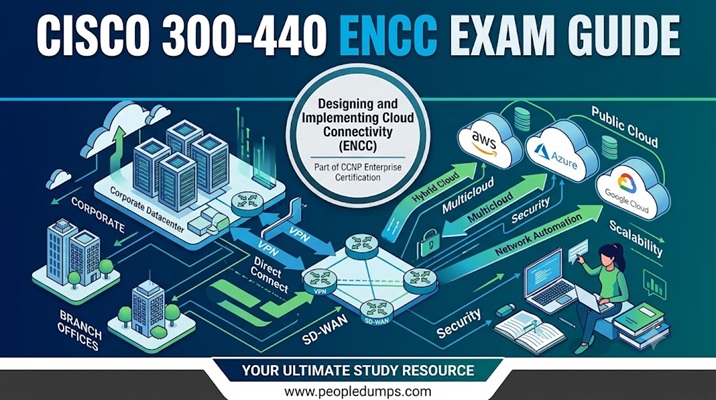
The Cisco 300-440 ENCC exam, officially named Designing and Implementing Secure Cloud Connectivity, is designed for professionals who need to build and operate these hybrid and multicloud connections. It combines traditional enterprise networking skills with cloud architecture, IPsec, routing, Cisco Catalyst SD-WAN, security policy, and troubleshooting.
This guide explains what the 300-440 ENCC exam covers, how it fits into the Cisco certification program, which technical skills candidates should develop, and how to create a practical preparation plan. Candidates looking for additional preparation support can also review these Cisco 300-440 ENCC exam preparation resources.
What Is the Cisco 300-440 ENCC Exam?
Table of Contents
ToggleThe Cisco 300-440 ENCC exam validates a candidate’s ability to design, implement, and troubleshoot secure connectivity between enterprise networks and cloud environments.
Unlike a general cloud certification, ENCC does not focus primarily on deploying virtual machines, databases, or cloud-native applications. Its focus is the network path between users, branches, data centers, cloud workloads, SaaS applications, and security services.
Candidates are expected to understand how an enterprise can connect to cloud providers such as:
- Amazon Web Services
- Microsoft Azure
- Google Cloud
The exam also covers connectivity to SaaS platforms and secure internet gateways through traditional IPsec solutions and Cisco Catalyst SD-WAN.
Cisco 300-440 ENCC Exam Details
| Exam item | Current information |
|---|---|
| Exam code | 300-440 |
| Exam abbreviation | ENCC |
| Official exam name | Designing and Implementing Secure Cloud Connectivity |
| Version | v1.0 |
| Exam duration | 90 minutes |
| Exam price | US$300, subject to regional pricing and future changes |
| Available languages | English and Japanese |
| Certification earned | Cisco Certified Specialist – Enterprise Cloud Connectivity |
| CCNP pathway | Counts as a CCNP Enterprise concentration exam |
Cisco does not require candidates to hold a CCNA certification before attempting a professional-level concentration exam. However, the absence of a formal prerequisite should not be confused with an entry-level difficulty level.
A candidate should ideally have a solid understanding of routing, VPN technologies, enterprise WAN design, Cisco IOS XE, and basic cloud networking before starting serious ENCC preparation.
Which Certification Do You Earn by Passing 300-440 ENCC?
Passing the exam earns the Cisco Certified Specialist – Enterprise Cloud Connectivity certification.
This specialist credential can stand on its own. It demonstrates focused knowledge in enterprise-to-cloud connectivity, secure tunneling, cloud routing, SD-WAN integration, and operational troubleshooting.
The exam can also be used as the concentration requirement for the CCNP Enterprise certification. To earn the full CCNP Enterprise credential, a candidate must pass:
- The 350-401 ENCOR core exam
- One eligible CCNP Enterprise concentration exam, such as 300-440 ENCC
The two exams may be taken in either order. A network engineer who works heavily with cloud connectivity could therefore take ENCC first, earn the specialist certification, and complete ENCOR later.
Who Should Consider the Cisco ENCC Certification?
The 300-440 ENCC exam is particularly relevant to professionals who connect enterprise networks to public cloud, SaaS, and cloud-delivered security services.
Suitable roles include:
- Enterprise network engineers
- Cloud network engineers
- SD-WAN engineers
- Network security engineers
- Cloud connectivity architects
- Network consultants
- Infrastructure engineers
- Cloud operations engineers
- Systems engineers supporting hybrid environments
The exam may also interest students who already understand CCNA-level networking and want to move toward cloud networking. Beginners should be prepared to spend additional time learning BGP, OSPF, IPsec, Cisco IOS XE, and SD-WAN fundamentals.
Before beginning a structured study schedule, candidates may find it useful to review a dedicated Cisco ENCC study course alongside the official exam blueprint.
Cisco 300-440 ENCC Exam Topics
The official ENCC v1.0 blueprint divides the exam into five domains.
| Domain | Weight |
|---|---|
| Architecture Models | 15% |
| Design | 15% |
| IPsec Cloud Connectivity | 25% |
| SD-WAN Cloud Connectivity | 25% |
| Operation | 20% |
The weighting shows that ENCC is not simply a cloud architecture exam. Half of the blueprint is dedicated to implementing IPsec and Cisco Catalyst SD-WAN cloud connectivity, while another 20% focuses on diagnosing operational problems.
1. Architecture Models – 15%
The architecture domain tests whether candidates understand the main ways an enterprise can reach cloud and SaaS environments.
Internet-Based Cloud Connectivity
Internet-based connectivity is often the fastest and most economical way to connect an enterprise site to a public cloud. However, traffic crossing the public internet normally requires encryption and careful availability planning.
Candidates should understand approaches such as native IPsec connectivity and Cisco Catalyst SD-WAN cloud connectivity. They should also recognize how internet path quality, ISP diversity, tunnel redundancy, and routing design affect the solution.
Private Cloud Connectivity
Private connectivity can provide more predictable performance than a public internet path. Depending on the design, an enterprise might connect to a cloud provider through:
- An MPLS service provider
- A colocation facility
- A software-defined cloud interconnect
- A regional cross-connect service
The exam does not only ask candidates to recognize these models. Candidates should understand when private connectivity is justified by bandwidth, latency, reliability, security, or compliance requirements.
SaaS Connectivity Models
SaaS applications create a different design problem because users may access them from offices, branches, remote locations, or directly over the internet.
The blueprint includes direct internet access, indirect access through a cloud security provider, centralized internet gateways, and dedicated connections to SaaS providers.
A good candidate should be able to explain the trade-offs. Centralized internet access may simplify inspection and policy enforcement, but it can also introduce latency and backhaul traffic. Direct internet access can improve application performance, but security controls must be distributed appropriately.
2. Design – 15%
The design portion of the Cisco ENCC exam requires more than memorizing product features. Candidates must select a connectivity model based on technical and business requirements.
Availability and Resiliency
A cloud connection is not automatically highly available. Engineers must consider:
- Redundant routers and tunnel endpoints
- Multiple internet service providers
- Multiple cloud availability zones or regions
- Diverse physical paths
- Routing convergence
- Failure detection
- Service-level agreements
A design may appear redundant on a diagram while still depending on a single colocation facility, provider circuit, cloud region, or physical path. ENCC candidates should learn to identify these hidden failure domains.
Bandwidth, QoS, Routing, and Multihoming
Cloud connectivity decisions also depend on traffic volume and application behavior. A backup IPsec tunnel may provide sufficient resiliency for a small branch but may not support the production traffic of a large data center.
Candidates should evaluate dedicated versus shared connectivity, bandwidth requirements, quality of service, routing behavior, and multihoming. They should also understand how route advertisements influence inbound and outbound paths.
Compliance Requirements
The exam blueprint references frameworks and standards such as NIST, FedRAMP, and ISO. Candidates are not expected to become compliance auditors, but they should understand how compliance requirements can affect architecture.
Examples include encryption requirements, traffic inspection, logging, segmentation, data location, access control, and the use of approved cloud services.
Cloud Security Policy
Cloud security is not limited to traffic entering from the internet. Engineers must consider:
- North-south traffic entering or leaving the cloud
- East-west traffic between cloud workloads
- Internet traffic backhauled through enterprise security controls
- Direct cloud-to-internet communication
- Inbound connectivity from external users or services
Understanding traffic direction is important because the inspection and routing requirements for east-west traffic may be very different from those used for branch-to-cloud communication.
3. IPsec Cloud Connectivity – 25%
IPsec is one of the largest sections of the exam. Candidates should be able to configure secure connectivity, not merely describe how encryption works.
GRE over IPsec Connectivity
GRE can carry multicast and dynamic routing traffic, while IPsec provides confidentiality, integrity, and authentication. Combining the two technologies allows an enterprise router to establish an encrypted routed connection to a compatible cloud endpoint or secure internet gateway.
Candidates should understand tunnel addressing, tunnel source and destination selection, IPsec protection, routing over the tunnel, maximum transmission unit considerations, and the effect of encryption overhead.
Native IPsec Connectivity
The exam also covers IPsec connectivity between an on-premises Cisco IOS XE router and cloud endpoints in AWS, Azure, and Google Cloud.
Important concepts include:
- IKE negotiation
- Encryption and integrity algorithms
- Authentication methods
- IPsec security associations
- Traffic selectors
- Tunnel redundancy
- Dead peer detection
- NAT traversal
- Route-based VPN behavior
Configuration knowledge should be supported by operational understanding. A candidate should know what happens when IKE succeeds but the IPsec security association does not form, or when the tunnel is active but application traffic still fails.
Cloud Routing with BGP and OSPF
Encryption only creates the secure transport. Routes must still be exchanged correctly between the enterprise and cloud networks.
The ENCC blueprint includes BGP, OSPF, redistribution, and static routing on Cisco IOS XE. Candidates should understand:
- BGP neighbor establishment
- Route advertisement and filtering
- Autonomous system design
- Path selection
- OSPF adjacency formation
- Default-route behavior
- Redistribution between routing domains
- Route feedback and routing loops
- Static route failover
Redistribution deserves particular attention. It is easy to create duplicate advertisements, suboptimal paths, or loops when routes move between cloud, WAN, and enterprise routing domains.
Because IPsec and routing represent a substantial part of the blueprint, candidates should combine configuration labs with focused 300-440 ENCC practice resources to identify topics that still require more hands-on work.
4. SD-WAN Cloud Connectivity – 25%
Cisco Catalyst SD-WAN is another major part of the 300-440 ENCC exam. Candidates should understand how SD-WAN extends enterprise policy and segmentation into cloud-connected environments.
Secure Connectivity to Public Cloud
The exam covers Cisco Catalyst SD-WAN connectivity to AWS, Azure, Google Cloud, and secure internet gateways.
Candidates should understand how SD-WAN edges establish overlay connectivity, how routes are exchanged across the fabric, and how centralized management can simplify deployment across multiple sites and clouds.
It is also important to understand the relationship between the underlay and overlay. A healthy internet circuit does not guarantee a healthy SD-WAN tunnel, and a functioning tunnel does not guarantee that the correct routes or policies are active.
Cloud OnRamp for SaaS
Cloud OnRamp for SaaS helps select appropriate network paths for supported SaaS applications. Rather than sending traffic through a fixed centralized gateway, the SD-WAN solution can evaluate available paths and improve application access.
Candidates should understand the purpose of SaaS path monitoring, application-aware routing, local internet breakout, and policy-based path selection.
North-South and East-West Policies
The blueprint expects candidates to configure policies affecting both north-south and east-west traffic.
- North-south traffic generally moves between cloud environments and external networks, branches, users, or the internet.
- East-west traffic generally moves between applications, virtual networks, regions, or workloads inside the broader cloud environment.
Policy topics include security, routing, and application behavior. Candidates should understand how an apparently small policy change can affect route reachability, segmentation, service insertion, or application performance across the entire SD-WAN fabric.
5. Operation – 20%
The operation domain measures a candidate’s ability to diagnose problems across IPsec, routing, SD-WAN, and policy layers.
This is one of the most practical parts of the exam because real cloud connectivity incidents rarely belong to only one technology.
Troubleshooting IPsec
A structured IPsec troubleshooting process should check:
- Basic IP reachability between tunnel endpoints
- IKE negotiation
- IPsec security association establishment
- Encryption and decryption counters
- Traffic selectors and access control rules
- Routing through the tunnel
- MTU, fragmentation, and application behavior
Checking the tunnel status alone is not sufficient. An IPsec tunnel may be established even when the enterprise is advertising the wrong routes or when a cloud security policy is blocking traffic.
Troubleshooting Routing
Routing problems may include missing prefixes, incorrect next hops, BGP session failures, OSPF adjacency problems, redistribution loops, or asymmetric paths.
Candidates should be comfortable reading routing tables, examining protocol neighbors, verifying advertised routes, and comparing the control plane with the actual data path.
Troubleshooting Catalyst SD-WAN
SD-WAN troubleshooting should separate the problem into layers:
- Underlay connectivity
- Control connections
- Overlay tunnels
- Route distribution
- Centralized policy
- Application policy
- Security policy
This layered approach prevents engineers from changing policy when the real problem is an unstable internet circuit or attempting to repair the underlay when a centralized route policy is rejecting the required prefixes.
How Difficult Is the Cisco 300-440 ENCC Exam?
The exam is best described as professional-level and implementation-focused. It can be challenging because candidates must combine several technology areas rather than study them independently.
A routing engineer may already understand BGP and IPsec but need more experience with cloud networking and SD-WAN policy. A cloud engineer may understand AWS or Azure networking but need deeper knowledge of Cisco IOS XE, routing redistribution, or VPN troubleshooting.
The most difficult part is often understanding how the technologies interact. For example, a failed cloud application session could be caused by:
- An incorrect cloud route table
- A missing BGP advertisement
- An IPsec traffic-selector mismatch
- A security policy
- An SD-WAN centralized policy
- An asymmetric return path
- An MTU problem
Successful preparation therefore requires configuration and troubleshooting practice, not only reading documentation.
Recommended Knowledge Before Studying for ENCC
Candidates should ideally be comfortable with the following subjects before beginning an intensive study plan:
- IPv4 addressing and subnetting
- Static and dynamic routing
- BGP and OSPF fundamentals
- Route filtering and redistribution
- IPsec and IKE concepts
- Cisco IOS XE configuration
- Basic enterprise WAN architecture
- Cloud virtual networks and route tables
- High availability and redundancy
- Basic Cisco Catalyst SD-WAN architecture
CCNA-level knowledge is a useful foundation, but ENCC candidates normally need additional professional-level routing and WAN experience.
A Practical Eight-Week ENCC Study Plan
Week 1: Review Routing and Cloud Fundamentals
Review BGP, OSPF, static routing, route redistribution, and route filtering. Study the basic networking constructs used by AWS, Azure, and Google Cloud, including virtual networks, subnets, gateways, route tables, and security controls.
Week 2: Study Cloud Connectivity Architectures
Compare internet VPNs, MPLS connectivity, colocation, software-defined cloud interconnects, direct cloud connections, centralized internet access, and local breakout.
Create simple diagrams showing where encryption, routing, and security inspection occur in each model.
Week 3: Study Design and High Availability
Practice selecting connectivity models based on cost, bandwidth, latency, availability, compliance, and operational complexity.
Pay close attention to failure domains, multihoming, route preference, and regional redundancy.
Week 4: Build IPsec and GRE/IPsec Labs
Configure tunnels between Cisco IOS XE routers. Verify IKE and IPsec security associations, tunnel routing, packet counters, and failover behavior.
Intentionally introduce errors such as incorrect pre-shared keys, mismatched proposals, wrong tunnel destinations, missing routes, and blocked traffic.
Week 5: Practice BGP, OSPF, and Redistribution
Establish routing across encrypted tunnels. Practice advertising selected prefixes, applying route filters, changing path preference, injecting default routes, and redistributing between protocols.
Document how you would detect and prevent route loops.
Week 6: Study Cisco Catalyst SD-WAN Cloud Connectivity
Review SD-WAN controllers, WAN edges, control connections, overlay tunnels, route distribution, Cloud OnRamp, and application-aware routing.
Focus on how cloud connectivity is deployed and managed rather than memorizing isolated interface screens.
Week 7: Practice Policy and Troubleshooting
Study routing, security, and application policies for north-south and east-west traffic. Work through troubleshooting scenarios that combine underlay, overlay, routing, and policy failures.
Week 8: Review the Blueprint
Use the official exam topics as a checklist. For every objective, determine whether you can:
- Explain the concept without notes
- Compare it with alternative designs
- Configure the required feature
- Verify that it is working
- Troubleshoot common failures
Spend the final days strengthening weak areas instead of repeatedly reviewing topics you already understand. A structured set of ENCC exam study materials can also help organize the final review around the major blueprint domains.
Recommended Lab Approach
A useful ENCC lab does not need to reproduce a large production cloud environment. The goal is to build enough complexity to observe routing, encryption, and policy behavior.
A basic practice environment can include:
- Two or more Cisco IOS XE virtual routers
- Multiple simulated enterprise and cloud networks
- GRE and IPsec tunnels
- BGP and OSPF routing
- Route redistribution
- Redundant tunnel paths
- Access control and security policies
- Packet capture and verification tools
Where possible, add a small AWS, Azure, or Google Cloud lab. Even limited cloud experience helps candidates understand provider-side route tables, gateways, security rules, and VPN configuration.
Each lab should include failure testing. Break the tunnel, remove a route, change a policy, create an asymmetric path, or introduce an MTU issue. Troubleshooting the failure is usually more educational than completing the initial configuration.
Common ENCC Preparation Mistakes
Studying Only One Cloud Provider
The exam references AWS, Azure, and Google Cloud. Candidates do not need to become administrators for all three platforms, but they should recognize the common connectivity patterns and provider-specific terminology.
Memorizing IPsec Theory Without Configuring It
Knowing the purpose of IKE and IPsec is not enough. Candidates should be able to interpret security associations, identify mismatched settings, and determine whether packets are being encrypted and decrypted.
Ignoring Return-Path Routing
Engineers often verify that traffic can reach the cloud but forget to confirm that the cloud has a valid return route. Cloud route tables and enterprise advertisements must be checked in both directions.
Treating SD-WAN as a Black Box
Candidates should understand what occurs beneath the centralized management interface. Underlay reachability, control connections, tunnel establishment, route distribution, and policy evaluation remain important.
Skipping Troubleshooting Practice
Twenty percent of the official blueprint is dedicated to operation, while troubleshooting knowledge is also useful throughout the implementation domains. Preparation should include broken configurations and diagnostic commands.
Is the Cisco ENCC Certification Worth It?
The value of ENCC depends on a candidate’s role and career direction. It is particularly valuable for engineers whose responsibilities are expanding from traditional enterprise networking into hybrid cloud, multicloud, SD-WAN, or secure internet access.
The certification demonstrates that the holder can connect networking concepts across several environments. This is increasingly relevant because enterprise applications may be distributed across data centers, cloud regions, SaaS providers, and remote users.
ENCC can be a strong choice when:
- Your organization is moving applications into public cloud
- You support hybrid or multicloud connectivity
- You work with Cisco Catalyst SD-WAN
- You design secure branch-to-cloud access
- You want a cloud-focused CCNP Enterprise concentration
- You need stronger knowledge of IPsec and cloud routing
Engineers focused mainly on advanced campus routing may find ENARSI more directly relevant. Engineers specializing specifically in Cisco SD-WAN implementation may also consider ENSDWI. ENCC is most suitable when cloud connectivity is the central objective.
Frequently Asked Questions About Cisco 300-440 ENCC
What does ENCC stand for?
ENCC is the exam abbreviation used for Cisco 300-440, Designing and Implementing Secure Cloud Connectivity.
Does passing 300-440 earn a certification?
Yes. Passing the exam earns the Cisco Certified Specialist – Enterprise Cloud Connectivity certification.
Does 300-440 count toward CCNP Enterprise?
Yes. ENCC is an eligible CCNP Enterprise concentration exam. Candidates must also pass the 350-401 ENCOR core exam to earn the complete CCNP Enterprise certification.
Do I need CCNA before taking the ENCC exam?
No formal CCNA prerequisite is required. However, candidates should already understand routing, IP networking, VPN concepts, and enterprise network fundamentals.
Which cloud providers appear in the ENCC blueprint?
The official blueprint references Amazon Web Services, Microsoft Azure, and Google Cloud.
Does the exam include Cisco SD-WAN?
Yes. Cisco Catalyst SD-WAN cloud connectivity accounts for 25% of the official blueprint. SD-WAN troubleshooting and policy behavior are also included in the operation domain.
How much of the exam focuses on IPsec?
IPsec Cloud Connectivity represents 25% of the exam blueprint. Candidates should be prepared to configure, verify, and troubleshoot secure cloud connections.
Is ENCC suitable for beginners?
ENCC is a professional-level exam rather than an introductory networking certification. Motivated beginners can prepare for it, but they should first build a strong foundation in routing, Cisco IOS XE, IPsec, and cloud networking.
Where can I find additional 300-440 preparation resources?
Candidates can supplement official Cisco documentation, hands-on labs, and blueprint reviews with a focused Cisco 300-440 ENCC preparation course. Any supporting resource should be used to reinforce technical understanding rather than replace practical configuration and troubleshooting experience.
Final Thoughts
The Cisco 300-440 ENCC exam reflects an important change in the role of the enterprise network engineer. Network boundaries now extend beyond physical offices and data centers into public cloud platforms, SaaS applications, secure internet gateways, and software-defined WAN fabrics.
Preparing for ENCC helps candidates develop a practical combination of architecture, routing, encryption, SD-WAN, security, and troubleshooting skills. The exam is demanding, but its subject matter maps closely to the work performed in modern hybrid and multicloud networks.
The strongest preparation strategy is to follow the official blueprint, build hands-on labs, compare multiple connectivity designs, and practice diagnosing failures across every layer of the network. Candidates who understand not only how to configure a solution but also why it was selected and how it can fail will be in the best position to succeed.
For a more organized review, candidates can explore the complete Cisco ENCC exam preparation page and use it together with official documentation, lab practice, and a blueprint-based study schedule.
Official and Authoritative Cisco 300-440 ENCC Resources
Preparing for the Cisco 300-440 ENCC exam requires more than memorizing individual technologies. Candidates should understand how enterprise networks connect securely to public cloud environments and how technologies such as IPsec, BGP, Cisco Catalyst SD-WAN, and multicloud connectivity work together. The following official and authoritative resources can help you verify the latest exam requirements and deepen your technical knowledge.
- Cisco – Official 300-440 ENCC Exam Page:
Designing and Implementing Secure Cloud Connectivity (300-440 ENCC)
– Cisco’s official exam page containing current information about the ENCC exam, certification outcomes, exam duration, languages, and preparation resources. - Pearson VUE – Cisco Certification Exams:
Cisco Certification Testing with Pearson VUE
– The official Cisco certification testing portal for exam scheduling, rescheduling, test-center information, and online-proctored exam options.