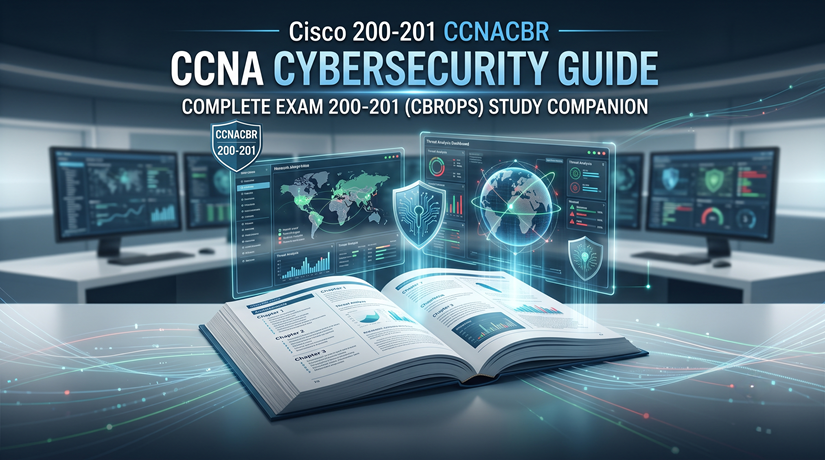
The Cisco 200-201 CCNACBR exam is designed for people who want to understand how cybersecurity operations work in practice. Rather than concentrating only on network configuration, it examines how security analysts monitor systems, investigate suspicious activity, interpret evidence, and respond to incidents.
Passing the exam earns the CCNA Cybersecurity certification, an associate-level Cisco credential aimed at aspiring security operations center analysts, network security professionals, and IT technicians moving into defensive cybersecurity.
You may still find books, courses, and discussion forums that refer to the exam as 200-201 CBROPS, Cisco CyberOps Associate, or Cybersecurity Associate. These names belong to earlier versions of Cisco’s certification branding. The current exam listing uses 200-201 CCNACBR and awards the CCNA Cybersecurity certification.
This guide explains what the exam covers, which technical skills matter most, how valuable the certification can be, and how beginners can prepare without reducing the process to simple question memorization. Candidates who prefer a structured review can also explore these 200-201 CCNACBR study resources alongside official documentation and hands-on laboratory practice.
What Is the Cisco 200-201 CCNACBR Exam?
Table of Contents
ToggleThe full name of the exam is Understanding Cisco Cybersecurity Operations Fundamentals. It tests the foundational knowledge and analytical skills required to work in a modern cybersecurity operations environment.
A traditional networking exam often asks how to build, configure, or troubleshoot infrastructure. CCNACBR approaches the network from a different direction. It asks candidates to look at traffic, logs, alerts, endpoints, and security events from the perspective of a defender.
In practical terms, the exam is about answering questions such as:
- What evidence suggests that a host has been compromised?
- Which log source would provide the most useful information?
- Is an alert a true positive, a false positive, or normal activity?
- What can be learned from a packet capture or NetFlow record?
- Which stage of the incident response process should happen next?
- How should digital evidence be collected and preserved?
Cisco 200-201 CCNACBR Exam Details
| Exam Item | Current Information |
|---|---|
| Exam code | 200-201 CCNACBR |
| Exam name | Understanding Cisco Cybersecurity Operations Fundamentals |
| Current version | v1.2 |
| Associated certification | CCNA Cybersecurity |
| Exam duration | 120 minutes |
| Exam language | English |
| Official list price | US$300 |
| Formal prerequisites | None |
| Recommended background | Basic TCP/IP, Windows, Linux, and cybersecurity knowledge |
Cisco does not require candidates to hold another certification before attempting the exam. However, “no formal prerequisites” should not be interpreted as “no technical preparation required.” Candidates need a working understanding of networking, operating systems, common attacks, security controls, and incident investigation.
Before scheduling the test, it is useful to compare your current knowledge with a complete Cisco 200-201 exam preparation course. This can help identify weak areas that need additional reading or laboratory work.
Current CCNACBR Exam Domains
The official 200-201 CCNACBR v1.2 blueprint is divided into five domains. Security Monitoring carries the largest percentage, but the domains overlap heavily. A packet investigation, for example, may require knowledge of network protocols, attack behavior, log interpretation, and incident response procedures at the same time.
| Domain | Weight | Main Focus |
|---|---|---|
| 1.0 Security Concepts | 20% | Security principles, risk, access control, threat intelligence, CVSS, cloud security, and detection methods |
| 2.0 Security Monitoring | 25% | Monitoring data, firewalls, NetFlow, attack types, encryption, certificates, and visibility challenges |
| 3.0 Host-Based Analysis | 20% | Endpoint security, Windows and Linux evidence, logs, malware analysis, and attribution |
| 4.0 Network Intrusion Analysis | 20% | Packet analysis, IDS/IPS events, protocols, PCAP files, NetFlow, artifacts, and regular expressions |
| 5.0 Security Policies and Procedures | 15% | Incident response, digital forensics, asset management, profiling, protected data, and SOC metrics |
Because the domains are interconnected, effective preparation should combine the official blueprint with practical exercises and carefully reviewed CCNACBR exam practice materials. The objective is to understand why an answer is correct rather than simply remembering it.
1. Security Concepts
The Security Concepts domain builds the vocabulary and decision-making framework used throughout the rest of the exam. Candidates should understand the confidentiality, integrity, and availability triad, commonly known as the CIA triad, as well as defense in depth and the difference between risks, threats, vulnerabilities, and exploits.
Access control is another important area. You should be able to compare discretionary, mandatory, role-based, rule-based, time-based, and attribute-based access control. Authentication, authorization, and accounting must also be understood as separate but related functions.
The current blueprint reaches beyond basic definitions. It includes concepts such as:
- Threat intelligence and threat hunting
- Malware analysis and reverse engineering
- Threat modeling
- DevSecOps
- SIEM and SOAR platforms
- Container, virtual, and cloud security
- CVSS attack, temporal, and environmental metrics
- Rule-based, behavioral, and statistical detection
For beginners, the challenge is not learning every term in isolation. The real goal is understanding how these concepts affect an analyst’s decisions. A vulnerability is not automatically an incident, and a high-volume alert is not automatically a high-risk alert. Context matters.
2. Security Monitoring
Security Monitoring is the largest domain of the exam. It focuses on how security teams collect, interpret, and correlate information from different technologies.
Candidates should recognize the data provided by packet-capture tools, NetFlow, next-generation firewalls, traditional stateful firewalls, web filters, email filters, and application visibility systems. They must also understand how technologies such as NAT, tunneling, encryption, proxies, peer-to-peer traffic, and load balancing can reduce or change visibility.
The exam expects you to distinguish among several categories of security data:
- Full packet data: Detailed packet headers and payloads
- Session data: Information about communication sessions
- Transaction data: Records of specific exchanges or activities
- Statistical data: Aggregated patterns, volumes, and trends
- Metadata: Descriptive information about communications or files
- Alert data: Events generated by security detection systems
Attack knowledge is also tested in this domain. Candidates should understand network-based attacks, denial-of-service attacks, web application attacks, social engineering, ransomware, command-and-control activity, endpoint attacks, and evasion techniques.
The inclusion of both manual and generative-AI-assisted social engineering reflects a broader reality: security analysts must understand not only how infrastructure can be attacked, but also how attackers manipulate users and business processes.
3. Host-Based Analysis
Host-Based Analysis examines what happens on endpoints such as Windows and Linux systems. A strong candidate should be comfortable reading operating-system logs, recognizing suspicious processes, and connecting host evidence to a wider security event.
Important endpoint technologies include host-based intrusion detection, antimalware software, antivirus tools, and host firewalls. The exam may require you to understand how rules, signatures, and predictive analysis contribute to endpoint monitoring.
You should also recognize common investigation concepts:
- Assets and affected systems
- Threat actors
- Indicators of compromise
- Indicators of attack
- Chain of custody
- Best, corroborative, and indirect evidence
Log interpretation deserves special attention. Candidates may need to examine operating-system, application, command-line, SIEM, or SOAR information and decide what happened. Malware-analysis reports may include file hashes, URLs, network connections, process behavior, and system changes.
This is one of the areas where hands-on practice has a clear advantage over reading alone. Opening Windows Event Viewer, reviewing Linux authentication logs, and tracing process activity will make the concepts easier to remember and apply.
4. Network Intrusion Analysis
Network Intrusion Analysis is where networking knowledge and security investigation meet. Candidates should understand how events from IDS/IPS systems, firewalls, proxies, antivirus platforms, application controls, and NetFlow records contribute to an investigation.
A central skill is distinguishing among:
- True positives
- False positives
- True negatives
- False negatives
- Benign activity
These terms may look simple, but they have operational consequences. A false positive wastes analyst time, while a false negative allows malicious activity to pass without detection. Effective security monitoring requires a balance between sensitivity and accuracy.
The CCNACBR blueprint also expects candidates to work with packet captures. You should be able to identify source and destination addresses, ports, protocols, and payloads. You should understand the fields and behavior associated with Ethernet, IPv4, IPv6, TCP, UDP, ICMP, DNS, ARP, email protocols, and HTTP-based traffic.
Wireshark is especially useful during preparation. You do not need to become a full-time packet-forensics expert, but you should be comfortable applying display filters, following TCP streams, locating suspicious DNS activity, identifying unusual port usage, and extracting files from a stream when appropriate.
5. Security Policies and Procedures
Cybersecurity operations are not based only on technical tools. Analysts must follow repeatable procedures so that incidents are handled consistently, evidence remains reliable, and the organization can learn from previous events.
This domain covers asset management, configuration management, patch management, mobile device management, and vulnerability management. It also includes incident response and digital-forensics concepts associated with NIST guidance.
The common incident response phases include:
- Preparation
- Detection and analysis
- Containment, eradication, and recovery
- Post-incident analysis and lessons learned
Candidates should understand where different stakeholders become involved and why evidence collection order, data integrity, data preservation, and volatile-data collection matter during an investigation.
Network and server profiling are also covered. A security analyst needs to know what normal activity looks like before unusual activity can be identified. Useful baseline information includes throughput, session duration, commonly used ports, listening services, logged-in accounts, running processes, scheduled tasks, and installed applications.
Is the CCNA Cybersecurity Certification Valuable?
The value of a certification depends on how it supports your broader skills and career plans. The CCNA Cybersecurity certification is most useful for people who want to build a foundation in defensive security and security operations.
It can be relevant to positions such as:
- Junior SOC analyst
- Cybersecurity operations analyst
- Network security technician
- Security monitoring analyst
- Incident response assistant
- IT operations specialist with security responsibilities
The credential has several practical strengths. Cisco is widely recognized in networking and enterprise IT, while the exam connects networking fundamentals with security monitoring, endpoint investigation, packet analysis, and incident response.
It is also reasonably focused. Candidates do not have to pass several separate exams to earn the certification. One exam covers a coherent set of associate-level cybersecurity operations skills.
At the same time, the certification should not be treated as a guaranteed job offer. Employers will still look for evidence of practical ability. A candidate who can explain a suspicious PCAP, interpret endpoint logs, and document an incident will generally make a stronger impression than someone who can only repeat definitions.
CCNACBR Compared with the Traditional CCNA
The traditional Cisco CCNA and CCNA Cybersecurity serve different purposes.
| Area | Traditional CCNA | CCNA Cybersecurity |
|---|---|---|
| Primary focus | Building and operating networks | Monitoring and defending networks and systems |
| Main technical perspective | Network implementation and administration | Security operations and investigation |
| Common skills | Routing, switching, IP services, automation | Logs, alerts, PCAPs, endpoint evidence, incident response |
| Typical entry-level direction | Network support or network engineering | SOC or cybersecurity operations |
Neither certification is universally better. A student interested in routers, switches, wireless networks, and infrastructure administration may prefer the traditional CCNA. Someone more interested in detecting attacks, investigating alerts, and responding to incidents may find CCNA Cybersecurity more closely aligned with their goals.
There is also considerable overlap. Cybersecurity analysts need networking knowledge, and network engineers increasingly need security knowledge. Studying one area often improves performance in the other.
Recommended Knowledge Before Starting
Beginners can prepare for the 200-201 CCNACBR exam, but several foundations should be in place first.
TCP/IP Networking
Understand IP addressing, ports, TCP and UDP, DNS, HTTP, HTTPS, ICMP, ARP, routing, NAT, and the client-server model. Packet analysis becomes much easier when normal protocol behavior is familiar.
Windows and Linux Fundamentals
You should know basic file systems, user accounts, permissions, services, processes, command-line tools, and log locations. The exam does not require advanced system administration, but it does expect you to interpret host activity.
Basic Security Concepts
Review malware, phishing, vulnerabilities, exploits, firewalls, IDS/IPS, encryption, authentication, authorization, risk, and incident response.
Basic Command-Line Skills
Practice commands used to inspect files, processes, connections, users, and logs. Understanding the output is more important than memorizing a long list of commands.
A Practical Eight-Week Study Plan
The following plan can be adjusted according to your experience and available study time. It works best when reading, laboratory practice, and 200-201 CCNACBR practice questions are used together rather than as separate activities.
| Week | Study Focus | Recommended Practice |
|---|---|---|
| 1 | Networking and security foundations | Review TCP/IP, ports, protocols, the CIA triad, risks, threats, and vulnerabilities |
| 2 | Security tools and monitoring data | Compare firewalls, IDS/IPS, NetFlow, packet captures, metadata, and alerts |
| 3 | Common attacks and cryptography | Study network, web, endpoint, social-engineering, and evasion techniques |
| 4 | Windows and Linux host analysis | Review system logs, processes, users, services, and command-line evidence |
| 5 | Packet and intrusion analysis | Analyze PCAP files, follow TCP streams, inspect DNS, HTTP, TCP, and ICMP traffic |
| 6 | Malware evidence and event correlation | Compare hashes, URLs, host logs, network events, and security alerts |
| 7 | Incident response and forensics | Build an incident timeline and map actions to the appropriate response phase |
| 8 | Review and exam preparation | Take practice assessments, analyze errors, and revisit weak blueprint objectives |
Hands-On Skills Worth Practicing
The exam is easier when abstract concepts are connected to real evidence. A small virtual lab can provide enough experience for associate-level preparation.
- Capture normal DNS and web traffic with Wireshark.
- Use display filters to isolate IP addresses, protocols, ports, and TCP streams.
- Compare packet-capture data with connection or flow summaries.
- Review failed and successful login events on Windows and Linux.
- Identify newly created processes, scheduled tasks, and network connections.
- Build a timeline from several related log entries.
- Calculate file hashes and compare them after a file changes.
- Write a brief incident report containing evidence, scope, actions, and recommendations.
- Classify example alerts as true positives, false positives, or benign activity.
- Practice preserving evidence without altering the original data.
These exercises do not require an expensive enterprise lab. Two virtual machines, a packet-analysis tool, operating-system logs, and several public training PCAPs can provide substantial practice.
Common Preparation Mistakes
Memorizing Terms Without Examining Evidence
Knowing the definition of an indicator of compromise is useful. Being able to recognize one in a log, packet capture, or malware report is more important.
Ignoring Networking Fundamentals
Students sometimes assume a cybersecurity certification will not require much networking. That is a serious mistake. Network intrusion analysis depends on understanding protocols, ports, sessions, addressing, and normal traffic behavior.
Studying All Domains Equally
Every domain matters, but Security Monitoring carries the greatest weight. Allocate additional time to data sources, attack types, network visibility, certificates, and monitoring technologies.
Using Outdated Exam Names as the Only Search Terms
Older CBROPS study materials can still explain many relevant concepts, but your final checklist should be based on the current CCNACBR v1.2 exam blueprint. Search using both the current and former names when locating resources, and verify that all current objectives have been covered.
Relying Only on Question Memorization
Memorized answers provide little help when the wording, evidence, or scenario changes. When working through Cisco CCNACBR exam questions, use each question to identify weak areas. Then return to the underlying technology and determine why every option is correct or incorrect.
How to Know When You Are Ready
You are approaching exam readiness when you can perform the following tasks without depending heavily on notes:
- Explain the difference between a threat, vulnerability, exploit, and risk.
- Compare packet data, flow data, logs, metadata, and alerts.
- Identify important fields in common network protocol headers.
- Interpret basic Windows, Linux, SIEM, and application logs.
- Recognize common web, network, endpoint, and social-engineering attacks.
- Explain true positives, false positives, true negatives, and false negatives.
- Analyze a simple PCAP and describe what the hosts are doing.
- Map an incident to the appropriate response phase.
- Explain how evidence integrity and chain of custody are maintained.
- Describe the next reasonable investigative step in a security scenario.
A practice-test score is helpful, but it should not be your only measurement. Review every missed question and every answer you guessed correctly. A guessed answer may hide a knowledge gap that becomes important on the real exam.
Final Thoughts
The Cisco 200-201 CCNACBR exam provides a structured introduction to the work performed in cybersecurity operations. It covers enough networking to support traffic analysis, enough system knowledge to investigate endpoints, and enough process knowledge to handle incidents in a disciplined way.
Its strongest feature is the connection between technical evidence and operational decisions. Candidates are not studying security only as a collection of products or definitions. They are learning how analysts determine what happened, how serious it is, what evidence supports the conclusion, and what should happen next.
For students and early-career IT professionals, the CCNA Cybersecurity certification can be a useful step toward SOC, network security, and incident-response roles. The best results will come from combining blueprint-based study, hands-on analysis, and a structured 200-201 Cisco CCNACBR exam review that helps reinforce the concepts covered in each domain.
Frequently Asked Questions About the 200-201 CCNACBR Exam
What certification do I earn after passing 200-201 CCNACBR?
Passing the 200-201 CCNACBR exam earns the CCNA Cybersecurity certification.
Is CCNACBR the same as CBROPS?
CCNACBR is the current acronym used for the 200-201 exam. Older study resources may refer to the exam as CBROPS, CyberOps Associate, or Cybersecurity Associate. Candidates should use the current CCNACBR v1.2 blueprint as their final preparation checklist.
Does the CCNACBR exam have formal prerequisites?
No formal certification prerequisite is required. However, candidates should understand basic TCP/IP networking, Windows and Linux operating systems, network security, and common cyberattack methods.
Is the 200-201 exam suitable for beginners?
It is suitable for motivated beginners who have first developed basic networking and operating-system knowledge. Complete beginners may benefit from studying introductory networking and cybersecurity material before starting focused CCNACBR preparation.
Do I need hands-on practice for the exam?
Hands-on practice is strongly recommended. Candidates should be comfortable interpreting logs, examining PCAP files, following TCP streams, recognizing suspicious endpoint activity, and mapping evidence to an incident-response process.
Which CCNACBR domain has the highest weight?
Security Monitoring is the largest domain at 25 percent. Security Concepts, Host-Based Analysis, and Network Intrusion Analysis are each weighted at 20 percent, while Security Policies and Procedures accounts for 15 percent.
What jobs can CCNA Cybersecurity help prepare me for?
The certification is relevant to junior SOC analyst, cybersecurity operations analyst, network security technician, security monitoring analyst, and entry-level incident-response positions. Certification alone does not guarantee employment, so candidates should also build practical skills and a small portfolio of security investigations or lab reports.
Where can I find 200-201 CCNACBR preparation materials?
Candidates can combine Cisco’s official exam blueprint, technical documentation, laboratory exercises, packet-analysis practice, and a structured collection of Cisco 200-201 CCNACBR preparation materials. Using multiple types of resources helps connect theoretical concepts with practical investigation skills.
Should I use older CBROPS books to prepare?
Older CBROPS resources can still be useful for foundational topics, but they may not cover every current objective or branding change. Compare all study materials with the latest official CCNACBR v1.2 exam topics and supplement any missing areas.
Editorial note: Exam names, prices, policies, and objectives can change. Candidates should confirm current details on the official Cisco exam page before registering.
Official and Authoritative CCNA Cybersecurity Resources
To ensure that your 200-201 CCNACBR preparation is based on accurate and up-to-date information, it is important to review official Cisco documentation alongside your study materials. The following resources provide authoritative information about the exam, certification requirements, exam objectives, training options, and exam registration.
- Cisco – Official 200-201 CCNACBR Exam Page:
Understanding Cisco Cybersecurity Operations Fundamentals (200-201 CCNACBR)
– The official Cisco exam page containing current information about the 200-201 CCNACBR exam and preparation resources. - Cisco – CCNA Cybersecurity Certification:
CCNA Cybersecurity Certification Overview
– Cisco’s official certification page explaining the skills and cybersecurity knowledge validated by the CCNA Cybersecurity certification. - Pearson VUE – Cisco Certification Exams:
Cisco Certification Testing with Pearson VUE
– The official testing platform for scheduling, managing, and taking Cisco certification exams.