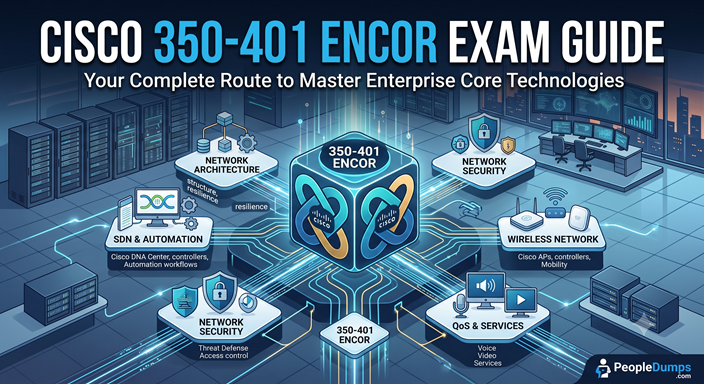
The Cisco 350-401 ENCOR exam is one of the most important professional-level networking exams in the Cisco certification portfolio. It covers the technologies that modern enterprise networks depend on, from traditional routing and switching to software-defined networking, security, network assurance, virtualization, automation, and artificial intelligence.
For students and early-career network engineers, ENCOR can feel like a major step up from associate-level study. The challenge is not simply the number of technologies included in the blueprint. Candidates must understand how those technologies interact inside a real enterprise environment and be able to configure, verify, analyze, and troubleshoot them.
This guide explains what the 350-401 ENCOR exam covers, how it fits into the Cisco certification path, why the credential remains valuable, and how to build a practical study plan without relying on memorization alone.
Cisco 350-401 ENCOR Exam at a Glance
Table of Contents
Toggle| Exam item | Current information |
|---|---|
| Exam code | 350-401 ENCOR |
| Official name | Implementing Cisco Enterprise Network Core Technologies |
| Exam duration | 120 minutes |
| Official exam price | US$400 or Cisco Learning Credits |
| Available languages | English and Japanese |
| Credential earned after passing | Cisco Certified Specialist – Enterprise Core |
| CCNP Enterprise requirement | Core exam; one additional concentration exam is required |
| CCIE path | Qualifying core exam for CCIE Enterprise Infrastructure |
| Formal prerequisite | None, although strong CCNA-level knowledge is recommended |
Cisco does not normally publish a fixed universal passing score for its professional certification exams. Candidates should therefore focus on developing balanced knowledge across every exam domain rather than aiming for an unofficial score shared on forums or social media.
What Is the Cisco ENCOR Exam?
ENCOR stands for Enterprise Network Core Technologies. It is designed to validate a broad set of professional networking skills rather than expertise in only one protocol, product, or platform.
A candidate preparing for ENCOR must move comfortably between several areas of enterprise networking. During one study session, that may mean troubleshooting an EtherChannel or OSPF adjacency. During another, it may mean interpreting a JSON payload, examining a RESTCONF response, or explaining how the control and data planes operate within a software-defined network.
This breadth is intentional. Enterprise network engineers rarely work with routing in isolation. A production environment combines switching, routing, high availability, security controls, monitoring systems, virtualization, controllers, APIs, and operational processes.
The exam is therefore much more than an advanced routing-and-switching test. Infrastructure remains a major component, but security, automation, assurance, architecture, software-defined networking, and virtualization also represent substantial parts of the exam.
Where ENCOR Fits in the Cisco Certification Path
Passing ENCOR earns a Specialist certification
Passing the 350-401 exam earns the Cisco Certified Specialist – Enterprise Core certification. This is a standalone Cisco credential that can be included on a résumé, professional profile, or internal employee skills record.
However, passing ENCOR alone does not award the complete CCNP Enterprise certification.
ENCOR is the core exam for CCNP Enterprise
To earn CCNP Enterprise, a candidate must pass:
- The 350-401 ENCOR core exam
- One approved CCNP Enterprise concentration exam
This structure gives candidates flexibility. After completing the core exam, they can select a specialization that matches their role, interests, or long-term career plans.
Common concentration areas include:
- Advanced routing and services
- Enterprise network design
- Cisco SD-WAN implementation
- Enterprise automation and programmability
- Cloud connectivity
- Network assurance
A routing-focused engineer may choose an advanced routing concentration, while someone working with Python, APIs, and controllers may prefer an automation-focused path.
ENCOR also supports the CCIE Enterprise Infrastructure path
The 350-401 ENCOR exam also serves as the qualifying core exam for CCIE Enterprise Infrastructure. After passing ENCOR, a candidate can pursue the separate hands-on CCIE lab examination.
This does not mean that passing ENCOR makes someone immediately ready for the CCIE lab. The practical examination requires a much deeper level of configuration, troubleshooting, design, optimization, and operational judgment. Nevertheless, ENCOR establishes the core technical foundation for that journey.
Why the Cisco 350-401 ENCOR Exam Is Challenging
ENCOR is challenging because it combines breadth with a meaningful level of technical depth. A candidate may understand OSPF well but struggle with APIs. Another may be comfortable with Python but have limited experience troubleshooting spanning tree, multicast, or first-hop redundancy.
The exam also requires candidates to shift between different types of thinking:
- Remembering protocol behavior
- Reading configurations and command output
- Identifying the cause of network failures
- Comparing architectural solutions
- Interpreting Python code and structured data
- Selecting an appropriate security or monitoring technology
This is why passive study is rarely sufficient. Watching a video course may make a topic look familiar, but familiarity is not the same as being able to configure or troubleshoot it under exam conditions.
A structured 350-401 ENCOR study plan should combine technical reading, configuration practice, command-output analysis, topic review, and scenario-based questions.
Cisco 350-401 ENCOR Exam Topics
The ENCOR blueprint is organized into several major technical domains. Although the percentages can help candidates allocate their study time, smaller sections should not be ignored. Technologies from different domains frequently appear together in real-world troubleshooting scenarios.
| Exam domain | Primary areas |
|---|---|
| Architecture | Enterprise design, high availability, SD-WAN, SD-Access, and QoS |
| Virtualization | Virtual machines, virtual switching, VRF, GRE, IPsec, LISP, and VXLAN |
| Infrastructure | Layer 2, OSPF, routing concepts, BGP, NAT, FHRP, and multicast |
| Network Assurance | Troubleshooting tools, NetFlow, SPAN, IP SLA, telemetry, and controllers |
| Security | AAA, ACLs, CoPP, segmentation, API security, and threat defense |
| Automation and AI | Python, JSON, YANG, REST APIs, EEM, and orchestration tools |
1. Enterprise Network Architecture
The architecture domain tests whether candidates understand how enterprise networks are designed and how modern solutions divide responsibilities across different components and operational planes.
Candidates should be familiar with traditional two-tier and three-tier campus designs, fabric-based architectures, cloud-connected networks, and high-availability techniques.
Important topics include:
- Access, distribution, and core layer functions
- Redundant network designs
- First Hop Redundancy Protocols
- Stateful Switchover
- On-premises and cloud infrastructure
- Software-defined network architectures
- Quality of Service principles
Candidates must also understand the working principles of Cisco SD-WAN and Cisco SD-Access. This includes identifying control-plane and data-plane elements, explaining the benefits of centralized policy, and understanding how traditional enterprise networks can integrate with fabric-based environments.
Quality of Service should be studied from an operational perspective. Rather than memorizing isolated commands, learn how traffic is classified, marked, queued, shaped, and policed.
2. Virtualization
Virtualization in ENCOR includes more than server virtualization. Candidates should understand Type 1 and Type 2 hypervisors, virtual machines, and virtual switching, but the domain also covers network and data-path virtualization.
Hands-on preparation should include configuring and verifying Virtual Routing and Forwarding instances. VRFs allow multiple separate routing tables to exist on the same physical router or Layer 3 switch.
This capability is commonly used for:
- Traffic separation
- Multi-tenant environments
- Management network isolation
- Overlapping IP address spaces
- Enterprise network segmentation
GRE and IPsec tunneling are also important. Candidates should understand that GRE provides a flexible tunneling mechanism, while IPsec provides encryption, authentication, and integrity protection.
At the conceptual level, candidates should also study LISP and VXLAN. These technologies support modern fabric and overlay architectures and are especially relevant when learning about Cisco SD-Access.
3. Layer 2 Infrastructure
Layer 2 technologies remain essential in enterprise campus networks. Candidates must be able to configure, verify, and troubleshoot common switching technologies.
Important topics include:
- Static and dynamic 802.1Q trunking
- Native VLAN behavior
- Access and trunk port configuration
- EtherChannel
- Link Aggregation Control Protocol
- Rapid Spanning Tree Protocol
- Multiple Spanning Tree Protocol
- Root guard
- BPDU guard
For trunking problems, candidates should check switchport mode, allowed VLAN lists, native VLAN settings, interface status, and encapsulation behavior.
For EtherChannel problems, common causes include mismatched channel modes, inconsistent VLAN configurations, different interface speeds, and incompatible port parameters.
Spanning tree questions often require candidates to determine the root bridge, identify port roles, understand convergence behavior, or recognize why a protection feature has disabled an interface.
4. Layer 3 Infrastructure
Routing is one of the most important parts of ENCOR preparation. Candidates should understand both protocol operation and practical troubleshooting.
OSPF
Candidates should be able to configure and verify OSPFv2 and OSPFv3 environments. Important topics include:
- Neighbor formation
- Router IDs
- Designated routers and backup designated routers
- Point-to-point and broadcast network types
- Passive interfaces
- Route summarization
- Route filtering
- Multiple normal areas
- OSPF cost and path selection
OSPF troubleshooting should begin with basic questions. Are the interfaces operational? Are both devices in the correct area? Do timers and network types match? Are authentication settings compatible? Is an interface configured as passive?
EIGRP concepts
Although the practical depth may differ from OSPF, candidates should understand EIGRP terminology, metrics, path selection, feasible successors, and unequal-cost load balancing.
You should also be able to compare EIGRP and OSPF in terms of algorithm, metric calculation, hierarchy, convergence behavior, and common deployment scenarios.
External BGP
The blueprint includes directly connected external BGP neighbors. Candidates should understand:
- Neighbor establishment
- Autonomous system numbers
- Network advertisement
- Basic best-path selection
- Common BGP attributes
- Route verification
The expected depth is not the same as a dedicated service-provider or advanced BGP examination. However, candidates should be comfortable configuring a simple eBGP relationship and diagnosing why a session is not established.
Additional infrastructure services
Other important infrastructure topics include:
- Policy-based routing
- NAT and PAT
- NTP and PTP
- HSRP and VRRP
- IPv4 and IPv6 services
- Multicast fundamentals
While reviewing the 350-401 ENCOR exam topics, candidates should pay particular attention to technologies described with words such as configure, verify, and troubleshoot. These objectives usually require more than definition-level knowledge.
5. Multicast Technologies
Multicast is often unfamiliar to candidates who primarily support small enterprise networks. However, it remains relevant for video distribution, financial applications, collaboration systems, and other one-to-many services.
Important concepts include:
- Multicast source and receiver behavior
- Internet Group Management Protocol
- Protocol Independent Multicast
- Reverse Path Forwarding
- PIM sparse mode
- Source-Specific Multicast
- Rendezvous points
- Bidirectional PIM
- Multicast Source Discovery Protocol
Candidates should begin by understanding packet flow rather than memorizing every multicast command. Learn how receivers join groups, how routers build distribution trees, and how Reverse Path Forwarding prevents loops.
6. Network Assurance and Troubleshooting
Network assurance is about obtaining reliable operational information and using it to identify performance problems, configuration errors, and network failures.
Candidates should be comfortable with traditional tools such as:
- Ping
- Traceroute
- Debug commands
- Conditional debugging
- SNMP
- Syslog
The objective is not merely to remember what each command does. Candidates should know which tool is appropriate for a particular symptom.
Practical topics also include:
- Flexible NetFlow
- SPAN
- RSPAN
- ERSPAN
- IP SLA
- Network telemetry
- Controller-based monitoring
For every monitoring technology, ask three questions:
- What information does it collect?
- Where is that information sent?
- What operational problem can it help solve?
Candidates should also understand the role of Cisco Catalyst Center in configuration, monitoring, assurance, policy management, and AI-assisted network operations.
7. Enterprise Network Security
Security represents a significant part of enterprise network engineering. Even when a dedicated security team exists, network engineers are responsible for protecting device access, controlling traffic, segmenting users, and securing management services.
Device access security
Candidates should understand:
- Local usernames
- Console and VTY lines
- Authentication
- Authorization
- Accounting
- AAA services
- Centralized authentication
It is important to understand the difference between proving a user’s identity, controlling what that user is allowed to do, and recording the actions that were performed.
Access control lists
Do not study ACLs only as permit-or-deny syntax. Practice identifying:
- Traffic direction
- ACL placement
- Wildcard masks
- Rule order
- Implicit deny behavior
- Standard and extended ACL use cases
A correctly written access list can still fail if it is applied to the wrong interface or in the wrong direction.
Control Plane Policing
CoPP protects the control plane of a network device from excessive or malicious traffic. Candidates should understand the difference between traffic that passes through a device and traffic directed toward the device itself.
Additional security technologies
The exam may also test candidates’ understanding of:
- Threat-defense solutions
- Endpoint security
- Next-generation firewalls
- Cisco TrustSec
- Security Group Tags
- MACsec
- API security
- Network segmentation
ENCOR does not require the same security depth as a dedicated Cisco security certification, but candidates must understand where these technologies fit within an enterprise architecture.
8. Network Automation and Programmability
Automation has become a core networking skill rather than an optional specialty. ENCOR candidates are not expected to be full-time application developers, but they should be able to read and interpret basic Python code.
Important Python concepts include:
- Variables
- Strings and integers
- Lists
- Dictionaries
- Loops
- Conditional statements
- Functions
- Basic exception handling
Pay particular attention to scripts that parse device information, process API responses, or extract values from nested JSON data.
JSON and structured data
Candidates should be able to recognize valid JSON and identify common syntax errors such as:
- Missing quotation marks
- Incorrect brackets
- Missing commas
- Trailing commas
- Improperly nested objects
YANG, NETCONF, and RESTCONF
YANG provides a structured way to model configuration and operational data. NETCONF and RESTCONF allow network management applications to retrieve or modify data using model-driven interfaces.
Candidates should understand how these technologies differ from screen-scraping command-line output.
REST APIs
Study the purpose of common HTTP methods:
- GET
- POST
- PUT
- PATCH
- DELETE
You should also recognize common response categories, including successful requests, client errors, authentication failures, authorization failures, and server-side errors.
Embedded Event Manager
EEM allows Cisco devices to execute actions when specific events occur. A simple EEM applet might respond to an interface state change, a syslog message, a timer, or a tracked condition.
For effective Cisco ENCOR exam preparation, candidates should practice reading short automation scripts and API examples rather than limiting their study to theoretical definitions.
Who Should Take the Cisco ENCOR Exam?
The Cisco ENCOR exam is a logical choice for:
- CCNA-certified professionals moving toward CCNP Enterprise
- Network administrators responsible for campus or branch networks
- Network support engineers who want stronger troubleshooting skills
- Systems engineers working with Cisco enterprise solutions
- Engineers beginning a CCIE Enterprise Infrastructure journey
- IT professionals transitioning into network automation
- Students who already have a solid routing-and-switching foundation
There is no formal requirement to hold CCNA before taking ENCOR. However, beginners should not interpret the absence of a prerequisite as evidence that basic networking knowledge is unnecessary.
Before beginning serious ENCOR preparation, candidates should already understand subnetting, VLANs, trunking, spanning tree, EtherChannel, static routing, OSPF fundamentals, IPv4 and IPv6, NAT, access lists, and basic Cisco device configuration.
Why the Cisco ENCOR Certification Is Valuable
It validates a broad enterprise networking foundation
Passing ENCOR demonstrates knowledge across infrastructure, security, virtualization, assurance, software-defined networking, and automation. This breadth is useful for engineers working in environments where responsibilities are not divided into narrow specialties.
It creates multiple certification options
ENCOR is not tied to only one outcome. It provides the core requirement for CCNP Enterprise, awards a Specialist certification, and serves as the qualifying core exam for CCIE Enterprise Infrastructure.
It encourages modern networking skills
The exam still values routing and switching, but it also requires candidates to study APIs, Python, structured data, controllers, overlays, segmentation, and automation.
These technologies are increasingly important in enterprise environments that must be managed securely and consistently at scale.
It can expose gaps in practical knowledge
A well-structured study process forces candidates to revisit technologies they may use without fully understanding. An engineer might configure HSRP regularly but have limited knowledge of object tracking, or operate OSPF without being comfortable with network types and route filtering.
The certification is most valuable when preparation is treated as an engineering project rather than a question-memorization exercise.
A Practical 12-Week ENCOR Study Plan
The correct preparation time depends on previous experience. The following twelve-week structure is suitable for candidates who already have a CCNA-level foundation and can study consistently each week.
Weeks 1–2: Architecture and virtualization
Review enterprise campus designs, redundancy, FHRPs, Stateful Switchover, QoS, SD-WAN, and SD-Access. Build small VRF and GRE labs and review how LISP and VXLAN support overlay networking.
Weeks 3–5: Layer 2 and Layer 3 infrastructure
Spend significant time on VLAN trunks, EtherChannel, RSTP, MST, OSPFv2, OSPFv3, EIGRP concepts, eBGP, NAT, HSRP, and VRRP.
Create failures intentionally and troubleshoot them without immediately looking at notes.
Week 6: IP services and multicast
Study NTP, PTP, policy-based routing, NAT/PAT, first-hop redundancy, and multicast fundamentals. Concentrate on traffic flow and protocol purpose rather than memorizing every possible command.
Week 7: Network assurance
Practice syslog, SNMP, debug commands, Flexible NetFlow, SPAN variants, and IP SLA. Review Catalyst Center workflows and compare CLI-based management with model-driven management.
Weeks 8–9: Security
Configure local authentication, AAA, ACLs, and CoPP. Review API security, TrustSec, MACsec, endpoint security, next-generation firewalls, and threat-defense systems.
Weeks 10–11: Automation and APIs
Read short Python scripts every day. Work with dictionaries, lists, loops, JSON files, HTTP methods, response codes, YANG models, RESTCONF, controller APIs, and EEM applets.
Week 12: Blueprint review and mixed practice
Return to the official blueprint and mark every objective as strong, moderate, or weak. Use mixed troubleshooting labs and timed 350-401 ENCOR practice resources to identify areas that still require additional review.
Spend the final days correcting weak areas rather than repeatedly reviewing topics you already know.
How to Build an Effective ENCOR Lab Environment
A useful lab does not need to reproduce a large corporate network. It needs to support repeated configuration, verification, failure, and recovery.
Depending on available licensing and equipment, candidates may use Cisco Modeling Labs, physical Cisco devices, virtual IOS XE environments, or another suitable network emulation platform.
Python, JSON, and API exercises can be completed on an ordinary computer with a code editor and access to suitable lab devices or developer sandboxes.
Your laboratory checklist should include:
- VLAN and trunk troubleshooting
- EtherChannel using static configuration and LACP
- RSTP and MST configuration
- Root guard and BPDU guard
- Single-area and multiarea OSPF
- OSPFv3 for IPv6
- Directly connected eBGP peers
- HSRP and VRRP
- NAT and PAT
- VRF and GRE tunnels
- Flexible NetFlow and IP SLA
- SPAN, RSPAN, and ERSPAN
- AAA, ACLs, and CoPP
- NETCONF and RESTCONF
- Basic Python and JSON processing
- EEM automation
For each laboratory exercise, answer four questions:
- What problem does this technology solve?
- How is it configured?
- How is it verified?
- What are the most likely failure points?
Common ENCOR Preparation Mistakes
Using an outdated exam blueprint
Cisco certification objectives can change over time. Always compare books, courses, and practice materials with the latest official exam topics before building your study schedule.
Spending all study time on routing
Routing is important, but ENCOR also tests architecture, security, virtualization, network assurance, APIs, controllers, and automation. Candidates with strong routing knowledge can still perform poorly if they ignore the other domains.
Ignoring verification commands
Typing configuration commands is only one part of network engineering. Practice reading routing tables, neighbor states, spanning-tree output, interface counters, logs, packet-flow information, and API responses.
Memorizing Python without running it
Short scripts become much easier to understand after you execute and modify them. Change variables, break the syntax, inspect error messages, and print intermediate values.
Waiting too long to use practice questions
Practice questions should not be reserved for the final week. Use them throughout your preparation to identify weak areas and improve your reasoning.
The purpose of practice is to understand why an answer is correct and why the alternatives are incorrect.
Studying only recognition-level knowledge
Seeing a familiar command can create false confidence. Close your notes and explain the technology aloud, draw its packet flow, or build the configuration from an empty device.
Exam-Day Strategy
Read every question carefully and identify what is actually being requested. Cisco exam questions may include details that are technically correct but irrelevant to the specific problem.
For configuration and troubleshooting scenarios, begin with the simplest explanation that fits the evidence. Check interface status, addressing, neighbor formation, routing information, filters, and policy application before assuming a complex software failure.
Manage the two-hour exam window deliberately. Do not spend a disproportionate amount of time trying to make one uncertain answer perfect. At the same time, avoid rushing through command output, configurations, or code snippets, where one small detail may change the result.
During your final review, concentrate on:
- Technologies that you frequently confuse
- Verification commands
- Common protocol failure conditions
- JSON and Python syntax
- API methods and response codes
- Architecture comparisons
Frequently Asked Questions About the Cisco 350-401 ENCOR Exam
Is ENCOR the same as CCNP Enterprise?
No. ENCOR is the core examination for CCNP Enterprise. Passing it earns the Cisco Certified Specialist – Enterprise Core credential. To earn the complete CCNP Enterprise certification, you must also pass one approved concentration exam.
Can I take the 350-401 ENCOR exam without CCNA?
Yes. Cisco does not require candidates to hold CCNA before taking a professional-level exam. Nevertheless, CCNA-level knowledge is strongly recommended because ENCOR builds on routing, switching, addressing, security, and operational fundamentals.
How long is the Cisco ENCOR exam?
The official exam duration is 120 minutes.
How much does the 350-401 exam cost?
The official listed price is generally US$400, although taxes, currency conversion, and regional registration conditions may affect the final amount paid.
What is the passing score for ENCOR?
Cisco does not normally publish a fixed universal passing score. Candidates should aim to develop balanced knowledge across all domains rather than relying on unofficial passing-score estimates.
Is Python required for ENCOR?
Yes, but the exam does not expect candidates to be advanced software developers. You should be able to interpret basic Python components and scripts, understand common data structures, and follow code used for network automation tasks.
Do I need hands-on laboratory experience?
Hands-on practice is strongly recommended. Many exam objectives use terms such as configure, verify, interpret, and troubleshoot. These skills are difficult to develop through reading alone.
How should beginners start preparing for ENCOR?
Beginners should first review CCNA-level concepts, then follow the official exam blueprint domain by domain. A combination of technical reading, video instruction, laboratory exercises, and a structured Cisco 350-401 ENCOR course can make the preparation process easier to organize.
How much hands-on practice is necessary?
There is no official number of required laboratory hours. A useful standard is to continue practicing until you can configure, verify, and troubleshoot each major objective without following a step-by-step guide.
Is passing ENCOR enough to begin the CCIE Enterprise Infrastructure path?
Passing ENCOR satisfies the qualifying core-exam requirement. Candidates must then pass the separate CCIE Enterprise Infrastructure lab exam to earn the CCIE certification.
Final Thoughts
The Cisco 350-401 ENCOR exam is demanding because enterprise networking itself has become broader. Engineers are still expected to understand VLANs, spanning tree, OSPF, BGP, NAT, and high availability, but they must also work with controllers, APIs, overlays, security controls, structured data, and automation.
That combination is what gives ENCOR its value. A successful candidate should leave the preparation process with more than a certification. The real outcome should be a stronger ability to understand how an enterprise network is designed, how it is operated, how it fails, and how it can be managed more securely and efficiently.
Use the official exam blueprint as your checklist, build practical labs, review failed configurations instead of only successful ones, and connect every exam topic to a real networking problem.
For candidates who want to organize their revision and evaluate their understanding of the major objectives, additional ENCOR exam study materials can be used alongside official Cisco documentation, laboratory practice, and structured technical training.
This approach requires more effort than memorization, but it produces knowledge that remains useful long after the examination is completed.
Official Cisco References
- Cisco 350-401 ENCOR Exam Page
- Official Cisco ENCOR Exam Topics
- CCNP Enterprise Exams and Training
- Cisco Exam and Certification Policies
Exam prices, objectives, policies, and certification requirements may change. Always verify the latest information on Cisco’s official website before scheduling an examination.