PMI-RMP_Part9
QUESTION 161
After completing the risk register, many team members feel there is a lack of time prioritization for one of the identified risks. What are the team members referring to?
A. Risk trigger
B. Risk escalation
C. Risk urgency
D. Risk time impact
Correct Answer: C
QUESTION 162
It typically takes 5 hours to perform a complete home inspection. If there are unforeseen risk factors, it can take up to 7 hours to finish the inspection. The earliest the project team has ever finished an inspection is in 3 hours. 3 hours. Using the project evaluation and review technique (PERT) to estimate duration, how many hours should the project manager plan to schedule the task, taking into account all the positive and negative risk factors?
A. 12 hours
B. 5 hours
C. 6 hours
D. 4 hours
Correct Answer: B
QUESTION 163
A large-scale IT system implementation project has multiple phases, including design, development, testing, and deployment. As the project progresses into the testing phase, stakeholders voice concerns about potential delays to the risk manager. Although the project team has been submitting weekly progress reports, the stakeholders feel these reports lack actionable insights.
What should the risk manager do?
A. Analyze performance data.
B. Develop report templates.
C. Conduct stakeholder identification.
D. Establish key performance indicators
Correct Answer: D
QUESTION 164
A financial service firm adheres to heavily regulated compliance legislation. During the firm’s latest project, the Chief Financial Officer (CFO) and the Chief Information Officer (CIO) endorsed a risk-based approach. This approach ensured compliance with the legislative requirements for properly storing confidential employee salary information. The risk manager recorded this information in the project’s risk management plan.
What is the organization’s risk maturity level?
A. Low maturity
B. High maturity
C. No maturity
D. Medium maturity
Correct Answer: B
QUESTION 165
Product testing can be done in multiple ways. A few project team members suggest testing be done in a laboratory environment, whereas others recommend completing the analysis via simulation methods. The testing manager has consulted with a peer, who recommends undertaking testing using field trials. The testing manager consults with the risk manager to assess the risk involved in the testing.
Which tool should the risk manager consider for assessing the test risk?
A. Monte Carlo simulation
B. Sensitivity analysis
C. Probability and impact matrix
D. Scenario analysis
Correct Answer: D
QUESTION 166
A project to develop a new offshore wind farm is underway. The project involves multiple contractors, regulatory compliance requirements, and a high environmental impact. During a workshop with stakeholders, the risk manager identifies potential risks. Due to the complexity of the environment, the risk manager suggests that the project team pay close attention to warning signs.
What should the risk manager do?
A. Measure the cause and effect based on the project’s environment.
B. Establish risk triggers and thresholds based on the project’s conditions.
C. Create tools and techniques to identify the project’s risk characteristics.
D. Analyze the project’s risk appetite and categorize potential impacts.
Correct Answer: B
QUESTION 167
When should the benefits of quantitative risk analysis be weighed against the effort required to ensure that the additional insights and value justify the extra effort?
A. During the Plan Risk Management process
B. After risks have been identified by stakeholders
C. Once the overall risk project has been estimated
D. Once all individual risks have been scored
Correct Answer: A
QUESTION 168
A construction project team has identified an environmental risk that could lead to project delays due to unanticipated seasonal floods affecting the construction site. The team has limited options to relocate equipment and only a marginal budget overflow buffer. What risk response strategy should the risk manager choose? (Choose 3)
A. Transfer the risk to an insurance company covering floods
B. Accept the risk and prepare to handle potential delays.
C. Increase labor hours to mitigate risks and finish ahead of floods.
D. Mitigate the risk by improving the project’s on-site drainage systems.
E. Enhance the team’s capability to handle flood risks.
Correct Answer: ABD
QUESTION 169
A financial institution is creating a new product database for their clients. The project sponsor of this project is concerned about failure of the digital platform that hosts the database. The risk manager states that this risk will only occur if there is a major power outage, however, the financial institution has back-up power generators in place. What type of risk is being referred to here?
A. Environment risk
B. Residual risk
C. Major risk
D. Secondary risk
Correct Answer: B
QUESTION 170
During the execution phase of a high-profile transportation project, unexpected issues arise due to a supplier defaulting on a contract. There is now a delay of material deliveries, which impacts the timeline and budget. The risk was identified and a contingency plan was developed, but recent updates show an increase in severity and impact on project milestones.
What action should the risk manager take?
A. Rebaseline resources from noncritical tasks to mitigate delay impacts to minimize the contractor default.
B. Communicate the issues and the implemented contingency plan to the project stakeholders.
C. Communicate with the legal department that the supplier defaulted and can no longer provide the materials
D. Rebaseline the project to accommodate the delays as outlined by the contingency plan.
Correct Answer: B
QUESTION 171
During the project’s lifecycle, project risk managers must monitor any risks and address risk responses. What does this level of monitoring consist of?
A. Develop the overall risk management strategy for risk integration.
B. Provide a numerical estimate of the overall effect of risk on the objectives.
C. Carry out the agreed risk response action should the risk occur.
D. Track identified risks and maintain the viability of response plans.
Correct Answer: D
QUESTION 172
A company has project whose objective is to extract gold reserves from Field 1. However, another field closest to the company, Field 2, which has a higher probability of having twice as much gold reserves than Field 1. The risk manager requests the board of Directors to include Field 2 under the scope of the current project by management of change because the project’s profitability will increase by 80%.
What type of request is the risk manager describing?
A. A challenge to the project investment
B. A challenge to stakeholder thresholds
C. A request to increase project earnings
D. A request to increase project resources
Correct Answer: C
QUESTION 173
A risk manager has been assigned to a new project and learns that stakeholders and project team members are spread across multiple time zones. Furthermore, many project team members have not worked together in the past. These items are identified as potential risks and added to the risk register. How should the risk manager improve collaboration during risk planning?
A. Gather risk information from all parties and compile all submissions into a strengths, weaknesses, opportunities, and threats (SWOT) analysis template.
B. Create a repository for project documents and related artifacts that can be accessed by all parties.
C. Work with the project manager to develop a start-up workshop and collocate the team if permitted
D. Communicate program metrics to all parties and create a scorecard to measure the effectiveness.
Correct Answer: C
QUESTION 174
A risk manager overseeing a government transportation infrastructure project has been tasked with evaluating potential cost overruns and schedule delays based on both recent project developments and data from previous similar projects. The goal is to predict risks effectively. Which approach should the risk manager employ to achieve this objective?
A. A PERT analysis to determine future project timelines
B. A Monte Carlo simulation to model risk impact ranges
C. The Delphi method to gather expert opinions on risk likelihood
D. A root cause analysis of previously identified risks
Correct Answer: B
QUESTION 175
During a project kickoff meeting for a new software development project, the project manager emphasizes the importance of risk management. The stakeholders express concerns about the project’s limited resources and tight deadlines. What should the risk manager do?
A. Develop an in-depth analysis of resource requirements and determine schedule risks.
B. Allocate part of the contingency reserve for resource and schedule risks.
C. Allocate additional resources to the areas with the most significant constraints.
D. Develop the risk WBS and enter the risks into the project’s timeline.
Correct Answer: A
QUESTION 176
A newly appointed risk manager on a commercial high-rise construction project has completed the assessment of all identified risks by evaluating probability and potential impact. The assessments included risks related to structural safety, material delivery delays, labor shortages, and environmental factors. What should the risk manager do next?
A. Create Ishikawi diagram
B. Perform quantitative analysis
C. Update the decision tree
D. Develop a risk response
Correct Answer: B
QUESTION 177
A risk manager has been assigned to a project that aims to align the technologies of two organizations merging. Stakeholders from both organizations have differing opinions on what will impact the project. This is slowing down the risk identification process. What should the risk manager do to regain stakeholder focus on risk identification?
A. Schedule a recurring meeting with all stakeholders to review the risk register and make modifications as needed.
B. Conduct a brainstorming session with all stakeholders to identify and document assumptions and constraints.
C. Inform the project’s executive sponsor and ask the sponsor to use their influence to drive alignment.
D. Request that the project manager negotiate with both stakeholder groups to narrow the risk focus.
Correct Answer: B
QUESTION 178
An automotive company has recently started a new program that will deliver a new vehicle model. The program manager has established recurring program-level meetings and has asked the risk manager for a weekly briefing on the status of the program’s risk management plan. What should the risk manager do to ensure that the briefing is concise and effective?
A. Gather information on all risk responses and provide this information to the program manager to focus the briefing on overall program impact.
B. Provide input to the overall program status based on the current state of risk realization and associated risk responses.
C. Provide the program manager with a shared link to the organizational process assets (OPAs) and risk management artifacts.
D. Develop a weekly risk management update that contains information about active risks and issues and provide the risk register as supporting material.
Correct Answer: D
QUESTION 179
A project team has collected the project’s probability and monetary potential impacts and is completing a quantitative analysis of the high-rated risks. What should be the project risks’ total expected monetary value (EMV) on the register below?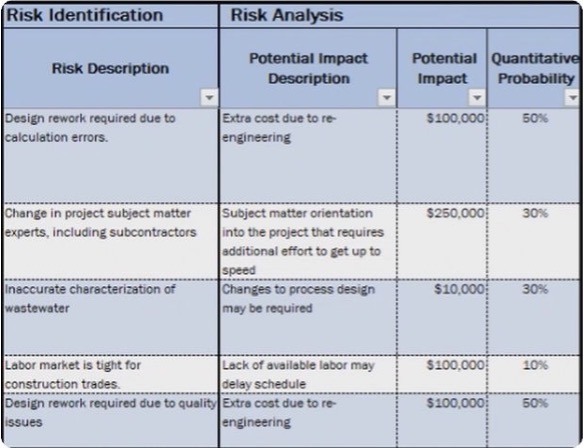
A. US$372,000
B. US$190,400
C. US$188,000
D. US$560,000
Correct Answer: C
QUESTION 180
During a project to develop a new software application, the risk manager notices an increase in the number of identified high-level risks. The project is currently in the execution phase, and the risk manager wants to ensure that the risk management plan remains effective. What should the risk manager do to monitor and control these risks?
A. Reassess all identified risks by conducting a full quantitative risk analysis to identify response plans.
B. Continue with the current risk response plans and increase the frequency of risk reviews.
C. Update the risk register with new risks and re-evaluate the impact and probability of existing risks.
D. Assign a risk owner to manage and report the newly identified risks to the project sponsor.
Correct Answer: C