PMI-RMP_Part10
QUESTION 181
An organization with a large computer network identified a potential cyber security threat. Although certain measures were implemented to avoid the risk, the cyber security threat occurs. The measures were partially successful and a new unforeseen risk emerges. What should the risk owner do?
A. Apply a work around to eliminate or mitigate the impact of the threat.
B. Escalate the case to the risk manager and wait for their instructions.
C. Develop an efficient network protection solution quickly to mitigate the risk.
D. Conduct an analysis to determine the root cause of the failed response.
Correct Answer: A
QUESTION 182
A project manager wants to avoid any possibility of a profit margin decrease in case the currency exchange rate drops. As a result, an agreement was reached with the customer on a workaround that enables the project to collect payments in a foreign currency. However, the government issued a law that criminalizes dealing with foreign currencies in some transactions.
What should the risk manager advise the project manager to do?
A. Utilize the contingency reserve to purchase insurance on the expected change.
B. Hold any transactions until the legal team reassess the workaround validity.
C. Escalate to the sponsor and ask for approval to utilize the management reserve.
D. Abandon the workaround immediately to eliminate the risk of law breach.
Correct Answer: D
QUESTION 183
A pharmaceutical project aiming to develop a lifesaving drug is underway with a tight deadline for market entry to gain competitive advantage. During the risk planning phase, the team identifies a critical risk of a regulatory requirement that could significantly impact the timeline. The project sponsors are highly concerned about this, and the company’s reputation is on the line.
What should the risk manager prioritize in planning the response to this identified risk?
A. Create a contingency fund to address potential financial losses due to delays.
B. Work with the regulatory team to develop a regulatory compliance checklist.
C. Plan for a parallel track approach to run different phases concurrently.
D. Conduct a comprehensive risk workshop to identify further mitigation actions.
Correct Answer: B
QUESTION 184
In performing quantitative analysis on the project risks, how much should the project manager budget in the contingency reserves for the project’s high risks based upon the project’s expected monetary value (EMV) heat chart?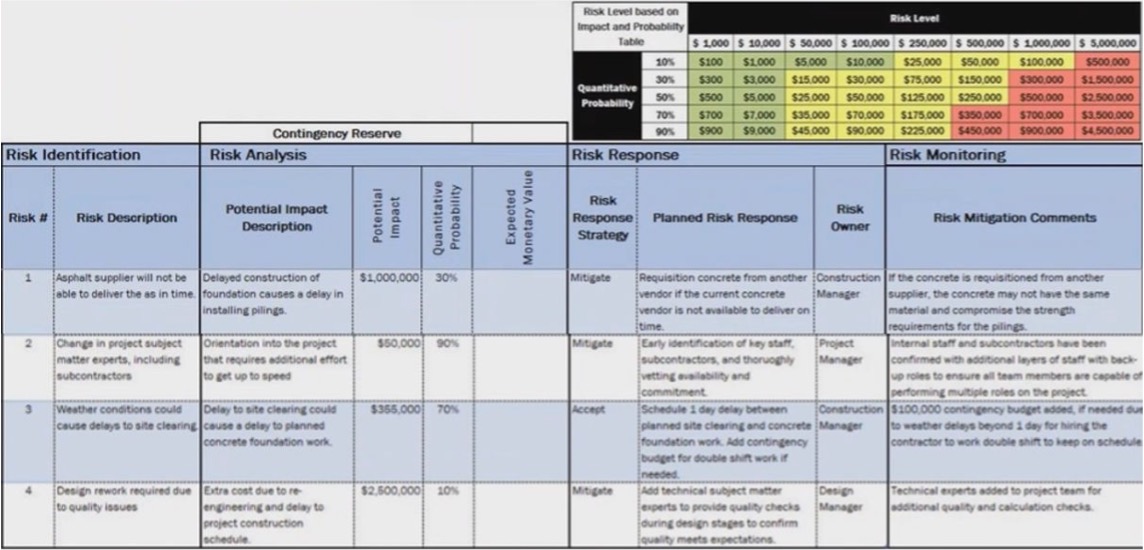
A. US$552,000
B. US$3,860,000
C. US$811,450
D. US$561,450
Correct Answer: C
QUESTION 185
A functional organization has established a new contract review process to identify risks prior to contract signature. The process includes evaluating financial terms by the finance team, conflict resolution terms by the legal team, and scope terms by the technical team. Which technique is being applied?
A. Strong matrix
B. Document review
C. Monte Carlo simulation
D. Weak matrix
Correct Answer: B
QUESTION 186
A new project is about to start, and the risk manager wants to review some documents that could be relevant for risk identification. Which document will help the risk manager in this process?
A. Detailed work breakdown structure (WBS)
B. Baselines approved by the project team
C. Actual data from the current project
D. Lessons learned from previous projects
Correct Answer: D
QUESTION 187
An Al startup is preparing to launch its first major product, an intelligent virtual assistant. The risk manager is organizing the first risk workshop to identify and classify risks. During the workshop, the risk manager and key stakeholders will collaboratively classify the identified risks to better prioritize and manage them. Which classification method should the risk manager use?
A. Risk frequency
B. Risk urgency
C. Risk source
D. Risk impact
Correct Answer: C
QUESTION 188
A newly assigned risk manager realizes that a project has unrealistic funding and low resources. Which document should the risk manager review?
A. Project management plan
B. Risk management plan
C. Project assumptions
D. Risk assessment criteria
Correct Answer: C
QUESTION 189
A healthcare organization is undertaking a major update of its digital records system. A range of stakeholders, including IT staff, healthcare professionals, and finance personnel, are eager to ensure that the project minimizes risks, particularly those that could affect sensitive patient information. During a recent planning meeting, some stakeholders expressed concerns about effectively prioritizing the wide array of identified risks.
What two actions should the risk manager take to engage stakeholders in the risk prioritization process? (Choose 2)
A. Schedule individual meetings with selected key stakeholders to prioritize risks.
B. Assign each stakeholder group a portion of the risk list to review independently and thoroughly.
C. Use a consensus-building approach that ensures all stakeholder groups have an equal voice.
D. Conduct a facilitated workshop where stakeholders evaluate and rank risks using agreed-upon criteria.
E. Engage external subject matter experts to prioritize the risks independently.
Correct Answer: CD
QUESTION 190
A project team is overseeing the implementation of a new inventory management system for a retail chain. During the project’s early stage, the risk manager identifies some potential issues, such as software integration challenges and employee training requirements. However, at this time there is no formal risk register in place. What should the risk manager do?
A. Focus only on internal issues, excluding organizational employee training requirements.
B. Develop a risk register that includes identified potential issues and mitigation plans.
C. Create a risk register with the most obvious issues, leaving out mitigation strategies for now.
D. Review the employee training requirements against the schedule and budget to identify risks.
Correct Answer: B
QUESTION 191
An IT company is launching a high-priority system implementation project scheduled to go live by the end of the fiscal year. Stakeholders are based in multiple regions and have varying holiday schedules, which may disrupt coordination and task completion. Additionally, the project team is working with limited resource availability and budget constraints; the timeline is non-negotiable.
What two actions should the risk manager take? (Choose 2)
A. Engage stakeholders to validate assumptions about availability and resource commitments.
B. Review the project charter and schedule baseline to confirm fixed constraints and deadlines.
C. Use simulation techniques to determine the potential impact on the completion date.
D. Prioritize risks in the risk register based on resource, budget, and schedule impact.
E. Develop budget contingency plans to deal with possible delays caused by stakeholder unavailability.
Correct Answer: AC
QUESTION 192
A risk manager is hired as a consultant by the executive sponsor to manage a major change program that has experienced two past failures. The current executive sponsor believes the project is in good shape based on feedback from the last project manager and reports this to senior executive management. The executive sponsor believes there were no major risks threatening the timeline, budget, or quality of the project. In the first week of risk analysis, the project manager concludes the project timeline is unrealistic and is actually three months behind schedule. The organization’s risk appetite is low.
What should the risk manager do?
A. Discuss the project schedule with the executive sponsor and agree on a strategy for updating the risk management plan and risk response plan.
B. Update existing risk response plans and include more resources to get the project back on track.
C. Immediately call a steering committee meeting, report the project status, and suggest project scope reductions to save time.
D. Review the project schedule and recommend fast tracking the schedule and/or crashing the critical path.
Correct Answer: A
QUESTION 193
A risk manager overhears a conversation between two project team members. One of the team members is discussing a private family matter, which may require requesting personal leave to deal with the situation at home. Should this be the case, the project would be stalled for over a month. This team member’s work package is on critical path, so the team member’s absence would lead to a cascade of delays.
What should the risk manager do?
A. Secure a backup so the deadline can be met.
B. Identify the conversation as a schedule risk.
C. Set a team meeting to review leave schedules.
D. Discuss the conversation with the individual in private.
Correct Answer: B
QUESTION 194
A risk manager on a global logistics project is reviewing a set of predictive models generated by an artificial intelligence (Al) tool. The risk manager determines that some potential strategies proposed by the Al are not viable due to budget constraints. What should the risk manager do?
A. Consult with stakeholders to switch to another Al model that may offer less expensive strategies.
B. Consult with the sponsor to alter the project scope and implement the Al mitigation strategies.
C. Implement the least costly strategies generated by the Al tool to remain within constraints.
D. Identify alternate Al strategies which are within the budget and assign owners.
Correct Answer: D
QUESTION 195
In a software development project, unexpected technical issues have caused delays in the testing phase. The project manager considers using Al-driven tools to identify potential solutions to streamline the testing process. What should the risk manager do?
A. Examine the current strategies until the testing phase ends and then use Al.
B. Examine other projects that are using Al solutions to resolve technical issues.
C. Implement Al-driven tools immediately to handle the technical issues.
D. Implement Al for recommendations and seek expert review to select a solution.
Correct Answer: D
QUESTION 196
In the early stages of a manufacturing project, a risk manager has identified a risk with a component provided by an external supplier that might be delayed. The delay may or may not be significant to the project. What should the risk manager do?
A. Align with stakeholders on the risk threshold.
B. Agree with the external supplier on the time line.
C. Engage another supplier with shorter delivery times.
D. Register the risk with a medium impact.
Correct Answer: A
QUESTION 197
During a quarterly review of a large government infrastructure project, the team identifies several recurring issues, including reduced productivity and communication gaps with stakeholders. The project manager partners with the risk manager to initiate a risk analysis process to improve future outcomes. What are two actions the risk manager should take? (Choose 2)
A. Assign risk analysis tasks to experienced staff to keep the process efficient.
B. Develop an Ishikawa diagram to analyze the root causes of project inefficiencies.
C. Conduct sensitivity risk analysis to assess productivity and communication issues.
D. Use a SWOT (trengths, weaknesses, opportunities, threats) analysis to evaluate the project and organizational alignment.
E. Review project documentation and historical data to identify new risks.
Correct Answer: BD
QUESTION 198
A large infrastructure project to construct a high-speed railway line is underway. The risk manager notes that the project’s success depends on several conditions and is constrained by specific limitations identified during the initiation phase. During the planning phase, the risk manager identifies potential risks arising from these conditions and limitations. What should the risk manager do to address the identified risks?
A. Limit the risk management plan to historical data from a previous project.
B. Consult the lessons learned for viable risk response strategies.
C. Examine assumption and constraint analyses to plan a risk response.
D. Engage stakeholders on the approach used for the risk response plan.
Correct Answer: C
QUESTION 199
The risk manager of a software development project for a multinational company identified a critical risk during the risk identification phase:there is a high likelihood that the delivery of major components from a third-party vendor will be delayed due to supply chain issues. The project sponsor suggests that the risk manager implement measures to minimize the potential impact of this delay.
What should the risk manager do?
A. Extend the project’s timeline.
B. Call for an emergency meeting with the vendor.
C. Create a risk response plan.
D. Conduct retrospectives on alternate vendor list.
Correct Answer: C
QUESTION 200
While performing a subjective risk analysis on a project, the risk manager along with the project team decide to use a tool that allows the organization to prioritize project risks based on potential impact and likelihood. This tool reflects the organization’s level of risk tolerance and helps in determining which risks should be analyzed in more detail. Which tools would help the organization prioritize project risks based on risk tolerance?
A. Probability and impact matrix
B. Risk data quality assessment
C. Risk urgency assessment
D. Estimation techniques
Correct Answer: A