PMI-RMP_Part2
QUESTION 21
A risk manager schedules workshops for identifying risks about an initiative involving multiple business units, recruitments for different roles, procurements, technological uplift, training, and changes in the ways of working. Who should participate in the risk management activity?
A. Key business stakeholders
B. Core project team
C. Internal stakeholders only
D. Internal and external stakeholders
Correct Answer: D
QUESTION 22
A project team successfully implemented a risk response plan for a major risk event. Residual risks were evaluated and actions were taken to keep them under control. There were no secondary risks after the implementation. What should the risk manager do next?
A. Study the change logs to implement the approved change requests.
B. Continue monitoring the critical response plan on the delivered product.
C. Get permission from stakeholders before documenting lessons learned.
D. Close out the expired risk and update the relevant project documents.
Correct Answer: D
QUESTION 23
The customer’s executive team requests the project sponsor accommodate the financial impact of a force majeure event that occurred during the project execution. The sponsor asks the risk manager to assess the risk to determine if it falls within the organizational limits. What should the risk manager do?
A. Develop a comprehensive risk management plan.
B. Analyze the management plan to identify potential adjustments.
C. Confirm the organization’s risk appetite and tolerance limits.
D. Implement and review a risk management strategy.
Correct Answer: C
QUESTION 24
During the execution phase of a large and complex program, the risk manager realizes that the risk levels associated with key deliverables are fluctuating often and significantly. To effectively monitor and control the varying risk levels, which action will provide the risk manager prioritization for continuous oversight?
A. Increase the frequency of risk audits to ensure that all identified risks are being effectively managed.
B. Update the risk register and risk response plans to reflect the current risk status and communicate changes to stakeholders.
C. Perform a detailed trend analysis using historical risk data to forecast future risk impacts.
D. Implement a robotic process automation tool to provide continuous updates on risk metrics and performance indicators.
Correct Answer: C
QUESTION 25
A risk manager reviewing an infrastructure project’s planning documents identifies misaligned task dependencies and sequences. These issues have caused delays to a critical milestone and may lead to further schedule disruptions. Shared resource constraints with another project are also impacting task prioritization. What should the risk manager do?
A. Analyze the critical path to resolve misaligned dependencies and prevent delays.
B. Validate scheduling assumptions by comparing planned versus actual durations.
C. Refine task sequencing to better align with critical milestones and prevent delays.
D. Evaluate shared resources to resolve task conflicts and reduce schedule impact.
Correct Answer: A
QUESTION 26
A complex project faces a compressed schedule due to federal funding requirements. During execution, a critical risk associated with supply chain disruptions has been triggered. Field staff promptly notified the risk manager, but the situation requires immediate risk response actions to prevent significant delays. What should the risk manager recommend for the triggered risk?
A. Review the risk management plan to ensure the owner executes the response strategy.
B. Notify the assigned risk action owner to implement the agreed-upon response strategy.
C. Consult the project sponsor to reallocate the budget and resources for immediate action.
D. Request field staff to complete a detailed project interruption form before proceeding.
Correct Answer: B
QUESTION 27
During a project’s execution phase, a subject matter expert (SME) advises the risk manager consider the potential for unexpected community resistance. The SME recommends they set measures in place to ensure the situation remains under control. What should the risk manager do?
A. Populate the risk register.
B. Review the risk assessment plan.
C. Develop a risk response plan.
D. Send risk list to the project team.
Correct Answer: C
QUESTION 28
During a project’s planning phase, the project team along with the project manager, identified four significant risks that could potentially impact the project. The team also evaluated the contingency reserve established to address these risks. However, during the execution phase, Risk R2 materialized, affecting the project. What is the remaining amount of the contingency reserve in this scenario?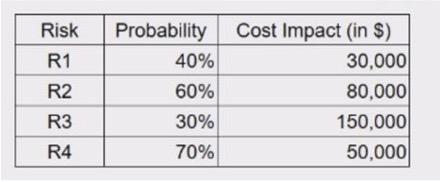
A. 140,000
B. -80,000
C. 60,000
D. 80,000
Correct Answer: C
QUESTION 29
An interim risk manager has been assigned to a project team because the primary risk manager is out on unexpected leave. The project manager shares all of the risk management artifacts with the interim risk manager. During a meeting, several stakeholders disagree on which risks should be mitigated due to the amount of resources required to implement the mitigations.
How should the risk manager respond to ensure that resources are allocated effectively to risk mitigations?
A. Escalate the stakeholders’ concerns around the risk responses to the project manager.
B. Reassure the stakeholders that the project reserves will cover the cost of mitigations.
C. Work with the project sponsor to contract additional resources to support the mitigations.
D. Review the risk register and associated mitigation plans to ensure accuracy.
Correct Answer: D
QUESTION 30
During the execution phase of a project, a team of selected experts is tasked with evaluating the projects risk management processes. The team begins by thoroughly examining the risk register to assess the number of risks that have materialized, along with the effectiveness of the corresponding response plans. The team also investigates the occurrence and potential impact of any unidentified risks that were not documented earlier. The team analyzes how the risk management processes align with the project s objectives and provides recommendations for improvement.
Which type of activity are the team of risk experts performing?
A. Risk Quality Check
B. Risk Inspection
C. Risk Assurance
D. Risk Audit
Correct Answer: D
QUESTION 31
A construction company is kicking off a new project to build a residential high-rise building. The project manager has been facilitating scoping sessions, in which multiple risks have been identified. The project manager has provided the risk manager with the meeting minutes that detail these risks. What should the risk manager do first to ensure the risks identified in the meeting minutes are incorporated into the project management plan?
A. No action is necessary on the risk manager’s part since the risks are already documented in the meeting minutes.
B. Develop a risk register template and begin populating the identified risks into the new project artifact.
C. Set up a meeting with all project stakeholders to discuss each risk in detail and assign ownership.
D. Extrapolate the risks from the meeting minutes into a consolidated view with risk title and date identified.
Correct Answer: D
QUESTION 32
A large infrastructure project is currently in the planning phase, and the risk manager is developing a comprehensive risk register. During a risk identification workshop, stakeholders identified several potential risks, including supply chain disruptions, regulatory changes, and technical failures. Which step is critical to ensure that the risk register accurately reflects the potential impact and likelihood of identified risks?
A. Conduct qualitative risk analysis to assess the probability and impact of each risk.
B. Assign risk owners responsible for monitoring and controlling the identified risks.
C. Prioritize risks based on potential impact on the project’s objectives.
D. Define risk responses for each identified risk to mitigate potential impact.
Correct Answer: A
QUESTION 33
The project team has completed risk identification, scoring. and prioritization. The results are as follows:
Low priority: 32 risks and 8 opportunities Medium priority: 28 risks and 5 opportunities High priority: 17 risks and 2 opportunities
The risk manager needs to determine which items should undergo quantitative analysis to refine impact estimates and develop response plans. Which risks and opportunities should be selected for quantitative analysis and response planning?
A. High-priority risks and opportunities should undergo quantitative analysis and response planning.
B. Focus on high-priority risks and medium opportunities for quantitative analysis and response planning.
C. All risks and opportunities, regardless of priority, should undergo quantitative analysis.
D. Only medium-priority and high-priority risks and opportunities should undergo quantitative analysis.
Correct Answer: A
QUESTION 34
A non-profit organization has kicked off a fundraising project. During the first meeting, the stakeholders identify multiple different risks that could potentially impact the project’s success. What should be the risk manager’s first step upon receiving this information?
A. Document the risks in the meeting minutes and share the risks with all stakeholders for visibility.
B. Assign ownership of each risk item to the appropriate stakeholder and get weekly updates.
C. Work with the project manager and project sponsor to address the stakeholders’ concerns.
D. Identify a template and populate the information from the meeting into a risk register for review.
Correct Answer: D
QUESTION 35
The functionality of a part required for a machine has been recently evaluated and was determined to be of low reliability. The project intends to produce a very large quantity. What should the risk response strategy be?
A. Avoid the risk.
B. Reject the risk.
C. Transfer the risk
D. Accept the risk.
Correct Answer: A
QUESTION 36
A project team is preparing a project plan for a government-funded project with multiple stakeholders, including government employees. The project sponsor requests the risk manager estimates the potential costs associated with delays that may arise from government employees, due to bureaucratic processes and other administrative factors. How should the risk manager approach this task?
A. Create a risk register to document all potential risks and estimated impacts, including delays due to government employees.
B. Develop a risk response plan that includes specific mitigation strategies for government-related delays.
C. Perform a quantitative risk analysis to determine the potential financial impact of government-related delays.
D. Conduct a qualitative risk analysis to assess the likelihood and impact of potential delays.
Correct Answer: C
QUESTION 37
During the planning phase of a project involving the implementation of an emerging technology, the team identifies several risks due to technical uncertainty. The risk manager must evaluate these risks to determine the most likely outcomes. What should the risk manager use to analyze the risks and guide the team’s decisions?
A. A technique to simulate thousands of scenarios to assess overall project variability
B. An analysis to determine how changes in key variables could alter project outcomes
C. A structured approach to evaluate multiple potential outcomes based on probabilities
D. A process to validate the completeness and reliability of the collected risk data
Correct Answer: C
QUESTION 38
During the project planning phase, the sponsor informs the risk manager of the project’s complex nature. There are a number of uncertainties arising from the project environment. The sponsor suggests the risk manager implements a comprehensive approach to control and manage both known and unknown events. How should the risk manager address the potential uncertainties?
A. Develop a risk management plan.
B. Analyze the project’s complexity.
C. Assign risk processes to the project team.
D. Eliminate known and unknown events.
Correct Answer:
QUESTION 39
A risk manager is working with the project manager and stakeholders to define how risk management will occur on a new technology project. Several of the stakeholders feel that risk management is just fear mongering and stifles the team’s ability to work on the project. These stakeholders are threatening to withdraw support tor formal risk planning. What should the risk manager do to ensure that all stakeholders remain engaged?
A. Escalate the concern to the stakeholders and encourage continued support on the project.
B. Evaluate the risk management approach and make modifications to ensure flexibility and value.
C. Work with the project manager to ensure that risk management activities continue in weekly project meetings.
D. Encourage stakeholders to focus on defined opportunities to garner excitement around risk management.
Correct Answer: B
QUESTION 40
A risk manager asked each team member to perform qualitative risk analysis individually and then held a meeting to combine the results. The results were divergent, and the risk manager discovered that most team members are unaware of project risk processes. What should the risk manager do?
A. Schedule a coaching session for the team.
B. Escalate the concern to the project sponsor.
C. Accept the results as the impact is not high.
D. Hire a subject matter expert (SME).
Correct Answer: A