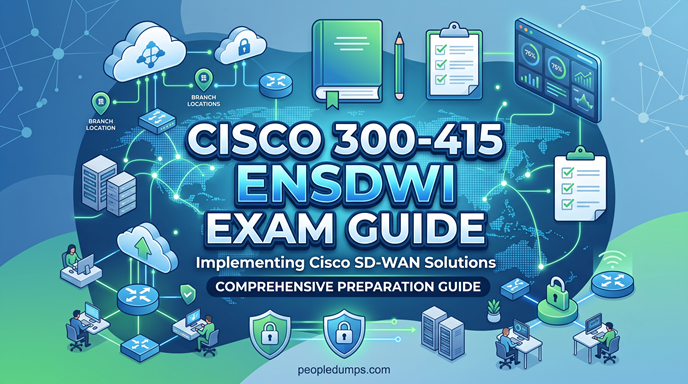
The Cisco 300-415 ENSDWI exam is designed for networking professionals who want to move beyond traditional WAN routing and develop practical skills with Cisco Catalyst SD-WAN. It is also one of the concentration exams available within the CCNP Enterprise certification track.
Although the exam focuses on a specific Cisco solution, it covers much more than a single management interface. Candidates are expected to understand how controllers, WAN Edge routers, overlay tunnels, routing policies, application-aware routing, security services, and monitoring tools work together as one system.
That makes ENSDWI particularly useful for engineers who are beginning to work with software-defined networking, branch transformation, cloud connectivity, or large enterprise WAN environments.
This guide explains the current exam structure, the technologies you should understand, the value of the certification, and a realistic way to prepare for the exam without relying on memorization alone.
Exam requirements and topic weightings may change. Candidates should always verify the latest information on Cisco’s official certification website before scheduling the exam.
Table of Contents
Table of Contents
Toggle- What Is the Cisco 300-415 ENSDWI Exam?
- Cisco 300-415 Exam Details
- How ENSDWI Fits into CCNP Enterprise
- Is the ENSDWI Certification Valuable?
- Cisco 300-415 ENSDWI Exam Topics
- Key Technologies You Need to Understand
- Recommended Knowledge Before Starting
- A Practical ENSDWI Study Plan
- Recommended Lab Practice
- Common Preparation Mistakes
- Exam-Day Strategy
- Frequently Asked Questions
What Is the Cisco 300-415 ENSDWI Exam?
The official name of the exam is Implementing Cisco Catalyst SD-WAN Solutions. Its exam code is 300-415 ENSDWI.
The exam measures whether a candidate understands how to deploy, configure, secure, monitor, and troubleshoot a Cisco Catalyst SD-WAN environment. It covers both the conceptual architecture and the operational decisions that engineers make during a real deployment.
For example, you may need to understand why a control connection is not forming, how an OMP route is advertised, where a centralized policy is applied, or how application-aware routing selects a better transport path.
This is an important distinction. The exam is not simply a test of where options appear in SD-WAN Manager. The graphical interface may help you configure the solution, but the GUI is not the architecture. Successful candidates understand what is happening behind the interface.
Before beginning your preparation, it is helpful to review the complete blueprint and organize your resources around the major domains. A structured set of 300-415 ENSDWI study resources can help you identify which technical areas deserve the most attention.
Cisco 300-415 Exam Details
| Item | Details |
|---|---|
| Exam code | 300-415 ENSDWI |
| Official exam name | Implementing Cisco Catalyst SD-WAN Solutions |
| Current blueprint version | Version 1.2 at the time of writing |
| Exam duration | 90 minutes |
| Exam price | US$300, subject to regional taxes and Cisco pricing changes |
| Available languages | English and Japanese |
| Certification earned | Cisco Certified Specialist – Enterprise SD-WAN Implementation |
| CCNP Enterprise role | Fulfills the concentration exam requirement |
Cisco does not require candidates to complete an official training course before taking the exam. However, structured training and hands-on practice can be especially useful because several blueprint objectives use action verbs such as configure and troubleshoot.
How ENSDWI Fits into CCNP Enterprise
Passing the Cisco 300-415 ENSDWI exam produces an immediate certification result. You earn the Cisco Certified Specialist – Enterprise SD-WAN Implementation certification.
The exam can also be used as the concentration exam for CCNP Enterprise. To earn the full CCNP Enterprise certification, a candidate must pass:
- 350-401 ENCOR, the required enterprise core exam; and
- One approved concentration exam, such as 300-415 ENSDWI.
You may take the exams in either order. Passing ENSDWI alone does not award CCNP Enterprise, but it still gives you a standalone specialist certification that demonstrates a focused technical skill set.
This structure is helpful for engineers who want to build their certification path gradually. You can first validate your SD-WAN knowledge and then complete ENCOR when you are ready to pursue the broader professional-level credential.
Is the Cisco ENSDWI Certification Valuable?
The value of ENSDWI depends largely on the type of networking work you want to perform.
For an engineer working only with small LAN environments, the exam may be more specialized than necessary. For someone supporting enterprise branches, managed WAN services, cloud connectivity, or network transformation projects, the knowledge can be directly relevant.
The certification is particularly useful for roles such as:
- Enterprise network engineer
- SD-WAN implementation engineer
- Network operations engineer
- Network support or escalation engineer
- Solutions engineer
- Network consultant
- Infrastructure or cloud connectivity engineer
Its main strength is technical focus. ENSDWI does not attempt to cover every part of enterprise networking. Instead, it demonstrates that you understand how Cisco’s SD-WAN control, management, orchestration, and data planes operate together.
At the same time, candidates should keep the certification in perspective. A certificate cannot replace troubleshooting experience, routing fundamentals, or the ability to explain design decisions. The best value comes from combining the credential with practical labs and real operational knowledge.
Cisco 300-415 ENSDWI Exam Topics
The current ENSDWI v1.2 blueprint is divided into six major domains.
| Domain | Weight | Main Areas |
|---|---|---|
| 1.0 Architecture | 20% | SD-WAN planes, components, WAN Edge platforms, Multi-Region Fabric, and Cloud OnRamp |
| 2.0 Controller Deployment | 15% | Cloud and on-premises controllers, certificates, device lists, redundancy, and control connections |
| 3.0 Router Deployment | 20% | WAN Edge onboarding, data plane configuration, OMP, TLOCs, routing protocols, templates, and multicast |
| 4.0 Policies | 20% | Control policies, data policies, segmentation, application-aware routing, and Direct Internet Access |
| 5.0 Security and Quality of Service | 15% | Service insertion, security functions, cloud security, QoS, and AppQoE |
| 6.0 Management and Operations | 10% | Authentication, monitoring, reporting, troubleshooting, REST APIs, and software image management |
The percentages should influence your study schedule. Architecture, router deployment, and policies account for 60% of the blueprint, so weak knowledge in those three areas is difficult to compensate for elsewhere.
When reviewing the domains, use the exam blueprint as a checklist rather than simply reading chapters in order. You can also use carefully selected Cisco ENSDWI practice questions to check whether you can apply the concepts in realistic technical scenarios.
1. Architecture
The architecture domain requires a clear understanding of the different operational planes in Cisco Catalyst SD-WAN.
- SD-WAN Validator, formerly vBond: Supports orchestration, initial device authentication, controller discovery, and NAT-related connection establishment.
- SD-WAN Manager, formerly vManage: Provides centralized management, configuration, monitoring, reporting, and operational visibility.
- SD-WAN Controller, formerly vSmart: Operates in the control plane and distributes routing and policy information through the Overlay Management Protocol.
- WAN Edge routers: Form the data plane and forward user traffic across the available WAN transports.
You should also understand Multi-Region Fabric, WAN Edge platform capabilities, and Cloud OnRamp use cases for SaaS, IaaS, colocation, and multicloud connectivity.
2. Controller Deployment
This domain covers cloud-hosted and on-premises controller models. Candidates should understand controller installation concepts, public and private hosting platforms, scalability, redundancy, certificates, and authorized device lists.
Troubleshooting control-plane connectivity is especially important. A candidate should be able to reason through problems involving reachability, certificates, time synchronization, organization names, device authorization, and control connection states.
3. Router Deployment
Router deployment is one of the most practical sections of the exam. It includes WAN Edge onboarding through zero-touch provisioning or bootstrap methods, hub deployment models, circuit termination, TLOC extension, dynamic tunnels, and underlay-to-overlay connectivity.
The blueprint also expects candidates to configure or understand:
- OMP
- Transport Locators
- VRRP
- OSPF
- BGP
- EIGRP
- CLI and SD-WAN Manager feature configuration templates
- Configuration groups and policy groups
- Feature profiles and workflows
- Multicast support
Do not study these items as isolated features. Think about how routes move from a service-side routing protocol into OMP, how they are distributed through the control plane, and how remote WAN Edge routers use the information.
4. Policies
Policies are often one of the more challenging parts of ENSDWI because several policy types may influence the same traffic flow.
You need to distinguish between control policies and data policies, understand where each policy is processed, and recognize how policy changes affect route advertisement or packet forwarding.
The domain also covers:
- End-to-end VPN segmentation
- VPN membership
- Hub-and-spoke and other custom topologies
- Application-aware routing
- SLA-based path selection
- AI-driven Predictive Path Recommendation
- Direct Internet Access
A useful way to study policy is to begin with a desired business result. For example, imagine that voice traffic should use an MPLS circuit when latency and loss are acceptable, but move to internet transport when the primary path violates its SLA. Then identify the policy objects and measurements required to produce that result.
5. Security and Quality of Service
Cisco Catalyst SD-WAN combines connectivity with several integrated security and traffic-optimization capabilities.
The security section includes service insertion, application-aware enterprise firewall functions, intrusion prevention, URL filtering, malware protection, SSL and TLS proxy concepts, TrustSec, DNS security, and Secure Internet Gateway integration.
The QoS portion includes:
- Traffic classification and marking
- Queuing and scheduling
- Shaping and policing
- Per-tunnel QoS
- Adaptive QoS
Candidates should also understand Application Quality of Experience features such as TCP optimization, Data Redundancy Elimination, packet duplication, Forward Error Correction, AppNav, and next-generation firewall integration.
6. Management and Operations
The final domain focuses on the day-to-day operation of an SD-WAN fabric. It includes authentication, monitoring, reporting, troubleshooting, REST API monitoring, and software image management from SD-WAN Manager.
This section may carry the lowest percentage, but it should not be ignored. In production networks, visibility and operational discipline are just as important as the initial deployment.
Key Technologies You Need to Understand
Underlay and Overlay Networks
The underlay is the physical or provider-based network that supplies basic IP connectivity. It may include MPLS, broadband internet, private circuits, or cellular transport.
The overlay is the logical SD-WAN fabric built across those transports. WAN Edge routers use encrypted or logical tunnels to communicate through the overlay without requiring every transport provider to understand the enterprise routing design.
A common troubleshooting mistake is to investigate the overlay before confirming that the underlay can provide DNS, routing, NAT, time synchronization, and basic IP reachability.
Overlay Management Protocol
OMP is a central technology in Cisco Catalyst SD-WAN. It operates between WAN Edge routers and SD-WAN Controllers and distributes information such as routes, Transport Locators, services, and policy attributes.
Traditional routing knowledge still matters here. OMP does not remove BGP, OSPF, or EIGRP from the network. Instead, WAN Edge routers can learn routes from service-side protocols and advertise selected information into the SD-WAN control plane.
Transport Locators
A Transport Locator, commonly called a TLOC, identifies a WAN Edge attachment to a transport network. A TLOC is associated with information such as the system IP, transport color, and encapsulation.
Understanding TLOCs is important because they influence control connections, tunnel formation, path selection, redundancy, and policy behavior.
Bidirectional Forwarding Detection
BFD is used to monitor tunnel availability and path characteristics between WAN Edge routers. Its measurements can provide information about latency, jitter, and packet loss.
Application-aware routing can use these measurements to decide whether a transport path continues to meet the required SLA.
Segmentation
Segmentation allows multiple logical networks to share the same SD-WAN infrastructure while keeping their routing and traffic policies separate.
You should understand service VPNs, VPN membership, route leaking considerations, and the difference between segmentation and encryption. Two traffic classes may both be encrypted while still belonging to different logical VPNs.
Application-Aware Routing
Application-aware routing makes forwarding decisions according to application identity and transport performance rather than relying only on a static routing metric.
For example, an organization may prefer MPLS for voice, direct internet access for trusted SaaS traffic, and a separate path for bulk data transfers. If a preferred path exceeds defined latency, loss, or jitter thresholds, traffic can be moved to another available transport.
Recommended Knowledge Before Starting
There are no formal CCNA requirements for taking the ENSDWI exam. However, the absence of a formal prerequisite does not make the exam entry-level.
Before beginning serious ENSDWI preparation, you should be comfortable with:
- IPv4 addressing and subnetting
- Basic IPv6 concepts
- Static and dynamic routing
- OSPF and BGP fundamentals
- NAT and access control concepts
- IPsec and tunnel fundamentals
- Quality of Service terminology
- High availability and first-hop redundancy
- Basic JSON, REST API, and automation concepts
CCNA-level knowledge is a reasonable starting point, but candidates with some ENCOR-level routing, security, and network design knowledge will usually find the material easier to connect.
A Practical Cisco ENSDWI Study Plan
The following eight-week plan can be adjusted according to your existing experience and available study time. Your preparation should combine official documentation, video instruction, lab practice, personal notes, and Cisco 300-415 exam preparation materials that help you evaluate your understanding of each domain.
Week 1: Architecture and Terminology
- Learn the orchestration, management, control, and data planes.
- Understand the current and former Cisco component names.
- Study system IPs, site IDs, colors, TLOCs, OMP routes, and control connections.
- Draw the architecture from memory.
Week 2: Controllers and WAN Edge Onboarding
- Compare cloud and on-premises controller deployments.
- Study certificates, serial-number authorization, and device lists.
- Review ZTP and bootstrap onboarding workflows.
- Practice troubleshooting failed control connections.
Week 3: Data Plane and Routing
- Study overlay tunnel formation and BFD sessions.
- Review OMP route types and route propagation.
- Practice integrating OSPF and BGP with service VPNs.
- Understand TLOC extension and transport redundancy.
Week 4: Templates and Configuration Workflows
- Create device and feature configuration templates.
- Review configuration groups, feature profiles, and workflows.
- Understand template attachment and configuration validation.
- Compare centralized configuration with local CLI behavior.
Week 5: Control and Data Policies
- Build simple control policies before attempting complex topologies.
- Study centralized and localized data policies.
- Practice segmentation and VPN membership decisions.
- Trace policy direction, attachment points, and expected outcomes.
Week 6: Application-Aware Routing, Security, and QoS
- Create SLA classes using latency, loss, and jitter.
- Study application-aware routing and Direct Internet Access.
- Review integrated and cloud-delivered security options.
- Practice QoS classification, marking, queuing, shaping, and policing.
Week 7: Management and Troubleshooting
- Use SD-WAN Manager dashboards and monitoring tools.
- Review alarms, events, control connections, tunnels, and device status.
- Study software image management and upgrade workflows.
- Review REST API monitoring concepts.
Week 8: Final Review
- Return to the official blueprint and mark every objective.
- Repeat labs in your weakest domains.
- Practice reading topology and configuration scenarios quickly.
- Review concepts instead of memorizing isolated answers.
Recommended Hands-On Lab Practice
Reading is useful, but ENSDWI becomes much easier when you can observe the relationships between components.
A useful lab environment should allow you to practice tasks such as:
- Onboarding a WAN Edge router
- Checking controller and control connection states
- Creating and attaching configuration templates
- Advertising service-side routes through OMP
- Verifying TLOCs and BFD sessions
- Building a hub-and-spoke topology
- Creating a centralized control policy
- Configuring an application-aware routing policy
- Testing transport failure and path recovery
- Reviewing alarms, events, statistics, and device logs
- Exploring monitoring data through REST APIs
When performing a lab, avoid stopping as soon as the configuration works. Break one part of it deliberately and observe the symptoms. Troubleshooting a failed certificate, incorrect site ID, missing route, or policy attachment is often more educational than completing a perfect deployment.
After completing each lab topic, use a small set of 300-415 ENSDWI exam questions to test whether you can recognize the same concept when it appears in a topology, configuration, or troubleshooting scenario.
Common ENSDWI Preparation Mistakes
Memorizing the Interface Without Understanding Packet Flow
Menu locations can change between software releases. Architecture and packet flow are more durable. Always ask which device makes the decision, which protocol carries the information, and where the policy is enforced.
Ignoring the Older Product Names
The current blueprint uses names such as SD-WAN Manager, SD-WAN Controller, and SD-WAN Validator. However, technical documentation and existing deployments may still use vManage, vSmart, and vBond.
You should recognize both naming systems immediately.
Treating OMP Like a Completely Isolated Protocol
OMP interacts with service-side routing, TLOC information, policy, and the overlay data plane. Studying it without understanding redistribution and route propagation creates significant knowledge gaps.
Studying Policy Syntax Without a Business Objective
Policy becomes confusing when it is reduced to lists and sequences. Begin with the intended result, identify the matching conditions, and then determine which policy type can produce that result.
Skipping Security and QoS
Architecture and routing may feel more familiar, but security and QoS still represent a significant part of the blueprint. These topics can also differentiate a basic SD-WAN deployment from a production-ready design.
Using Only Practice Questions
Practice questions can identify weak areas, but they should not become the entire study method. A candidate who recognizes an answer without understanding why the alternatives are wrong may struggle with a differently worded scenario.
The best approach is to use questions after studying and lab practice. For every incorrect answer, return to the relevant blueprint objective and explain why the correct option works and why the alternatives do not.
Cisco 300-415 Exam-Day Strategy
During the exam, read each scenario carefully and identify the operational plane involved before reviewing the answer choices.
For example:
- A device onboarding or NAT traversal problem may involve the orchestration plane.
- A configuration, monitoring, or reporting question may involve SD-WAN Manager.
- An OMP route or centralized control policy issue may involve the control plane.
- A tunnel, BFD, or forwarding problem may involve the data plane.
Pay attention to words such as best, most appropriate, first, and most likely. Several answers may describe technically possible actions, but only one may match the stage of the troubleshooting process.
It is also worth learning the meaning of the verbs in the blueprint. An objective that says “describe” may require conceptual recognition. An objective that says “configure” or “troubleshoot” usually requires deeper operational knowledge.
Frequently Asked Questions About Cisco 300-415 ENSDWI
Is the Cisco 300-415 ENSDWI exam difficult?
ENSDWI can be challenging because it combines routing, overlay architecture, policy, security, QoS, cloud connectivity, and troubleshooting. Candidates with traditional routing experience may understand the underlay quickly but still need time to become comfortable with OMP, TLOCs, centralized policy, and SD-WAN operational workflows.
Do I need CCNA before taking the 300-415 exam?
No formal CCNA certification is required. However, candidates should already understand routing, IP addressing, NAT, VPNs, security fundamentals, and QoS. CCNA-level knowledge is a useful foundation even when the certification itself is not required.
Does passing 300-415 give me CCNP Enterprise?
Not by itself. Passing 300-415 earns the Cisco Certified Specialist – Enterprise SD-WAN Implementation certification and completes the concentration exam requirement. You must also pass the 350-401 ENCOR core exam to earn CCNP Enterprise.
Can I take ENSDWI before ENCOR?
Yes. Cisco allows candidates to take the core and concentration exams in either order. Some candidates choose ENSDWI first because their current job is focused on SD-WAN, while others complete ENCOR first to establish a broader enterprise networking foundation.
How long does it take to prepare for the Cisco ENSDWI exam?
Preparation time varies significantly. An engineer who already supports Cisco Catalyst SD-WAN may need only several weeks of focused blueprint review. Someone new to SD-WAN may need two or three months to study the architecture, complete labs, and build reliable troubleshooting skills.
Is hands-on experience necessary?
Hands-on experience is strongly recommended. The blueprint includes configuration and troubleshooting objectives that are difficult to understand through reading alone. Even a limited lab can help you connect controller status, OMP routes, TLOCs, tunnels, policies, and monitoring data.
What is the difference between vManage and SD-WAN Manager?
SD-WAN Manager is the current Cisco name for the component previously known as vManage. In the same naming transition, vSmart became SD-WAN Controller and vBond became SD-WAN Validator. Older documentation and existing networks may still use the former names.
Is ENSDWI useful if I already have CCNP Enterprise?
It can be useful when your existing CCNP concentration focused on another area, such as advanced routing, design, or automation. Passing ENSDWI provides a separate specialist certification and can demonstrate focused knowledge of Cisco Catalyst SD-WAN implementation.
How should I use ENSDWI practice questions?
Use them after studying a topic, not as a replacement for learning. Review every incorrect answer, identify the related blueprint objective, and confirm the behavior through documentation or lab practice whenever possible.
Final Thoughts
The Cisco 300-415 ENSDWI exam is a focused certification for professionals who want to understand how modern enterprise WANs are built and operated with Cisco Catalyst SD-WAN.
The exam covers a broad technical journey: controllers establish trust and distribute information, WAN Edge routers build the overlay, OMP carries routing information, policies control topology and forwarding behavior, and operational tools provide the visibility required to keep the fabric healthy.
The most effective preparation method is to combine the official blueprint with structured reading, diagrams, hands-on configuration, deliberate troubleshooting, and a reliable Cisco ENSDWI exam preparation course. Do not limit your preparation to remembering product terms or interface locations. Learn how the entire system behaves when it is working—and what evidence appears when it is not.
That approach will help you prepare for the certification exam while also developing SD-WAN skills that remain useful after the test is over.
Official and Authoritative Cisco 300-415 ENSDWI Resources
When preparing for the Cisco 300-415 ENSDWI exam, candidates should use official Cisco documentation and trusted certification resources to verify the latest exam objectives, technologies, and training requirements. The following references are useful for building a reliable Cisco Catalyst SD-WAN study plan.
- Cisco – Official 300-415 ENSDWI Exam Page:
Implementing Cisco Catalyst SD-WAN Solutions (300-415 ENSDWI)
– Cisco’s official exam page with current information about the ENSDWI certification exam, preparation resources, and related certification paths. - Cisco Learning Network:
Cisco Learning Network
– Cisco’s official certification learning community where candidates can find study resources, certification discussions, exam information, and learning guidance. - Pearson VUE – Cisco Certification Exams:
Cisco Certification Testing with Pearson VUE
– The authorized Cisco certification testing portal for exam scheduling, test center information, online-proctored testing, and exam management.