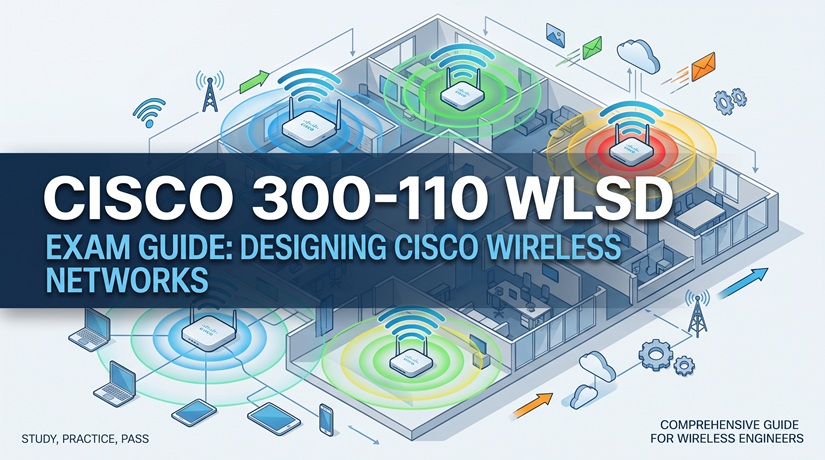
Wireless networking is no longer just about installing access points and confirming that users can connect. Modern enterprise wireless networks must support high client density, voice and video applications, location services, seamless roaming, security requirements, and business-critical availability.
The Cisco 300-110 WLSD exam, officially named Designing Cisco Wireless Networks, focuses on the design decisions behind these environments. It evaluates whether a candidate can translate business and technical requirements into a wireless solution that is reliable, scalable, and suitable for real-world deployment.
For students and early-career network engineers, the exam provides a structured way to develop wireless design knowledge. For experienced engineers, it offers an opportunity to validate specialist-level skills and work toward the CCNP Wireless certification.
Candidates who are already building a study plan can also review dedicated Cisco 300-110 WLSD exam preparation resources alongside official documentation, lab practice, and wireless design training.
What Is the Cisco 300-110 WLSD Exam?
Table of Contents
ToggleThe Cisco 300-110 WLSD exam is a professional-level concentration exam centered on enterprise wireless network design. It covers the complete design process, beginning with requirement collection and site surveys and continuing through infrastructure planning, mobility design, roaming optimization, and high availability.
Passing the exam earns the Cisco Certified Specialist – Wireless Design certification. It also satisfies the concentration exam requirement for CCNP Wireless.
To earn the full CCNP Wireless certification, candidates must pass:
- 350-101 WLCOR: Implementing and Operating Cisco Wireless Core Technologies
- One concentration exam: such as 300-110 WLSD or 300-120 WLSI
The exams do not necessarily have to be taken in a particular order. A candidate may take the WLSD concentration exam before completing the WLCOR core exam, although a solid understanding of wireless fundamentals makes the design material much easier to study.
Before scheduling the exam, candidates should compare the official blueprint with their chosen 300-110 WLSD study materials to make sure all major exam domains are covered.
Cisco 300-110 WLSD Exam Details
| Exam code | 300-110 |
|---|---|
| Exam name | Designing Cisco Wireless Networks |
| Exam abbreviation | WLSD |
| Certification level | Professional / Specialist |
| Certification earned | Cisco Certified Specialist – Wireless Design |
| Professional certification path | CCNP Wireless |
| Primary focus | Enterprise wireless network design |
| Exam language | English |
Exam duration, pricing, language availability, and registration policies may change. Candidates should confirm the latest details through Cisco and its authorized exam delivery provider before scheduling the test.
How WLSD Relates to the Previous 300-425 ENWLSD Exam
The 300-110 WLSD exam is closely related to the former 300-425 ENWLSD exam, which was previously part of the CCNP Enterprise certification track.
As part of Cisco’s dedicated wireless certification structure, the wireless design concentration was realigned with CCNP Wireless and renamed from 300-425 ENWLSD to 300-110 WLSD. The newer exam retains the central focus on wireless design but places that knowledge within a certification path dedicated specifically to wireless technologies.
This change is useful for candidates who want their certification path to reflect a clear specialization. Instead of treating wireless design as a concentration under general enterprise networking, Cisco now positions it as an important skill within the professional wireless track.
Cisco 300-110 WLSD Exam Topics
The official WLSD blueprint is organized around several major wireless design domains. Candidates should use the current blueprint as their primary checklist because Cisco may revise individual objectives over time.
The key knowledge areas generally include:
- Wireless site surveys and requirement gathering
- Wired and wireless infrastructure design
- Radio frequency planning and optimization
- Mobility and roaming design
- Wireless LAN high availability
- Voice, video, location, and high-density requirements
The blueprint may look compact, but each objective represents a broad set of practical design decisions. Memorizing definitions alone is unlikely to be enough. Candidates should understand why a particular design is appropriate and how changing one requirement affects the rest of the solution.
1. Wireless Site Surveys
A successful wireless design begins with accurate information. Before choosing access point models or controller architecture, a designer must understand the environment, users, applications, and physical limitations of the site.
The site survey domain covers requirement collection, environmental analysis, predictive planning, physical validation, and the interpretation of RF data.
Collecting Design Requirements
Wireless requirements are more detailed than the number of users expected in a building. A wireless designer may need to determine:
- How many client devices will be active in each area
- Whether users will run voice, video, or other real-time applications
- Which access point and antenna types are appropriate
- Whether the network supports data, location, voice, or video services
- Which security and authentication requirements must be met
- Whether redundancy and uninterrupted roaming are required
For example, a warehouse with handheld scanners, metal shelving, and high ceilings requires a very different design from a university lecture hall filled with hundreds of laptops and smartphones.
Material Attenuation
Wireless signals lose strength as they travel through walls, doors, glass, shelving, furniture, and other physical materials. The amount of loss depends on the material, thickness, frequency, and surrounding environment.
A designer must consider attenuation when estimating access point placement and coverage. A predictive design based on inaccurate wall materials may look excellent on a heat map but perform poorly after installation.
Types of Wireless Site Surveys
WLSD candidates should understand several survey methods:
- Layer 1 survey: Identifies RF activity, interference, noise, and channel utilization without focusing only on Wi-Fi traffic.
- Pre-deployment survey: Collects environmental and RF information before the final network is installed.
- Predictive survey: Uses floor plans, building materials, AP models, and antenna characteristics to estimate coverage and capacity.
- Post-deployment survey: Validates that the installed wireless network meets the original design requirements.
Planning and analysis platforms may include predictive design tools, protocol analyzers, packet capture utilities, and spectrum analyzers. Candidates should understand what information each tool provides and how the results influence design decisions.
2. Wired and Wireless Infrastructure
An enterprise WLAN depends heavily on the network underneath it. An access point may communicate with clients over radio frequencies, but it still requires power, switching capacity, cabling, licensing, controller connectivity, and proper physical installation.
Physical Infrastructure Requirements
A wireless designer should be able to evaluate:
- Power over Ethernet requirements
- Cabling type and distance limitations
- Switch port availability and capacity
- AP mounting location and orientation
- Grounding and environmental requirements
- Uplink bandwidth and multigigabit Ethernet requirements
Modern access points may require higher PoE levels to enable all radios, spatial streams, USB functions, or IoT capabilities. Connecting an advanced AP to a switch port that supplies insufficient power can result in reduced functionality.
Logical Infrastructure and Licensing
The logical design includes controller placement, access point connectivity, architecture selection, VLAN planning, policy design, and controller or AP licensing requirements.
Candidates should be comfortable comparing centralized, distributed, embedded, and branch-oriented wireless architectures. The correct choice depends on factors such as the number of sites, WAN availability, operational requirements, scalability, and failure behavior.
Radio Resource Management
Radio Resource Management, commonly called RRM, helps automate channel and transmit-power decisions across the wireless network.
Even when automated systems are used, a designer must understand the desired outcome. Automation cannot compensate for poor AP placement, an incorrect antenna choice, or unrealistic capacity assumptions.
Related technologies and concepts include:
- RF profiles
- Radio profiles
- Transmit Power Control
- Dynamic Channel Assignment
- Channel width planning
- Receive Start of Packet, or RxSOP
RxSOP can influence how sensitive an access point is to incoming frames. Used carefully, it may help reduce the effective size of a cell in certain high-density environments. Used incorrectly, it can create connectivity and roaming problems.
Application-Specific Wireless Design
A WLAN designed for ordinary web access is not automatically suitable for voice, video, location services, or high-density environments.
Voice networks require predictable roaming, low latency, limited jitter, appropriate channel utilization, and sufficient overlap between cells. Video may require significantly more capacity. Location services depend on AP geometry, placement, and visibility rather than simple coverage alone.
Candidates should also be familiar with wireless mesh networking, Ethernet bridging, Workgroup Bridge operation, high-density design, location analytics, and roaming requirements.
3. Mobility and Roaming
Wireless users expect to move through a building without losing connectivity. Delivering that experience requires more than overlapping AP coverage.
The mobility section examines how controllers, access points, tags, tunnels, and client behavior work together as devices move between coverage areas.
Mobility Groups and Controller Roles
A mobility group allows wireless controllers to exchange information needed to support client movement. Designers must understand controller roles and how the mobility architecture affects control traffic, data forwarding, guest access, and failure recovery.
The goal is not simply to place every controller into one large group. The mobility design should reflect the actual network topology, scale, latency, and operational requirements.
Client Roaming Optimization
Roaming performance is influenced by both infrastructure design and client behavior. Wireless clients generally decide when to roam, but the network can provide features that improve the process.
A design should consider:
- Cell size and coverage overlap
- Minimum supported data rates
- Channel planning
- Transmit power
- Client capabilities
- Authentication methods
- Fast-roaming technologies
- Application sensitivity to packet loss and delay
A network with excessive coverage may create sticky-client problems, while insufficient overlap can cause calls or application sessions to drop during movement.
Mobility Tunneling and Site Tags
Candidates should understand how data and control paths are established and how mobility tunnels can be validated.
Site Tags are also important in modern Cisco wireless architecture. In Cisco Catalyst 9800 deployments, tags help determine how access points receive policies and connect to wireless site configurations. A designer should understand their purpose and how they fit into a scalable deployment model.
4. WLAN High Availability
Wireless connectivity often supports business-critical operations. Hospitals, warehouses, manufacturing facilities, retail stores, and offices may depend on Wi-Fi for communication and access to essential applications.
A professional wireless design must therefore consider what happens when controllers, network links, switches, power systems, or access points fail.
Controller High Availability
Important controller availability technologies include:
- Link Aggregation: Provides additional link capacity and can protect against individual physical-link failures.
- Stateful Switchover: Allows a standby controller to maintain synchronized state and take over when the active controller fails.
- Controller priority and redundancy: Determines how APs select and recover connections to available controllers.
- Anchor controller designs: Support use cases such as guest traffic tunneling and mobility anchoring.
High availability should be designed as a complete system. Controller redundancy alone is not enough if both controllers depend on the same switch, power source, upstream path, or physical location.
Access Point High Availability
AP availability topics include AP prioritization and the assignment of primary, secondary, and tertiary controllers.
Prioritization becomes important when controller capacity is limited during a failure. Critical APs may need to reconnect before APs serving less important areas.
The exam may also require candidates to understand embedded or AP-based controller architectures and where they may be appropriate for smaller or less complex deployments.
Is the Cisco 300-110 WLSD Certification Valuable?
The value of the WLSD certification comes from its specialization. Many networking professionals understand how to configure a WLAN, but fewer can explain how the network should be designed before installation begins.
Wireless design requires a combination of skills:
- RF and IEEE 802.11 knowledge
- Wired infrastructure planning
- Business requirement analysis
- Capacity and coverage calculations
- Mobility and roaming design
- High-availability planning
- Post-deployment validation
- Technical documentation and design justification
These skills are relevant to wireless engineers, network engineers, systems engineers, consultants, technical architects, network administrators, and presales professionals.
The certification will not replace practical experience. However, it can demonstrate that a candidate understands a recognized wireless design methodology and can evaluate more than basic AP configuration.
Who Should Take the 300-110 WLSD Exam?
The exam is a strong option for professionals who:
- Want to earn the CCNP Wireless certification
- Plan or review enterprise WLAN deployments
- Work with Cisco wireless controllers and access points
- Perform predictive or on-site wireless surveys
- Support voice, video, location, or high-density WLANs
- Want to move from wireless operations into design or architecture
Beginners may also use WLSD as a long-term learning goal, but it should not normally be their first networking exam. CCNA-level networking knowledge and a solid foundation in wireless technologies provide a more realistic starting point.
Recommended Knowledge Before Studying WLSD
Before beginning serious WLSD preparation, it is useful to understand:
- IPv4 addressing and VLANs
- Ethernet switching and trunking
- Power over Ethernet
- Basic routing concepts
- CAPWAP and controller-based WLAN architecture
- 2.4 GHz, 5 GHz, and 6 GHz frequency characteristics
- Channels, channel width, and co-channel interference
- RSSI, SNR, noise floor, and data rates
- Basic wireless authentication and encryption
- Controller, access point, and client roaming behavior
A candidate who cannot yet explain the relationship between RSSI, SNR, channel utilization, and client performance should strengthen those fundamentals before focusing on advanced design scenarios.
How Difficult Is the Cisco WLSD Exam?
The difficulty of the exam depends heavily on the candidate’s background. Engineers with site-survey and Cisco wireless experience may find many topics familiar. Candidates who have only configured small office WLANs may find the design questions more challenging.
One of the main difficulties is that several answers may appear technically possible. The candidate must identify the option that best satisfies the complete set of requirements.
For example, adding more access points may improve signal strength, but it can also increase contention and co-channel interference. Increasing transmit power may extend coverage, but it can create an imbalance between AP transmit power and client transmit capability.
Good wireless design is built on trade-offs. That is why scenario-based study is more effective than memorizing isolated facts.
How to Prepare for the Cisco 300-110 WLSD Exam
1. Begin With the Official Exam Blueprint
Download the current blueprint and use it as a checklist. Every numbered objective should become a study question.
Instead of writing only “study site surveys,” divide the topic into smaller tasks:
- Explain the difference between predictive and post-deployment surveys
- Identify metrics used to validate voice coverage
- Describe the effect of wall attenuation
- Compare spectrum analysis with standard Wi-Fi scanning
2. Strengthen RF Fundamentals
Wireless design becomes much easier when RF behavior is understood. Review signal propagation, free-space path loss, attenuation, reflection, diffraction, absorption, interference, antenna patterns, and link-budget concepts.
You do not need to become a radio physicist, but you should be able to predict how an environmental or configuration change may affect coverage and capacity.
3. Practice With Wireless Planning Tools
Hands-on experience with wireless planning tools can make survey concepts more concrete. Practice importing a floor plan, scaling the drawing, defining wall types, selecting APs, adjusting transmit power, and evaluating predicted coverage.
Pay attention to more than signal strength. Review SNR, channel overlap, data rates, capacity, secondary coverage, and application-specific requirements.
4. Study Cisco Catalyst Wireless Design Concepts
The WLSD exam includes topics associated with modern Cisco wireless architecture, including Site Tags, radio profiles, RRM, SSO, mobility, controller redundancy, and embedded controller designs.
Where possible, use Cisco documentation or lab environments to connect the design concept with the actual feature.
5. Build Scenario-Based Notes
Organize notes around environments instead of creating only a long list of definitions.
Example scenarios include:
- A high-density university lecture hall
- A hospital using wireless voice devices
- A warehouse with directional antennas
- A branch office using an embedded controller
- A guest WLAN using an anchor controller
- A campus requiring seamless roaming and controller redundancy
For each scenario, identify the requirements, risks, design choices, and validation method.
6. Use Practice Questions as a Diagnostic Tool
Practice questions are most useful when they reveal weaknesses. After answering a question, explain why the correct option is appropriate and why the other options are less suitable.
If the explanation depends only on remembering a phrase, the topic may not yet be fully understood. A structured set of Cisco WLSD practice questions can help candidates identify weak domains, but each answer should be reviewed against the underlying wireless design concept.
7. Combine Several Study Methods
No single resource is likely to cover every design skill in enough depth. A balanced preparation strategy may include:
- The official Cisco exam blueprint
- Cisco configuration and design guides
- Wireless design training
- Predictive survey exercises
- Controller and AP lab practice
- Scenario-based questions
- Timed mock exams
When reviewing 300-110 Cisco WLSD exam questions, focus on understanding the reasoning behind the correct design choice rather than simply memorizing an answer.
Example Eight-Week WLSD Study Plan
| Week | Main Study Focus |
|---|---|
| Week 1 | RF fundamentals, antennas, channels, RSSI, SNR, and interference |
| Week 2 | Requirement collection and wireless design methodology |
| Week 3 | Predictive, pre-deployment, Layer 1, and post-deployment surveys |
| Week 4 | Physical infrastructure, PoE, cabling, mounting, and licensing |
| Week 5 | RRM, RF profiles, RxSOP, high-density, voice, video, and location design |
| Week 6 | Mobility groups, roaming, mobility tunnels, and Site Tags |
| Week 7 | Controller and AP high availability, SSO, LAG, redundancy, and embedded controllers |
| Week 8 | Blueprint review, scenario practice, weak-topic revision, and mock exams |
This schedule is only a starting point. Candidates with limited wireless experience may need additional time for RF fundamentals and hands-on practice.
During the final week, candidates can use a focused Cisco 300-110 WLSD study course to review missed questions and identify topics that still require additional reading or lab work.
Common WLSD Study Mistakes
Focusing Only on Signal Coverage
A network can have excellent signal strength and still provide poor performance. Capacity, contention, interference, client density, application requirements, and roaming behavior are equally important.
Ignoring the Wired Network
AP uplinks, PoE budgets, switch capacity, VLANs, controller connectivity, and redundancy directly affect WLAN performance and availability.
Memorizing Features Without Understanding Design Goals
Knowing what SSO or RRM stands for is not enough. Candidates should understand which problem the technology solves, where it is appropriate, and what dependencies it introduces.
Using Only One Source
Wireless design covers RF behavior, infrastructure, mobility, applications, and availability. Depending on one book, course, or question bank can leave important gaps.
Studying From an Outdated Blueprint
Cisco exam objectives can change. Always compare study materials with the current 300-110 WLSD blueprint, especially when using resources originally written for the older 300-425 ENWLSD exam.
Career Opportunities After WLSD
The certification can support career development in roles such as:
- Wireless Network Engineer
- Wireless Design Engineer
- Network Consulting Engineer
- Systems Engineer
- Network Solutions Architect
- Wireless Presales Engineer
- Network Administrator
- Wireless Infrastructure Specialist
Job titles vary between organizations, and certification alone does not guarantee a particular position. Its strongest value appears when it is combined with implementation experience, survey-tool knowledge, troubleshooting ability, and clear documentation skills.
Final Thoughts
The Cisco 300-110 WLSD exam is designed for professionals who want to understand how enterprise wireless networks should be planned, not simply how they are configured.
Its coverage of site surveys, infrastructure, mobility, and high availability reflects the real responsibilities of a wireless designer. A strong candidate must connect RF behavior, business requirements, wired infrastructure, controller architecture, and client experience into one coherent solution.
For candidates pursuing CCNP Wireless, WLSD provides a design-focused concentration path. For professionals already working with WLANs, the Cisco Certified Specialist – Wireless Design credential can provide a clear way to demonstrate specialized knowledge.
The most effective preparation strategy is a combination of official blueprint review, technical reading, scenario analysis, planning-tool practice, hands-on exposure, and carefully reviewed 300-110 WLSD exam preparation.
Frequently Asked Questions
What is the full name of the Cisco 300-110 exam?
The full exam name is Designing Cisco Wireless Networks. Its abbreviated name is WLSD.
What certification do I earn after passing 300-110 WLSD?
Passing the exam earns the Cisco Certified Specialist – Wireless Design certification. It also satisfies the concentration exam requirement for CCNP Wireless.
Do I need to pass WLCOR before taking WLSD?
Candidates should check Cisco’s current certification policies for the required exams and any applicable order requirements. In general, both the wireless core requirement and an eligible concentration exam must be completed to earn CCNP Wireless.
Is Cisco 300-110 WLSD related to 300-425 ENWLSD?
Yes. Both exams focus on enterprise wireless design. Candidates using older ENWLSD resources should compare them carefully with the current WLSD blueprint because technologies and objectives may have changed.
Does the WLSD exam include wireless site surveys?
Yes. Wireless site-survey concepts are an important part of the exam and include requirement gathering, predictive design, RF analysis, pre-deployment surveys, and post-deployment validation.
Is the WLSD exam suitable for beginners?
Beginners can use the exam objectives as a learning path, but the exam is professional-level. CCNA-level networking knowledge and a strong understanding of wireless fundamentals are recommended.
What is the difference between WLSD and WLSI?
WLSD focuses primarily on wireless network design, including surveys, infrastructure planning, mobility, and high availability. WLSI is more implementation-oriented and focuses on deploying and operating advanced wireless technologies.
How long should I study for the WLSD exam?
Study time depends on experience. Candidates who already work with enterprise wireless networks may prepare within several weeks, while candidates new to wireless design may need several months of structured study and hands-on practice.
Where can I find additional WLSD preparation resources?
Candidates can combine official Cisco documentation, design guides, labs, wireless planning tools, and Cisco 300-110 WLSD preparation resources to create a more complete study plan.
Official References and Further Reading
To supplement your preparation for the Cisco 300-110 WLSD exam, the following official Cisco resources and industry references provide additional information on exam objectives, wireless network design, site surveys, mobility, high availability, and enterprise wireless technologies.
- Cisco 300-110 WLSD – Official Exam Page
– Cisco’s official page for the Designing Cisco Wireless Networks (300-110 WLSD) exam, including certification information, preparation resources, and exam details. - Cisco Catalyst 9800 Wireless Controller Design Guides
– Cisco technical design documentation covering enterprise wireless architectures, controller deployment, RF design, mobility, resiliency, and other WLAN design considerations. - Cisco Catalyst 9800 Series Configuration Best Practices
– A detailed Cisco technical reference covering recommended wireless controller design and configuration practices, including networking, RF, security, and operational considerations. - IEEE 802.11 Wireless LAN Working Group
– An authoritative resource for IEEE 802.11 wireless LAN standards and technologies that form the technical foundation of modern Wi-Fi networks.