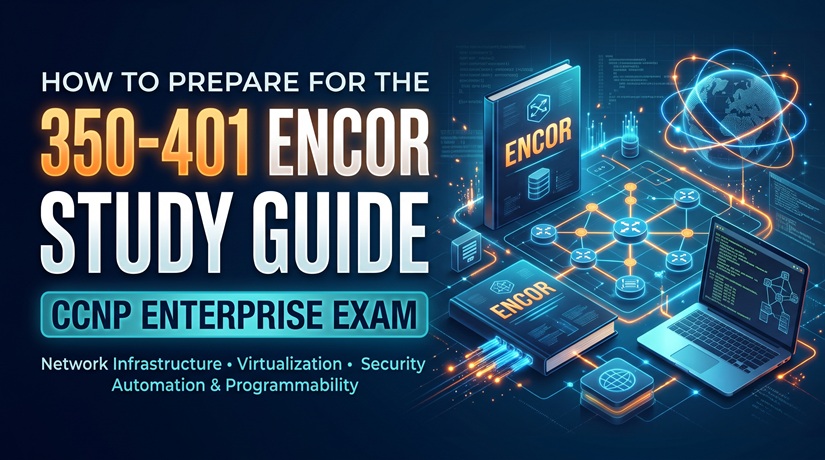
That is the context behind Cisco’s 350-401 ENCOR exam. For learners working toward the CCNP Enterprise certification, ENCOR is the core exam that brings together many of the technologies used to design, implement, operate, and troubleshoot modern enterprise networks.
This 350-401 ENCOR Study Guide is written for students, early-career network technicians, and IT professionals who want a structured route into professional-level enterprise networking. If you are comparing preparation options, you can also review our 350-401 ENCOR exam preparation resource. It explains what the exam represents, how it fits into the CCNP pathway, which technical areas deserve attention, and how to turn study time into practical ability.
What Is the 350-401 ENCOR Exam?
Table of Contents
ToggleENCOR stands for Implementing Cisco Enterprise Network Core Technologies. The 350-401 exam evaluates a candidate’s understanding of core enterprise networking technologies, including dual-stack architecture (IPv4 and IPv6), infrastructure, virtualization, network assurance, security, and automation.
According to Cisco’s current exam information, ENCOR is a 120-minute exam. Passing it earns the Cisco Certified Specialist – Enterprise Core certification and satisfies the core-exam requirement for the CCNP Enterprise certification. It can also be used as the core exam for the CCIE Enterprise Infrastructure pathway.
- Exam code: 350-401 ENCOR
- Exam name: Implementing Cisco Enterprise Network Core Technologies
- Duration: 120 minutes
- Current blueprint: Version 1.2, effective March 19, 2026
- Official exam price listed by Cisco: US$400 (subject to change by region, tax, or Cisco policy)
- Languages listed by Cisco: English and Japanese
Always check Cisco’s live exam page before booking. Exam details, pricing, delivery options, and blueprints can change. The official exam-topic document—not a third-party course outline or an old practice test—should be your final reference when deciding what to study.
How ENCOR Fits into the CCNP Enterprise Certification
The CCNP Enterprise Exam Guide begins with an important distinction: ENCOR is the core exam, not the entire CCNP Enterprise certification by itself. To earn CCNP Enterprise, candidates pass the 350-401 ENCOR core exam and one approved concentration exam of their choice.
The core exam demonstrates broad knowledge across enterprise networking. The concentration exam lets a candidate develop a deeper specialty, such as advanced routing, SD-WAN, network design, automation, cloud connectivity, or network assurance. Cisco may update the available concentration portfolio, so confirm the current choices on the official certification page before selecting one.
Choosing a concentration
- Advanced routing and services: A natural direction for engineers who enjoy routing protocols, troubleshooting, and complex IP services.
- SD-WAN: Relevant to organizations modernizing branch connectivity and centralized WAN operations.
- Enterprise network design: A good fit for learners interested in architecture, scalability, resiliency, and design decisions.
- Automation: Useful for engineers who want to manage infrastructure through APIs, data models, Python, and orchestration tools.
- Cloud connectivity and assurance: Relevant to hybrid environments and teams responsible for visibility, performance, and cloud integration.
Each exam passed in the CCNP Enterprise track can also earn a corresponding Cisco Specialist certification. This gives candidates a way to demonstrate progress and a focused technical capability while working toward the full professional-level credential.
Why the CCNP Enterprise Certification Matters
A certification cannot replace production experience, but a well-prepared candidate can use it to demonstrate a structured understanding of enterprise networking. The CCNP Enterprise track is useful for people who want to move beyond entry-level device configuration and develop a broader view of how networks are designed and operated.
1. It provides a structured technical foundation
ENCOR brings together routing and switching, high availability, network services, security, virtualization, monitoring, and automation. Studying these subjects as one system helps learners understand how a change in one part of a network can affect another.
2. It supports professional development
CCNP-level knowledge is relevant to roles such as network engineer, enterprise network administrator, infrastructure specialist, network operations engineer, and network implementation consultant. Employers will still consider hands-on experience, communication skills, and the requirements of the specific role, but a current certification can help make a candidate’s technical development more visible.
3. It encourages practical troubleshooting
Professional networking is not simply about knowing commands. Engineers must interpret symptoms, isolate a fault, validate a hypothesis, and make changes without creating a larger outage. A strong ENCOR preparation process develops this methodical approach.
4. It creates a path toward deeper specialization
After the core exam, the concentration exam allows candidates to focus on a technical area that matches their work or career goals. Enterprise networking requires both broad fundamentals and deeper expertise.
Core CCNP Exam Topics to Understand
When people search for a CCNP Exam Topic, they often want a checklist of technologies to memorize. A better approach is to group the blueprint into connected technical domains and understand what each technology does, why it is used, and how to verify its operation.
The following sections are a learning-oriented overview of ENCOR v1.2 subject areas, not a substitute for Cisco’s detailed exam blueprint. Cisco’s March 2026 v1.2 update removed specified wireless and QoS tasks, along with certain hardware/software switching-mechanism tasks, from the ENCOR blueprint. Do not assume every topic found in older v1.0 or v1.1 study material remains an examinable v1.2 objective.
1. Enterprise network architecture
Architecture is about making networks scalable, resilient, and manageable. Candidates should understand hierarchical campus designs, two-tier and three-tier models, redundancy, and the trade-offs involved in different topologies. High availability is a recurring operational concern. Be comfortable explaining why redundant links and devices are deployed, how first-hop redundancy protocols provide gateway resilience, and how mechanisms such as Stateful Switchover (SSO) help reduce disruption during certain control-plane events.
2. Virtualization and overlay technologies
Virtualization separates logical network services from the physical infrastructure that carries them. Understand the purpose of network overlays, underlays, tunneling, and segmentation. Learn the basic roles and concepts behind Cisco Catalyst SD-WAN and Cisco SD-Access. Focus on control-plane and data-plane responsibilities, policy, segmentation, and how an overlay interacts with the underlying network. Cisco’s v1.2 terminology uses updated product names, including Catalyst Center and current SD-WAN component names.
3. Infrastructure: Layer 2 and Layer 3
Infrastructure knowledge is central to day-to-day network operations. Review Ethernet switching, VLANs, trunking, EtherChannel, spanning tree, routing fundamentals, and the behavior of IPv4 and IPv6. Know how devices learn and forward traffic, how routing decisions are made, and how to interpret interface and protocol status. Understand static routes and dynamic routing protocols, the information represented in routing tables, and the difference between reachability and an end-to-end working application. For IPv6, practice address notation, prefix lengths, neighbor discovery, and the way IPv6 differs from IPv4 in operation.
4. Network services
Enterprise networks rely on services that make connectivity useful and manageable. Review the purpose and operation of DHCP, DNS, NTP, SNMP, and syslog. Be prepared to reason about what happens when a service is unavailable, incorrectly configured, or blocked by an access policy.
5. Network assurance and troubleshooting
Network assurance is the practice of determining whether the network is operating as intended. It combines telemetry, monitoring, logs, packet-level evidence, and performance indicators. Learn how to interpret device outputs and distinguish a physical-link issue from a VLAN, routing, policy, or application problem. Useful habits include checking the physical layer first, confirming interface and VLAN state, validating addressing and routing, reviewing logs, and testing the path from more than one point.
6. Security fundamentals
Security is part of network engineering, not a separate afterthought. Study access control, device hardening, secure management, segmentation, identity-based access concepts, and common enterprise security controls. Understand the difference between authenticating a user or device, authorizing access, and accounting for activity. Learn how control-plane protection, management-plane security, and segmentation reduce risk. In practical work, consider the impact of a security change on legitimate traffic and management access.
7. Automation and programmability
Modern network teams increasingly use software interfaces to collect information and apply consistent configuration. You do not need to become a full-time software developer to benefit from automation, but you should understand APIs, structured data, and common network programmability tools. Start with JSON and basic Python. Then learn what REST APIs do and become familiar with NETCONF, RESTCONF, and YANG data models. Practice reading an API response, identifying important fields, and understanding how automation can reduce repetitive manual work.
8. Network virtualization and cloud concepts
Enterprise infrastructure increasingly spans on-premises data centers, branch locations, and public cloud environments. Learn the basic differences between physical and virtual network functions, how virtual machines connect to networks, and why organizations use hybrid connectivity. Focus on networking principles rather than memorizing product names without understanding their purpose.
How to Use This 350-401 ENCOR Study Guide
A reliable study process combines the official blueprint, a primary learning resource, hands-on practice, and regular review. For an additional study resource, see our Cisco 350-401 ENCOR exam preparation page. Avoid collecting dozens of courses and PDFs before you have completed one coherent learning path.
Step 1: Download the current exam topics
Start with Cisco’s official 350-401 ENCOR exam page and open the current exam topics. Save the blueprint and use it as your checklist. Mark each objective as unfamiliar, understood in theory, or verified in a lab. This helps prevent spending too much time on familiar topics while overlooking weak areas.
Step 2: Assess your networking fundamentals
If subnetting, VLANs, trunking, spanning tree, routing, and IPv6 are still difficult, strengthen those foundations before moving to more complex topics. Professional-level study becomes easier when you can reason confidently about packet forwarding and the path traffic takes through a network.
Step 3: Learn concepts before memorizing commands
Commands are useful, but they make sense only when you understand the behavior they control. For every feature, ask four questions: What problem does it solve? Where does it operate? What does a correct configuration look like? How would you verify and troubleshoot it?
Step 4: Use labs to test your understanding
Build small topologies and change one variable at a time. Configure a feature, verify it, break it deliberately, and troubleshoot the failure. This is more effective than copying a configuration and assuming that successful command entry means the technology is understood.
Step 5: Review mistakes systematically
Keep a short error log. Record the question or lab objective, the incorrect assumption, the correct explanation, and the command or evidence that confirmed it. Revisit the log every week. The aim is not to accumulate notes; it is to stop making the same reasoning error.
Build Practical Skills with ENCOR Labs
Hands-on work is one of the strongest ways to turn theory into operational knowledge. Depending on your hardware access and budget, you can use physical Cisco equipment, Cisco Modeling Labs, or other network simulation and emulation environments. Check platform compatibility and licensing before choosing a lab tool.
Suggested beginner-to-intermediate lab exercises
- VLAN and trunking lab: Create multiple VLANs, configure trunk links, and verify that hosts in the same VLAN can communicate across switches.
- Spanning Tree lab: Build a redundant Layer 2 topology, observe root bridge selection, and test how the topology responds to a link failure.
- Layer 3 routing lab: Configure IPv4 and IPv6 addressing, add routing, and verify end-to-end reachability.
- First-hop redundancy lab: Configure a supported FHRP scenario and test gateway behavior when the active device becomes unavailable.
- Network services lab: Configure or inspect DHCP, DNS, NTP, and syslog behavior in a small environment.
- Security lab: Apply access controls to management and user traffic, then verify both permitted and denied flows.
- Automation lab: Use Python to parse structured data or make a simple API request against a lab service. Start with read-only operations before attempting configuration changes.
For each lab, write down the topology, intended outcome, configuration changes, verification commands, and troubleshooting steps. This creates a personal reference that is more useful than a folder of unannotated configuration files.
A Practical 10-Week CCNP Enterprise Study Plan
The schedule below is a sample for learners who can study consistently alongside work or school. Adjust the pace to your experience and map your work to the current v1.2 blueprint.
| Week | Study focus | Practical checkpoint |
|---|---|---|
| 1 | Review the blueprint; assess IPv4, IPv6, subnetting, and switching fundamentals. | Build a small routed-and-switched topology and document the traffic path. |
| 2 | Enterprise architecture, hierarchical design, and high availability. | Explain a redundant campus design and test a gateway failover scenario. |
| 3 | Layer 2 infrastructure: VLANs, trunks, EtherChannel, and spanning tree. | Configure and troubleshoot a multi-switch campus lab. |
| 4 | Layer 3 infrastructure, IPv4/IPv6 routing, and network services. | Verify routing and diagnose a deliberately introduced reachability fault. |
| 5 | Virtualization, overlays, SD-WAN, and SD-Access concepts. | Draw control-plane/data-plane relationships and explain traffic flow. |
| 6 | Security concepts, secure management, access control, and segmentation. | Apply an access policy and test allowed and blocked traffic. |
| 7 | Network assurance, telemetry, monitoring, and troubleshooting. | Use logs and device outputs to isolate a simulated fault. |
| 8 | Automation, APIs, JSON, Python fundamentals, and data models. | Complete a small read-only API or structured-data exercise. |
| 9 | Review weak objectives and complete mixed-topic labs. | Repeat labs without following a step-by-step tutorial. |
| 10 | Final blueprint review and timed practice. | Explain every objective and review mistakes before booking. |
A useful weekly rhythm is to spend the first part of a session learning a concept, the next part testing it in a lab, and the final part writing a short explanation from memory. Even a modest, consistent routine is usually more productive than irregular marathon sessions.
Common ENCOR Preparation Mistakes
- Studying an outdated blueprint: Older videos and notes may include objectives that have since changed. Check the version and effective date of every major resource.
- Memorizing commands without understanding behavior: A command list cannot explain why a route is missing or why a client cannot reach an application.
- Skipping IPv6: Dual-stack networking is part of the exam’s stated scope. Do not treat IPv6 as an optional extra.
- Ignoring automation: Network programmability is part of modern enterprise operations. Basic familiarity with APIs, JSON, and Python is worth developing.
- Relying only on practice questions: Question banks can help identify gaps, but they should not replace learning, labs, or the official exam topics. Use them alongside structured ENCOR exam preparation materials and hands-on practice.
- Booking before reviewing weak areas: A readiness check should include both conceptual understanding and the ability to verify configurations in a lab.
Frequently Asked Questions
Is 350-401 ENCOR the same as CCNP Enterprise?
No. ENCOR is the core exam required for CCNP Enterprise. Candidates must also pass one approved concentration exam to earn the full CCNP Enterprise certification. Passing ENCOR alone earns the Cisco Certified Specialist – Enterprise Core certification.
Is the 350-401 ENCOR exam suitable for beginners?
It is a professional-level exam, so it is more approachable if you already understand networking fundamentals. Beginners can work toward it, but should first become comfortable with IP addressing, subnetting, Ethernet switching, routing, and basic troubleshooting.
How long should I study for ENCOR?
There is no single timeline that works for everyone. Your preparation time depends on existing experience, weekly study hours, and how much hands-on practice you need. The 10-week schedule in this guide is a framework, not a guarantee of exam readiness.
What changed in ENCOR v1.2?
Cisco’s minor update took effect on March 19, 2026. The published change summary lists removals that include specified wireless design, wireless infrastructure and security tasks, QoS tasks, and certain hardware/software switching-mechanism tasks. It also updates several product names. Consult the official release notes and current exam topics rather than relying on a summary alone.
Do I need to know Python for ENCOR?
Automation and programmability are part of ENCOR’s stated scope. Basic Python literacy and an understanding of APIs and structured data are useful. Focus on understanding how network automation works and how to interpret data, rather than trying to become an advanced software developer solely for this exam.
Can I use ENCOR as a step toward CCIE?
Yes. Cisco identifies 350-401 ENCOR as the core exam for the CCIE Enterprise Infrastructure pathway as well. CCIE certification has additional requirements, including a separate lab exam, so passing ENCOR does not by itself earn CCIE.
Where should I find the latest CCNP Exam Topic list?
Use Cisco’s official ENCOR exam page and its linked exam topics. Third-party study guides can help explain the material, but Cisco’s current blueprint should be the authority for exam scope.
Final Thoughts: Study for the Skills, Not Just the Exam
The 350-401 ENCOR exam is a broad checkpoint in the development of an enterprise network engineer. It covers the foundations that keep business networks connected, resilient, observable, secure, and increasingly programmable. A strong preparation plan therefore needs more than flashcards: it needs a current blueprint, clear technical explanations, repeated lab practice, and honest review of weak areas.
Use this 350-401 ENCOR Study Guide as a roadmap, the CCNP Enterprise Exam Guide structure to plan your certification path, and the official CCNP Exam Topic list to keep your study aligned with the current exam. You can also visit our 350-401 Cisco ENCOR exam page for a related preparation resource. Most importantly, make sure you can explain what a technology does and demonstrate how to verify it. Those are the skills that remain valuable long after exam day. When you are ready to organize your final review, take a look at this ENCOR exam study resource as a supplementary reference.
Official References and Further Reading
Use the following sources to verify exam details, certification requirements, and the latest blueprint. Cisco may update its pages and exam documents, so check them again before scheduling your exam.
- Cisco 350-401 ENCOR Exam Page — official exam overview, duration, price, and preparation links.
- Cisco CCNP Enterprise Certification — certification structure and concentration exam options.
- Cisco CCNP Enterprise v1.1 and v1.2 Release Notes (PDF) — published summary of the March 2026 minor update.
- Cisco ENCOR Training Course — official training description and learning objectives.
- Cisco Learning Network — Cisco certification community and learning resources.
- RFC Editor — authoritative Internet standards and protocol specifications.
- IANA — protocol registries and Internet numbering resources.