If you have spent most of your networking study time on routing, switching, VLANs, and IP addressing, the Cisco 500-052 UCCXD exam can feel like a move into a completely different part of the Cisco world. In many ways, it is.
UCCX sits at the intersection of networking, voice, application logic, and customer service operations. You are no longer concerned only with whether packets can reach a destination. You also need to understand what happens when a customer calls a company, how that call enters an IVR, how an application makes a routing decision, how an available agent is selected, and what happens when part of the contact center fails.
That is what makes Deploying Cisco Unified Contact Center Express (500-052 UCCXD) an interesting exam. It is specialized, fairly technical, and much closer to a real collaboration deployment than a general networking fundamentals test.
There is also an important detail that candidates should understand before buying study material: although Cisco still lists 500-052 as a current exam as of August 2026, its published exam objectives are based on Cisco Unified Contact Center Express version 11.0. Cisco’s product documentation has since moved on to newer UCCX releases, including version 15.0. In other words, study the exam blueprint for the test, but do not assume that every exam-specific detail represents the newest production environment.
Cisco 500-052 UCCXD Exam Quick Facts
| Exam Code | 500-052 |
|---|---|
| Exam Name | Deploying Cisco Unified Contact Center Express |
| Exam Acronym | UCCXD |
| Duration | 60 minutes |
| Language | English |
| Published Question Count | 45–55 questions in Cisco’s linked exam blueprint |
| Exam Technology Version | Cisco Unified Contact Center Express 11.0 |
| Main Domains | Design, Implementation, and Operations |
| Current Cisco Classification | Channel, partner, and other exams |
Important: Cisco can change exam availability and objectives. Always check Cisco’s official exam page before scheduling the test. Candidates who are organizing their preparation can also review this 500-052 UCCXD exam preparation resource alongside the official blueprint.
What Is Cisco Unified Contact Center Express?
Cisco Unified Contact Center Express, usually shortened to UCCX or Unified CCX, is Cisco’s contact center platform aimed primarily at small and medium-sized contact center deployments. Cisco currently describes the platform as supporting environments of up to 400 agents.
At its core, UCCX is an IP-based Automatic Call Distribution (ACD) and Interactive Voice Response (IVR) platform. It works with Cisco Unified Communications Manager and other collaboration components to receive customer interactions, execute routing logic, queue calls, and deliver those calls to suitable agents.
Imagine calling a company’s support number. You hear:
“Thank you for calling. Press 1 for sales, press 2 for technical support, or press 3 for billing.”
That apparently simple interaction can involve several systems. CUCM handles call-control functions. UCCX executes application and IVR logic. A Contact Service Queue determines where the contact should wait. Agent information and skills influence routing. Cisco Finesse provides the agent desktop, while reporting tools provide supervisors and administrators with operational data.
This is why UCCX requires more than traditional network knowledge. You need to understand the complete call path.
Understanding UCCX Architecture
A simplified inbound call flow may look like this:
Customer
   |
   v
PSTN / SIP Provider
   |
   v
Voice Gateway or CUBE
   |
   v
Cisco Unified Communications Manager (CUCM)
   |
   v
UCCX Trigger / Application
   |
   v
UCCX Script and IVR Logic
   |
   v
Contact Service Queue (CSQ)
   |
   v
Selected Agent
   |
   +---- Cisco Finesse Agent Desktop
   |
   +---- Reporting / Cisco Unified Intelligence Center
The exact architecture varies between organizations, but this model gives beginners a useful mental picture.
CUCM and UCCX
Cisco Unified Communications Manager is responsible for enterprise call control. UCCX integrates tightly with CUCM so that the contact center can monitor telephony resources and control call routing. Cisco JTAPI plays an important role in this relationship.
You do not need to become a JTAPI programmer for the 500-052 exam, but you should understand why CTI and JTAPI connectivity matter. If UCCX loses the communication channel it uses to control or monitor phones and route points, the effect can be far more serious than a simple web-interface problem.
Applications, Triggers, and Scripts
One of the first concepts I recommend getting completely clear is the relationship between a trigger, an application, and a script.
A caller dials a number associated with a UCCX trigger. That trigger invokes a UCCX application, and the application runs a script containing the contact-processing logic.
The script may then:
- Accept the incoming contact.
- Play a welcome prompt.
- Check business hours.
- Present an IVR menu.
- Collect caller input.
- Make routing decisions.
- Place the caller into a queue.
- Select an appropriate resource.
- Handle exceptions, timeouts, or overflow conditions.
Once you understand this flow conceptually, the UCCX Application Editor becomes much less intimidating.
Resources, Skills, and CSQs
These concepts appear constantly in real UCCX administration.
A resource generally represents an agent available to the contact center. Agents can be associated with skills, and those skills can be used when determining which resources should service a particular Contact Service Queue (CSQ).
For example, an organization might create:
- English Support skill
- Spanish Support skill
- Billing skill
- Level-2 Technical Support skill
A well-designed routing strategy can then send a Spanish-speaking billing customer to an agent with the appropriate capabilities instead of simply giving the call to the next person who becomes available.
Cisco Finesse
Cisco Finesse provides the browser-based desktop used by contact center agents and supervisors. From an agent’s point of view, this is where much of the contact center becomes visible: login state, Ready and Not Ready status, call controls, and other contact-center functions.
From an administrator’s point of view, agent state is also valuable troubleshooting information. If calls are sitting in a queue while several agents appear to be online, their actual state, skill assignment, resource configuration, and telephony connectivity become obvious places to investigate.
Cisco Unified Intelligence Center
Reporting is another important part of contact center operations. Cisco Unified Intelligence Center, or CUIC, provides access to historical and live reporting information for Unified CCX environments.
A network engineer may naturally focus on whether the servers and interfaces are “up.” A contact center engineer also needs to think about operational measurements such as calls offered, calls handled, abandoned contacts, queue behavior, agent states, and talk time.
That difference in perspective is worth learning early.
Networking and Collaboration Technologies You Should Know
You do not need CCIE-level knowledge before studying UCCX, but weak fundamentals make the platform considerably harder to understand.
1. IP Networking
You should be comfortable with IP addressing, routing, VLANs, DNS, NTP, default gateways, firewall rules, and basic packet-flow troubleshooting. UCCX is an application, but every application dependency eventually relies on the network.
2. Voice over IP
Learn the purpose of SIP, RTP, codecs, DTMF, call signaling, and media streams. One of the most useful habits in voice troubleshooting is separating signaling problems from media problems.
A call that cannot be established and a call that connects with one-way audio may sound similar to an end user, but they suggest very different troubleshooting paths.
3. Cisco Unified Communications Manager
A UCCX engineer should understand at least the basics of CUCM devices, directory numbers, route patterns, CTI route points, application users, regions, device pools, and call routing.
4. CTI and JTAPI
Computer Telephony Integration allows applications to interact with the telephony environment. In Cisco UCCX deployments, JTAPI connectivity between Unified CCX and CUCM is a fundamental part of call control and resource monitoring.
5. Quality of Service
Contact centers are sensitive to packet loss, latency, and jitter. QoS knowledge is therefore more than a CCNA side topic. A contact center may have perfectly functional application servers and still provide a terrible customer experience if the voice network performs poorly.
6. Virtualization and High Availability
Modern UCCX deployments run as virtualized collaboration applications. Candidates should understand server sizing, dependencies, redundancy, backup strategy, and failover concepts.
Current UCCX documentation describes a high-availability cluster with up to two UCCX servers: an active server and a standby server. If the active server becomes unavailable, failover allows the standby server to assume the active role.
Cisco 500-052 UCCXD Exam Topics and Weighting
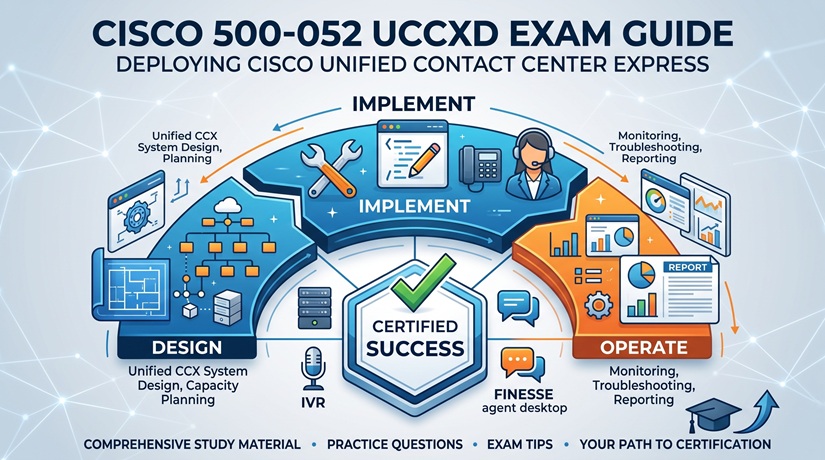
The Cisco exam blueprint divides the test into three major areas. When building a Cisco 500-052 study plan, these percentages are useful because they help you decide where to spend most of your preparation time.
| Domain | Weight | Main Focus |
|---|---|---|
| Design a Unified Contact Center Express Deployment | 32% | Capacity, requirements, features, configuration choices |
| Implement a Unified Contact Center Express System | 40% | Installation, configuration, provisioning, scripting |
| Operate a Unified Contact Center Express System | 28% | Administration, monitoring, troubleshooting, upgrades |
The obvious takeaway is that implementation is the largest individual section. Spending all of your preparation time reading architecture diagrams while avoiding configuration and scripting would be a poor strategy.
Domain 1: Designing a UCCX Deployment — 32%
Design questions are not simply asking whether you recognize product names. They test whether you can translate a business requirement into a technically sensible contact center.
Suppose a customer tells you:
“We have 120 agents, two offices, English and Spanish support teams, a 24-hour emergency queue, business-hours billing service, and we cannot tolerate a single UCCX server failure.”
That short requirement already raises multiple technical questions.
You need to think about capacity, licensing, high availability, network design, skills, CSQs, operational hours, failover, CUCM integration, reporting, and application logic.
Capacity Planning
Know that sizing is not simply the number of employees in a company. Contact center capacity can depend on concurrent agents, IVR requirements, feature use, call volume, deployment model, and platform limits.
Feature Requirements
Learn to distinguish customer requirements from technical features. If a business wants callers to hear estimated wait information, reach agents according to language, receive callback treatment, or enter information before reaching an employee, your job is to translate those requirements into UCCX functions and script logic.
High Availability
Do not treat HA as “install another server and forget about it.” You should understand why redundancy exists, which dependencies remain outside UCCX itself, and what users experience during failure and recovery.
Business Edition 6000
The official 500-052 blueprint also includes Cisco Business Edition 6000 in the implementation-related objectives. This is one of the clues that the exam reflects the product ecosystem of its original UCCX 11.0 era.
For exam preparation, do not ignore an objective simply because it feels less prominent in today’s market. Cisco tests against the published blueprint.
Domain 2: Implementing UCCX — 40%
This is the biggest section of the exam and, in my view, the part where hands-on practice pays the largest dividend. It is also an area that deserves extra attention when working through 500-052 UCCXD preparation material.
Installation and Initial Configuration
Understand the overall deployment sequence rather than memorizing screenshots. You should know where UCCX fits in the collaboration environment, what information is required during installation, what integrations must be established, and what needs to happen before the system can process production calls.
User and Agent Provisioning
Learn how CUCM users become usable contact center resources, how agents are associated with teams and skills, and how CSQs use those resources.
A classic troubleshooting scenario is a newly created agent who can use a Cisco phone but cannot correctly participate in the contact center. That type of problem forces you to think beyond basic telephony registration.
UCCX Scripting
Scripting is one of the defining UCCX skills.
You do not need to approach it like traditional software development. Start by thinking in terms of a flowchart:
Incoming Call
     |
     v
Accept Contact
     |
     v
Check Business Hours
     |
     +---- Closed ----> Play Closed Message ----> End
     |
     v
Play Welcome Prompt
     |
     v
Menu
 |        |
Sales   Support
 |        |
 v        v
CSQ A    CSQ B
 |        |
 +--- Select Available Agent
If you can draw the logic clearly on paper, building it in the UCCX Application Editor becomes much easier.
As your skills improve, add exception handling, retries, timeouts, queue treatment, database lookups, HTTP integrations, callback logic, and more sophisticated routing.
Do Not Memorize the GUI Alone
A common mistake with Cisco application exams is memorizing where a button appears instead of understanding why the configuration exists.
Menus move between software releases. Concepts survive much longer.
If you know what a CSQ does, what a trigger does, why JTAPI is required, and how an application reaches a script, you can adapt when the interface changes.
Domain 3: Operating and Troubleshooting UCCX — 28%
A contact center is not finished when installation completes. Production systems need monitoring, troubleshooting, patching, backups, upgrades, reporting, and license management.
Start Troubleshooting with the Call Flow
When a call fails, do not immediately restart services.
Ask where the call stopped.
- Did the call reach the gateway?
- Did CUCM receive and route it correctly?
- Did it reach the UCCX trigger?
- Did the application execute?
- Did the script follow the expected branch?
- Was the caller placed into the expected CSQ?
- Were suitable resources available?
- Was the agent in the correct state?
- Did signaling work but media fail?
This layered method is much faster than randomly changing configuration.
Monitoring
Learn which tools show service status, contact center activity, agent state, call statistics, reporting information, and system health.
The exam blueprint specifically calls out monitoring and troubleshooting processes, so operations should not be treated as an afterthought.
Logs and Traces
For beginners, log files can look overwhelming. The goal is not to memorize every filename. Learn to correlate a problem with a component and a timestamp.
If a caller reports that a specific number failed at 10:43 AM, that timestamp is extremely useful. If you also know the calling number, called number, application, and affected agent, troubleshooting becomes much more focused.
Upgrades and Licensing
The 500-052 blueprint also expects familiarity with patching, system upgrades, and license additions. Study these as operational processes: prerequisites, compatibility, backups, maintenance planning, and post-change verification all matter.
How Valuable Is the Cisco 500-052 UCCXD Exam?
This question deserves a more careful answer than “Cisco certifications are valuable.”
The 500-052 UCCXD exam is a niche product-focused exam. Cisco’s current exam catalog places it under “Channel, partner, and other exams,” rather than under its main Career Certification section. It should therefore not be viewed as a direct substitute for a broad credential such as CCNA or CCNP Collaboration.
Its value is strongest when your job actually involves Cisco Unified Contact Center Express.
Where the Exam Can Be Valuable
- Cisco collaboration engineers supporting UCCX environments
- Voice engineers moving into contact center technologies
- System integrators deploying Cisco collaboration solutions
- Cisco partner engineers working with customer contact centers
- Administrators responsible for UCCX, Finesse, CUCM, and reporting
- Students who want deeper specialization after learning networking and VoIP fundamentals
An engineer who genuinely understands UCCX scripting, queues, agent resources, CUCM integration, and troubleshooting can solve problems that a general network engineer may not be comfortable touching.
Where It May Be Less Valuable
If your goal is general routing and switching, cybersecurity, cloud infrastructure, or software development, 500-052 is probably too specialized to be a first priority.
The same applies if your target employers exclusively use cloud-native contact center platforms rather than Cisco UCCX.
There is also the version issue. The exam objectives remain based on UCCX 11.0 while Cisco’s current product documentation includes UCCX 15.0. That does not make the exam useless, but it means candidates should understand exactly what they are studying and why.
I would describe its value this way: 500-052 is more useful as proof of product depth than as a general-purpose networking credential.
Recommended Cisco 500-052 UCCXD Study Plan
A good Cisco UCCXD exam preparation strategy should combine the official exam objectives with practical UCCX knowledge. The following stages provide a sensible progression for students and junior network engineers.
Stage 1: Build the Voice Foundation
Before opening the UCCX scripting editor, make sure you understand basic CUCM and VoIP concepts.
Focus on:
- SIP basics
- RTP and media flow
- Codecs
- DTMF
- CUCM call routing
- Directory numbers and route patterns
- CTI concepts
- Basic QoS
Stage 2: Learn the UCCX Object Model
Be able to explain these terms without looking at your notes:
- Resource
- Resource Group
- Skill
- Team
- Contact Service Queue
- Application
- Trigger
- Script
- Prompt
- Agent
- Supervisor
If these objects are mixed together in your head, scripting and troubleshooting will remain difficult.
Stage 3: Trace a Complete Call
Take one example number and follow it all the way from the caller to the agent.
Draw the path. Identify which system controls each step. Then ask what would happen if each component failed.
This single exercise connects networking, CUCM, UCCX, scripting, queues, and Finesse into one mental model.
Stage 4: Practice Scripting
Start with a small script:
- Accept the contact.
- Play a prompt.
- Provide two menu choices.
- Send each choice to a different CSQ.
- Provide queue treatment when no agent is immediately available.
- Handle invalid input and timeout conditions.
Then add business-hour checks, holidays, overflow logic, and other functions.
Stage 5: Break the Lab
Configuration teaches you how a system should work. Deliberately breaking the lab teaches you how it actually works.
Try scenarios such as:
- Remove an agent’s required skill.
- Put all agents into Not Ready state.
- Use an incorrect trigger configuration.
- Change script routing logic.
- Investigate a failed CUCM/UCCX integration dependency.
- Observe what happens when a required service is unavailable.
Then troubleshoot without immediately undoing your change.
Stage 6: Return to the Official Blueprint
A week or two before the exam, stop studying random UCCX topics and map your notes directly to the official 500-052 objectives.
For every blueprint item, ask:
Can I explain this concept to another engineer without opening a book?
If the answer is no, that topic deserves another review. At this stage, using a structured 500-052 exam review resource can also help you identify areas that still need attention.
Building Practical UCCX Skills
UCCX is one of those technologies where hands-on experience makes a very noticeable difference.
A useful training environment would ideally give you access to:
- Cisco Unified Communications Manager
- Cisco Unified Contact Center Express
- A few test users and endpoints
- Cisco Finesse
- UCCX Application Editor
- Reporting and administration interfaces
You do not need hundreds of agents. Two or three test agents are enough to explore skills, CSQs, agent states, teams, queue behavior, and scripting.
If you are a student without access to a full lab, concentrate on understanding architecture and call flow first. Read Cisco configuration guides while following the configuration process logically rather than trying to memorize page after page of menus.
Common Mistakes When Preparing for 500-052
Mistake 1: Treating UCCX Like a Router Exam
CLI knowledge alone will not carry you through contact center concepts. UCCX is application-heavy and workflow-driven.
Mistake 2: Ignoring CUCM
UCCX and CUCM are tightly integrated. Trying to learn UCCX while avoiding CUCM call control creates major knowledge gaps.
Mistake 3: Skipping Scripting
Implementation is the largest exam domain, and the official objectives specifically include the UCCX Application Editor. Scripting should be a core study topic.
Mistake 4: Memorizing Answers Without Understanding the Technology
Memorizing isolated answers does very little when a production queue stops routing calls on Monday morning.
Contact center engineering rewards troubleshooting ability. Use any Cisco 500-052 exam study resource as a supplement to actual technical learning rather than as a replacement for understanding UCCX architecture, scripting, call flow, and troubleshooting.
Mistake 5: Studying Only the Latest UCCX Version
This sounds counterintuitive, but remember that the 500-052 blueprint specifically targets UCCX 11.0. Modern UCCX documentation is excellent for understanding today’s platform, but exam preparation should remain aligned with Cisco’s published objectives.
Mistake 6: Studying Only the Old Version
The opposite approach is also limiting.
If your goal extends beyond passing the test, spend some time reading the current UCCX documentation so that you understand how the product has evolved. Certification study should ideally make you more useful in a real environment, not only more familiar with exam terminology.
Exam-Day Strategy
With a 60-minute exam window, time management matters.
- Read scenario questions carefully and identify what is actually being asked.
- Separate design requirements from configuration details.
- When troubleshooting, think through the call flow instead of guessing.
- Pay attention to terminology such as resource, skill, CSQ, application, trigger, and script.
- Do not spend excessive time on one difficult question.
- Use the official blueprint as your final preparation checklist.
Cisco 500-052 UCCXD FAQ
Is Cisco 500-052 UCCXD still available?
As of August 17, 2026, Cisco still lists 500-052 UCCXD – Deploying Cisco Unified Contact Center Express on its Current Exams page. Because certification portfolios can change, verify the Cisco website again before purchasing or scheduling an exam.
What version of UCCX does the 500-052 exam cover?
Cisco’s official exam description states that the exam tests knowledge of Cisco Contact Center Express version 11.0 deployments.
How long is the Cisco UCCXD exam?
The official Cisco exam page lists a duration of 60 minutes.
How many questions are on 500-052?
The exam-topic document currently linked by Cisco describes the exam as containing 45 to 55 questions. Cisco’s main exam page does not separately display the question count, so candidates should always treat the latest Cisco exam information as authoritative.
Is 500-052 part of CCNP Collaboration?
Cisco’s current exam catalog does not list 500-052 with the CCNP Collaboration career-certification exams. It appears in the “Channel, partner, and other exams” section.
This distinction matters when evaluating the certification value. Do not assume that passing 500-052 fulfills a current CCNP Collaboration concentration requirement unless Cisco or your specific partner program explicitly says so.
Is Cisco 500-052 difficult for beginners?
It can be. UCCX combines networking, CUCM, VoIP, CTI, application configuration, scripting, contact center routing, and troubleshooting.
A student who already understands basic IP networking and CUCM will have a much easier starting point than someone entering UCCX with no voice background.
What should I study most for UCCXD?
According to Cisco’s published weighting, implementation represents 40 percent of the exam, followed by design at 32 percent and operations at 28 percent.
That makes installation concepts, provisioning, application configuration, scripting, resources, skills, and CSQs particularly important, while design and troubleshooting should still receive substantial study time.
Should I learn UCCX scripting for the exam?
Yes. The official blueprint specifically includes use of the Unified Contact Center Express Application Editor. More importantly, scripting is one of the most useful practical skills you can develop as a UCCX engineer.
How should I prepare for the Cisco 500-052 UCCXD exam?
Start with the official Cisco blueprint, make sure your CUCM and VoIP fundamentals are solid, learn the UCCX object model, practice scripting, and work through troubleshooting scenarios. You can then use additional 500-052 Cisco UCCXD exam preparation material to reinforce the topics you have already studied and identify weaker areas before the exam.
Is UCCX still relevant when cloud contact centers are growing?
Cloud contact center adoption has changed the collaboration market, but on-premises UCCX knowledge can still be relevant in organizations that operate Cisco Unified Communications environments. Cisco also continues to publish documentation for modern UCCX releases.
The better career strategy is not to view UCCX as your only skill. Combine it with CUCM, SIP, troubleshooting, network fundamentals, automation, APIs, and modern customer-experience technologies.
Final Thoughts
The Cisco 500-052 UCCXD exam is unusual compared with mainstream Cisco certification exams. Its published objectives are based on an older UCCX release, yet Cisco still lists the exam in its current exam catalog. It is also a specialized channel/partner-oriented exam rather than one of Cisco’s main career-certification exams.
Those facts do not eliminate its value. They simply tell you how to value it correctly.
If you work with Cisco Unified Contact Center Express, the real benefit of studying UCCXD is learning how a contact center fits together: CUCM sends calls into the environment, triggers invoke applications, scripts make decisions, CSQs organize contacts, skills influence agent selection, Finesse connects agents to their work, and reporting tells the operational story.
Once those pieces make sense, UCCX stops looking like a collection of unrelated administration pages and starts looking like one system.
For a new network or collaboration engineer, that shift in understanding is more valuable than memorizing another list of exam answers. Candidates preparing specifically for the certification can also review the site’s dedicated Cisco 500-052 UCCXD exam page as part of a broader study strategy.
Official Cisco References
- Cisco 500-052 UCCXD Official Exam Page
- Cisco Current Exams List
- Cisco 500-052 UCCXD Exam Topics
- Cisco Unified Contact Center Express Product Page
- Cisco Unified Contact Center Express 15.0 Solution Design Guide
- Cisco UCCX 15.0 Administration and High Availability Documentation
- Cisco UCCX JTAPI Architecture and Call Flow
Editorial note: Exam status and Cisco product information were reviewed on August 17, 2026. Cisco may update exam availability, objectives, software versions, and certification requirements without notice. Always verify the latest information on Cisco’s official website before registering for an exam.