If you are moving from networking into cybersecurity, sooner or later you discover that detecting an attack is only half the job. The harder questions come afterward: What actually happened? Which systems were affected? What evidence can be trusted? How did the attacker get in? And what should the security team do next?
Those questions sit at the center of the Cisco 300-215 CBRFIR exam.
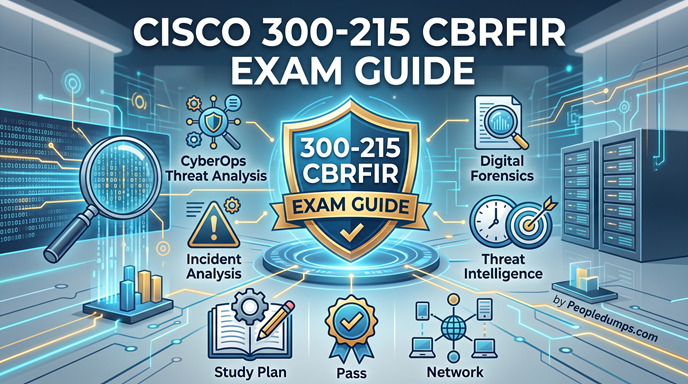
Officially titled Conducting Forensic Analysis and Incident Response Using Cisco Technologies for Cybersecurity, the 300-215 CBRFIR exam focuses on digital forensics, security investigations, threat intelligence, malware analysis, network evidence, and incident response. It is also one of the concentration exams available for the CCNP Cybersecurity certification.
This is not another Cisco exam built mainly around configuring routers and switches. Networking knowledge still matters, but CBRFIR asks you to look at networks from an investigator’s point of view. Logs, packets, endpoint artifacts, suspicious processes, threat intelligence, and forensic evidence become just as important as IP addresses and protocols.
For students and early-career network engineers, that makes the exam particularly interesting. It provides a useful bridge between traditional network engineering and modern Security Operations Center (SOC) work.
What Is the Cisco 300-215 CBRFIR Exam?
The 300-215 CBRFIR exam validates knowledge of forensic analysis and incident response fundamentals, techniques, and processes. The current exam version is CBRFIR v1.2.
In practical terms, the exam is about what happens after suspicious activity is detected. Instead of simply asking whether traffic should be permitted through a firewall, you may need to understand how multiple pieces of evidence fit together during an investigation.
You should be comfortable thinking about questions such as:
- Which logs should be collected after a security incident?
- How can network traffic reveal malicious behavior?
- How can an analyst identify indicators of compromise on a host?
- What does a suspicious process or binary tell us?
- How should forensic evidence be collected and preserved?
- Which incident response action should be taken next?
- How can threat intelligence improve an investigation?
- Which Cisco security technology is appropriate for a particular detection or response scenario?
That makes CBRFIR a fairly broad exam. It touches networking, endpoint security, malware analysis, scripting, digital forensics, threat intelligence, SIEM operations, and incident response.
If you are preparing for the certification, it is useful to combine the official Cisco blueprint with focused 300-215 CBRFIR exam preparation resources so that your study plan remains closely aligned with the technologies and scenarios covered by the exam.
One naming detail is worth knowing before you search for study materials. Older Cisco resources may refer to CyberOps Professional or Cisco Certified Cybersecurity Professional. Cisco subsequently aligned its cybersecurity certification naming with the CCNA and CCNP brands. As of 2026, the professional certification path is known as CCNP Cybersecurity.
Cisco 300-215 CBRFIR Exam Details at a Glance
| Item | Current Information |
|---|---|
| Exam Code | 300-215 |
| Exam Name | Conducting Forensic Analysis and Incident Response Using Cisco Technologies for Cybersecurity |
| Acronym | CBRFIR |
| Current Version | v1.2 |
| Duration | 90 minutes |
| Language | English |
| Official Exam Price | US$300 or Cisco Learning Credits |
| Certification Earned by Passing | Cisco Certified Specialist – Cybersecurity Forensic Analysis and Incident Response |
| Professional Certification Path | CCNP Cybersecurity concentration exam |
Before beginning your preparation, reviewing both the official exam topics and a structured Cisco 300-215 CBRFIR study resource can help you identify which areas require the most attention.
Exam prices, policies, names, and blueprints can change. Always verify the current information on Cisco’s official certification website before scheduling an exam.
How Does 300-215 CBRFIR Fit Into CCNP Cybersecurity?
This point causes confusion for many candidates: passing 300-215 alone does not earn the full CCNP Cybersecurity certification.
The current CCNP Cybersecurity path requires:
- One core exam: 350-201 CBRCOR
- One concentration exam, such as 300-215 CBRFIR
Passing CBRFIR by itself is still meaningful because Cisco awards the Cisco Certified Specialist – Cybersecurity Forensic Analysis and Incident Response certification.
If you later combine it with the required 350-201 CBRCOR core exam, you can satisfy the exam requirements for CCNP Cybersecurity.
This modular structure is useful if your immediate goal is to demonstrate a specialization in incident response and digital forensics without completing the entire professional-level path at once.
How Valuable Is the Cisco CBRFIR Certification?
No certification guarantees a job, and CBRFIR should not be treated as a substitute for practical investigation experience. Its value comes from the combination of skills represented by the exam.
1. It Connects Networking With Cybersecurity Operations
A network engineer normally looks at traffic to understand connectivity and performance. A security analyst may look at exactly the same traffic and ask whether it represents command-and-control communication, reconnaissance, data exfiltration, or another suspicious pattern.
CBRFIR encourages that second way of thinking.
Knowledge of TCP/IP, DNS, HTTP, network flows, packet captures, firewalls, IDS/IPS alerts, and syslog suddenly becomes part of a larger investigation.
2. It Focuses on Skills Used in Real Security Investigations
The blueprint includes technologies such as YARA, Wireshark, tcpdump, Volatility, SIEM platforms, Python, PowerShell, Bash, STIX/TAXII, MITRE ATT&CK concepts, and several Cisco security products.
These are not isolated certification terms. They represent categories of tools and techniques that appear regularly in digital forensics and incident response workflows.
3. It Can Help Differentiate a Security-Focused Cisco Professional
Many Cisco engineers understand routing, switching, firewalls, or general network security. Fewer specialize in Digital Forensics and Incident Response (DFIR).
For someone targeting roles involving SOC operations, security investigations, incident response, or threat analysis, a forensic-focused Specialist certification can communicate a clearer technical direction than a broad networking credential alone.
4. The Skills Are Not Limited to Cisco Products
CBRFIR naturally includes Cisco technologies, but a large portion of the blueprint covers broader cybersecurity concepts: evidence analysis, malware indicators, memory forensics, scripting, threat intelligence, packet analysis, incident playbooks, and forensic processes.
That is important. A good incident responder must understand the investigation itself, not simply memorize where a particular button is located in one vendor’s dashboard.
Cisco 300-215 CBRFIR Exam Topics and Weighting
The current CBRFIR v1.2 blueprint is divided into five major domains. Candidates working through their 300-215 exam study materials should make sure that all five domains receive appropriate attention.
| Domain | Weight |
|---|---|
| 1.0 Fundamentals | 20% |
| 2.0 Forensics Techniques | 20% |
| 3.0 Incident Response Techniques | 30% |
| 4.0 Forensics Processes | 15% |
| 5.0 Incident Response Processes | 15% |
The percentages matter. Incident Response Techniques alone represents 30 percent of the blueprint, so treating CBRFIR as purely a malware-forensics exam would be a serious study mistake.
1.0 Fundamentals – 20%
This section establishes the vocabulary and foundational thinking required for a forensic investigation.
Topics include root cause analysis, forensic analysis of infrastructure devices, anti-forensic techniques, encoding and obfuscation, basic YARA concepts, malware-analysis utilities, memory forensics, and evidence collection from virtualized or cloud environments.
You should understand the difference between finding a suspicious artifact and proving how that artifact fits into an incident.
Encoding deserves attention as well. Base64 and hexadecimal data may look suspicious to a beginner, but encoding is not the same thing as encryption. Attackers frequently use encoding and obfuscation to make scripts or payloads harder to recognize, so analysts need to be able to identify what they are looking at.
2.0 Forensics Techniques – 20%
This domain moves from concepts into investigative techniques.
You are expected to understand topics such as:
- Fileless malware and relevant MITRE ATT&CK methods
- Important host files and artifact locations
- Process analysis
- SIEM and log analysis
- Cloud-native application logs
- Network traffic analysis
- Basic code recognition
- Python, PowerShell, and Bash scripting
- Memory and system forensic utilities
The scripting requirement is especially important. You do not need to become a professional software developer, but a security analyst should be able to automate repetitive work such as searching thousands of log entries, extracting indicators, filtering records, or combining data from multiple sources.
3.0 Incident Response Techniques – 30%
This is the largest exam domain and deserves the largest share of your study time.
The blueprint covers interpretation of SIEM, IDS/IPS, and syslog alerts; correlation of host and network activity; attack vectors; mitigation recommendations; post-incident analysis; zero-day response; threat intelligence; indicators of compromise; indicators of attack; threat actor profiling; and Cisco security technologies.
This section tests an important professional skill: turning technical evidence into a defensible response decision.
Imagine that an endpoint generates a suspicious alert. A weak approach is simply to memorize what the alert means. A stronger analyst asks:
- What other telemetry can confirm the activity?
- Did the host contact a suspicious domain?
- Was the same indicator observed elsewhere?
- Should the endpoint be isolated?
- Does the evidence suggest persistence?
- Which systems need further investigation?
- What mitigation reduces the immediate risk without destroying evidence?
That analytical mindset is much closer to what CBRFIR is trying to validate.
4.0 Forensics Processes – 15%
The Forensics Processes domain covers anti-forensics, web server and application logs, network monitoring, file evaluation, and binary interpretation.
Apache and NGINX logs are worth practicing with. Web logs can reveal scanning activity, suspicious URI requests, exploit attempts, authentication attacks, unusual user agents, or access patterns associated with compromise.
Network evidence is equally important. NetFlow can give you high-level visibility into communication patterns, while Wireshark allows much deeper packet inspection. Knowing which source of evidence to use is often as important as knowing how to use the tool.
5.0 Incident Response Processes – 15%
The final domain focuses on structured response.
You should understand incident response goals, playbooks, endpoint file evaluation, ad-hoc scanning, threat intelligence reports, and formats such as STIX and TAXII.
For students, the concept of an incident response playbook deserves special attention. Real organizations do not want analysts improvising every action during a serious breach. A playbook provides repeatable procedures for situations such as ransomware, phishing, compromised credentials, malware infections, or suspicious network activity.
Networking Skills You Need for CBRFIR
Although CBRFIR is a cybersecurity exam, strong networking fundamentals make it considerably easier.
You should be comfortable with the following areas:
TCP/IP Fundamentals
Understand source and destination IP addresses, TCP and UDP behavior, ports, sessions, and common application protocols. When analyzing malicious traffic, you need to understand what normal communication should look like before you can identify abnormal communication.
DNS
DNS is extremely useful during investigations. Suspicious domains, unusual query patterns, newly observed hosts, and repeated communication to attacker-controlled infrastructure can all become valuable evidence.
HTTP and Web Traffic
You should be able to interpret HTTP requests, status codes, methods, headers, URI paths, and server logs. Web traffic frequently becomes part of exploit investigations.
Packet Analysis
Basic Wireshark and tcpdump skills are highly useful. Learn how to filter conversations, isolate hosts, identify protocols, and follow relevant traffic instead of scrolling through thousands of packets manually.
NetFlow and Network Telemetry
Packet capture gives depth; flow data gives scale. An incident responder should understand why NetFlow-style telemetry can help identify unusual communication patterns across a large environment.
Syslog, IDS/IPS, and Firewall Events
Logs from security infrastructure are often pieces of a larger timeline. The exam expects you to correlate evidence instead of evaluating every alert in isolation.
Important Tools and Technologies for the 300-215 CBRFIR Exam
You do not need expert-level mastery of every tool listed in the blueprint, but you should understand what each tool category does and where it fits into an investigation.
| Tool or Technology | Why It Matters |
|---|---|
| YARA | Creating and understanding rules used to identify and classify suspicious or malicious files |
| Ghidra / Radare | Basic static analysis, disassembly, and understanding suspicious binaries |
| Volatility | Analyzing memory images for processes, connections, injected code, and other forensic artifacts |
| Sysinternals | Windows process, system, and endpoint investigation |
| SIFT Tools | Digital forensic investigation and evidence analysis |
| Wireshark | Packet-level network traffic analysis |
| tcpdump | Command-line packet capture and filtering |
| NetFlow | Analyzing network communication patterns and anomalies |
| Python | Log parsing, indicator extraction, data processing, and investigation automation |
| PowerShell | Windows-oriented investigation and automation |
| Bash | Linux command-line investigation, filtering, and automation |
| MITRE ATT&CK | Mapping attacker tactics and techniques to observed behavior |
| STIX / TAXII | Structuring and exchanging threat intelligence |
| SIEM / SOAR | Centralizing security telemetry, correlating events, and coordinating response workflows |
Cisco Security Technologies
The current blueprint also expects familiarity with Cisco security solutions and data sources, including technologies such as:
- Cisco Umbrella
- Cisco Secure Endpoint
- Cisco Secure Network Analytics
- Cisco XDR
- Cisco Firepower-related security capabilities
- pxGrid
Do not study these products only as collections of interface screens. Focus on what security information each technology can provide and how that information contributes to detection, investigation, and response.
How Difficult Is the 300-215 Exam?
CBRFIR is a professional-level concentration exam, so I would not describe it as a true beginner certification.
Cisco does not impose a formal certification prerequisite for the professional-level cybersecurity path, but that should not be confused with saying that no experience is necessary. Cisco’s official CBRFIR training recommends familiarity with network and endpoint security, intrusion analysis, security policies, risk management, traffic analysis, log analysis, APIs, and approximately two to three years of SOC-related experience.
The difficulty comes from three areas.
Breadth
You move between packet analysis, malware concepts, host forensics, threat intelligence, Cisco security tools, scripting, cloud evidence, and incident response processes.
Interpretation
Knowing a definition is not always enough. Blueprint verbs such as analyze, evaluate, interpret, construct, and recommend imply that you need to apply knowledge to a scenario.
Tool Familiarity
Reading ten pages about Wireshark is not the same as investigating a PCAP. Reading about YARA is not the same as writing a simple rule. And memorizing the word Volatility is very different from examining a memory image.
That is why hands-on practice has a disproportionately large impact on CBRFIR preparation. Candidates can also use a focused 300-215 CBRFIR preparation page alongside laboratory practice to review the areas they still find difficult.
Who Should Take the 300-215 CBRFIR Exam?
CBRFIR makes the most sense for people interested in roles such as:
- SOC Analyst
- Incident Response Analyst
- Digital Forensics Analyst
- Cybersecurity Investigator
- Security Engineer
- Network Security Engineer
- Threat Analyst
- Malware Analyst
What About Students and Complete Beginners?
You can certainly start learning CBRFIR topics as a student, but attempting the certification without solid fundamentals may create unnecessary difficulty.
If terms such as SIEM, IDS/IPS, TCP three-way handshake, PCAP, IOC, process tree, hash, syslog, and DNS query are all new to you, build the foundations first.
A more natural progression for a new cybersecurity student is to develop CCNA Cybersecurity-level knowledge before moving deeply into the CBRFIR blueprint.
On the other hand, a networking student who already understands TCP/IP, DNS, Wireshark, Linux, and basic Python may find the transition surprisingly manageable. In that case, the main learning curve will be forensic methodology and incident response rather than networking itself.
A Practical 8-Week Cisco 300-215 CBRFIR Study Plan
The exact schedule depends on your background, but the following structure works well as a blueprint-driven approach. You can supplement this schedule with additional 300-215 CBRFIR study materials when you need more focused review of exam-specific topics.
Week 1: Build the Investigation Foundation
- Review TCP/IP, DNS, HTTP, and common security protocols
- Understand SOC workflows
- Study incident response goals and terminology
- Learn IOC versus IOA
- Review root cause analysis
Week 2: Logs and Network Evidence
- Practice reading syslog messages
- Analyze sample IDS/IPS alerts
- Review firewall events
- Analyze Apache and NGINX logs
- Practice Wireshark display filters
- Use tcpdump on Linux
Week 3: Host and File Forensics
- Review common Windows and Linux artifacts
- Practice process analysis
- Understand file metadata and hashes
- Experiment with hexadecimal and Base64 encoding
- Study anti-forensic concepts
Week 4: Malware and Memory Analysis
- Learn basic YARA syntax
- Review static versus dynamic malware analysis
- Explore Ghidra or another basic disassembler
- Perform a basic Volatility investigation
- Study fileless malware concepts
Week 5: Incident Response Techniques
- Build incident timelines
- Practice correlating endpoint and network evidence
- Study containment, mitigation, and post-incident actions
- Work through hypothetical ransomware and compromised-host scenarios
Week 6: Cisco Security Ecosystem
- Review Cisco Umbrella use cases
- Understand Cisco Secure Endpoint telemetry
- Study Cisco Secure Network Analytics
- Understand the role of Cisco XDR
- Review how different telemetry sources can be correlated
Week 7: Threat Intelligence and Automation
- Study MITRE ATT&CK
- Review STIX and TAXII
- Practice identifying threat intelligence artifacts
- Write simple Python log-parsing scripts
- Practice basic PowerShell and Bash filtering
Week 8: Blueprint Review and Practice
- Go through every line of the official blueprint
- Mark topics as strong, weak, or unknown
- Spend extra time on the 30% Incident Response Techniques domain
- Repeat hands-on exercises instead of only rereading notes
- Review your 300-215 notes and exam preparation resources
- Take legitimate practice assessments where available
Hands-On Labs Worth Building Before the Exam
You do not need an enterprise SOC in your bedroom to practice CBRFIR. A virtual machine environment and publicly available training data can cover a surprising amount of the blueprint.
Lab 1: Analyze a PCAP
Open a sample packet capture in Wireshark. Identify the communicating endpoints, DNS queries, protocols, suspicious connections, and relevant HTTP activity. Then write a short incident summary explaining what you found.
Lab 2: Investigate Web Server Logs
Take Apache or NGINX access logs and search for suspicious requests. Use command-line tools or Python to identify unusual IP addresses, status codes, URI patterns, and repeated requests.
Lab 3: Write a Basic YARA Rule
Create a harmless sample file containing known strings and write a simple YARA rule to detect it. The goal is not sophisticated malware research; it is understanding how YARA rules are structured and why analysts use them.
Lab 4: Practice Memory Forensics
Use a training memory image with Volatility. Explore processes, network connections, and other artifacts. Try to explain why one process might deserve further investigation.
Lab 5: Parse Logs With Python
Write a small script that reads a log file and extracts IP addresses, timestamps, failed logins, or another useful indicator. This is exactly the kind of small automation task that makes analysts more effective.
Lab 6: Build an Incident Response Playbook
Create a simple playbook for a compromised endpoint. Define detection, validation, evidence collection, containment, eradication, recovery, and post-incident actions.
This exercise forces you to connect individual technical topics into an actual response process.
How to Prepare for 300-215 CBRFIR More Effectively
Use the Official Blueprint as Your Checklist
Do not organize your entire study plan around a third-party course outline. Start with Cisco’s official CBRFIR v1.2 blueprint and map every resource back to it.
A good approach is to use the official blueprint as your master checklist, then use your notes, lab exercises, documentation, and Cisco CBRFIR exam preparation resources to reinforce topics that need additional review.
Pay Attention to the Verbs
There is a real difference between being asked to describe something and being asked to analyze or recommend something.
If the blueprint says “recognize,” identification may be enough. If it says “construct,” “evaluate,” or “analyze,” passive memorization is much less likely to prepare you adequately.
Do Not Ignore Scripting
You do not need advanced algorithm knowledge, but you should be able to read and create straightforward Python, PowerShell, or Bash scripts used for searching and parsing security data.
Study Evidence Correlation
Real incidents rarely provide one perfect alert saying, “This host is compromised and here is exactly why.”
You may receive a DNS event from one source, an endpoint process alert from another, a firewall connection from a third, and threat intelligence from a fourth. Practice combining those facts into one timeline.
Spend More Time Doing Than Watching
Video courses are useful for introducing concepts. Labs are what turn those concepts into skills.
If you can explain exactly how you used a packet capture, process list, memory image, YARA rule, or log file to reach a conclusion, you are studying in the right direction.
Avoid Outdated Exam Blueprints
Make sure your study material is aligned with CBRFIR v1.2. Older CBRFIR v1.0 and v1.1 resources can still contain useful technical material, but they should not replace the current blueprint.
Frequently Asked Questions About Cisco 300-215 CBRFIR
What is Cisco 300-215 CBRFIR?
300-215 CBRFIR is Cisco’s professional-level concentration exam covering digital forensic analysis and incident response. It is currently associated with the CCNP Cybersecurity certification path.
What certification do I receive after passing 300-215?
Passing 300-215 earns the Cisco Certified Specialist – Cybersecurity Forensic Analysis and Incident Response certification.
Does passing CBRFIR automatically give me CCNP Cybersecurity?
No. To earn CCNP Cybersecurity, you must satisfy both the core and concentration exam requirements. CBRFIR satisfies the concentration requirement; the core exam is 350-201 CBRCOR.
How long is the Cisco 300-215 exam?
The current CBRFIR v1.2 exam duration is 90 minutes.
How much does the CBRFIR exam cost?
Cisco currently lists the 300-215 exam at US$300, with Cisco Learning Credits also accepted. Always check Cisco’s current pricing before registering.
How should I study for the Cisco 300-215 CBRFIR exam?
Start with the official Cisco exam blueprint, then combine technical reading with hands-on labs involving Wireshark, log analysis, YARA, Volatility, scripting, and incident response scenarios. Additional 300-215 CBRFIR study resources can be used to help organize your review around the exam objectives.
Is CBRFIR suitable for beginners?
It is possible for a motivated beginner to study the material, but CBRFIR is a professional-level concentration rather than an entry-level exam. Candidates should ideally have solid networking, security monitoring, log analysis, and incident response foundations before attempting it.
Do I need programming skills for 300-215?
You should have practical familiarity with scripting. The current blueprint explicitly includes Python, PowerShell, and Bash for parsing and searching logs or multiple data sources. Advanced software development knowledge is not the primary goal.
Is Wireshark important for CBRFIR?
Yes. The blueprint includes network traffic analysis and specifically references Wireshark display filtering as part of analyzing traffic associated with malicious activity.
Do I need to know malware reverse engineering?
You should understand basic malware-analysis and reverse-engineering concepts, including the role of hex editors, disassemblers, debuggers, deobfuscation tools, YARA, and memory forensics. The exam is not designed to turn you into an advanced reverse engineer, but basic analytical familiarity is expected.
Is CBRFIR useful for SOC analysts?
Yes. Its subject matter is closely aligned with SOC and incident-response work, including SIEM alerts, IDS/IPS, network telemetry, endpoint evidence, threat intelligence, investigation workflows, and mitigation decisions.
Should I take CBRFIR or 300-220 CBRTHD?
The better choice depends on your specialization. CBRFIR is more naturally aligned with forensic investigation and incident response, while 300-220 CBRTHD focuses more heavily on threat hunting and defense. Review both official blueprints before deciding.
Final Thoughts: Is Cisco 300-215 CBRFIR Worth Studying?
For someone interested in digital forensics, incident response, SOC operations, or cybersecurity investigation, the Cisco 300-215 CBRFIR exam covers a genuinely useful collection of skills.
Its strongest feature is the way it connects different parts of cybersecurity. You are not studying packet analysis in isolation, malware in isolation, or threat intelligence in isolation. You are learning how those sources of evidence can work together during an investigation.
For traditional network engineers, that perspective is especially valuable. The same network that you once monitored for latency, packet loss, and routing problems can also reveal reconnaissance, malware communication, lateral movement, and data exfiltration.
For students, however, there is no need to rush directly into a professional-level certification. Build your fundamentals, learn Linux, become comfortable with TCP/IP and Wireshark, write a few useful scripts, and investigate real sample data. Once those skills begin to connect, the CBRFIR blueprint becomes much easier to understand.
When you reach the final review stage, you can organize your remaining preparation around the official objectives and a dedicated Cisco 300-215 CBRFIR exam study page, while continuing to validate your knowledge through legitimate labs and practice exercises.
The certificate matters, but the more important result is being able to look at a collection of security evidence and answer three questions with confidence:
- What happened?
- How do we know?
- What should we do next?
That is the mindset behind effective digital forensics and incident response, and it is ultimately what makes the 300-215 CBRFIR path worth studying.
Related 300-215 CBRFIR Resource
If you are currently preparing for the exam, visit our 300-215 Cisco CBRFIR exam preparation page for additional information related to the certification and exam-focused study.
Official Cisco Resources
- Cisco 300-215 CBRFIR Exam Page
- Cisco 300-215 CBRFIR Exam Topics and Study Guide
- Official Cisco CBRFIR Training
- CCNP Cybersecurity Exams and Training