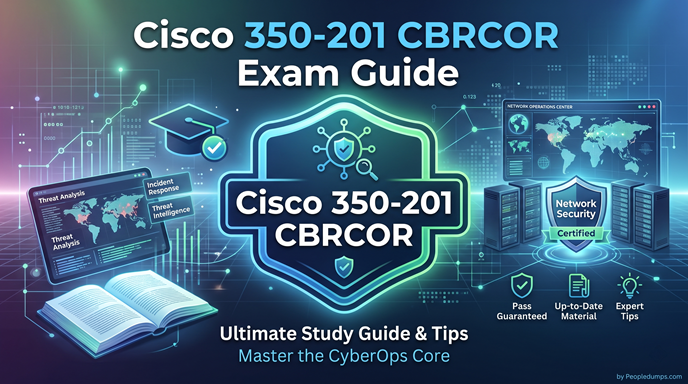
If you come from a networking background and want to move toward security operations, the Cisco 350-201 CBRCOR exam is one of the more interesting professional-level Cisco exams to study. It sits at the point where traditional network knowledge meets SOC operations, threat investigation, incident response, cloud security, and automation.
That combination is also what makes CBRCOR challenging. This is not simply an exam about memorizing Cisco security products, and it is not a traditional networking exam with a few cybersecurity questions added on top. You are expected to understand how security teams detect an attack, investigate evidence, evaluate risk, respond to incidents, and automate repetitive security work.
For students and relatively new network engineers, that may sound intimidating. The good news is that the exam topics form a fairly logical learning path. Once you understand what Cisco is really testing, CBRCOR becomes much easier to approach systematically.
What Is the Cisco 350-201 CBRCOR Exam?
Table of Contents
ToggleThe full name of 350-201 CBRCOR is Performing Cybersecurity Using Cisco Security Technologies. It is the core examination associated with the CCNP Cybersecurity certification.
Passing 350-201 by itself does not complete the full CCNP Cybersecurity certification. It does, however, earn the Cisco Certified Specialist – Cybersecurity Core certification and satisfies the core-exam requirement for CCNP Cybersecurity.
To complete CCNP Cybersecurity, candidates must also pass an eligible concentration exam. At the time of writing, Cisco lists concentration options focused on forensic analysis and incident response (300-215 CBRFIR) and threat hunting and defense (300-220 CBRTHD).
| Exam Detail | Current Information |
|---|---|
| Exam Code | 350-201 CBRCOR |
| Exam Name | Performing Cybersecurity Using Cisco Security Technologies |
| Certification Track | CCNP Cybersecurity |
| Duration | 120 minutes |
| Language | English |
| Official Exam Price | US$400 |
| Credential Earned by Passing | Cisco Certified Specialist – Cybersecurity Core |
One detail worth checking before you begin studying is the blueprint version. As of this update, Cisco’s main CBRCOR exam page still refers to version 1.1, while Cisco’s newer official exam-topics document is labeled 350-201 CBRCOR v1.2. Because Cisco states that exam objectives may change, candidates should always download the latest official exam topics before scheduling the test.
Is the CBRCOR Certification Worth It?
The value of CBRCOR makes more sense when you look at the skills rather than the badge alone. The exam forces you to connect several areas that are often studied separately: networking, security monitoring, threat intelligence, incident response, malware analysis, cloud security, risk management, and scripting.
That is a useful combination for someone moving toward roles such as SOC analyst, security operations engineer, incident responder, network security engineer, or cybersecurity investigator. In real security operations, you rarely work on only one of these subjects. A suspicious connection might begin as a firewall alert, lead to a packet capture, require endpoint investigation, produce an IOC, trigger a SIEM correlation rule, and finally become part of an automated response workflow.
CBRCOR is valuable because its objectives reflect that workflow-oriented approach. It asks more than “What does this technology do?” In many cases, the more important question is “Given this evidence, what should the analyst do next?”
At the same time, no certification should be treated as a replacement for practical experience. A candidate who can recite definitions but cannot interpret a PCAP, understand a log message, or modify a simple Python API script will have a difficult time both on the exam and in an actual SOC. The strongest use of the certification is as a framework for building hands-on skills.
A useful rule for CBRCOR study: if you can explain what happened, why it matters, what evidence supports your conclusion, and what the next security action should be, you are studying at the right level.
Cisco 350-201 CBRCOR Exam Topics and Weighting
The current Cisco CBRCOR v1.2 blueprint divides the exam into four major domains. Two of them, Techniques and Processes, account for 60 percent of the blueprint, so investigation and practical security operations deserve a large share of your preparation time.
| Domain | Weight | Main Focus |
|---|---|---|
| 1.0 Fundamentals | 20% | Playbooks, risk, compliance, incident response, cloud security |
| 2.0 Techniques | 30% | Hardening, SIEM, SOAR, DLP, threat intelligence, packet analysis, detection |
| 3.0 Processes | 30% | Threat modeling, malware analysis, investigation, IOCs, IOAs, vulnerability triage |
| 4.0 Automation | 20% | Python, APIs, data formats, Bash, CI/CD, DevOps, Infrastructure as Code |
1. Fundamentals: Learn How a SOC Thinks
The Fundamentals section is not “basic cybersecurity” in the casual sense. It is about understanding the operational framework surrounding security decisions.
A major concept is the security playbook. A playbook defines how analysts should respond to a particular type of event. For example, an unauthorized privilege escalation, a DDoS attack, or website defacement should not result in random troubleshooting. A mature SOC follows a repeatable process for validating the event, collecting evidence, containing the problem, escalating when necessary, and documenting the response.
You should therefore understand the incident response workflow rather than memorizing isolated incident-response terms. Think about detection, analysis, containment, remediation, recovery, communication, and post-incident improvement as connected activities.
Risk analysis is another important topic. Security risk is not simply the presence of a vulnerability. You have to consider the asset, the threat, the vulnerability, the likelihood of exploitation, and the potential impact. This becomes especially important when security teams have hundreds or thousands of vulnerabilities but limited time to remediate them.
The blueprint also includes compliance and regulatory concepts. You do not need to become a lawyer, but you should recognize why standards and frameworks such as PCI-related requirements, FISMA, FedRAMP, SOC reporting, SOX, GDPR, privacy requirements, and ISO security standards influence security operations.
Cloud environments are also part of the domain. Make sure you understand the basic differences between service models such as IaaS and PaaS and, more importantly, how security responsibilities change when infrastructure moves from a traditional data center to a cloud provider.
2. Techniques: The Largest Hands-On Security Domain
Techniques represents 30 percent of the CBRCOR blueprint and contains many of the technologies that students normally associate with day-to-day SOC work.
Start with system and network hardening. You should understand why unnecessary services increase the attack surface, why patching must be prioritized, how secure system images help create consistent deployments, and how segmentation limits lateral movement after an attacker compromises part of the environment.
For network engineers, segmentation should feel familiar, but CBRCOR expects you to think about it from a security perspective. VLANs, access controls, firewall policy, network boundaries, and micro-segmentation are not simply design features. They are controls that reduce exposure and restrict how an attacker can move between assets.
SIEM, SOAR, and Security Data
You should be comfortable with the purpose of a Security Information and Event Management (SIEM) platform. A SIEM collects and analyzes security-related data from multiple sources and helps analysts correlate events that may not look suspicious in isolation.
For example, a failed login is common. A login from an unusual geography may also be explainable. A privileged login from an unusual geography followed by abnormal data access and outbound traffic is much more interesting. Security analytics is about putting those pieces together.
CBRCOR also covers Security Orchestration, Automation, and Response (SOAR). The important distinction is that a SIEM primarily helps collect, search, correlate, and analyze data, while SOAR helps coordinate workflows and automate actions across security tools.
You should understand where automation is useful and where human judgment is still required. Automatically enriching an IP address with threat intelligence may be reasonable. Automatically isolating a critical production server based on a single weak indicator may not be.
UEBA and Behavioral Analysis
User and Entity Behavior Analytics, or UEBA, focuses on identifying behavior that differs from an established baseline. Instead of looking only for known malicious signatures, analysts can ask whether a user, host, service account, or device is behaving in an unusual way.
This is particularly useful when legitimate credentials are compromised. The username may be valid, but the behavior associated with the account may not be.
Threat Intelligence and TTPs
Threat intelligence is more than collecting lists of malicious IP addresses. A useful analyst must understand context: who may be behind an attack, which infrastructure is involved, which techniques are being used, and whether the information is relevant to the organization.
The CBRCOR blueprint specifically expects candidates to work with concepts such as Threat Intelligence Platforms, indicators, and attacker tactics, techniques, and procedures (TTPs). Understanding TTPs is usually more durable than memorizing individual indicators because attacker infrastructure can change quickly while behavioral patterns often remain useful for detection.
Packet Analysis Still Matters
One of the reasons I consider CBRCOR particularly relevant for network students is that packet-level knowledge still matters. Security products generate alerts, but analysts often need to verify what actually happened on the wire.
You should be comfortable reading basic packet captures and following network conversations. That means understanding Ethernet, IP addressing, TCP and UDP behavior, ports, DNS, HTTP, and the general role of encrypted protocols such as TLS.
You do not need to become a packet-forensics specialist before taking CBRCOR, but you should be able to look at a capture and answer practical questions. Which host initiated the connection? Which protocol was used? Is the traffic pattern normal? Is there evidence of scanning, command-and-control communication, unusual DNS activity, or data transfer?
This is where a good networking foundation becomes a major advantage. Someone who already understands routing, switching, TCP/IP, DNS, NAT, ACLs, and firewalls can concentrate on learning how those technologies appear during a security investigation rather than learning networking from scratch.
3. Processes: From Alert to Investigation
The Processes domain is also worth 30 percent, but it approaches cybersecurity from a different angle. Instead of asking how a technology works, it focuses heavily on how an investigation is conducted.
Threat modeling is one example. A threat model helps analysts and engineers think systematically about assets, trust boundaries, possible attackers, attack paths, and security controls. The goal is not to predict every possible attack; it is to understand where risk is concentrated and where defensive controls are most valuable.
Malware Analysis
The exam blueprint includes the malware analysis process, including sample identification, dynamic analysis, static analysis, sandboxing, reverse-engineering concepts, and communicating the results.
For most CBRCOR candidates, the goal should not be to become an expert malware reverse engineer. Instead, understand the workflow. Know why analysts may first execute suspicious code inside an isolated sandbox, what behavioral evidence they can collect, when static analysis becomes useful, and how those findings can become detection logic or indicators for the rest of the security team.
IOC vs. IOA
A distinction worth mastering is the difference between an Indicator of Compromise (IOC) and an Indicator of Attack (IOA).
An IOC often represents evidence associated with compromise, such as a malicious file hash, domain, IP address, registry artifact, or other observable. An IOA is more focused on behavior that suggests an attack is occurring or being attempted.
In practice, both are valuable. IOCs can help identify known malicious artifacts, while behavioral indicators can reveal attacks that use previously unseen infrastructure or tools.
Vulnerability Triage and CVSS
The blueprint also expects candidates to understand vulnerability mitigation, triage, and risk analysis using scoring systems such as CVSS.
A common beginner mistake is assuming that the vulnerability with the highest numerical score must always be fixed first. Real prioritization also considers exposure, exploitability, asset value, existing compensating controls, business impact, and whether attackers are actively exploiting the weakness.
That broader risk-based thinking is exactly the type of judgment professional-level security exams try to develop.
4. Automation: Do Not Ignore the 20 Percent
Candidates with traditional networking backgrounds sometimes underestimate the Automation section. That is a mistake. Automation accounts for 20 percent of the blueprint, and the topics are quite specific.
The encouraging part is that you do not need to become a professional software developer. The expectation is closer to practical security scripting: read a basic script, understand what it does, identify a problem, and make a small change so that it can automate a security task.
Python is particularly important. You should understand basic variables, conditional logic, loops, functions, data structures, and how a script interacts with an API. If you can read a short Python program that retrieves JSON from a REST API, checks a value, and performs an action, you are working at an appropriate level.
You should also recognize common formats such as JSON, XML, CSV, and HTML. Security tools constantly exchange data, and an analyst who understands structured data can automate enrichment, reporting, ticket creation, and response much more efficiently.
REST APIs and HTTP
REST API knowledge deserves special attention. Make sure you understand HTTP request and response concepts, common status codes, headers, response bodies, authentication mechanisms, API keys, tokens, rate limits, timeouts, and payload constraints.
You should be able to distinguish a successful API response from an authentication failure, permission problem, missing resource, malformed request, or server-side issue. In a real automation workflow, knowing how to troubleshoot the API is often more important than writing the original script.
Bash, DevOps, and Infrastructure as Code
The automation domain also includes basic Bash commands, CI/CD concepts, DevOps practices, and Infrastructure as Code.
Why are these topics on a cybersecurity exam? Because security teams increasingly operate in environments where infrastructure is built and changed through software pipelines rather than by an administrator manually configuring every server. Security therefore has to become part of the development and deployment process.
Understanding DevSecOps means understanding how security checks, policies, vulnerability scanning, code review, and configuration validation can become part of an automated delivery pipeline instead of being performed only after a system reaches production.
AI Is Now Part of the CBRCOR Blueprint
The current v1.2 exam topics also include several AI-related objectives, including AI-powered data analytics, AI-driven threat intelligence, and interpretation of attack events using predictive analysis of traffic patterns.
Do not interpret that as a requirement to study advanced machine-learning mathematics. The emphasis is operational. You should understand where AI-assisted analytics can help security teams process large volumes of telemetry, identify anomalies, prioritize alerts, enrich threat intelligence, and recognize patterns that would be difficult to review manually.
You should also maintain a healthy degree of skepticism. AI-generated conclusions still need context and validation. In security operations, a high-confidence model result is evidence, not automatically the final decision.
Is 350-201 CBRCOR Beginner Friendly?
Technically, Cisco does not impose a formal prerequisite for the professional certification track. Practically, however, I would not recommend CBRCOR as someone’s first exposure to networking or cybersecurity.
Cisco’s own CBRCOR training materials recommend familiarity with UNIX or Linux shell commands, basic scripting, and SIEM-style search and navigation. That gives a useful indication of the expected starting point.
Before serious CBRCOR preparation, a student should ideally be comfortable with TCP/IP, subnetting, routing basics, switching basics, DNS, HTTP, Linux command-line navigation, security fundamentals, packet captures, log analysis, and very basic Python.
You do not need years of SOC experience to begin learning the material. You do need enough foundation that every packet, log field, shell command, and Python statement does not require a separate lesson. Otherwise, the volume of new material becomes overwhelming.
If you are completely new to cybersecurity operations, Cisco’s associate-level cybersecurity track can provide a more gradual starting point before moving into CBRCOR. Students with a CCNA-level networking foundation can also transition effectively, provided they spend additional time on SOC processes and security analysis.
A Practical 10-Week CBRCOR Study Plan
There is no universal preparation schedule, but the following structure works well for someone who already has basic networking knowledge and can dedicate consistent study time each week.
| Weeks | Primary Focus | Practical Goal |
|---|---|---|
| 1–2 | Networking, Linux, SOC fundamentals | Review TCP/IP, DNS, HTTP, Linux commands, logs, and packet captures |
| 3 | Fundamentals | Study playbooks, incident response, risk, compliance, and cloud models |
| 4–5 | Security techniques | Practice SIEM concepts, SOAR workflows, UEBA, DLP, hardening, and threat intelligence |
| 6 | Network investigation | Analyze PCAP files, traffic patterns, network controls, and detection logic |
| 7 | Security processes | Study threat modeling, malware workflow, IOC/IOA analysis, CVSS, and vulnerability triage |
| 8 | Automation | Practice Python, REST APIs, JSON, HTTP responses, authentication, and Bash |
| 9 | Integrated labs | Work through complete alert-to-investigation scenarios |
| 10 | Blueprint review | Map weak areas directly to Cisco exam objectives and perform final practice |
The key word here is integrated. Do not spend ten weeks reading definitions. Build small scenarios. Capture traffic in a lab. Read DNS and HTTP activity. Generate authentication logs. Parse JSON with Python. Query an API. Write down what you would investigate after an alert. That practice creates connections between the domains.
How I Would Build a CBRCOR Lab
You do not need an expensive enterprise SOC in your bedroom. A useful study environment can be built with a few virtual machines, packet-analysis tools, Linux, Python, sample logs, public PCAP files, and security platforms that provide community or lab access.
The specific vendor is less important than the workflow. Practice collecting data, finding suspicious activity, forming a hypothesis, validating it with another source, documenting the evidence, and deciding on a response.
For example, start with a suspicious DNS request. Identify the client, inspect the surrounding traffic, check whether the destination appears elsewhere in the logs, look for subsequent HTTP or TLS connections, and decide whether the activity is likely benign or malicious. Then imagine how that process could be partially automated.
That single exercise touches networking, SIEM analysis, threat intelligence, incident investigation, and automation—the same mixture that makes CBRCOR different from a purely theoretical exam.
How to Approach CBRCOR Questions
Pay close attention to the verbs in the official blueprint. Cisco uses words such as describe, interpret, determine, apply, analyze, evaluate, recommend, and troubleshoot.
Those verbs indicate the expected depth. “Describe” generally suggests conceptual understanding. “Analyze” means you may need to interpret evidence. “Recommend” means multiple technically possible answers may exist, but one makes the most sense for the scenario. “Troubleshoot” means you should understand why something is not working rather than simply knowing its purpose.
This is why memorizing flashcards alone is not enough. A definition tells you what SIEM means. A CBRCOR-style scenario may ask you to interpret events from the SIEM, recognize anomalous behavior, decide whether escalation is justified, and determine the appropriate next action.
The same applies to automation. Do not only memorize HTTP status codes. Read actual API responses. Do not only memorize JSON syntax. Write a small Python script that parses JSON. Do not only memorize what a PCAP is. Open one and follow a conversation.
Common CBRCOR Preparation Mistakes
One common mistake is spending too much time memorizing product interfaces. Cisco technology is part of the learning ecosystem, but the exam objectives are heavily centered on transferable security concepts and operational decisions. Learn what a tool is doing and why an analyst would use it.
Another mistake is avoiding automation until the final week. Twenty percent of the blueprint is too large to treat as optional, and basic scripting usually becomes much easier once you practice it in small pieces.
A third mistake is treating networking as something you already “finished” when you earned an earlier certification. In cybersecurity operations, networking knowledge is not background trivia. It is how you interpret evidence. DNS, TCP sessions, ports, addressing, segmentation, firewall behavior, and traffic flows appear repeatedly during investigations.
Finally, avoid building your preparation around so-called exam dumps. Apart from the obvious integrity problem, memorized questions are a poor way to prepare for an exam whose objectives evolve. Cisco explicitly notes that exam topics can change. A blueprint-driven lab strategy is slower at first but far more useful after the exam.
CBRCOR vs. Traditional Cisco Networking Exams
If you have previously studied for CCNA or a networking-focused CCNP exam, expect CBRCOR to feel different.
Traditional Cisco networking exams often revolve around how infrastructure behaves: routing decisions, switching behavior, protocol operation, configuration, design, and troubleshooting. CBRCOR asks you to look at infrastructure as a source of security evidence and as part of a defensive system.
A router is not only moving packets; its telemetry may reveal scanning or command-and-control traffic. A firewall is not only permitting and denying connections; its logs become evidence. DNS is not only name resolution; unusual DNS behavior may be part of malware activity. An API is not only a programmability feature; it can automate threat enrichment or incident response.
That change in perspective is one of the most useful things a network engineer can gain from studying CBRCOR.
Who Should Consider the Cisco 350-201 Exam?
CBRCOR makes the most sense for people who want to work closer to security operations while retaining a strong infrastructure perspective. Network engineers moving into cybersecurity are an obvious audience, but the exam is also relevant to junior SOC analysts who want a deeper technical foundation, security engineers who need stronger investigation skills, and students building toward a professional-level cybersecurity career.
If your goal is purely penetration testing or offensive security, CBRCOR probably should not be your only certification path. The exam is fundamentally defensive and operational. Its center of gravity is monitoring, investigation, response, hardening, threat intelligence, and automation.
If that is the kind of security work you enjoy, the blueprint is well worth studying even before you decide whether to sit the actual exam.
Frequently Asked Questions About 350-201 CBRCOR
Is 350-201 CBRCOR the core exam for CCNP Cybersecurity?
Yes. Cisco currently lists 350-201 CBRCOR as the core examination for CCNP Cybersecurity. Passing the exam also earns the Cisco Certified Specialist – Cybersecurity Core credential. A concentration exam is still required to complete the full CCNP Cybersecurity certification.
How long is the Cisco CBRCOR exam?
Cisco currently lists the 350-201 CBRCOR exam duration as 120 minutes.
How much does the 350-201 exam cost?
At the time of writing, Cisco lists the exam price as US$400. Pricing and exam policies can change, so check Cisco’s official exam page before registering.
What is the current CBRCOR exam version?
Cisco’s newer official exam-topics PDF is labeled 350-201 CBRCOR v1.2. The main exam landing page still displays a v1.1 reference at the time of this update. Candidates should therefore use Cisco’s latest downloadable exam blueprint as the primary checklist when studying.
Do I need to know Python for CBRCOR?
Yes, at a practical introductory level. The blueprint expects candidates to interpret basic scripts and modify a provided script to automate a security operations task. Understanding REST APIs, JSON, HTTP, authentication, and basic Bash is also important.
Do I need CCNA before taking CBRCOR?
There is no formal CCNA prerequisite, but solid networking fundamentals make CBRCOR considerably easier. Candidates who struggle with TCP/IP, DNS, routing basics, ports, packet captures, and Linux should strengthen those subjects before moving deeply into the professional-level material.
Is CBRCOR only about Cisco products?
No. Cisco technologies naturally appear in the training ecosystem, but the exam blueprint covers broad cybersecurity concepts including SIEM, SOAR, threat intelligence, UEBA, DLP, malware analysis, incident response, packet analysis, cloud security, Python, REST APIs, DevOps, and Infrastructure as Code. Those concepts transfer to many security environments.
Final Thoughts
The Cisco 350-201 CBRCOR exam is a demanding certification exam because it requires breadth without allowing you to stay completely superficial. You need enough networking knowledge to understand traffic, enough security knowledge to investigate attacks, enough operational awareness to follow incident-response processes, and enough scripting ability to understand modern security automation.
For a beginner, that means CBRCOR should be treated as a journey rather than a quick exam target. Build the networking foundation first. Learn how a SOC works. Spend time with packet captures and logs. Write small Python scripts. Use APIs. Investigate realistic scenarios instead of memorizing hundreds of disconnected terms.
For a network engineer, the exam can be especially valuable because it teaches you to see familiar network technologies from a security analyst’s perspective. Once you start looking at DNS, TCP sessions, access controls, logs, and APIs as pieces of an investigation rather than isolated technologies, the CBRCOR blueprint begins to make much more sense.
And that is probably the best way to prepare for the exam: do not study only to recognize the right answer. Study until you can explain why it is the right answer.
Official Cisco References
For the latest exam version, pricing, certification requirements, and blueprint changes, always verify the information directly with Cisco before scheduling your exam.