If you are studying networking or cybersecurity, you will eventually notice that modern security jobs are moving beyond the traditional idea of configuring firewalls and building VPN tunnels. Security engineers are increasingly expected to understand identity, cloud applications, automation, software development pipelines, risk management, and even the security implications of artificial intelligence.
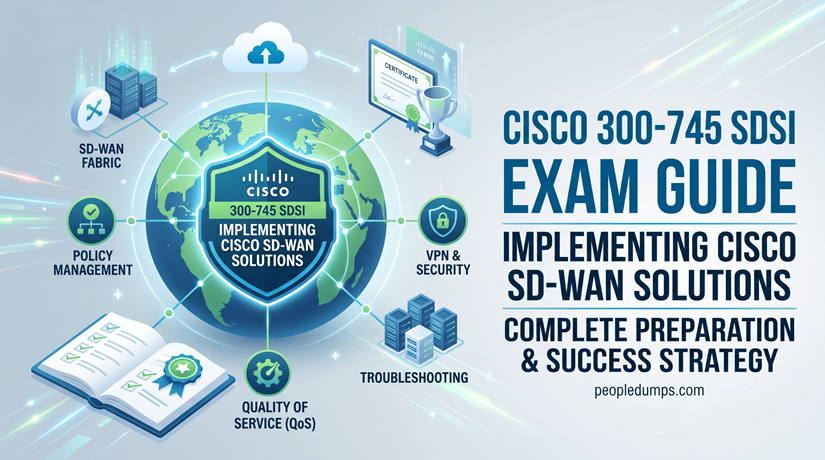
The Cisco 300-745 SDSI exam, Designing Cisco Security Infrastructure, is an exam that reflects this change particularly well.
Rather than concentrating on a single Cisco security product, SDSI approaches security from an architectural point of view. It asks an important question that appears repeatedly in real enterprise environments: given a business requirement, a technical constraint, and a particular threat, how should the security architecture be designed?
That makes the exam interesting not only for experienced Cisco engineers, but also for students and early-career network professionals who want to understand where enterprise security is heading.
What Is the Cisco 300-745 SDSI Exam?
Table of Contents
ToggleThe full name of the certification exam is Designing Cisco Security Infrastructure v1.0, commonly abbreviated as SDSI. Its exam code is 300-745.
SDSI is one of the concentration exams associated with the CCNP Security certification track. It focuses primarily on security architecture and design rather than on the detailed configuration of one individual platform.
At the time of writing, the main exam details are:
| Item | Details |
|---|---|
| Exam Code | 300-745 |
| Exam Name | Designing Cisco Security Infrastructure |
| Version | v1.0 |
| Duration | 90 minutes |
| Exam Fee | US$300 |
| Certification Track | CCNP Security |
| Specialist Certification | Cisco Certified Specialist – Designing Cisco Security Infrastructure |
Passing 300-745 earns the corresponding Cisco Specialist certification and satisfies the concentration-exam portion of the CCNP Security path.
However, passing SDSI alone does not automatically give you the full CCNP Security certification. Candidates pursuing CCNP Security must also satisfy Cisco’s core exam requirement, which is currently based on 350-701 SCOR: Implementing and Operating Cisco Security Core Technologies.
What Makes SDSI Different from Traditional Cisco Security Exams?
Many Cisco exams have historically been associated with a recognizable product or implementation domain. You might study firewall configuration, VPN technologies, identity services, routing protocols, or another clearly defined technical area.
SDSI feels different because the central skill is design judgment.
Imagine that an organization tells you the following:
- Employees work from offices, homes, and public networks.
- Some business applications run in a private data center.
- Other applications are hosted in public clouds or delivered as SaaS.
- Developers use containers and automated CI/CD pipelines.
- The security operations team wants better telemetry and faster incident response.
- The company must comply with industry regulations.
There is no single command that solves this problem.
You have to decide where controls should be placed, how identities should be verified, how traffic should be segmented, how applications should be protected, which telemetry should be collected, and how security can be integrated into automated infrastructure.
That style of thinking is central to SDSI.
Cisco 300-745 SDSI Exam Topics and Weighting
Understanding the official 300-745 SDSI exam topics is one of the most important first steps in building an effective study plan. The SDSI v1.0 blueprint is organized into four major domains:
| Domain | Weight |
|---|---|
| Secure Infrastructure | 30% |
| Applications | 25% |
| Risk, Events, and Requirements | 30% |
| Artificial Intelligence, Automation, and DevSecOps | 15% |
The percentages tell an important story. SDSI is not simply a firewall exam with a few cloud questions added to it. Application security, risk management, automation, AI, and DevSecOps collectively represent a substantial part of the blueprint.
1. Secure Infrastructure – 30%
Secure Infrastructure is one of the two largest SDSI domains.
For newcomers, it is useful to think about this section as the security architecture surrounding users, devices, networks, connectivity, and infrastructure components.
Endpoint and User Security
Enterprise users no longer connect exclusively from managed desktop computers inside a corporate office. A security architecture may need to support corporate laptops, personal devices, contractors, remote workers, IoT systems, and endpoints operating outside the traditional network perimeter.
This naturally leads to technologies and concepts such as:
- Multi-factor authentication (MFA)
- Passwordless authentication
- Continuous trust evaluation
- Identity intelligence
- Endpoint security
- Secure remote access
A beginner should pay particular attention to the relationship between identity and network security. In older security models, knowing that traffic originated from an internal IP address might have provided some degree of trust. Modern architectures increasingly want to know who the user is, what device is being used, whether that device is healthy, what resource is being requested, and whether the current session still deserves access.
That is one reason identity plays such a central role in modern Zero Trust designs.
Email Threats
Email remains one of the most common paths used by attackers. SDSI therefore expects candidates to understand security approaches associated with threats including:
- Phishing
- Ransomware
- Business email compromise
- Malware
- Email spoofing
The important point is not merely memorizing the definition of phishing. From an architecture perspective, you should understand that email security usually requires multiple layers: sender authentication, malware detection, URL inspection, identity protection, endpoint controls, user awareness, and incident response.
Hybrid Workers, SaaS, IoT, and Multi-Cloud
Modern networks have become geographically and logically distributed.
An employee might sit in a branch office while using Microsoft 365, accessing a workload in AWS, connecting to an internal application in a private data center, and joining a meeting through another cloud platform—all within the same hour.
SDSI expects candidates to understand how a security architecture should change when supporting:
- Hybrid workers
- Internet of Things devices
- Software-as-a-Service applications
- Data-center applications
- Multi-cloud environments
For students, this is a useful reminder that the traditional network perimeter is no longer the only place where security enforcement happens.
VPN and Tunneling Technologies
Networking fundamentals still matter considerably in SDSI.
The blueprint includes the selection of VPN and tunneling approaches based on technical and business requirements, including technologies such as:
- SD-WAN
- IPsec
- MPLS
- GRE
- DMVPN
- Public-cloud tunneling options
You do not want to approach these technologies as a list of acronyms. Instead, compare them using questions such as:
- Does this technology provide encryption?
- Is it primarily an overlay or transport technology?
- How well does it scale?
- Does it support dynamic connectivity?
- What operational complexity does it introduce?
- How would it work in a hybrid-cloud design?
Understanding those trade-offs is more valuable than memorizing isolated facts.
Protecting the Management and Control Planes
A secure network is not only about protecting user traffic.
Routers, switches, firewalls, controllers, and other infrastructure components have management interfaces and control-plane functions that are themselves attractive targets.
A well-designed security architecture should therefore consider administrative access, authentication, authorization, management network isolation, logging, control-plane protection, secure protocols, and least-privilege access.
Choosing the Right Firewall Architecture
SDSI also broadens the meaning of the word firewall.
Candidates may need to understand the architectural role of technologies such as:
- Traditional firewalls
- Next-generation firewalls
- Web Application Firewalls (WAFs)
- IDS and IPS
- Distributed firewalls
- Host-based firewalls
- eBPF-based security mechanisms
This is an excellent example of the design philosophy behind the exam. A WAF and a network firewall are both security controls, but they protect different layers of the environment. Selecting the correct control depends on what you are actually trying to protect.
2. Applications – 25%
Application architecture has changed dramatically in the last decade, and network security engineers can no longer ignore that transformation.
Protecting Application Traffic
SDSI expects candidates to understand how controls such as firewalls, Data Loss Prevention, endpoint security, SSL decryption, and SSL offloading may be used based on application behavior and traffic flows.
Encrypted traffic creates an especially interesting security problem.
TLS protects data from interception, which is essential for privacy and confidentiality. However, encryption can also hide malicious traffic from security inspection systems. Security designers therefore need to balance visibility, privacy, performance, certificate management, and regulatory requirements when deciding where TLS inspection should occur.
Cloud-Native Applications
A traditional three-tier application running on several virtual machines is very different from an application composed of dozens or hundreds of short-lived containers.
SDSI introduces security design considerations around:
- Cloud-native applications
- Microservices
- Containers
- Serverless computing
- Segmentation
- Microsegmentation
Microsegmentation is particularly important.
Traditional segmentation may separate a user VLAN from a server VLAN. Microsegmentation can go much further, limiting communication among individual workloads or application components.
The security goal is straightforward: if one workload becomes compromised, the attacker should not automatically gain unrestricted access to everything else in the environment.
Generative AI, Machine Learning, and Quantum Computing
One of the more modern aspects of 300-745 SDSI is its inclusion of emerging technologies.
Candidates should understand how security design policies may need to evolve because of technologies such as:
- Generative artificial intelligence
- Machine learning
- Quantum computing
You do not need to become an AI researcher or quantum physicist to understand the security implications.
For generative AI, useful areas of study include sensitive-data exposure, AI-assisted attacks, access control around AI systems, model and data governance, and the security implications of connecting AI tools to enterprise information.
For quantum computing, networking students should at least understand why sufficiently capable future quantum systems could affect some of the public-key cryptography used today, and why organizations are beginning to discuss cryptographic agility and post-quantum security planning.
3. Risk, Events, and Requirements – 30%
This domain may initially look less technical than VPNs or firewalls, but it is extremely important for anyone who wants to move from network administration into security architecture.
A security architect does not deploy controls simply because a technology is available. Controls should address identifiable risks and business requirements.
Security Operations and Incident Response
SDSI expects candidates to understand how a Security Operations Center, or SOC, uses incident-handling and incident-response tools.
In practice, security architecture and security operations must support each other.
A beautifully designed firewall policy is of limited value if nobody receives useful telemetry when an attack occurs. Likewise, a SOC cannot investigate effectively if network, identity, endpoint, cloud, and application systems fail to provide useful evidence.
This is why logging and telemetry should be considered during the design stage rather than added as an afterthought.
Designing Around Risk
A useful way to think about security risk is:
What valuable asset are we protecting, what could threaten it, how vulnerable is it, and what would the business impact be if something went wrong?
This perspective helps engineers avoid a common mistake: deploying expensive security technology without first understanding the problem that technology is supposed to solve.
SDSI also expects candidates to reason about modifying an architecture after an incident. A security incident is not only something to investigate and close. It can reveal weaknesses in the existing architecture and create new design requirements.
Security Frameworks
The blueprint includes frameworks and methodologies such as:
- MITRE CAPEC
- NIST SP 800-37
- Cisco SAFE
Students do not need to treat every framework as a book that must be memorized word for word. It is more useful to understand what problem each framework helps security professionals solve.
For example, some frameworks help describe attacker behavior or attack patterns, while others help organizations structure risk management or build security architectures systematically.
Compliance and Business Requirements
Technical teams do not operate independently of legal and business requirements.
Organizations may need to follow different compliance requirements depending on their industry, geographic location, customers, and the type of information they process.
For an aspiring network engineer, this can feel far removed from routers and switches. In professional security work, however, compliance requirements can directly influence architecture.
They may affect how data is encrypted, where logs are retained, who can access systems, how networks are segmented, and even where workloads may be hosted.
4. Artificial Intelligence, Automation, and DevSecOps – 15%
This is the smallest SDSI domain by percentage, but arguably one of the best indicators of how the role of the network security engineer is evolving.
AI in Network Security
Artificial intelligence can help security platforms analyze very large amounts of telemetry, identify suspicious patterns, prioritize alerts, and assist analysts during investigations.
At the same time, AI does not eliminate the need for security engineering judgment.
Automated systems can produce false positives, miss context, or make decisions based on incomplete information. Security architects therefore need to understand both the potential and the limitations of AI-assisted security.
Security Automation
Traditional infrastructure administration often involves an engineer manually logging into individual devices and changing configuration.
Modern environments increasingly use:
- APIs
- Infrastructure as Code (IaC)
- Automated monitoring
- Security telemetry
- Automated alerting
- Container scanning
- Security orchestration
- SOAR platforms
This changes security in an important way.
If infrastructure can be deployed automatically in minutes, security policies also need to operate at machine speed. Waiting for someone to perform a manual security review after every deployment is often impractical.
That is why security policies increasingly become part of templates, pipelines, APIs, and automated validation processes.
DevSecOps
DevSecOps is sometimes described as simply “putting security into DevOps,” but that explanation does not go far enough.
The bigger idea is to move security earlier in the development and deployment lifecycle while making security controls repeatable and automated.
Instead of discovering a serious vulnerability only after software reaches production, teams may introduce security checks while code is written, built, tested, packaged, and deployed.
For SDSI preparation, it helps to understand concepts such as:
- CI/CD pipelines
- Source-code security
- Dependency and vulnerability scanning
- Container image scanning
- Secrets management
- Infrastructure as Code validation
- Automated policy enforcement
- Deployment approval workflows
Is the Cisco 300-745 SDSI Certification Worth It?
The answer depends on what you want to do professionally.
If your only objective is to configure one specific security appliance, SDSI may not be the most direct certification path. Its value is broader.
SDSI is particularly relevant for people interested in roles such as:
- Network Security Engineer
- Security Engineer
- Security Consultant
- Network Architect
- Security Architect
- Infrastructure Engineer
- Cloud Security Engineer
- Pre-sales or Systems Engineer
The certification can be valuable because the topics encourage you to connect several areas that are often studied separately: networking, identity, application security, cloud, incident response, automation, and risk.
That combination increasingly resembles the skill set required in real enterprise security projects.
Still, certifications should be viewed realistically. A certificate can help demonstrate structured study and technical knowledge, but it does not replace practical experience. An engineer who understands why a particular architecture is appropriate will generally be more useful than someone who has memorized hundreds of isolated exam facts.
Is 300-745 SDSI Suitable for Beginners?
It depends on what we mean by beginner.
A student with absolutely no networking knowledge will probably find SDSI difficult because the exam assumes familiarity with networking and security concepts.
You should ideally understand the basics of:
- TCP/IP networking
- Routing and switching
- VLANs and network segmentation
- DNS and HTTP/HTTPS
- Firewalls
- VPNs
- Authentication and authorization
- Cloud computing fundamentals
- Basic cybersecurity terminology
You do not necessarily need years of professional experience before beginning to learn SDSI topics. Students can benefit considerably from studying them. However, the learning process will be much easier if you already have knowledge roughly comparable to CCNA networking fundamentals and basic cybersecurity concepts.
How Should You Prepare for the Cisco 300-745 Exam?
A successful Cisco 300-745 SDSI exam preparation strategy should combine blueprint-based study, strong networking fundamentals, practical labs, and scenario-based architecture practice rather than relying on memorization alone.
Step 1: Start with the Official Exam Blueprint
Do not begin your preparation by randomly watching security videos.
Start with the official 300-745 SDSI exam topics and convert each objective into a checklist.
For every item, ask yourself:
- Can I explain the technology?
- Can I explain where it belongs in an architecture?
- Do I understand its advantages?
- Do I understand its limitations?
- Could I choose it over another technology in a scenario?
The last question is especially important for a design-oriented exam.
Step 2: Strengthen Your Networking Fundamentals
If terms such as GRE, IPsec, MPLS, DMVPN, control plane, TLS, VLAN, routing, or segmentation are unfamiliar, spend time reviewing networking fundamentals before going deeper.
Security architecture becomes much easier to understand when you already understand how traffic moves.
Step 3: Learn Security Concepts Before Product Names
When learning about a Cisco security solution, ask what general security problem it solves.
For example, rather than simply memorizing a product feature, think in terms of:
- Identity verification
- Access control
- Network segmentation
- Threat prevention
- Application protection
- Data protection
- Telemetry
- Incident response
This makes your knowledge far more transferable.
Step 4: Practice Architecture Scenarios
Create simple imaginary organizations and design security architectures for them.
For example:
Scenario: A company has 2,000 employees, three offices, remote workers, workloads in AWS, several SaaS applications, IoT devices, and a small SOC.
Then ask:
- How should remote users authenticate?
- Where should security inspection occur?
- How should IoT devices be segmented?
- How should cloud workloads communicate?
- What telemetry should reach the SOC?
- Which controls could be automated?
- How would the architecture respond to compromised credentials?
This exercise develops exactly the kind of reasoning that architecture-focused certifications are designed to test.
Step 5: Build Small Labs
SDSI is a design exam, but practical work is still valuable.
You can build labs around:
- Firewall rules
- Site-to-site VPNs
- Network segmentation
- AAA and identity concepts
- API calls
- Python automation
- Infrastructure as Code
- Container networking
- Logging and monitoring
You do not need an enormous enterprise lab. Even a small virtual environment can make abstract security concepts much easier to remember.
Step 6: Think in Terms of Trade-Offs
One of the most useful habits for SDSI is to stop asking, “Which technology is best?”
Instead ask:
Which technology is best for this requirement?
A security design has to balance multiple factors:
- Security
- Cost
- Performance
- Scalability
- User experience
- Operational complexity
- Compliance
- Existing infrastructure
There is rarely a universally perfect architecture.
A Practical 8-Week SDSI Study Plan
Students looking for a structured approach could use a study schedule similar to the following:
| Week | Main Focus |
|---|---|
| Week 1 | Networking, security, identity, and Zero Trust fundamentals |
| Week 2 | VPNs, tunneling, hybrid work, IoT, SaaS, and multi-cloud security |
| Week 3 | Firewalls, IDS/IPS, WAF, endpoint security, and infrastructure protection |
| Week 4 | Application security, TLS inspection, containers, serverless, and microsegmentation |
| Week 5 | Risk management, SOC operations, incident response, and security frameworks |
| Week 6 | AI security, APIs, automation, Infrastructure as Code, and SOAR |
| Week 7 | DevSecOps, CI/CD security, container scanning, telemetry, and architecture scenarios |
| Week 8 | Full blueprint review, weak-topic revision, and scenario-based practice |
The exact schedule is less important than consistency. Someone working full-time may need twelve weeks; a student on vacation may complete the same material more quickly.
Common Mistakes When Preparing for 300-745 SDSI
Memorizing Without Understanding
If you can define IPsec but cannot explain when you would choose it, your preparation is incomplete.
Studying Only Cisco Products
Cisco knowledge is obviously important for a Cisco certification, but SDSI also contains broader industry concepts such as application architectures, risk frameworks, AI, DevSecOps, Infrastructure as Code, and cloud-native security.
Ignoring Application Security
Network engineers sometimes concentrate entirely on packets, ports, and firewalls. Modern security architecture crosses the boundary between networking and applications.
Avoiding Automation
You do not need to become a professional software developer, but APIs, automation, and Infrastructure as Code are increasingly normal infrastructure skills rather than optional extras.
Relying Only on Memorization
Memorizing isolated answers without understanding the architecture behind them is a weak preparation strategy for a design-oriented examination. Small changes in a scenario can completely change the correct architectural decision.
Instead, combine technical documentation, hands-on labs, structured review, and scenario-based practice so that you understand why an answer or design choice is appropriate.
SDSI vs. 350-701 SCOR: What Is the Difference?
Students preparing for CCNP Security sometimes confuse SDSI with SCOR.
350-701 SCOR is the core CCNP Security examination and covers broad security technologies that form the foundation of the certification.
300-745 SDSI, by comparison, is a concentration exam focused specifically on designing security infrastructure and making architectural decisions across infrastructure, applications, risk, AI, automation, and DevSecOps.
A simplified way to remember the difference is:
- SCOR: broad security core knowledge and technologies.
- SDSI: how security components and requirements fit together into an architecture.
What Skills Can You Gain from Studying SDSI?
Even if you do not immediately take the certification exam, studying the SDSI blueprint can help you build a more complete view of cybersecurity.
You should become more comfortable discussing:
- Enterprise security architecture
- Zero Trust and identity-centric security
- Hybrid workforce protection
- VPN and network connectivity design
- Firewall architecture
- Application and cloud-native security
- Microsegmentation
- Security operations and incident response
- Risk management and compliance
- AI-related security concerns
- Infrastructure automation
- DevSecOps
Those skills are useful well beyond the exam itself.
Frequently Asked Questions About Cisco 300-745 SDSI
What does SDSI stand for?
SDSI refers to Designing Cisco Security Infrastructure, Cisco exam 300-745.
How long is the Cisco 300-745 exam?
The SDSI exam currently has a duration of 90 minutes.
How much does the 300-745 SDSI exam cost?
The listed exam price is currently US$300, although taxes, currency conversion, regional conditions, and Cisco policies may affect the final amount paid by an individual candidate.
Does passing 300-745 give me CCNP Security?
Not by itself. Passing 300-745 satisfies the concentration-exam requirement and earns the associated Specialist certification. To earn CCNP Security, candidates must also meet the core-exam requirement, currently based on 350-701 SCOR.
What is the passing score for Cisco 300-745?
Candidates should be careful with websites claiming a guaranteed fixed passing percentage. Cisco’s public certification information describes exam results as pass/fail, and candidates should rely on current Cisco information rather than unofficial passing-score claims.
Is SDSI mostly a firewall exam?
No. Firewalls are part of the blueprint, but the exam also covers identity, VPNs, cloud and application security, risk, incident response, security frameworks, AI, automation, Infrastructure as Code, SOAR, and DevSecOps.
Do I need programming skills for SDSI?
You do not need to be a full-time programmer, but familiarity with APIs, automation concepts, Infrastructure as Code, and modern deployment pipelines is useful.
Is Cisco 300-745 good for students?
Yes, provided the student already has basic networking and security knowledge. SDSI can be particularly valuable for students because it teaches them to connect individual technologies into a larger enterprise security architecture.
Where can I learn more about the 300-745 SDSI exam?
If you want to continue researching the certification, review the exam objectives carefully and explore additional Cisco SDSI 300-745 exam resources alongside Cisco documentation, hands-on labs, and your regular study materials.
Final Thoughts
The most interesting aspect of the Cisco 300-745 SDSI certification is that it reflects a broader change in network security careers.
Knowing how a firewall works is still important. Knowing how IPsec works is still important. Understanding routing, segmentation, authentication, and traffic flows remains fundamental.
But modern organizations also need engineers who can connect those technologies to cloud platforms, applications, identities, automated infrastructure, incident-response processes, compliance requirements, and software-development workflows.
That is where SDSI becomes valuable.
For students, the exam provides a useful bridge between traditional networking and modern cybersecurity architecture. For experienced engineers, it encourages a shift from thinking primarily about individual devices to thinking about complete systems and business requirements.
If you prepare for 300-745 with that mindset—understanding why a design is appropriate rather than simply memorizing what a technology does—you will gain knowledge that remains useful long after the certification exam is finished.
Official References and Further Reading
For candidates preparing for the Cisco 300-745 SDSI exam, the following official Cisco and authoritative cybersecurity resources provide additional information about security architecture design, secure infrastructure, application security, risk management, artificial intelligence, automation, Zero Trust, and DevSecOps.
- Cisco 300-745 SDSI – Official Exam Page
– Cisco’s official page for the Designing Cisco Security Infrastructure (300-745 SDSI) exam, including current exam information, certification requirements, preparation options, and scheduling resources. - NIST Cybersecurity Framework (CSF) 2.0
– An authoritative cybersecurity risk management framework that helps organizations identify, assess, prioritize, and manage cybersecurity risks across enterprise environments. - NIST SP 800-207 – Zero Trust Architecture
– The NIST reference for Zero Trust Architecture, covering identity-based access, continuous verification, resource protection, policy enforcement, and modern enterprise security design. - OWASP DevSecOps Guideline
– An authoritative application security resource explaining how security can be integrated into DevOps and CI/CD pipelines through practices such as SAST, DAST, software composition analysis, container scanning, and infrastructure-as-code security testing. - MITRE ATT&CK Framework
– A widely adopted cybersecurity knowledge base describing adversary tactics and techniques that can help security architects understand threats and design appropriate detection, prevention, and response controls.