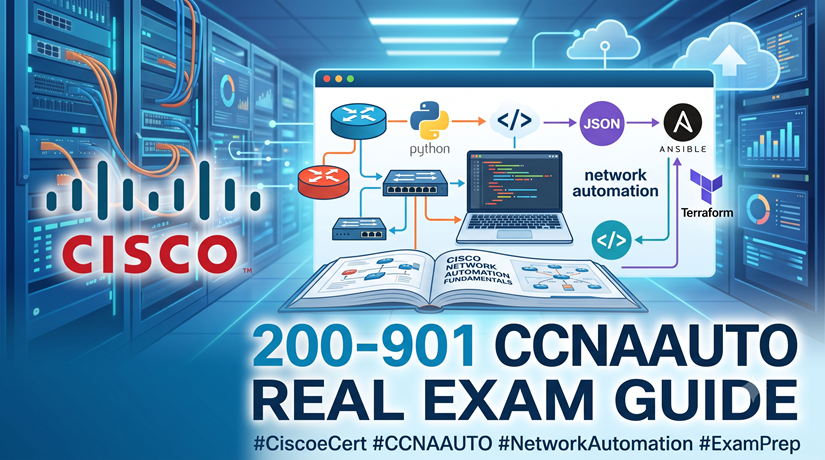
Network engineering is changing. Traditional routing, switching, and troubleshooting skills still matter, but modern infrastructure is increasingly managed through APIs, automation platforms, software-defined controllers, and repeatable code. The Cisco 200-901 CCNAAUTO exam is designed for people who want to work at the intersection of networking and software.
This guide explains what the exam covers, why the CCNA Automation certification can be valuable, which technical skills candidates should develop, and how to prepare for the real testing experience without relying on memorization alone. Candidates looking for structured preparation materials can begin with this Cisco CCNAAUTO Real Exam preparation course.
What Is the Cisco 200-901 CCNAAUTO Exam?
Table of Contents
ToggleThe official exam name is Automating Networks Using Cisco Platforms v1.1, and its exam code is 200-901 CCNAAUTO. Passing the exam earns the Cisco Certified Network Associate Automation certification, commonly shortened to CCNA Automation.
The certification was previously associated with the DevNet Associate name. Cisco later transitioned the DevNet certification family to its current Automation branding. As a result, candidates may still find older books, videos, and practice materials that use terms such as DEVASC or DevNet Associate. These resources may remain useful, but they should always be checked against the current blueprint and updated Cisco 200-901 CCNAAUTO exam resources.
| Exam Detail | Information |
|---|---|
| Exam Code | 200-901 CCNAAUTO |
| Official Name | Automating Networks Using Cisco Platforms v1.1 |
| Certification Earned | CCNA Automation |
| Exam Duration | 120 minutes |
| Available Languages | English and Japanese |
| Listed Exam Price | US$300, subject to regional taxes and pricing changes |
| Formal Prerequisites | None |
Although there are no formal prerequisites, the exam is not purely theoretical. Candidates benefit from basic Python experience, an understanding of IP networking, familiarity with REST APIs, and hands-on exposure to Git, Linux commands, JSON, YAML, Docker, and automation tools.
Before beginning a study program, it is helpful to review a complete 200-901 CCNAAUTO study guide and compare its coverage with the official exam objectives.
Why the CCNA Automation Certification Matters
The main value of CCNA Automation is that it validates a combination of skills that are often studied separately. A traditional network engineer may understand VLANs, routing, DNS, NAT, and troubleshooting but have limited programming experience. A junior software developer may be comfortable with Python and APIs but may not understand how an application interacts with network infrastructure.
The 200-901 exam brings these areas together. It demonstrates that a candidate can understand the network, communicate with infrastructure through APIs, interpret automation workflows, and work with modern software development practices.
This combination can be relevant to roles such as:
- Junior network automation engineer
- Network operations engineer
- DevOps or NetDevOps associate
- Infrastructure automation specialist
- Systems integration programmer
- Cloud or platform operations technician
- Technical support engineer working with programmable infrastructure
A certification does not replace real experience, and it does not guarantee a job. However, it can provide a structured learning path and a recognizable way to demonstrate foundational automation knowledge to employers, instructors, and technical teams.
Students who want to evaluate their current readiness can use CCNAAUTO practice questions to identify weak areas before scheduling the exam.
Cisco 200-901 CCNAAUTO Exam Domains
The exam blueprint contains six major domains. Understanding their relative weight is important because the exam is not simply a Python test or a basic networking test. It evaluates how software, infrastructure, APIs, security, and network fundamentals work together.
| Domain | Weight | Main Focus |
|---|---|---|
| Software Development and Design | 15% | Data formats, Git, testing, software methods, design patterns |
| Understanding and Using APIs | 20% | REST APIs, HTTP, authentication, webhooks, Python requests |
| Cisco Platforms and Development | 15% | Cisco APIs, SDKs, DevNet resources, model-driven programmability |
| Application Deployment and Security | 15% | Cloud models, containers, CI/CD, Docker, application security |
| Infrastructure and Automation | 20% | Ansible, Terraform, NSO, YANG, NETCONF, RESTCONF, IaC |
| Network Fundamentals | 15% | IP addressing, VLANs, network devices, services, troubleshooting |
Because the domains are broad, candidates should use a preparation resource that includes both conceptual review and scenario-based questions. This Cisco automation exam preparation page can be incorporated into a broader study plan.
1. Software Development and Design — 15%
This domain introduces the software practices that make automation reliable and maintainable. Candidates should understand how XML, JSON, and YAML represent data and how those formats can be parsed into Python data structures.
You should also be comfortable with the purpose of functions, classes, modules, version control, and common software development approaches. The exam may test your ability to recognize Agile, Lean, and Waterfall methods or explain why code should be organized into reusable components.
Git is especially important. Candidates should understand practical operations such as cloning a repository, adding files, committing changes, pushing and pulling updates, creating branches, merging code, resolving conflicts, and viewing differences between versions.
2. Understanding and Using APIs — 20%
APIs form one of the largest parts of the exam. You should be able to read API documentation and determine how to construct a valid REST request. That includes selecting the correct HTTP method, endpoint, headers, authentication method, parameters, and request body.
Important topics include:
- GET, POST, PUT, PATCH, and DELETE requests
- HTTP status codes such as 200, 201, 204, 400, 401, 403, 404, and 500
- Request and response headers
- JSON request and response bodies
- Basic authentication, API keys, and tokens
- Synchronous and asynchronous APIs
- REST and RPC styles
- Webhooks and event-driven communication
- API rate limits, pagination, and common consumption constraints
Candidates should also be able to recognize or complete a short Python script that uses the requests library to call an API.
import requests

url = "https://api.example.com/devices"
headers = {
    "Authorization": "Bearer YOUR_TOKEN",
    "Accept": "application/json"
}

response = requests.get(url, headers=headers, timeout=10)
response.raise_for_status()

devices = response.json()
print(devices)
The exam is unlikely to require large software projects, but it does expect candidates to understand what each part of a small script is doing. Exam-focused learners can reinforce this area with 200-901 API and Python practice questions.
3. Cisco Platforms and Development — 15%
This domain focuses on the programmable capabilities of Cisco platforms. Candidates should understand where different APIs and management systems fit, rather than memorizing every endpoint from every Cisco product.
Platforms referenced in the blueprint include Cisco Meraki, Catalyst Center, ACI, Catalyst SD-WAN, NSO, UCS Manager, Intersight, Webex, Firepower, ISE, Secure Endpoint, IOS XE, and NX-OS.
You should understand the difference between controller-level management and direct device-level management. You should also know the role of Cisco DevNet resources, including sandboxes, API documentation, Learning Labs, Code Exchange, community forums, and developer support resources.
Model-driven programmability is another major topic. Candidates should recognize the roles of:
- YANG for defining structured data models
- NETCONF for configuration and operational data exchange
- RESTCONF for HTTP-based access to YANG-modeled data
4. Application Deployment and Security — 15%
Automation scripts and applications need somewhere to run. This domain tests whether candidates understand common deployment models, including public cloud, private cloud, hybrid cloud, edge environments, virtual machines, bare-metal systems, and containers.
Docker knowledge is practical rather than deeply administrative. You may need to interpret a Dockerfile, understand the purpose of a container image, or recognize common commands used in a local development environment.
The domain also covers CI/CD concepts, unit testing, Bash commands, DevOps principles, secret protection, encryption, secure data handling, and common web application threats such as cross-site scripting, SQL injection, and cross-site request forgery.
A useful preparation approach is to connect these topics to a simple automation project. For example, store a Python script in Git, test it, package it in a container, protect its API token with an environment variable, and document how it would move through a basic CI/CD pipeline.
5. Infrastructure and Automation — 20%
This is the other highest-weighted exam domain. It focuses on applying software and automation principles to infrastructure management.
Candidates should understand infrastructure as code, configuration consistency, source-controlled changes, automated testing, and repeatable deployment workflows. The blueprint references tools such as Ansible, Terraform, Cisco NSO, Cisco Modeling Labs, and pyATS.
You may be asked to interpret:
- A Python script that interacts with a Cisco API
- An Ansible playbook that manages packages, users, services, or configuration
- A Bash script that performs file or system-management tasks
- A RESTCONF or NETCONF response
- A basic YANG model
- A unified diff showing configuration or code changes
- A sequence diagram containing API calls
This domain rewards candidates who practice reading code and automation files, even when they did not write the original content themselves. A set of realistic Cisco network automation exam questions can help candidates become more comfortable with these formats.
6. Network Fundamentals — 15%
CCNA Automation is still a networking certification. Candidates need a practical understanding of MAC addresses, VLANs, IP addresses, prefixes, gateways, routes, switches, routers, firewalls, load balancers, and basic topology diagrams.
You should know the purpose of the management, control, and data planes. You should also understand common services and protocols, including DHCP, DNS, NAT, SNMP, NTP, SSH, HTTP, HTTPS, Telnet, and NETCONF.
Troubleshooting questions may present an application connectivity problem involving a blocked transport port, an incorrect NAT rule, a proxy, a VPN, DNS resolution, latency, bandwidth, or packet loss. The goal is to identify how a network condition affects an application.
What Makes the 200-901 Exam Challenging?
The exam is broad. Many candidates are stronger on one side of the blueprint than the other. Network-focused learners may struggle with Python, APIs, Git, containers, and CI/CD. Software-focused learners may struggle with subnetting, NAT, VLANs, network services, and packet flow.
Another challenge is that many questions are contextual. Instead of asking for a simple definition, the exam may provide a code snippet, JSON response, HTTP error, topology diagram, YAML file, or automation workflow and ask you to interpret the result.
This means preparation should include three levels of learning:
- Concept recognition: Know the terminology and purpose of each technology.
- Technical interpretation: Read code, API responses, configuration files, and diagrams.
- Practical application: Build small scripts and complete hands-on labs.
After completing the theory, candidates can use a CCNAAUTO exam readiness test to determine whether they can apply these concepts under time pressure.
How to Prepare for the Cisco CCNAAUTO Real Exam
People searching for the phrase Cisco CCNAAUTO Real Exam are usually looking for realistic question styles, accurate topic coverage, and a clearer idea of what to expect on test day. Effective preparation should reproduce the exam’s reasoning process rather than encourage candidates to memorize isolated answers.
Step 1: Start With the Official Blueprint
Download the current 200-901 CCNAAUTO exam topics and turn each objective into a checklist. Mark each item as familiar, partially understood, or not yet studied. This prevents you from spending too much time on comfortable topics while ignoring weaker domains.
Step 2: Build a Small Python Foundation
You do not need to become a professional application developer before taking the exam. However, you should be able to read variables, lists, dictionaries, loops, functions, conditional statements, exception handling, modules, and HTTP requests.
Practice converting JSON responses into Python dictionaries and extracting nested values. This is a common skill in network automation because API responses often contain multiple levels of structured data.
Step 3: Practice With APIs
Use Postman, Python, or Cisco developer sandboxes to send API requests. Practice authentication, headers, query parameters, request bodies, and error handling. Deliberately create mistakes so you can observe the difference between authentication failures, authorization failures, invalid requests, missing resources, and server errors.
Step 4: Use Git Regularly
Create a repository for your study scripts. Commit changes, create a branch, merge it, and review the diff. Git becomes easier when it is used as part of normal study rather than memorized as a list of commands.
Step 5: Build Hands-On Automation Labs
A useful beginner project could perform the following workflow:
- Read device information from a YAML file.
- Call a REST API with Python.
- Parse a JSON response.
- Print selected device information.
- Store the script in Git.
- Create a simple unit test.
- Package the script in a Docker container.
Even a small project can connect several exam domains and make abstract concepts easier to remember.
Step 6: Use Exam-Focused Practice Questions
Practice questions are most useful when they explain why each option is correct or incorrect. They should help you identify gaps in understanding, improve time management, and become comfortable with code snippets, API responses, and scenario-based questions.
For additional practice, review these 200-901 CCNAAUTO practice questions and answers. Use them alongside labs and official documentation rather than treating question memorization as a substitute for technical understanding.
Step 7: Simulate the Testing Experience
Complete timed practice sessions without checking notes. Flag difficult questions and return to them later. After each session, categorize mistakes by exam domain. A score alone is less useful than understanding why errors occurred.
A full-length Cisco 200-901 mock exam can also help you practice pacing and become familiar with the pressure of answering technical questions within a limited time.
A Practical Eight-Week Study Plan
| Week | Study Focus | Practical Task |
|---|---|---|
| 1 | Python basics, JSON, XML, YAML | Parse sample API data with Python |
| 2 | Git, software methods, testing concepts | Create a repository and practice branching and merging |
| 3 | REST APIs, HTTP methods, status codes | Send requests with Postman and Python |
| 4 | Cisco platforms, APIs, SDKs, DevNet resources | Explore a Cisco sandbox or API documentation |
| 5 | YANG, NETCONF, RESTCONF, model-driven programmability | Read a YANG model and interpret API output |
| 6 | Docker, CI/CD, DevOps, application security | Build and run a basic Docker image |
| 7 | Ansible, Terraform, NSO, IaC, network fundamentals | Read playbooks and troubleshoot simple network scenarios |
| 8 | Full review and timed practice | Complete mock exams and revise weak objectives |
The exact timeline depends on your background. A network engineer with limited coding experience may spend more time on Python and APIs. A developer with limited networking knowledge may need additional practice with IP addressing, NAT, VLANs, ports, and troubleshooting.
During the final two weeks, combine your notes with a focused CCNA Automation exam preparation course to review frequently tested concepts and identify any remaining knowledge gaps.
Common Preparation Mistakes
Studying Only Definitions
Knowing what RESTCONF or Ansible means is not enough. You should be able to interpret a basic request, response, playbook, or workflow.
Ignoring Network Fundamentals
Some candidates assume the exam is entirely about programming. Network fundamentals still account for a significant part of the blueprint and also appear indirectly in application troubleshooting questions.
Trying to Memorize Every Cisco API
The exam does not require memorizing every endpoint across every Cisco platform. Focus on reading documentation, identifying authentication requirements, understanding request structure, and choosing the correct platform for a scenario.
Avoiding Hands-On Practice
Automation becomes much easier to understand after you have sent real API requests, parsed responses, committed code to Git, and examined a Dockerfile or Ansible playbook.
Using Outdated DEVASC Material Without Checking It
Older DevNet Associate resources may still explain many relevant concepts, but product names, platform coverage, and exam terminology can change. Compare every resource with the current CCNAAUTO v1.1 blueprint and an updated 200-901 CCNAAUTO exam preparation resource.
Is the CCNA Automation Certification Worth It?
For learners interested in network automation, programmability, DevOps, or software-defined infrastructure, the certification provides a strong entry-level framework. It is particularly useful for people who want to move beyond manual device-by-device configuration and understand how modern infrastructure is managed at scale.
Its value is highest when the certification is supported by practical evidence. A small GitHub portfolio, lab notes, Python scripts, API projects, Ansible playbooks, or documented troubleshooting exercises can show employers that you applied what you learned.
The certification is also a logical option for traditional networking students who want to add automation skills without immediately attempting a professional-level exam.
Final Thoughts
The Cisco 200-901 CCNAAUTO exam is not simply a coding test with a few networking questions added. It evaluates whether you can understand software development practices, communicate with APIs, work with Cisco platforms, interpret automation workflows, deploy applications securely, and troubleshoot the network services those applications depend on.
The strongest preparation combines the official exam blueprint, structured study, hands-on labs, and realistic practice questions. Candidates who understand the reasoning behind each workflow will be better prepared for both the exam and real automation projects.
To strengthen your final review, visit the Cisco 200-901 CCNAAUTO Real Exam study page for exam-focused preparation resources, practice content, and additional study support.
Explore 200-901 CCNAAUTO Preparation
Frequently Asked Questions
What is the Cisco 200-901 CCNAAUTO exam?
The 200-901 CCNAAUTO exam is the associate-level Cisco exam for the CCNA Automation certification. It covers software development, APIs, Cisco platforms, application deployment, infrastructure automation, security, and network fundamentals. Candidates can review a structured Cisco 200-901 exam preparation course before beginning their studies.
How long is the 200-901 CCNAAUTO exam?
The official exam duration is 120 minutes. Candidates should practice answering technical and scenario-based questions under timed conditions.
How much does the CCNAAUTO exam cost?
Cisco currently lists the exam price as US$300. Regional taxes, exchange rates, and pricing policies may affect the final amount, so candidates should confirm the price during registration.
Are there prerequisites for CCNA Automation?
There are no formal prerequisites. However, basic Python programming, computer literacy, internet knowledge, and networking fundamentals are strongly recommended.
Is 200-901 CCNAAUTO the same as the old DEVASC exam?
The current certification name is CCNA Automation, while older resources may refer to DevNet Associate or DEVASC. Candidates should use the latest blueprint and updated CCNAAUTO exam study materials.
Do I need advanced Python skills for the exam?
No. Candidates should be able to read and understand short Python scripts, work with dictionaries and lists, parse structured data, call REST APIs, and recognize basic testing and error-handling concepts.
Which exam domains have the highest weight?
Understanding and Using APIs and Infrastructure and Automation each account for 20% of the exam. The other four domains are weighted at 15% each.
What is the best way to prepare for the Cisco CCNAAUTO Real Exam?
Use the official blueprint, practice Python and API tasks, complete hands-on automation labs, review network fundamentals, and work through realistic CCNAAUTO practice questions that include clear explanations.