H31-311_Part2
QUESTION 21
UNS4 is a universal line board that supports SDH virtual ports at the STM-16 and STM-64 rates.
A. TRUE
B. FALSE
Correct Answer: B
QUESTION 22
The following figure shows the signal flow of an OTM site. Which of the following statements are correct?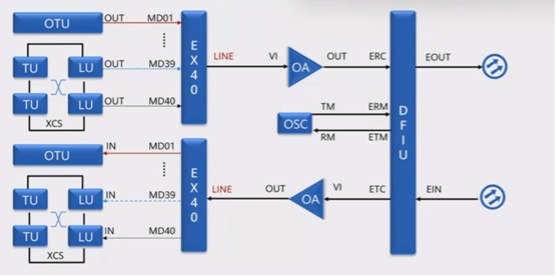
A. Any wavelength can be added or dropped through the MD01 port.
B. A maximum of 40 wavelengths can be added or dropped at this site.
C. The two EX40 boards in this signal flow are used for multiplexing and demultiplexing respectively.
D. The MD01 ports on the two EX40 boards are connected to the same OTU board.
Correct Answer: BC
QUESTION 23
An OTM site mainly adds/drops services, multiplexes/demultiplexes signals, and amplifies signals. It does not support the processing of optical supervisory signals.
A. TRUE
B. FALSE
Correct Answer: B
QUESTION 24
Which of the following functions can be implemented at an FOADM site?
A. Optical supervisory channel amplification
B. Multiplexing and demultiplexing
C. Service signal adding/dropping
D. Static wavelength pass-through
Correct Answer: BCD
QUESTION 25
Which of the following device combinations cannot be installed in an A63B cabinet (2200 mm (H) x 600 mm
(W) x 350 mm (D))?
A. One OSN 9800 M24/E9624 subrack and two OSN 9800 M12/E9612 subracks
B. One OSN 9800 U32E subrack and one OSN 9800 M12/E9612 subrack
C. Four OSN 9800 M12/E9612 subracks
D. Two OSN 9800 M24/E9624 subracks
Correct Answer: D
QUESTION 26
During device installation, you need to install boards and components into a chassis first, and then install the chassis into a cabinet.
A. TRUE
B. FALSE
Correct Answer: B
QUESTION 27
Which of the following statements about routing E1 cables are correct?
A. After installation is complete, you need to arrange E1 cables neatly and route them through the corresponding cable manager.
B. E1 cables should not block the air intake vent of the chassis or affect the insertion and removal of other boards.
C. You must insert the connectors of E1 cables into corresponding ports on the board and tighten screws.
D. When using an E1 cable, a thin cable with a core a diameter of 1.6 mm, you need to use a 75-2-2 connector to make the connector on the DDF side.
Correct Answer: ABC
QUESTION 28
An OptiXtrans E6616/OSN 1800 V Pro can only be installed in a 19-inch cabinet. It cannot be installed in an ETSI cabinet.
A. TRUE
B. FALSE
Correct Answer: B
QUESTION 29
To remove an optical module, you must hold the puller of the optical module instead of the label.
A. TRUE
B. FALSE
Correct Answer: A
QUESTION 30
Which type of label is shown in the following figure?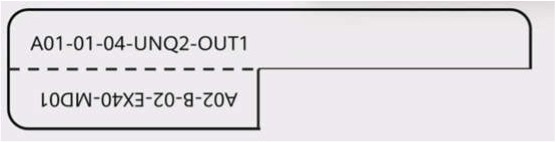
A. A label for optical fibers connecting the device and ODF
B. A label for external alarm cables
C. A label for optical fibers connecting devices
D. A power cable label
Correct Answer: C
QUESTION 31
Gateway NEs can directly communicate with the NMS, whereas non-gateway NEs can communicate with the NMS only through gateway NEs.
A. TRUE
B. FALSE
Correct Answer: A
QUESTION 32
Which of the following DCN communication channels are supported by OTN line boards?
A. OSC
B. GCC1/GCC2
C. GCC0
D. D1-D12
Correct Answer: C
QUESTION 33
Which of the following statements about DCN for optical transmission is incorrect?
A. Internal DCNs are classified as either inband or outband.
B. The DCN between NEs is called an internal DCN.
C. The DCN between the NMS and NEs is called an external DCN.
D. Internal DCN can be connected only through optical fibers, not through network cables.
Correct Answer: D
QUESTION 34
To manually create an NE on NCE, which of the following parameters is not required?
A. Basic NE ID
B. Gateway type
C. NE version
D. Extended NE ID
Correct Answer: C
QUESTION 35
Which of the following NE details cannot be queried using the NCE or Web LCT?
A. Current alarms of an NE
B. Historical alarms of an NE
C. Software version of an NE
D. Power-on running duration of an NE
Correct Answer: D
QUESTION 36
Common NE alarm severities on the NMS are critical, major, minor, and warning.
A. TRUE
B. FALSE
Correct Answer: A
QUESTION 37
To add TPS protection boards on the NMS, you need to add a service processing board (such as PD1) before adding an interface board (such as DMS or OMS).
A. TRUE
B. FALSE
Correct Answer: B
QUESTION 38
Which of the following statements about verifying the connectivity of PDH/SDH services is correct?
A. Services are not interrupted during a PRBS test.
B. During a PRBS test, you do not need to perform any loopback operations.
C. When the PRBS test is performed in the tributary direction, the cross-connection does not need to be configured for the tested tributary port.
D. A PRBS test does not support cable connectivity testing for a PDH service port.
Correct Answer: C
QUESTION 39
Which of the following statements about configuring SDH/PDH services a on a per-NE basis is incorrect?
A. The timeslot range does not support multiple discrete timeslots.
B. Ifa service is an E1 service, you need to set “Level” to “VC12”.
C. When parameter “Direction” is set to “Unidirectional”, only the cross-connection from the service source to the service sink is created.
D. To apply the configured SDH service to an NE immediately, set “Activate Immediately” to “Yes”.
Correct Answer: A
QUESTION 40
When the physical board does not exist, you can configure services on the logical board through NMS.
A. TRUE
B. FALSE
Correct Answer: B