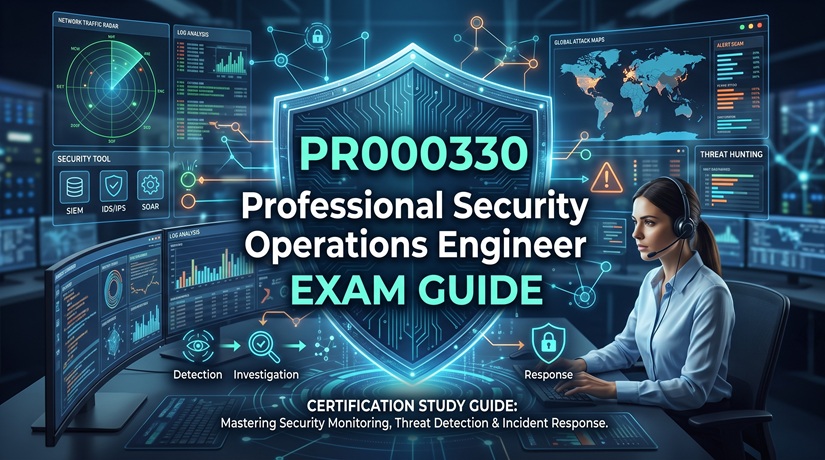
The PR000330 Professional Security Operations Engineer exam is designed for security professionals who work with modern security operations environments built around Google Cloud technologies. Unlike a general cloud security certification, PR000330 focuses heavily on security monitoring, threat detection, threat hunting, detection engineering, incident investigation, response automation, and security operations observability.
If you are preparing for the certification, the most important thing to understand is that this is not simply a product-knowledge test. Google expects candidates to understand how security operations work as a complete system. You need to know how telemetry enters the platform, how security data is normalized, how detections are created, how analysts investigate suspicious activity, and how automated response can reduce operational workload.
This PR000330 Professional Security Operations Engineer guide covers the exam structure, certification value, major technologies, official exam domains, hands-on skills, and a practical study strategy for candidates preparing for the Google Cloud certification.
PR000330 Professional Security Operations Engineer Exam Overview
The PR000330 Professional Security Operations Engineer exam belongs to Google Cloud’s professional-level certification portfolio. It validates whether a candidate can operate security monitoring and response capabilities using Google Cloud and Google Security Operations technologies.
| Exam Information | Details |
|---|---|
| Exam Code | PR000330 |
| Certification | Google Cloud Certified – Professional Security Operations Engineer |
| Exam Duration | 2 hours |
| Number of Questions | Approximately 50–60 questions |
| Question Format | Multiple choice and multiple select |
| Registration Fee | USD $200 plus applicable tax |
| Available Languages | English and Japanese |
| Delivery Method | Online-proctored or onsite-proctored exam |
| Formal Prerequisites | None |
| Recommended Experience | 3+ years in the security industry, including 1+ year using Google Cloud security technologies |
Although Google does not require another certification before taking PR000330, this should not be interpreted as an entry-level exam. The recommended experience makes the expected difficulty clear. Candidates are expected to make security decisions based on realistic operational scenarios rather than simply recognize product names.
For that reason, a good PR000330 exam preparation strategy should combine official documentation, hands-on practice, security operations concepts, and scenario-based review.
Is the PR000330 Certification Worth It?
The value of the PR000330 Professional Security Operations Engineer certification comes primarily from its specialization. Instead of attempting to cover every aspect of cloud security, the certification concentrates on the daily responsibilities of security operations teams.
The certification is particularly relevant for professionals working in roles such as:
- Security Operations Center analyst
- SOC engineer
- Security operations engineer
- Detection engineer
- Threat hunter
- Incident response analyst
- SIEM engineer
- SOAR engineer
- Cloud security analyst
- Cybersecurity consultant
The technical concepts covered by PR000330 are also useful outside Google Cloud. Log normalization, detection logic, threat hunting, incident response, alert enrichment, case management, false-positive reduction, risk scoring, and security automation are important skills across many security platforms.
This makes the certification especially interesting for security professionals who want to move from traditional SOC monitoring into cloud-focused security operations.
PR000330 vs. Professional Cloud Security Engineer
One common source of confusion is the difference between Professional Security Operations Engineer and Professional Cloud Security Engineer.
| Area | Professional Security Operations Engineer | Professional Cloud Security Engineer |
|---|---|---|
| Main Focus | Detection, monitoring, investigation, threat hunting and response | Secure cloud architecture and infrastructure |
| Typical Technologies | SIEM, SOAR, Google SecOps, YARA-L, threat intelligence | IAM, networking, encryption, policies, data security |
| Typical Roles | SOC analyst, detection engineer, threat hunter | Cloud security engineer, security architect |
| Operational Emphasis | High | Moderate |
| Architecture Emphasis | Moderate | High |
If your work primarily involves alerts, investigations, threat hunting, SIEM content, and incident response, PR000330 is probably the more relevant certification. If you mainly design secure cloud environments, IAM models, and network security architectures, Professional Cloud Security Engineer may be a better starting point.
PR000330 Professional Security Operations Engineer Exam Domains
The official PR000330 exam guide divides the certification into six major technical domains.
| Exam Domain | Approximate Weight | Main Topics |
|---|---|---|
| Platform Operations | 14% | Architecture, IAM, integrations, APIs, audit logs and platform access |
| Data Management | 14% | Log ingestion, parsers, UDM, normalization, entities and data quality |
| Threat Hunting | 19% | Queries, IOCs, behavioral analysis, historical searches and retrohunts |
| Detection Engineering | 22% | Detection rules, YARA-L, risk, tuning and contextual enrichment |
| Incident Response | 21% | Investigation, containment, evidence, playbooks, SOAR and case management |
| Observability | 10% | Dashboards, reports, KPIs, monitoring, thresholds and source health |
Important exam insight: Detection Engineering, Incident Response, and Threat Hunting together represent approximately 62% of the PR000330 exam blueprint.
This distribution gives you a useful clue about how to allocate your study time. Product administration matters, but the exam is primarily designed around security operations workflows.
1. Platform Operations – Approximately 14%
Platform Operations covers the foundation required to operate security tooling safely. Candidates should understand how security products are deployed and integrated, how access is controlled, and how APIs can support automated security workflows.
Important topics include:
- Google Cloud IAM
- User identities
- Service accounts
- IAM roles and permissions
- Workforce Identity Federation
- Audit logs
- API access
- Security tooling integrations
- Security coverage gaps
- Automation opportunities
Least privilege is particularly important. A security platform may have excellent detection capabilities, but overly broad administrative permissions can introduce unnecessary security risk.
2. Data Management – Approximately 14%
Security operations begins with telemetry. If logs are missing, incorrectly parsed, or poorly normalized, investigations and detections become unreliable.
You should understand:
- Log ingestion methods
- Security telemetry sources
- Parsers
- Parser troubleshooting
- Data normalization
- Unified Data Model
- Entity context
- Data quality
- Ingestion health
- Data ingestion cost
A common beginner mistake is assuming that collecting more data automatically improves security. In practice, useful telemetry must be relevant, searchable, normalized, reliable, and economically sustainable.
3. Threat Hunting – Approximately 19%
Threat hunting is the proactive search for suspicious activity that may not have generated a traditional security alert.
A threat hunter might begin with a hypothesis such as:
- A compromised account is being used from unusual locations.
- A newly published malicious domain may have contacted internal systems.
- A rare process is running on a sensitive endpoint.
- A privileged account is exhibiting unusual behavior.
- An attacker may have used a recently discovered technique.
The hunter then searches security telemetry to determine whether evidence supports the hypothesis.
PR000330 candidates should understand historical searches, IOC searches, behavioral investigations, user activity, risk information, entity context, and retrohunt workflows.
4. Detection Engineering – Approximately 22%
Detection Engineering is the largest individual domain in the PR000330 Professional Security Operations Engineer exam.
Detection engineering converts security knowledge into repeatable detection logic. A good detection should identify meaningful suspicious activity while avoiding unnecessary alert noise.
Important technologies and concepts include:
- YARA-L detection rules
- Google SecOps reference lists
- Entity context
- Risk Analytics
- Curated detections
- Security Command Center findings
- Event Threat Detection
- Detection tuning
- False-positive reduction
- Contextual enrichment
When studying this domain, do not simply ask, “Does this detection work?” Also ask, “Will this detection be useful to an analyst?”
5. Incident Response – Approximately 21%
Incident response begins when suspicious activity requires investigation and potentially containment.
Candidates should be comfortable with:
- Incident scope
- Evidence collection
- Root cause analysis
- Containment
- Escalation
- Notification
- Case management
- SOAR playbooks
- Automated enrichment
- Response orchestration
An effective response must balance speed with evidence preservation and business impact. Automatically shutting down every suspicious workload may stop malicious activity, but it may also destroy evidence or interrupt critical business services.
6. Observability – Approximately 10%
Security teams must monitor the health of their own security infrastructure.
Useful operational metrics can include:
- Log ingestion volume
- Detection activity
- Alert volume
- Top detection rules
- False-positive trends
- Case resolution times
- Data source health
- Missing telemetry sources
One especially important concept is silent source detection. If an identity platform, firewall, endpoint tool, or cloud service suddenly stops sending logs, the SOC may develop a significant visibility gap without immediately realizing it.
Google Security Operations: The Core PR000330 Platform
Google Security Operations, commonly called Google SecOps, is central to the PR000330 certification.
The platform brings together capabilities traditionally associated with SIEM and SOAR platforms, including:
- Security telemetry ingestion
- Log normalization
- Search
- Threat detection
- Threat hunting
- Alert investigation
- Case management
- Threat intelligence
- Security orchestration
- Automated response
For the exam, you do not need to memorize every interface element. What matters more is understanding how the workflow fits together.
A simplified security operations workflow looks like this:
- Security telemetry is generated.
- The telemetry is ingested into Google SecOps.
- Parsers transform the raw data.
- Events are normalized into UDM.
- Searches and detections analyze the normalized events.
- Threat intelligence adds context.
- Alerts are investigated.
- Cases are created or enriched.
- SOAR playbooks automate selected actions.
- Dashboards monitor security and operational health.
This lifecycle is one of the most important mental models for Google Cloud PR000330 preparation.
Unified Data Model (UDM)
Different security products describe similar events using different field names and formats. That creates a significant challenge when analysts need to search across multiple telemetry sources.
Google Security Operations addresses this problem using the Unified Data Model, or UDM.
UDM normalizes security telemetry so analysts and detection rules can work with consistent security concepts across multiple log sources.
For example, a user identity might appear differently in:
- A firewall event
- An identity provider log
- A cloud audit log
- An endpoint detection platform
- A SaaS application
Normalization allows these events to be searched and correlated using consistent concepts.
For PR000330, focus on why normalization matters, how parsers affect UDM records, and what happens when important fields are mapped incorrectly.
A parser can technically succeed while still producing poor security outcomes. If a source IP, hostname, username, or event type is mapped incorrectly, downstream detections may fail even though data continues to arrive.
YARA-L 2.0 and the PR000330 Exam
YARA-L is one of the most important technologies to study for the PR000330 Professional Security Operations Engineer exam.
Google Security Operations uses YARA-L for security searches, dashboards, and detection rules.
A simplified educational example might look like this:
rule same_user_multiple_cities {
  meta:
    author = "study-example"
    description = "Detects one user logging in from multiple cities"

  events:
    $e.metadata.event_type = "USER_LOGIN"
    $e.principal.user.userid = $user
    $e.principal.location.city = $city

  match:
    $user over 10m

  condition:
    $e and #city > 1
}
You should not memorize this rule. Instead, understand how the sections work.
- meta describes the rule.
- events defines the security events of interest.
- match defines correlation over a time window.
- condition determines whether the rule produces a result.
Start with basic single-event queries before studying more complex multi-event correlation rules. Once you understand rule logic, spend time learning how to reduce false positives and improve detection quality.
Security Command Center
Security Command Center provides centralized security posture and threat visibility for Google Cloud environments.
PR000330 candidates should understand how Security Command Center can contribute context to investigations and detections.
Typical areas include:
- Security posture
- Misconfigurations
- Vulnerabilities
- Threat findings
- Risk information
- Cloud asset context
It is useful to distinguish between a security posture issue and active malicious behavior.
For example, an overly permissive cloud configuration may represent a risk. Suspicious credential usage may represent active threat activity. During an investigation, both can become important because the configuration weakness may help explain how the attacker gained access.
Google Threat Intelligence
Google Threat Intelligence provides context that can help security teams prioritize alerts, hunt for threats, and understand attacker activity.
Threat intelligence can include indicators such as:
- IP addresses
- Domains
- URLs
- File hashes
- Malware information
- Threat actor information
- Campaign details
- Tactics, techniques and procedures
However, mature threat intelligence workflows are not based only on matching indicators.
A suspicious IP address becomes much more useful when combined with:
- Asset importance
- User identity
- Historical activity
- Threat actor context
- Detection risk
- Other correlated events
That context can help analysts distinguish a low-priority event from a serious incident.
Threat Hunting for PR000330
Threat hunting receives approximately 19% of the current exam blueprint, making it a major study area.
A useful threat-hunting workflow is:
- Create a hypothesis.
- Identify relevant telemetry.
- Search historical events.
- Analyze users, assets and entities.
- Compare findings with threat intelligence.
- Determine whether suspicious behavior exists.
- Create or improve detections based on the results.
Notice the final step. Threat hunting and detection engineering often support each other. A successful hunt may reveal behavior that deserves a permanent detection rule.
Detection Engineering for PR000330
Because Detection Engineering accounts for approximately 22% of the exam, it deserves significant study time.
A detection engineer must balance sensitivity and precision.
If a detection is too narrow, malicious activity may be missed. If it is too broad, analysts may receive hundreds of low-value alerts.
When reviewing a detection, ask:
- What behavior is the rule trying to identify?
- Which telemetry sources are required?
- Are the required fields normalized correctly?
- Can legitimate activity trigger the rule?
- Can entity context improve the detection?
- Should risk scoring be included?
- Would a reference list improve accuracy?
- How could an attacker avoid this detection?
Those questions reflect the kind of operational reasoning that is more useful than memorizing rule syntax.
Incident Response and SOAR Automation
Incident Response accounts for approximately 21% of the PR000330 blueprint.
A typical incident lifecycle may include:
- Detection
- Triage
- Investigation
- Evidence collection
- Scope determination
- Containment
- Eradication
- Recovery
- Documentation
- Lessons learned
SOAR automation can reduce repetitive analyst work during this process.
For example, a playbook might automatically:
- Enrich an IP address.
- Check a file hash against threat intelligence.
- Retrieve endpoint information.
- Add information to a case.
- Create a ticket.
- Notify the security team.
- Disable an account under approved conditions.
- Isolate an endpoint under approved conditions.
The important phrase is under approved conditions. Automation should reduce repetitive work without creating unnecessary business risk.
Eight-Week PR000330 Professional Security Operations Engineer Study Plan
A structured study plan is usually more effective than reading random documentation. The following schedule can be adapted based on your existing experience.
Week 1: Google Cloud Security Fundamentals
- Google Cloud resource hierarchy
- IAM
- Service accounts
- Cloud Audit Logs
- Basic networking
- Security Command Center
The objective is to remove basic Google Cloud platform confusion before moving into security operations.
Week 2: Google SecOps and Data Management
- Security telemetry ingestion
- Parsers
- UDM
- Normalization
- Entity context
- Data quality
Draw the path from raw telemetry to a normalized security event. If you cannot explain the process without documentation, continue studying it.
Week 3: YARA-L
Start with basic queries and gradually move toward detection logic.
Practice:
- Event filtering
- UDM fields
- Variables
- Match windows
- Conditions
- Multi-event correlation
Week 4: Threat Hunting and Threat Intelligence
Create several simple hunting hypotheses and determine which telemetry you would need to investigate them.
Review:
- IOC searches
- Historical investigations
- Retrohunt
- Behavioral hunting
- Threat intelligence enrichment
- User and entity context
Week 5: Detection Engineering
This should be one of your most intensive study weeks.
Focus on:
- YARA-L detections
- Detection tuning
- Reference lists
- Risk Analytics
- Curated detections
- False-positive reduction
- Contextual enrichment
You can also use a structured PR000330 Professional Security Operations Engineer study resource to organize review around the highest-weight exam objectives.
Week 6: Incident Response and SOAR
Walk through several hypothetical incidents from detection to closure.
For each scenario, determine:
- What evidence should be collected?
- How should the incident be scoped?
- What should be contained?
- Which response actions can be automated?
- When should the incident be escalated?
Week 7: Observability
Review dashboards, KPIs, security reporting, ingestion health, alerting thresholds, notifications, and silent source detection.
Ask yourself what metrics would prove that your security operations platform is healthy.
Week 8: PR000330 Exam Review
Return to the official PR000330 exam guide and classify every objective as:
- Strong
- Needs review
- Weak
Spend the final study period on weak areas rather than repeatedly reviewing topics you already understand.
Hands-On Practice for PR000330
Hands-on practice is especially valuable for a professional-level security certification.
Useful exercises include:
- Create a Google Cloud project.
- Inspect Cloud Audit Logs.
- Use Logs Explorer to investigate administrative actions.
- Identify the user or service account responsible for an event.
- Study UDM examples.
- Write simple YARA-L searches.
- Modify YARA-L detection rules.
- Map detections to MITRE ATT&CK.
- Design an incident-response playbook.
- Design a security operations dashboard.
If you are a student or early-career candidate, consider documenting these exercises as a portfolio. A short technical explanation of how you investigated an event or designed a detection can demonstrate practical knowledge beyond the certification badge.
PR000330 Exam Preparation and Exam-Day Strategy
The PR000330 Professional Security Operations Engineer exam provides two hours for approximately 50–60 questions. Time management is therefore important, but candidates usually have enough time if they avoid spending too long on a single scenario.
Look carefully for requirement words such as:
- Most appropriate
- Least operational overhead
- Reduce false positives
- Historical analysis
- Automate
- Least privilege
- Minimize cost
- Improve detection coverage
These words often reveal what the question is actually testing.
When two answers both appear technically valid, choose the option that most directly satisfies the stated requirement while minimizing unnecessary complexity.
For multiple-select questions, evaluate each option independently. Do not select an answer simply because it belongs to a technology that appears elsewhere in the scenario.
For additional structured preparation, review the PR000330 exam guide and study resources together with Google’s official exam objectives and documentation.
PR000330 Professional Security Operations Engineer FAQ
What is the PR000330 exam?
PR000330 is the exam code for the Google Cloud Certified – Professional Security Operations Engineer certification. It focuses on operating modern security detection, monitoring, investigation, threat hunting, automation, and incident-response capabilities.
Is the PR000330 Professional Security Operations Engineer exam difficult?
Yes. PR000330 is a professional-level certification exam. Google recommends more than three years of security-industry experience, including at least one year working with Google Cloud security technologies.
What should I study for PR000330?
Prioritize Detection Engineering, Incident Response, and Threat Hunting because those three domains account for approximately 62% of the current exam blueprint. You should also understand Google SecOps, UDM, YARA-L, Security Command Center, Google Threat Intelligence, IAM, logging, SOAR, and security observability.
Do I need to know YARA-L for PR000330?
Yes. YARA-L is explicitly included in the exam objectives. Candidates should understand how YARA-L searches and detection rules use normalized UDM telemetry.
Is PR000330 only about Google Cloud?
No. The certification is part of Google Cloud, but security operations concepts such as SIEM, SOAR, log normalization, detection engineering, threat hunting, and incident response can apply to telemetry from cloud, on-premises, identity, endpoint, and network environments.
Is PR000330 the same as Professional Cloud Security Engineer?
No. Professional Cloud Security Engineer focuses more broadly on designing and securing Google Cloud infrastructure. Professional Security Operations Engineer focuses on security monitoring, detection engineering, threat hunting, investigations, and response.
How should beginners prepare for PR000330?
Beginners should first develop a foundation in networking, IAM, cloud computing, logs, SIEM concepts, incident response, and Google Cloud. After that, use the official exam guide and a structured PR000330 study guide to work through the exam domains systematically.
Are PR000330 sample questions available?
Google provides official sample questions for the Professional Security Operations Engineer certification. They are useful for understanding question style, but Google states that they are not intended to represent the complete difficulty or scope of the real exam.
Final Thoughts on the PR000330 Professional Security Operations Engineer Exam
The best way to prepare for the PR000330 Professional Security Operations Engineer certification is to think about security operations as a complete lifecycle rather than a collection of Google products.
Security telemetry enters the environment. Parsers and UDM give the data structure. Threat intelligence and entity information provide context. YARA-L and other detections turn suspicious behavior into signals. Security analysts investigate those signals. Incident responders contain confirmed threats. SOAR playbooks automate repeatable work. Observability confirms that the security operations pipeline remains healthy.
Once you understand how those pieces interact, many scenario-based questions become easier because you can identify where a particular requirement belongs in the security operations lifecycle.
The certification itself is useful, but the larger value comes from developing practical skills in detection engineering, investigation, threat hunting, and response. Those capabilities remain relevant even when the individual security products change.
Official and Authoritative PR000330 References
- Google Cloud – Professional Security Operations Engineer Certification
- Google Cloud – Professional Security Operations Engineer Official Exam Guide
- Google – Professional Security Operations Engineer Sample Questions
- Google Skills – Professional Security Operations Engineer Learning Path
- Google Cloud – Google Security Operations
- Google Security Operations Documentation
- Google Security Operations – Unified Data Model Overview
- Google Security Operations – Getting Started with YARA-L
- Google Cloud – Security Command Center Documentation
- Google Threat Intelligence
- MITRE ATT&CK
- NIST SP 800-61 Rev. 3 – Incident Response Recommendations