Every modern business generates enormous amounts of data. Online retailers process customer transactions, telecommunications providers monitor network events, and financial institutions continuously analyze payment activities. However, collecting data is only the beginning. The real challenge is transforming raw information into useful business insights.
This is where professional big data developers become essential.
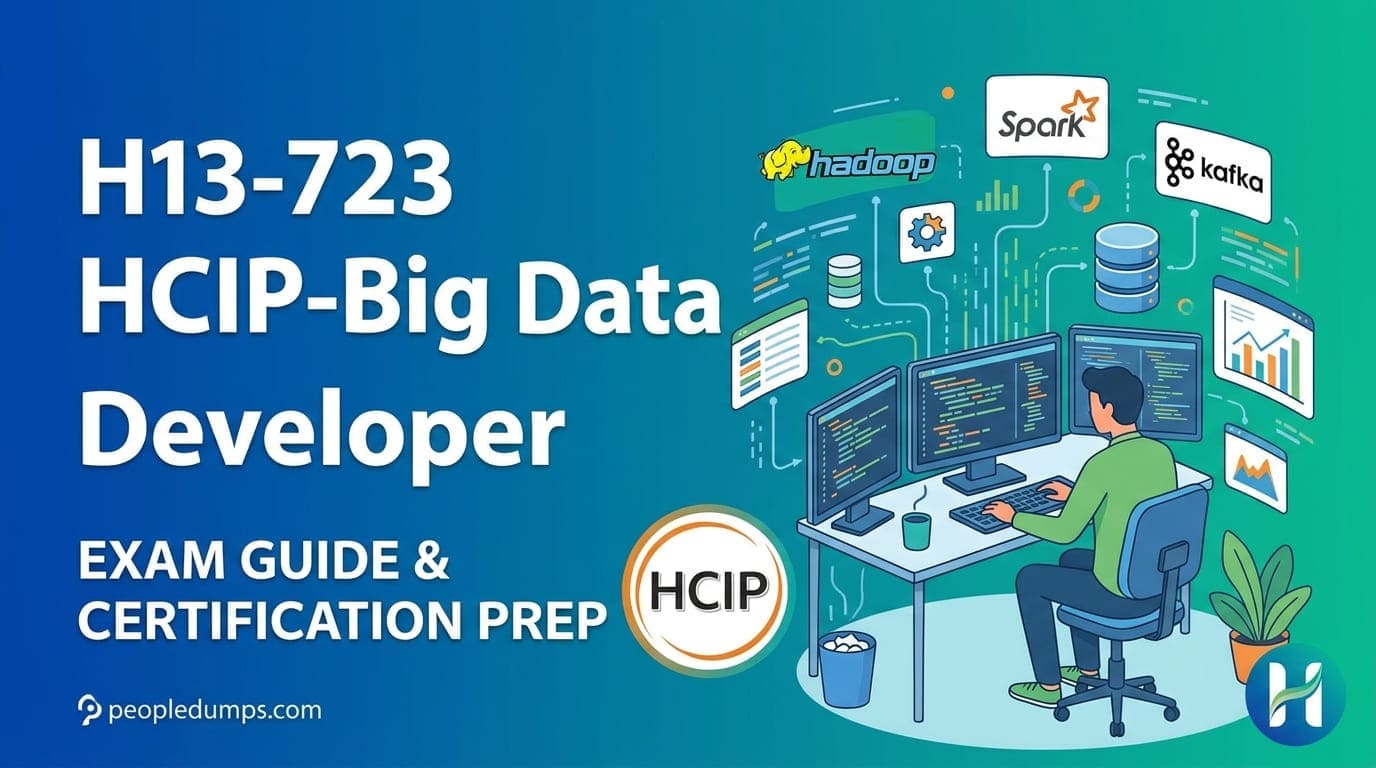
The HCIP-Big Data Developer certification (H13-723) focuses on distributed data processing, application development, real-time analytics, and enterprise big data technologies.
Developed within Huawei’s ICT certification framework, this professional-level certification covers important technologies such as Apache Hadoop, Spark, Kafka, Flink, HBase, and Elasticsearch.
For students, junior developers, and IT professionals interested in data engineering, understanding these technologies can provide a valuable foundation for developing scalable data processing applications.
In this comprehensive guide, we will explore the Huawei HCIP-Big Data Developer exam, its major technical domains, certification benefits, recommended preparation strategies, and practical applications in modern enterprise environments.
What Is the Huawei HCIP-Big Data Developer Certification?
Table of Contents
ToggleHCIP stands for Huawei Certified ICT Professional. It represents the professional level within Huawei’s certification framework, positioned above the associate level and below the expert level.
The HCIP-Big Data Developer certification is designed to develop professional knowledge of distributed data processing and big data application development.
Unlike introductory certifications that primarily emphasize fundamental concepts, HCIP-level training explores how various big data technologies interact within practical enterprise architectures.
For example, a modern data platform may use:
- Apache Kafka to collect and distribute application events.
- Apache Flink to process incoming data continuously.
- HDFS to store large historical datasets.
- Apache Spark to perform distributed data transformations.
- Apache Hive to support SQL-based data analysis.
- Elasticsearch to provide search and analytics capabilities.
A qualified big data developer should understand not only the purpose of these technologies but also how to select appropriate components for different business requirements.
Huawei’s big data certification curriculum also introduces technologies and development scenarios associated with Huawei’s enterprise data processing ecosystem.
Students interested in following a structured certification pathway can explore the Huawei H13-723 Big Data Developer exam preparation resources while studying these core technologies.
HCIP-Big Data Developer H13-723 Exam Overview
Before preparing for the examination, candidates should understand its structure and the technical knowledge expected at the professional certification level.
The following information is based on Huawei’s published HCIP-Big Data Developer V2.0 examination documentation.
| Exam Information | Details |
|---|---|
| Certification Name | HCIP-Big Data Developer |
| Exam Code | H13-723 |
| Referenced Version | HCIP-Big Data Developer V2.0 |
| Certification Level | Professional (HCIP) |
| Exam Duration | 90 minutes |
| Passing Score | 600 out of 1000 |
| Exam Languages | English and Chinese |
| Published Exam Fee | USD 300 |
| Primary Focus | Big Data Application Development |
Important: These details reflect published examination documentation and may not represent current registration availability or policies. Candidates should confirm the active exam version, pricing, and requirements through Huawei’s official certification channels before scheduling an examination.
Why Is HCIP-Big Data Developer Worth Pursuing?
Big data development has become an important part of enterprise IT infrastructure. Organizations increasingly depend on distributed platforms to process large datasets, support operational analytics, and improve business decision-making.
Although cloud platforms simplify infrastructure deployment, engineers still need to understand how distributed systems store, retrieve, and process information.
1. Develop Professional Data Engineering Knowledge
Processing several thousand database records is very different from analyzing billions of events distributed across multiple computing nodes.
Large-scale systems introduce challenges involving data partitioning, resource management, failure recovery, network communication, and processing efficiency.
The HCIP-Big Data Developer curriculum introduces important concepts that help engineers understand these challenges.
For example, candidates should consider:
- How can datasets be distributed efficiently across multiple nodes?
- What happens when a processing node becomes unavailable?
- How should applications handle delayed streaming events?
- How can developers reduce unnecessary data movement?
- Which storage system is most appropriate for a particular workload?
These are practical engineering questions that appear frequently in enterprise data platform development.
2. Learn Widely Used Big Data Technologies
Another advantage of studying for H13-723 is exposure to technologies used across different enterprise platforms.
Hadoop, Spark, Kafka, Flink, and Elasticsearch are not limited to a single vendor’s infrastructure.
Their fundamental concepts are transferable between private data centers, hybrid environments, and cloud-based architectures.
This makes the technical knowledge useful beyond the certification examination itself.
3. Improve Your Understanding of Enterprise Data Architectures
Real data platforms rarely depend on a single processing framework.
An e-commerce company might use Kafka for event ingestion, Flink for real-time analytics, Spark for historical reporting, and Elasticsearch for searching operational events.
Understanding why these technologies are combined is an important professional skill.
As candidates progress through the HCIP Big Data Developer H13-723 study materials, they should focus on architectural relationships rather than memorizing isolated definitions.
4. Support Long-Term Career Development
The knowledge covered in this certification can be relevant to several technical positions, including:
- Big Data Developer
- Junior Data Engineer
- Data Platform Engineer
- Hadoop Developer
- Spark Application Developer
- Cloud Data Processing Engineer
- Enterprise Data Integration Engineer
However, earning a certification does not automatically qualify someone for these roles.
Employers also value programming skills, database knowledge, troubleshooting ability, and experience building reliable data pipelines.
The best preparation strategy combines certification knowledge with practical development projects.
H13-723 Exam Objectives and Knowledge Domains
Huawei’s published HCIP-Big Data Developer V2.0 examination outline organizes the technical knowledge into four major domains.
| Knowledge Domain | Exam Weight |
|---|---|
| Big Data Application Development Overall Guide | 15% |
| Big Data Offline Batch Processing | 25% |
| Big Data Real-Time Retrieval | 30% |
| Big Data Real-Time Stream Computing | 30% |
These weightings show the importance of real-time retrieval and stream processing within the published examination objectives.
Together, those two areas represent 60% of the exam content.
Nevertheless, candidates should study every domain because distributed storage, batch processing, and data ingestion provide the foundation for more advanced technologies.
Domain 1: Big Data Application Development Fundamentals (15%)
The first examination domain introduces the architecture and fundamental principles of enterprise big data systems.
Understanding Distributed Computing
Traditional applications often execute on a single server. This design can become difficult to scale when datasets grow beyond the capacity of one machine.
Distributed computing addresses this problem by dividing workloads across multiple interconnected computing nodes.
Several principles are particularly important:
- Horizontal scalability: Increasing system capacity by adding additional machines.
- Fault tolerance: Maintaining or recovering processing operations after component failures.
- Parallel execution: Running different tasks simultaneously across multiple processors or servers.
- Data locality: Processing data close to its storage location when practical.
- Resource scheduling: Allocating available computing resources to applications and workloads.
These concepts explain why distributed platforms behave differently from traditional single-server applications.
Batch Processing vs. Stream Processing
One fundamental distinction in big data engineering is the difference between batch and stream processing.
Batch processing generally analyzes bounded datasets, such as transactions collected over the previous day.
Stream processing continuously handles incoming data, making it suitable for applications that require frequent updates or low processing latency.
For example, a bank might use batch processing to generate historical financial reports while using streaming applications to detect suspicious transactions shortly after they occur.
Understanding these processing models helps developers select technologies according to business requirements.
Domain 2: Big Data Offline Batch Processing (25%)
Offline batch processing remains essential for data warehousing, historical analytics, reporting, and large-scale data transformation.
This domain introduces technologies associated with distributed storage and batch computation.
Apache Hadoop and HDFS Architecture
Apache Hadoop provides a foundation for distributed storage and data processing.
One of its most important components is the Hadoop Distributed File System (HDFS).
HDFS divides large files into blocks and distributes them across multiple storage nodes.
The architecture includes:
- NameNode: Maintains file system metadata and manages the namespace.
- DataNode: Stores data blocks and handles data access operations.
- Block replication: Supports data redundancy and recovery according to configured policies.
For H13-723 preparation, candidates should understand the responsibilities of these components and the principles behind distributed file storage.
Other useful topics include block placement, replication behavior, failure handling, and the performance characteristics of large sequential data operations.
Apache Hive and SQL-Based Analytics
Apache Hive provides a SQL-oriented interface for analyzing large datasets.
It allows developers to express analytical tasks using familiar query structures.
Consider a retail business that wants to calculate total revenue by product category.
SELECT
    category,
    SUM(order_amount) AS total_revenue
FROM sales_transactions
GROUP BY category;
Although the query appears simple, processing it over a large dataset may require distributed execution across numerous computing resources.
Important study topics include:
- Hive tables and data types
- Partitioned tables
- SQL aggregation
- Data storage formats
- Query execution principles
- Basic performance optimization
Apache Spark and Spark SQL
Apache Spark is a distributed data processing engine commonly used for large-scale transformations and analytical workloads.
Spark SQL provides structured processing capabilities through SQL statements and DataFrame APIs.
The following PySpark example calculates total sales by product category:
from pyspark.sql import SparkSession

spark = (
    SparkSession.builder
    .appName("SalesAnalytics")
    .getOrCreate()
)

sales = spark.read.parquet(
    "/data/sales/"
)

result = (
    sales.groupBy("category")
    .sum("order_amount")
)

result.show()

spark.stop()
In a distributed environment, Spark coordinates processing across available cluster resources.
Developers should understand transformations, actions, partitioning, execution planning, and data shuffling.
Data shuffling is particularly important because transferring large amounts of data between computing nodes can significantly affect application performance.
ETL and Data Ingestion Technologies
Before analyzing data, developers must collect information from databases, applications, files, and other sources.
ETL stands for Extract, Transform, and Load.
- Extract: Retrieve data from source systems.
- Transform: Clean, validate, and restructure information.
- Load: Write processed data into the destination platform.
The published H13-723 curriculum references technologies such as Loader, Sqoop, and Kettle.
These tools illustrate important enterprise data integration concepts, although their individual capabilities and maintenance status may change over time.
Domain 3: Big Data Real-Time Retrieval (30%)
Not every application needs to scan an entire dataset to produce analytical results.
Some systems require efficient access to individual records, indexed documents, or relationships between entities.
This is the focus of the real-time retrieval domain.
Apache HBase
Apache HBase is a distributed database that supports large-scale storage and key-oriented data access.
It uses a wide-column data model and is frequently associated with applications that require scalable access to large datasets.
Unlike traditional relational databases, HBase does not depend on standard SQL joins as its primary access mechanism.
Developers must carefully design row keys and data structures according to application access patterns.
Important HBase concepts include:
- Row keys
- Column families
- Regions
- RegionServers
- Data distribution
- Read/write performance
- Hotspot prevention
A poorly designed row key can create uneven data distribution and concentrate traffic on specific regions.
Understanding this relationship between data modeling and performance is important for both examination preparation and practical development.
Elasticsearch and Distributed Search
Elasticsearch is a distributed search and analytics engine.
It is commonly used for applications involving full-text search, log analytics, and flexible document retrieval.
For example, a telecommunications provider may need to search large volumes of infrastructure logs using timestamps, device identifiers, and event severity.
Elasticsearch can support this scenario through indexing and distributed search operations.
Key technical areas include:
- Indexes and documents
- Mappings
- Inverted indexes
- Shards and replicas
- Query processing
- Search performance
Candidates should understand how search-oriented storage differs from key-based databases such as HBase.
Graph Engine Service (GES)
Graph-oriented systems organize information around entities and their relationships.
This approach is useful when analyzing connections between records.
Typical applications include:
- Fraud detection
- Network topology analysis
- Social network relationships
- Knowledge graphs
- Recommendation systems
Huawei’s Graph Engine Service is referenced in the published H13-723 examination outline.
Students should understand the differences between graph databases, relational databases, and key-oriented storage systems.
Choosing the Right Data Retrieval Technology
Different retrieval systems are designed for different workloads.
HBase is suitable for many key-oriented access patterns, Elasticsearch specializes in indexed search, and graph systems emphasize relationships and traversal operations.
The best technology depends on the application’s data model, access patterns, consistency requirements, and operational constraints.
When reviewing H13-723 certification exam preparation topics, pay particular attention to questions involving technology selection and practical application scenarios.
Domain 4: Big Data Real-Time Stream Computing (30%)
Real-time stream computing enables applications to process continuously arriving information.
This approach is useful for monitoring, fraud detection, financial events, IoT telemetry, and other workloads where data must be evaluated rapidly.
The H13-723 curriculum includes Kafka, Flink, Spark Streaming, Flume, and Redis.
Apache Kafka and Event Streaming
Apache Kafka is a distributed event streaming platform.
It allows applications to publish events to topics and enables downstream systems to consume those events independently.
Important Kafka concepts include:
- Producer: Publishes records to Kafka topics.
- Consumer: Reads records from Kafka topics.
- Topic: A logical category containing event records.
- Partition: Enables parallel processing and provides ordering within the partition.
- Consumer group: Coordinates message consumption among multiple consumers.
- Offset: Identifies the position of a record within a partition.
Kafka can act as the central event ingestion layer of a data processing architecture.
For example, an online shopping platform may publish customer actions, payment events, and inventory updates into separate Kafka topics.
Different processing applications can then consume these events according to their individual requirements.
Apache Flink and Stateful Stream Processing
Apache Flink is a distributed processing engine with support for stateful stream processing.
One important concept is the difference between event time and processing time.
Event time represents when an event occurred in its source system.
Processing time represents when a processing application handles the event.
These timestamps can differ because events may arrive late or out of order.
Flink supports mechanisms such as watermarks, windows, and checkpoints to help developers build reliable streaming applications.
For example, an application may calculate the number of network errors during each five-minute interval.
The developer must decide how to handle delayed records, manage application state, and recover from processing failures.
These considerations demonstrate why streaming development requires more than simply reading messages from an event queue.
Apache Spark Streaming
Apache Spark also provides streaming capabilities.
Its streaming technologies include the traditional DStream-based Spark Streaming API and the newer Structured Streaming model.
Structured Streaming allows developers to express continuous computations using DataFrame and SQL-style operations.
When preparing for H13-723, candidates should match their studies to the actual examination version rather than assuming that every feature from the latest Spark release is included.
Redis and Low-Latency Data Access
Redis is commonly used for fast in-memory data operations and caching.
Within a streaming application, Redis can provide quick access to selected processing results.
For example, a Flink application might continuously calculate network performance metrics and write the latest values to Redis.
A monitoring dashboard can retrieve those values without directly querying the stream processing engine.
Practical Example: Building an Enterprise Big Data Pipeline
Understanding individual technologies is important, but real engineering work involves combining different components.
Consider an online retail company that wants to analyze customer transactions and identify suspicious activity.
Step 1: Collect Application Events
The company’s applications publish transaction records, customer actions, and payment events into Kafka topics.
This event-driven approach allows different processing applications to consume relevant information independently.
Step 2: Perform Real-Time Analytics
A Flink application processes incoming transactions and evaluates behavioral patterns.
It may identify unusually frequent transactions, calculate short-term statistics, or produce operational alerts.
Step 3: Store Historical Information
Historical event records are stored in HDFS or an appropriate cloud storage environment.
This provides a foundation for later analysis without requiring every analytical workload to operate directly on the streaming system.
Step 4: Run Batch Processing Jobs
Spark SQL processes stored transaction datasets to generate daily financial reports and customer activity summaries.
Step 5: Provide Data Retrieval Services
Elasticsearch indexes selected operational records for searching, while Redis stores frequently requested metrics for dashboard applications.
This architecture illustrates how event ingestion, streaming computation, historical storage, batch analytics, and real-time retrieval can work together.
It is an educational design example rather than a mandatory Huawei implementation.
What Skills Are Recommended Before Taking H13-723?
HCIP-Big Data Developer is a professional-level certification, so some previous programming and systems knowledge is beneficial.
Recommended foundational skills include:
- Basic Java or Python programming
- SQL and relational database fundamentals
- Linux command-line operations
- TCP/IP networking fundamentals
- Basic server and storage concepts
- Understanding of distributed systems
- Familiarity with data processing workflows
For students who are completely new to big data, studying associate-level concepts first may make the professional-level curriculum easier to understand.
Networking knowledge is also valuable because distributed applications depend on reliable communication between computing nodes.
How to Prepare for the HCIP-Big Data Developer H13-723 Exam
Effective examination preparation should combine official documentation, structured learning, practical laboratories, and regular knowledge assessment.
Step 1: Review the Official Exam Syllabus
Begin by identifying the technologies and concepts included in the examination version you intend to take.
Create a checklist that covers all four knowledge domains.
Use the published topic weighting to organize your study time, but avoid neglecting smaller areas.
Step 2: Strengthen Programming and SQL Skills
Spend time practicing SQL queries and basic data transformations.
If you are using Python or Java, become comfortable reading structured data, manipulating records, and understanding common programming errors.
Step 3: Practice Distributed Storage and Batch Processing
Explore HDFS, Hive, and Spark using a suitable laboratory environment.
Practice:
- Reading and writing datasets
- Performing SQL aggregations
- Working with partitions
- Understanding distributed execution
- Identifying performance bottlenecks
Step 4: Study Data Retrieval Systems
Compare HBase, Elasticsearch, and graph-based data models.
Try to determine which technology is suitable for a particular business scenario and explain the reasoning behind your choice.
Step 5: Build a Simple Streaming Pipeline
Create a Kafka producer and consumer, then experiment with processing incoming events.
Study how data partitioning, event ordering, processing state, and failure recovery affect streaming applications.
Step 6: Evaluate Your Knowledge
After covering the major technical domains, use legitimate practice questions and scenario-based exercises to identify weak areas.
Avoid memorizing answers without understanding the technical principles behind them.
For a structured review of examination objectives and related concepts, candidates can refer to the HCIP-Big Data Developer H13-723 exam study guide alongside Huawei’s official documentation and practical laboratory exercises.
Suggested Eight-Week H13-723 Study Plan
The following schedule provides a practical starting point for candidates who already have basic IT knowledge.
| Week | Study Topics | Learning Objective |
|---|---|---|
| Week 1 | Linux, SQL, Distributed Systems | Build technical foundations |
| Week 2 | Hadoop and HDFS | Understand distributed storage |
| Week 3 | Hive and Spark SQL | Practice batch analytics |
| Week 4 | Data Ingestion and ETL | Build basic processing pipelines |
| Week 5 | HBase, Elasticsearch, GES | Compare retrieval technologies |
| Week 6 | Kafka and Streaming Fundamentals | Understand event processing |
| Week 7 | Flink, Spark Streaming, Redis | Practice real-time computation |
| Week 8 | Technical Review and Practice | Identify remaining knowledge gaps |
This is a suggested study plan rather than an official training schedule.
Beginners may need additional time, especially when learning programming and distributed systems for the first time.
Common Mistakes During H13-723 Exam Preparation
Memorizing Definitions Without Understanding Architecture
Knowing that Kafka processes event streams is not sufficient.
Candidates should understand how partitions, producers, consumers, and offsets influence application behavior.
Ignoring Practical Development
Big data systems become easier to understand when developers work with actual datasets and observe application execution.
Even a small laboratory environment can help demonstrate concepts such as partitioning, query execution, and processing failures.
Underestimating Distributed System Performance
Network communication, memory management, data distribution, and resource scheduling can significantly influence application performance.
Understanding these relationships is an important part of professional-level technical preparation.
Using Materials That Do Not Match the Exam Version
Big data frameworks and Huawei certification requirements may change over time.
Always verify that your study materials correspond to the examination version available when you register.
HCIP-Big Data Developer vs. HCIA-Big Data
Students entering Huawei’s big data certification pathway may wonder whether they should begin with HCIA-level learning or move directly into HCIP-level topics.
| Comparison | HCIA-Big Data | HCIP-Big Data Developer |
|---|---|---|
| Certification Level | Associate | Professional |
| Primary Focus | Big Data Fundamentals | Application Development |
| Technical Depth | Foundational | Intermediate to Advanced |
| Typical Audience | Students and Beginners | Developers and Data Engineers |
| Learning Emphasis | Understanding Technologies | Applying Technologies |
HCIA-level learning is useful for understanding basic architecture and terminology.
HCIP-Big Data Developer extends this foundation through more detailed study of distributed processing, data retrieval, and streaming technologies.
For candidates with existing programming and database experience, professional-level topics may be more accessible.
Formal prerequisites, if applicable, should always be verified against current Huawei certification requirements.
Is HCIP-Big Data Developer Still Relevant in 2026?
Enterprise data platforms continue to evolve as organizations adopt cloud-native infrastructure, managed analytics services, lakehouse architectures, and AI-powered applications.
However, these developments have not eliminated the importance of distributed computing fundamentals.
Modern data engineers still need to understand:
- Distributed storage
- Parallel processing
- Data partitioning
- Streaming architectures
- Query optimization
- Failure recovery
- Data consistency
- Scalable application design
The technologies covered by HCIP-Big Data Developer provide a foundation for studying these principles.
There is an important distinction between the continuing relevance of the technical skills and the current availability of a particular examination code.
Candidates planning to pursue H13-723 in 2026 should confirm whether Huawei currently offers the exam and which version is active.
For long-term career development, combining big data fundamentals with modern cloud technologies, automation, and software engineering practices is a practical approach.
Frequently Asked Questions About HCIP-Big Data Developer H13-723
What is the HCIP-Big Data Developer H13-723 exam?
H13-723 is the examination code associated with Huawei’s published HCIP-Big Data Developer certification documentation. Its V2.0 syllabus covers application development fundamentals, offline batch processing, real-time retrieval, and stream computing.
Is HCIP-Big Data Developer suitable for beginners?
Motivated beginners can work toward this certification, but prior knowledge of SQL, programming, Linux, and distributed systems is recommended.
What is the passing score for H13-723?
Huawei’s published V2.0 examination documentation specifies a passing score of 600 out of 1000. Candidates should verify current examination policies before registering.
How long is the H13-723 examination?
The published V2.0 examination duration is 90 minutes.
Does H13-723 cover Hadoop and Spark?
Yes. The published curriculum includes technologies such as HDFS, Hive, and Spark SQL within its offline batch processing domain.
Does the exam include Kafka and Flink?
Yes. Kafka and Flink are important technologies identified in the real-time stream computing domain.
Is programming knowledge important for H13-723?
Yes. Programming knowledge helps candidates understand application development and data processing logic. Java, Python, and SQL are useful languages for practical preparation.
How difficult is the HCIP-Big Data Developer exam?
The difficulty depends on the candidate’s experience. Professionals familiar with distributed systems may find the material more accessible, while beginners may need additional time to understand data processing architectures.
Where can I find H13-723 exam preparation resources?
Candidates can review official Huawei certification documentation, study the relevant open-source technologies, and explore H13-723 HCIP-Big Data Developer certification study resources for additional examination preparation support.
Can the certification help me become a data engineer?
The curriculum includes technologies and principles relevant to data engineering, but practical experience, programming ability, and troubleshooting skills remain essential for professional development.
Final Thoughts: Preparing for Your HCIP-Big Data Developer Certification
The Huawei HCIP-Big Data Developer H13-723 certification provides a structured framework for learning important distributed data processing technologies.
By studying Hadoop, Spark, Kafka, Flink, HBase, Elasticsearch, and related systems, candidates can gain a better understanding of how enterprise data platforms operate.
However, successful preparation requires more than memorizing technical definitions.
Students should practice developing data pipelines, processing real datasets, troubleshooting application problems, and comparing different architectural approaches.
These experiences help transform theoretical knowledge into practical engineering skills.
Whether your goal is certification, professional development, or a future career in data engineering, understanding distributed storage, batch processing, real-time retrieval, and stream computing is a valuable investment.
If you are preparing for the Huawei certification examination, explore the HCIP-Big Data Developer H13-723 certification preparation page and combine structured study with hands-on technical practice.
Official References and Additional Learning Resources
The following authoritative resources provide additional information about Huawei certifications and the open-source technologies discussed in this guide.
-
Huawei ICT Talent and Certification
— Official Huawei certification and professional learning information. -
Huawei Career Certification Brochure (2022)
— Historical Huawei certification reference covering its professional certification portfolio. -
Huawei Cloud MapReduce Service
— Official information about Huawei’s managed big data processing service. -
Apache Hadoop Documentation
— Official reference for Hadoop, HDFS, and distributed storage technologies. -
Apache Spark Documentation
— Official technical reference for Spark SQL, DataFrames, and distributed computation. -
Apache Kafka Documentation
— Official documentation for Kafka architecture and event streaming. -
Apache Flink Documentation
— Technical documentation for stream processing, event time, and state management. -
Apache HBase Reference Guide
— Official reference for HBase data models and distributed database architecture. -
Elastic Documentation
— Technical resources for Elasticsearch and distributed search.
Disclaimer: This article is an independent educational resource and is not an official Huawei certification publication. Examination requirements, supported technologies, pricing, and availability may change. Candidates should consult Huawei’s latest official documentation before registering for an examination.