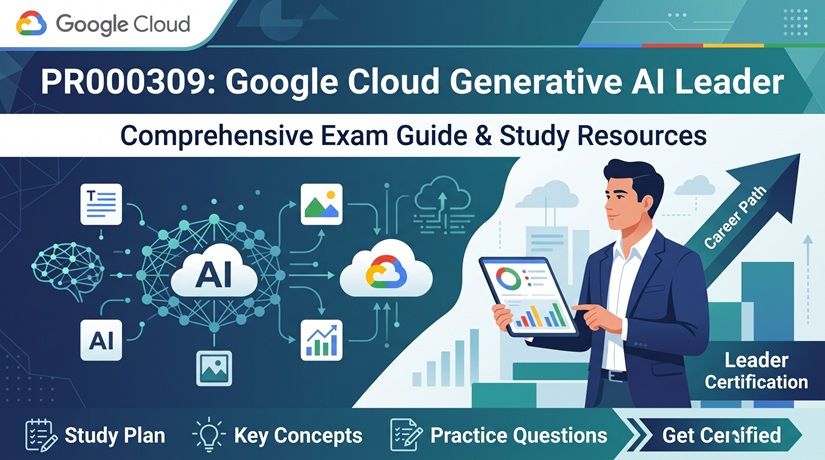
The PR000309 Google Cloud Generative AI Leader certification is one of Google Cloud’s foundational credentials for professionals who want to understand generative AI, Gemini, AI agents, prompt engineering, retrieval-augmented generation (RAG), responsible AI, and the business use of artificial intelligence on Google Cloud.
Unlike an advanced machine learning engineering certification, the Google Cloud Generative AI Leader exam is not mainly about writing Python code, training neural networks, or building production ML pipelines. It focuses on understanding generative AI concepts, recognizing appropriate Google Cloud technologies, improving model output, evaluating business use cases, and making responsible decisions around AI adoption.
This makes PR000309 particularly interesting for students, junior IT professionals, cloud beginners, network engineers, technical sales professionals, project managers, and anyone who expects generative AI to become part of their future work.
In this guide, we will look at the exam structure, the technologies you should understand, the value of the certification, a practical PR000309 study plan, and several concepts that are especially important before scheduling the exam.
What Is the PR000309 Google Cloud Generative AI Leader Certification?
Table of Contents
ToggleGoogle Cloud classifies Generative AI Leader as a foundational-level certification. There are no formal prerequisites, and Google positions it for people in a wide range of technical and non-technical roles.
The word “Leader” sometimes causes confusion. It may sound as though the certification is intended exclusively for executives or senior managers, but that is not really the case.
The certification is better understood as an assessment of whether you can understand generative AI well enough to participate in business and technical discussions about it.
You should be able to explain questions such as:
- What is generative AI and how is it different from traditional machine learning?
- What is a foundation model?
- Why might a company choose Gemini for a particular use case?
- What is retrieval-augmented generation?
- Why is grounding important?
- What is an AI agent?
- How can prompt engineering improve output?
- Why are security, privacy, bias, and responsible AI important?
- Which Google Cloud product or capability is appropriate for a business scenario?
In other words, the exam is about connecting AI technology with practical business requirements.
PR000309 Exam Details at a Glance
| Exam Detail | Current Information |
|---|---|
| Certification | Google Cloud Certified – Generative AI Leader |
| Exam Code | PR000309 |
| Certification Level | Foundational |
| Exam Duration | 90 minutes |
| Number of Questions | 50–60 multiple-choice questions |
| Registration Fee | USD $99, plus applicable taxes |
| Prerequisites | None |
| Exam Delivery | Online-proctored or onsite-proctored |
| Available Languages | English, Japanese, Spanish, Portuguese |
| Certification Validity | 3 years |
Although the exam has no formal prerequisites, beginners should not assume that it requires no preparation. The terminology can become challenging when topics such as LLMs, multimodal models, RAG, grounding, agents, prompt engineering, model parameters, security, and responsible AI appear together in scenario-based questions.
A good preparation strategy is to compare the official exam blueprint with a structured PR000309 exam preparation resource so that your study time remains focused on the topics that are actually relevant to the certification.
What Does the PR000309 Generative AI Leader Exam Cover?
The current exam guide organizes PR000309 into four major domains.
| Exam Domain | Approximate Weight |
|---|---|
| Fundamentals of generative AI | 30% |
| Google Cloud’s generative AI offerings | 35% |
| Techniques to improve generative AI model output | 20% |
| Business strategies for a successful generative AI solution | 15% |
The weighting gives us a useful clue about how to approach the exam. Approximately 65 percent of the assessment is focused on AI fundamentals and Google Cloud’s generative AI ecosystem.
That means you should not prepare by memorizing generic AI definitions alone. You also need to understand how Google Cloud converts those concepts into models, services, applications, agents, infrastructure, and enterprise solutions.
PR000309 Exam Domain 1: Generative AI Fundamentals
If generative AI is new to you, this is where your preparation should begin.
Before learning individual Google Cloud products, make sure you understand the concepts those products are designed to address.
AI, Machine Learning, and Generative AI
You should be comfortable distinguishing between:
- Artificial Intelligence (AI)
- Machine Learning (ML)
- Deep Learning
- Generative AI
- Foundation Models
- Large Language Models (LLMs)
Artificial intelligence is the broadest category. Machine learning is one approach to creating AI systems by learning patterns from data. Deep learning uses neural networks with multiple layers, while generative AI focuses on producing new content such as text, images, audio, code, and video.
Foundation models are large models trained on extensive datasets that can be adapted to many downstream tasks. Large language models are foundation models particularly suited to understanding and generating natural language.
Traditional Machine Learning Concepts
Even though PR000309 focuses on generative AI, candidates should understand the basic differences between:
- Supervised learning – training with labeled examples.
- Unsupervised learning – identifying patterns in data without predefined labels.
- Reinforcement learning – learning behavior through rewards, penalties, and interaction.
You are unlikely to need advanced mathematics for this certification, but you should understand the purpose of each approach.
Data Quality Matters
AI systems are heavily influenced by the quality of the data available to them.
Candidates should recognize the difference between structured and unstructured data, as well as labeled and unlabeled data.
Important data characteristics include:
- Completeness
- Consistency
- Relevance
- Accuracy
- Availability
- Accessibility
- Appropriate format
Poor-quality data can result in poor model behavior even when the underlying AI model is highly capable.
Foundation Model Selection
One of the most important ideas for beginners is that the largest model is not automatically the best model.
A business should select a model according to its requirements.
Relevant factors can include:
- Supported modality
- Context window
- Security requirements
- Reliability
- Performance
- Latency
- Customization options
- Fine-tuning support
- Cost
- Availability
For example, a company that needs to categorize short support messages may not require the most powerful multimodal model available. On the other hand, an application that needs to reason across documents, images, audio, and text may benefit from a more advanced multimodal model.
On PR000309, the important question is often not “Which model is the most powerful?” but rather “Which option best meets the stated business requirements?”
Google Foundation Model Families
Candidates should recognize several important Google model families.
- Gemini – Google’s major multimodal model family for language, reasoning, coding, multimodal understanding, and general generative AI workloads.
- Gemma – Google’s open model family, useful when developers need additional deployment or customization flexibility.
- Imagen – Google’s generative image technology.
- Veo – Google’s generative video model family.
Avoid spending too much time memorizing individual version numbers. Generative AI changes quickly, and product versions may evolve faster than certification study material.
Focus primarily on capabilities, use cases, and architectural decisions.
PR000309 Exam Domain 2: Google Cloud’s Generative AI Ecosystem
This is the largest PR000309 exam domain and accounts for approximately 35 percent of the assessment.
Candidates should understand the Google Cloud AI ecosystem from underlying infrastructure to models, platforms, agents, and end-user applications.
A useful simplified model is:
Infrastructure → Models → Platform → Agents → Applications
At the bottom of the stack, Google Cloud provides computing infrastructure, networking, storage, GPUs, TPUs, and data services. Foundation models sit above that infrastructure. Development platforms expose those models to developers. Agents combine models with tools and data. Applications make AI capabilities available to end users.
Gemini
Gemini is central to Google’s generative AI strategy and is one of the most important technologies to understand for the PR000309 Google Cloud exam.
Candidates should understand Gemini as more than a chatbot. Gemini models can support reasoning, text generation, code, multimodal content, summarization, information extraction, and many custom AI applications.
When studying, focus on what problems Gemini can solve rather than memorizing marketing descriptions.
Vertex AI and the Evolving Agent Platform
If you use older Google Cloud training material, you will encounter Vertex AI frequently.
Current Google Cloud material increasingly emphasizes agent-oriented terminology and platforms, including Gemini Enterprise Agent Platform and related agent-building capabilities.
This is a useful reminder that cloud product names evolve.
The underlying concepts remain important: selecting models, developing AI applications, grounding models with enterprise data, managing AI workflows, creating agents, evaluating output, securing workloads, and operating AI solutions in production.
For exam preparation, always treat the latest official exam guide as the primary reference and use older tutorials mainly to understand the underlying concepts.
Gemini for Workplace Productivity
The exam also expects candidates to distinguish between AI used directly by employees and AI platforms used by developers.
Workplace use cases may include:
- Drafting documents
- Summarizing information
- Generating ideas
- Analyzing documents
- Improving communication
- Summarizing meetings
- Researching information
- Automating repetitive knowledge work
A scenario in which employees want AI assistance directly inside familiar productivity applications usually points toward a different solution than a scenario in which developers are creating a custom customer-facing AI application.
AI Agents
AI agents are becoming increasingly important across the Google Cloud generative AI ecosystem.
A traditional chatbot typically receives a prompt and returns an answer. An agent can go further by reasoning about a goal, accessing data, calling tools, using APIs, performing actions, and repeating a workflow until it reaches an outcome.
A useful conceptual model is:
AI Agent = Model + Instructions + Data + Tools + Control Logic
For example, a customer support agent could:
- Receive a customer’s question.
- Retrieve the customer’s account information.
- Search a knowledge base.
- Check order status through an API.
- Summarize the relevant information.
- Provide a response or perform an authorized action.
Understanding this difference between a simple conversational model and an action-oriented agent is important for PR000309.
Google Cloud Services Around AI Applications
Generative AI applications do not exist in isolation. They often rely on traditional cloud services for storage, databases, application logic, security, APIs, and networking.
Candidates should recognize the general purposes of technologies such as:
- Cloud Storage
- Cloud Run
- Cloud databases
- Functions
- Speech-to-Text
- Text-to-Speech
- Translation services
- Document AI
- Cloud Vision
- Video Intelligence
- Natural Language technologies
The best way to study these services is to associate them with business problems.
For example, extracting information from invoices and forms suggests document-processing technology. Converting recorded audio into text suggests Speech-to-Text. Providing application logic that an agent can call may involve Cloud Run or functions.
PR000309 Exam Domain 3: Prompt Engineering, Grounding, and RAG
The third domain covers techniques used to improve generative AI output.
This is one of the most useful parts of the certification because the concepts apply well beyond the exam.
Generative AI models are probabilistic. They can produce inaccurate information, misunderstand a request, generate biased responses, lack access to recent information, or confidently produce information that sounds correct but is not.
Improving output therefore requires more than simply choosing a powerful model.
Prompt Engineering
Prompt engineering is the process of designing instructions and context that help a model generate more useful output.
Candidates should understand techniques including:
- Zero-shot prompting – asking the model to complete a task without giving an example.
- One-shot prompting – providing one example of the desired result.
- Few-shot prompting – providing several examples.
- Role prompting – giving the model a role or perspective.
- Prompt chaining – dividing a complex task into multiple steps.
- ReAct – combining reasoning-oriented behavior with actions or tool use.
For exam purposes, focus on when and why a prompting method is useful rather than memorizing textbook definitions.
Grounding
Grounding connects generative AI output to trusted or relevant sources of information.
A generic foundation model does not automatically know your organization’s current inventory, internal documentation, private policies, customer database, or the latest information produced after its training.
Grounding gives the model additional context from trusted sources so that its response can be more relevant to the current task.
This can include internal enterprise data, external data sources, search results, databases, or other authoritative information.
Retrieval-Augmented Generation (RAG)
Retrieval-augmented generation is one of the most important concepts to understand before taking the Generative AI Leader exam.
A simplified RAG workflow looks like this:
- A user asks a question.
- The application searches a trusted data source.
- Relevant information is retrieved.
- The retrieved information is added to the model’s context.
- The model generates a response using that context.
Imagine a university wants to build an AI assistant that answers questions about academic regulations.
Training an entirely new foundation model would usually be unnecessary. Instead, the university could index its official documentation, retrieve relevant passages when a student asks a question, and provide those passages to Gemini before generating the response.
That is the kind of architectural reasoning the PR000309 exam expects candidates to understand.
Model Parameters
Candidates should also understand that model behavior can be influenced by parameters including:
- Temperature
- Top-p
- Token limits
- Output length
- Safety settings
Temperature is a common example.
A higher temperature generally allows more variation in model output, which may be useful for creative tasks. Lower values generally produce more predictable output.
However, reducing temperature does not guarantee factual accuracy.
A deterministic incorrect answer is still incorrect. Accuracy may depend much more on grounding, data quality, prompt design, context, model selection, and evaluation.
PR000309 Exam Domain 4: Security, Responsible AI, and Business Strategy
The final domain represents approximately 15 percent of the exam.
It may have the smallest weighting, but it should not be ignored.
Enterprise AI solutions frequently process confidential documents, customer information, source code, employee data, financial information, and proprietary business knowledge.
As soon as that happens, traditional cloud security and governance principles become part of the AI architecture.
Secure AI
Candidates should understand security throughout the AI lifecycle and become familiar with Google’s Secure AI Framework (SAIF).
Relevant Google Cloud security concepts include:
- Identity and Access Management (IAM)
- Authentication and authorization
- Security Command Center
- Workload monitoring
- Data protection
- Access boundaries
- Secure-by-design infrastructure
Security should not be something added only after an AI prototype has been completed.
Access control, privacy, monitoring, and data governance should be considered from the beginning of the design process.
Responsible AI
Responsible AI extends beyond cybersecurity.
Candidates should understand concepts such as:
- Fairness
- Bias
- Accountability
- Transparency
- Explainability
- Privacy
- Data anonymization
- Pseudonymization
For example, an AI application used to assist with hiring decisions could be technically secure but still create serious problems if its training data contains bias or its decisions cannot be reasonably explained.
The PR000309 certification therefore encourages candidates to think of generative AI as a complete business and technical system, not simply an API call to an LLM.
How Valuable Is the Google Cloud Generative AI Leader Certification?
The value of the certification depends on what you expect it to prove.
If you expect the certification to demonstrate advanced machine learning engineering skills, its value will be limited. It is not designed to prove that you can train custom models, build complex ML pipelines, optimize inference systems, or operate large-scale production AI platforms.
Its value is much stronger when viewed as a certification of generative AI literacy combined with Google Cloud knowledge.
That makes it relevant for:
- Students
- Junior cloud engineers
- Network engineers
- System administrators
- Technical sales professionals
- Cloud consultants
- Solution architects moving into AI
- Project managers
- IT managers
- Business analysts
I would describe the certification as a bridge credential.
A network engineer who passes PR000309 does not suddenly become a machine learning engineer. However, that engineer may now better understand why AI applications need accelerators, how data reaches models, why grounding matters, how agents interact with tools, and why IAM controls are important around enterprise AI workloads.
That broader architectural awareness can be extremely useful as AI becomes part of more traditional IT projects.
What PR000309 Does Not Prove
Certification candidates should also understand the limitations of the credential.
Passing a foundational multiple-choice exam does not prove that you can:
- Build production RAG pipelines
- Develop large-scale AI applications
- Fine-tune models professionally
- Operate distributed ML infrastructure
- Optimize GPU or TPU workloads
- Design production MLOps pipelines
- Implement advanced model evaluation systems
For technical candidates, I strongly recommend combining certification study with a small hands-on project.
For example, build a document Q&A application that retrieves information from trusted documents, sends relevant context to Gemini, applies access controls, and evaluates incorrect answers.
The certification demonstrates that you understand the concepts. A practical project demonstrates that you can use them.
PR000309 Study Plan and Exam Preparation Strategy
For someone who already understands basic cloud computing, approximately two weeks of focused study can provide a reasonable starting point. Complete beginners may need additional time.
A useful approach is to combine the official blueprint with a structured PR000309 study guide and then spend the final stage of preparation reviewing scenario-based questions and weak topics.
Days 1–3: Learn the AI Fundamentals
Focus on:
- AI versus machine learning
- Generative AI
- Deep learning
- Supervised and unsupervised learning
- Reinforcement learning
- Foundation models
- Large language models
- Multimodal AI
- Structured and unstructured data
- Data quality
- Model-selection criteria
Do not rush this stage. Good fundamentals make the Google Cloud product ecosystem much easier to understand.
Days 4–7: Study the Google Cloud AI Ecosystem
Learn the roles of:
- Gemini
- Gemma
- Imagen
- Veo
- Google Cloud AI platforms
- Agent development capabilities
- Workspace AI capabilities
- Cloud Run
- Storage and databases
- Document AI
- Speech and language APIs
A useful study technique is to create a table with three columns:
Business Problem → Google Cloud Capability → Why It Fits
This is generally more useful than memorizing product names by themselves.
Days 8–10: Study Model Output and RAG
Focus on:
- Hallucinations
- Knowledge limitations
- Grounding
- Retrieval-augmented generation
- Prompt engineering
- Zero-shot prompting
- Few-shot prompting
- Prompt chaining
- ReAct
- Fine-tuning concepts
- Human-in-the-loop approaches
- Model evaluation
- Temperature
- Top-p
- Safety settings
Days 11–12: Security and Responsible AI
Review:
- IAM
- Secure AI Framework
- Security Command Center
- Privacy
- Data governance
- Bias
- Fairness
- Transparency
- Explainability
- Accountability
Days 13–14: Scenario-Based Review
At this point, reduce the amount of new material you study and focus instead on making decisions.
For every scenario, identify the real requirement before selecting a product.
Ask yourself:
- Does the company want employee productivity?
- Does it need a custom AI application?
- Does the model need access to private enterprise data?
- Would RAG or grounding improve the result?
- Does the system need to perform actions through an agent?
- Is the primary concern security or governance?
- Does the task involve text, images, audio, or video?
- Is low-code or custom development more appropriate?
Once the business requirement is clear, the correct technology choice often becomes much easier.
How to Approach PR000309 Exam Questions
I would approach the PR000309 exam as an architecture and decision-making assessment rather than a pure vocabulary test.
When reading a question, pay particular attention to constraints such as:
- Enterprise data
- Private information
- Current information
- Customer experience
- Employee productivity
- Low-code requirements
- Custom development
- Grounding
- Security
- Scalability
- Responsible AI
- Cost
These details often provide more useful clues than the product names in the answer choices.
You should also resist the temptation to automatically choose the most sophisticated solution.
If employees simply need AI assistance inside their normal productivity environment, a full custom application platform may be unnecessary.
If developers need to build a customer-facing AI workflow with private data, tools, APIs, and business logic, a simple end-user chatbot is unlikely to be sufficient.
Think about the requirement first. Choose the product second.
Is PR000309 Suitable for Students and Beginners?
Yes. The certification is officially foundational and has no formal prerequisites.
For students interested in networking, cloud computing, cybersecurity, software development, or data, the PR000309 Google Cloud Generative AI Leader certification can provide a structured introduction to concepts that are increasingly becoming part of mainstream IT.
AI workloads depend on much more than models.
They also depend on:
- Compute infrastructure
- GPUs and TPUs
- Storage
- High-performance networking
- APIs
- Identity systems
- Databases
- Security controls
- Monitoring
- Data platforms
That means even professionals who do not plan to become ML engineers can benefit from understanding how generative AI applications are designed and operated.
However, students should avoid collecting certifications without building practical skills.
After the exam, try creating a small Gemini-based application, experimenting with prompts, adding grounding, connecting a data source, or exploring agent behavior.
A certificate and a small project together are far more useful than a certificate alone.
Who Should Probably Skip the PR000309 Certification?
Experienced machine learning engineers who already develop and operate production generative AI systems on Google Cloud may find much of the material basic.
For those candidates, a more advanced engineering certification, specialized training, or a substantial hands-on project may provide stronger evidence of technical ability.
The certification may also be less useful for someone who wants only vendor-neutral AI knowledge and has no interest in the Google Cloud ecosystem.
PR000309 makes the most sense when you want to combine generative AI fundamentals with an understanding of Google’s cloud AI products and business strategy.
PR000309 Frequently Asked Questions
Is the PR000309 Google Cloud Generative AI Leader exam difficult?
The exam is foundational, but beginners may still find it challenging because it covers a broad range of AI concepts, Google Cloud products, agents, RAG, prompting, security, and responsible AI. The difficulty usually comes from understanding how these concepts apply to business scenarios rather than from advanced mathematics or coding.
Do I need programming experience for PR000309?
No. Google Cloud does not list programming experience as a prerequisite. Technical experience can make some concepts easier to understand, but the exam is designed to be accessible to candidates without hands-on engineering backgrounds.
Is PR000309 suitable for beginners?
Yes. It is a foundational certification with no formal prerequisites. Complete beginners should spend extra time learning cloud and machine learning terminology before concentrating on Google-specific services.
Is RAG important for the PR000309 exam?
Yes. Retrieval-augmented generation and grounding are important concepts in the official exam scope. You should understand why RAG is used, how retrieval provides additional context, and when it is preferable to relying only on a foundation model’s existing knowledge.
Do I need to understand Gemini?
Yes. Gemini is central to Google’s current generative AI strategy. Candidates should understand its general capabilities, multimodal nature, enterprise use cases, and how Gemini fits into the broader Google Cloud AI ecosystem.
Do I need to know Vertex AI?
Vertex AI remains important background knowledge, especially when studying older Google Cloud documentation and training. Google’s current AI ecosystem is evolving toward more agent-oriented terminology and capabilities, so candidates should always compare older material with the latest official exam guide.
How long is the Google Cloud Generative AI Leader certification valid?
The certification is currently valid for three years.
How should I prepare for the PR000309 exam?
Start with AI fundamentals, then study the Google Cloud AI ecosystem, Gemini, agents, prompt engineering, grounding, RAG, security, and responsible AI. During the final phase of study, focus on business scenarios and selecting the most appropriate Google Cloud solution rather than memorizing definitions.
You can also use a structured Google Cloud Generative AI Leader exam preparation resource together with Google’s official documentation to organize the topics you need to review.
Final Verdict: Is PR000309 Worth It?
The Google Cloud Certified – Generative AI Leader certification occupies a useful position in the current certification landscape.
It is not an advanced machine learning engineering credential, and it should not be treated as one.
Its value comes from validating that a candidate understands the modern generative AI landscape well enough to connect models, prompts, data, RAG, grounding, agents, security, responsible AI, and business requirements.
For students and early-career IT professionals, that is a useful foundation.
For experienced cloud professionals moving toward AI, PR000309 provides a structured way to organize knowledge that may otherwise have been learned in separate pieces.
For non-developers who work with technical teams, it provides a common vocabulary for discussing enterprise AI architecture without requiring deep machine learning engineering experience.
My recommendation is to treat the Generative AI Leader PR000309 certification as the beginning of an AI learning path rather than the final destination.
Prepare for the exam, understand the concepts, and then build something practical.
Experiment with Gemini. Create a grounded application. Test a RAG workflow. Explore an agent. Apply IAM permissions. Evaluate incorrect responses. Observe how different prompts change the model’s behavior.
That combination of certification knowledge and hands-on experimentation is considerably more valuable than either one by itself.
Official and Recommended PR000309 Resources
- Google Cloud – Generative AI Leader Certification
- Official Google Cloud Generative AI Leader Exam Guide
- Official Generative AI Leader Study Guide
- Google Skills – Generative AI Leader Learning Path
- Google Cloud Blog – Generative AI Leader Certification
- Generative AI on Google Cloud
- Google Secure AI Framework (SAIF)
- Google Cloud Certification Program