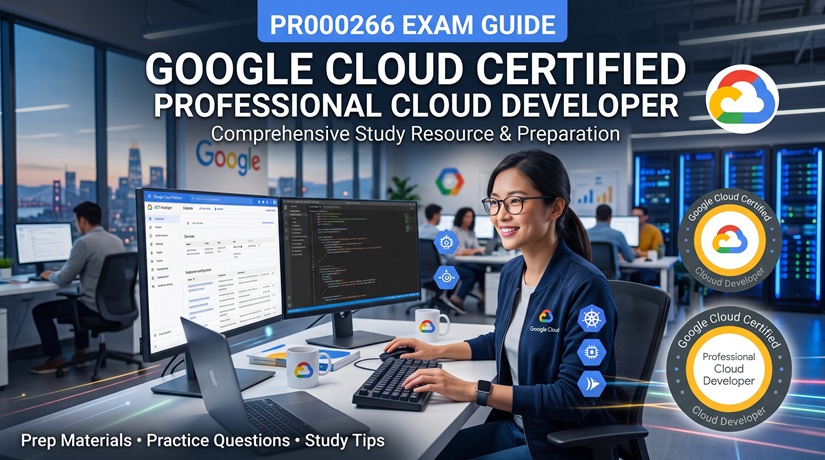
If you are moving from writing applications on your laptop to building software that must survive real traffic, failures, security reviews, and production deployments, the Google Cloud Professional Cloud Developer PR000266 exam sits in an interesting place. It is not primarily a programming-language exam, and it is not an infrastructure-only exam. It tests whether you can make sensible development decisions on Google Cloud across the full application lifecycle.
For students and junior engineers, that distinction matters. You do not need to memorize every Google Cloud product page. You do need to understand why one service is a better fit than another, how an application should authenticate, how a container reaches production safely, how events move between services, and how you troubleshoot the application after deployment.
This PR000266 exam guide focuses on the current Professional Cloud Developer PR000266 certification exam. Google updates certification objectives over time, so always compare your preparation against the official exam guide shortly before booking the test.
What Is the PR000266 Professional Cloud Developer Certification?
Table of Contents
ToggleThe Google Cloud Professional Cloud Developer certification validates the ability to design, build, test, configure, deploy, integrate, secure, and troubleshoot cloud-native applications on Google Cloud. In other words, it is aimed at developers who are expected to own more than application code.
A cloud developer may still write Java, Go, Python, Node.js, .NET, or another general-purpose language, but the certification is largely language-neutral. The harder PR000266 exam questions are usually about architecture and operational choices: should a workload run on Cloud Run or GKE? Should two services communicate synchronously or through Pub/Sub? Should credentials be stored in a configuration file or supplied through a managed identity? Which database fits the access pattern? How do you make a deployment observable and reversible?
The current PR000266 exam guide also reflects a major change in modern software development: AI-assisted development is now part of the role. The official scope includes generative AI APIs, AI coding assistants, context engineering, automated debugging agents, Gemini Cloud Assist, and development integrations such as MCP servers.
Current PR000266 Exam Facts
| Item | Current Information |
|---|---|
| Certification | Google Cloud Certified – Professional Cloud Developer |
| Exam code | PR000266 |
| Exam length | 2 hours |
| Question format | 50–60 multiple-choice and multiple-select questions |
| Registration fee | USD $200, plus applicable taxes |
| Languages | English and Japanese |
| Delivery | Online proctored or onsite proctored at a testing center |
| Formal prerequisites | None |
| Recommended experience | 3+ years of industry experience, including 1+ year designing and managing solutions on Google Cloud |
| Certification validity | 2 years for Google Cloud professional-level certifications |
The lack of a formal prerequisite can be misleading. A motivated student can absolutely prepare for the PR000266 exam, but the questions are written from the perspective of someone making production decisions. If you have never deployed an application, configured IAM, used a managed database, built a container, or read application logs, the learning curve will be much steeper.
How Valuable Is the PR000266 Professional Cloud Developer Certification?
The certification has value when it is treated as a structured proof of cloud-development knowledge rather than a substitute for engineering experience. Its strongest signal is breadth: a successful PR000266 candidate should understand application architecture, managed compute, containers, identity, data services, messaging, CI/CD, software supply-chain security, observability, and deployment strategy in one coherent platform.
Where the Certification Can Help
- Students and early-career engineers: it provides a concrete roadmap for learning production cloud development beyond tutorials.
- Application developers: it helps bridge the gap between writing code and operating software in a managed cloud environment.
- Backend engineers: it validates knowledge of APIs, databases, asynchronous messaging, authentication, and scalable deployment patterns.
- Platform and DevOps-adjacent developers: it reinforces Cloud Build, Artifact Registry, deployment controls, GKE, Cloud Run, and observability.
- Consultants and partners: it provides a recognizable Google Cloud credential that can support customer-facing technical work.
Where It Does Not Help Enough by Itself
A certificate will not compensate for weak programming fundamentals, poor debugging skills, or a lack of practical projects. Employers hiring cloud developers still care about whether you can read unfamiliar code, design an API, reason about failure, work with source control, write tests, and explain trade-offs. The best use of PR000266 exam preparation is to make those skills more cloud-native and more systematic.
PR000266 Exam Domains and Weightings
A major part of an effective PR000266 Exam Guide is understanding how the exam objectives are distributed. The current official exam guide divides the Professional Cloud Developer test into four major sections.
| Domain | Approximate Weight | Main Focus |
|---|---|---|
| 1. Designing highly scalable, secure, and reliable cloud-native applications | ~32% | Architecture, compute choices, APIs, security, data, resiliency, cost, event-driven design |
| 2. Building and testing applications | ~23% | Development environment, Cloud Build, Artifact Registry, provenance, testing, AI-assisted development |
| 3. Configuring cloud-native applications for deployment | ~24% | Cloud Run, GKE, triggers, API exposure, health checks, autoscaling |
| 4. Integrating applications with Google Cloud services | ~21% | Data services, Google Cloud APIs, messaging, observability, error reporting, tracing |
Domain 1: Designing Scalable, Secure, and Reliable Applications (~32%)
This is the largest PR000266 exam domain and probably the most important one conceptually. It tests whether you can choose an architecture based on requirements rather than personal preference.
You should be comfortable comparing Compute Engine, GKE, and Cloud Run; choosing between synchronous REST or gRPC and asynchronous messaging; deciding when caching is useful; designing regional behavior; using load balancing; and planning gradual rollouts, rollbacks, and A/B testing. You also need to understand how Workflows, Eventarc, Cloud Tasks, Cloud Scheduler, and Pub/Sub fit into decoupled systems.
Security is not a separate afterthought. Expect to reason about IAM, service accounts, least privilege, Application Default Credentials, OAuth 2.0, JWTs, Workload Identity Federation, Secret Manager, Cloud KMS, Binary Authorization, Identity-Aware Proxy, private connectivity, and service-to-service controls.
Data selection is equally important. You should understand the practical differences among relational systems such as Cloud SQL, AlloyDB, and Spanner; non-relational systems such as Firestore and Bigtable; object storage with Cloud Storage; and analytical workloads in BigQuery.
Domain 2: Building and Testing Applications (~23%)
This PR000266 domain covers the path from a developer workstation to a repeatable build. You should know the purpose of the Google Cloud CLI, Cloud Shell, Cloud Workstations, Cloud Code, and local service emulation. The current guide also explicitly includes Gemini Cloud Assist, AI coding assistants, and MCP-server integrations in development environments.
For builds, focus on Cloud Build and Artifact Registry. Understand what a build pipeline does, how source code becomes a container or other deployable artifact, why provenance matters, and how Binary Authorization can help enforce deployment policy.
Domain 3: Configuring Cloud-Native Applications for Deployment (~24%)
This section of the PR000266 exam has become more focused around Cloud Run and Google Kubernetes Engine. For Cloud Run, know source-based deployment, containers, service invocation, Eventarc and Pub/Sub triggers, event receivers, revisions, API exposure, and security.
For GKE, know how containerized applications are deployed and how Kubernetes health checks and the Horizontal Pod Autoscaler affect availability and scaling. You do not need to become a Kubernetes administrator for this certification.
Domain 4: Integrating Applications with Google Cloud Services (~21%)
This PR000266 domain is where application code meets the rest of the platform. Be ready to reason about connecting to Cloud SQL, Firestore, and Cloud Storage; publishing and consuming messages; enabling APIs; calling Google Cloud services using client libraries, REST, or gRPC; and implementing batching, pagination, caching, and exponential backoff.
Observability is a major part of the current scope. Developers are expected to instrument applications with metrics, logs, and traces, use Error Reporting, correlate distributed traces with trace IDs, and use Google Cloud Observability to diagnose problems.
PR000266 Technical Topics You Should Know Before the Exam
1. Cloud Run vs. GKE vs. Compute Engine
One of the highest-value skills for the PR000266 exam is choosing the right compute model.
2. Identity, Authentication, and Least Privilege
Security questions often test whether you understand identity rather than whether you remember a product name. Learn the difference between a human user, a service account, an end-user identity, and a federated workload identity.
3. APIs: REST, gRPC, API Management, and Error Handling
A cloud developer should understand API behavior beyond HTTP status codes. Be ready to choose REST or gRPC based on interoperability and performance needs, expose and secure APIs, apply rate limiting, and understand the role of Apigee or API Gateway.
4. Event-Driven and Asynchronous Design
Pub/Sub and Eventarc are central technologies for loosely coupled applications. Understand why asynchronous messaging can improve resilience and scalability, but also remember the consequences: duplicate delivery, retries, eventual processing, ordering considerations, and the need for idempotent consumers.
5. Data Services and Access Patterns
A frequent beginner mistake is choosing a database by brand familiarity. The PR000266 exam expects you to choose based on data shape, consistency, scale, transactions, latency, and query patterns.
6. CI/CD and Software Supply-Chain Security
Cloud Build and Artifact Registry form a common path from source code to deployable artifacts. Study build triggers, build steps, container creation, artifact storage, automated testing, and deployment integration.
7. Observability: Metrics, Logs, Traces, and Errors
A production developer has to answer questions such as: Is the service down? Is it slow? Which dependency is failing? Which request crossed multiple microservices? What changed after a deployment?
8. Generative AI and AI-Assisted Development
This is one of the most noticeable additions to the current Professional Cloud Developer role description and an important topic to include in your PR000266 exam preparation.
How to Approach PR000266 Exam Questions
The most important shift for beginners preparing for PR000266 is moving from “Which service can do this?” to “Which option best satisfies the requirements?” Several Google Cloud services can often solve the same problem. The exam is usually looking for the solution that best balances reliability, security, operational effort, performance, and cost.
Use Requirements as Filters
When reading a PR000266 exam scenario, identify the constraints before looking at the answer choices.
Prefer Managed Services When They Meet the Requirement
Google Cloud certification questions commonly favor managed services because they reduce undifferentiated operational work.
Think in Failure Modes
Professional-level PR000266 questions often become easier when you ask what happens when something fails.
Eight-Week PR000266 Exam Study Plan
This PR000266 Exam Guide recommends an eight-week preparation plan for students and developers who can spend roughly 7–10 focused hours per week.
Week 1: Google Cloud Foundations for Developers
Week 2: Compute and Cloud-Native Architecture
Week 3: Data and Storage
Week 4: Messaging, APIs, and Integration
Week 5: Security
Week 6: Build, Test, and Software Supply Chain
Week 7: Deployment and Observability
Week 8: PR000266 Exam Simulation and Gap Closing
Common PR000266 Exam Preparation Mistakes
Memorizing Product Definitions
Knowing that Pub/Sub is a messaging service is not enough. You should know when asynchronous messaging is useful, how retries affect consumers, and why idempotency matters.
Ignoring IAM Until the End
IAM touches almost every Google Cloud service. Treat identity and permissions as part of application design from the first week of PR000266 preparation.
Studying Kubernetes Too Deeply
GKE is important, but PR000266 is not a dedicated Kubernetes certification.
Ignoring the Current AI-Related Objectives
Older study guides may underrepresent generative AI APIs and AI-assisted development. The current official exam guide explicitly includes these topics, so make sure your PR000266 study materials reflect the latest scope.
Taking the Exam Without Hands-On Work
You can memorize enough terminology to feel prepared and still struggle with scenario questions. A few small, well-designed projects are more valuable than dozens of hours of passive video watching.
Who Should Take the PR000266 Exam?
PR000266 is a strong fit if you already understand basic programming and want to become better at building production applications on Google Cloud. Backend developers, full-stack developers with backend responsibilities, cloud-native engineers, platform-minded software engineers, and technical students can all benefit.
PR000266 Exam Frequently Asked Questions
Is the PR000266 Professional Cloud Developer exam difficult?
Yes, especially for candidates who have only studied product definitions. The challenge comes from scenario-based decision making across architecture, security, data, deployment, and troubleshooting.
Do I need to know a specific programming language for PR000266?
No single language is required by the certification.
Do I need deep Kubernetes knowledge for the PR000266 exam?
No. You need practical developer-level knowledge of GKE and Kubernetes workloads, especially deployment, health checks, scaling, access, and container behavior.
Should I learn Cloud Run for PR000266?
Absolutely. Cloud Run is a major part of the current PR000266 exam guide and represents an important Google Cloud approach to managed containerized applications.
Are generative AI topics on the PR000266 exam?
They are now explicitly included in the official Professional Cloud Developer role description and exam guide.
How should I use PR000266 practice questions?
Use practice questions to identify gaps, not to memorize answer patterns. After every missed question, explain why the correct option fits the requirements and why each alternative is weaker.
Final Thoughts on PR000266 Exam Preparation
A good PR000266 Exam Guide should do more than help you memorize Google Cloud services. The Professional Cloud Developer certification is most useful when you treat its objectives as a blueprint for becoming a production-ready cloud developer.
For beginners, the path can look broad at first. Start with one application, keep improving it, and attach each PR000266 exam objective to something you can actually build or explain. By the time you can defend your choices between Cloud Run and GKE, synchronous and asynchronous integration, relational and non-relational storage, static credentials and managed identity, or logs and traces, you are preparing for more than the PR000266 certification—you are developing the judgment that cloud engineering roles actually require.
Official and Authoritative PR000266 References
Use the following official Google Cloud resources alongside this PR000266 exam guide to verify exam objectives and study individual technologies in more depth.
- Google Cloud – Professional Cloud Developer Certification
- Google Cloud – Professional Cloud Developer Official Exam Guide
- Google Cloud – Professional Cloud Developer Sample Questions
- Google Skills – Professional Cloud Developer Learning Path
- Google Cloud – Cloud Run Documentation
- Google Cloud – Google Kubernetes Engine (GKE) Documentation
- Google Cloud – Cloud Build Documentation
- Google Cloud – Pub/Sub Documentation
- Google Cloud – Identity and Access Management (IAM) Overview
- Google Cloud – Well-Architected FrameworkGoogle Cloud – Certification Renewal Information