
If you are interested in IT service management, technical support, service operations, or the operational side of project delivery, the ITIL 4 Specialist: Monitor, Support and Fulfil certification is one of the most practical ITIL qualifications to study.
Rather than focusing on a single ITIL practice, this specialist module brings together five closely connected practices that organizations use every day to keep digital services running: Incident Management, Service Desk, Service Request Management, Monitoring and Event Management, and Problem Management.
This makes the certification particularly relevant for IT support professionals, service managers, infrastructure engineers, operations teams, project professionals, and students who want to understand what happens after a new system or service goes live.
In this guide, we will look at what the certification covers, how the five practices work together, the current exam structure, the skills you can develop, and how to prepare effectively for the exam.
What Is ITIL 4 Specialist: Monitor, Support and Fulfil?
Table of Contents
ToggleITIL 4 Specialist: Monitor, Support and Fulfil is a practice-based ITIL module designed to help professionals understand how several operational service management practices work together within real service value streams.
The module combines five ITIL management practices:
- Incident Management
- Service Desk
- Service Request Management
- Monitoring and Event Management
- Problem Management
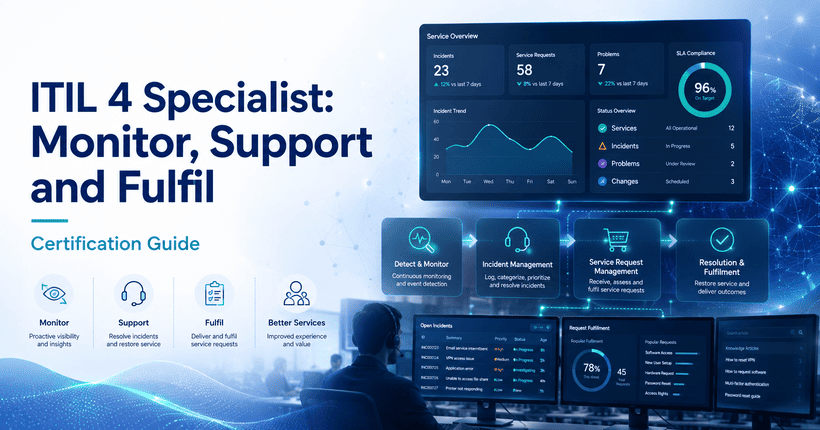
These practices are closely connected in real IT environments. Monitoring tools may detect an event, an incident may then be created, the service desk coordinates communication with users, incident management restores normal operation, and problem management investigates why the disruption occurred in the first place.
At the same time, routine user needs such as access requests, information requests, password resets, or standard software requests can be processed through service request management rather than being treated as incidents.
The important point is that ITIL does not treat these activities as isolated processes. The certification helps candidates understand how people, processes, technology, suppliers, information, and measurement work together to create reliable service operations.
ITIL 4 Monitor, Support and Fulfil Exam Overview
The ITIL 4 Monitor Support and Fulfil exam tests both knowledge of the five practices and the candidate’s ability to understand how those practices contribute to effective service management.
According to the current PeopleCert certification information, the exam is structured as follows:
| Exam Detail | Current Requirement |
|---|---|
| Certification | ITIL 4 Specialist: Monitor, Support and Fulfil |
| Number of Questions | 60 questions |
| Question Type | Multiple choice |
| Exam Duration | 90 minutes |
| Exam Format | Closed book |
| Passing Score | 65% |
| Approximate Correct Answers Required | 39 out of 60 |
| Certification Body | PeopleCert |
| Module Type | Practice-based ITIL specialist module |
Because the exam is closed book, simply knowing where information is located in the ITIL material is not enough. Candidates need to understand the purpose of each practice, the relationships between practices, important activities and roles, and how practices contribute to service value streams.
The Five Core Practices You Need to Understand
1. Incident Management
Incident management is one of the most familiar concepts in IT service management. Its focus is on minimizing the negative impact of incidents by restoring normal service operation as quickly as practical.
Imagine that employees suddenly cannot access a critical business application. The immediate priority is normally not to perform a complete technical investigation into every possible root cause. The organization first needs to restore the service and reduce business disruption.
That is where incident management becomes essential.
When studying this practice, candidates should understand topics such as:
- Incident identification and logging
- Classification and prioritization
- Incident diagnosis
- Escalation
- Resolution and recovery
- User communication
- Major incident handling
- Coordination with other practices
A useful exam mindset is to remember that incident management is primarily concerned with restoring service, while deeper investigation into underlying causes belongs mainly to problem management.
2. Service Desk
The service desk is much more than a traditional IT help desk. Within ITIL 4, it acts as an important communication point between the service provider and users.
A modern service desk may communicate through telephone calls, email, chat, self-service portals, collaboration platforms, automated assistants, or other digital channels.
Technical knowledge matters, but communication skills are equally important. A technically correct solution can still produce a poor service experience if users do not understand what is happening or receive no useful updates.
Important concepts include:
- User communication
- Service empathy
- Omnichannel support
- Ticket ownership
- Knowledge use
- Escalation
- User experience
- Coordination between support teams
For project management students, the service desk is also important because it often becomes the operational interface for users after a new project, application, or service enters production.
3. Service Request Management
A service request is different from an incident.
An incident usually involves an unexpected interruption or reduction in service quality. A service request normally represents a predefined user need that the organization expects to fulfil through an established procedure.
Examples might include:
- Requesting access to an application
- Requesting information
- Requesting standard software
- Requesting equipment
- Password or account-related services
- Other predefined standard services
Well-designed service request management can reduce unnecessary manual work and improve the user experience through standardization, automation, self-service, and clear fulfilment workflows.
One important concept for ITIL Monitor Support and Fulfil exam preparation is learning to distinguish between an incident and a service request. Both may arrive through the service desk, but they have different purposes and may follow different workflows.
4. Monitoring and Event Management
Modern IT environments generate enormous amounts of operational data. Servers, cloud platforms, applications, databases, network devices, security systems, and business services can continuously generate logs, metrics, alerts, and events.
The purpose of monitoring and event management is not simply to collect more data. It is to systematically observe services and service components and record and report selected changes of state that are relevant to managing those services.
Typical technologies associated with monitoring include:
- Infrastructure monitoring platforms
- Application performance monitoring
- Network monitoring
- Log management
- Cloud monitoring tools
- Observability platforms
- Alerting and notification systems
- Automation and event correlation tools
An effective monitoring system should help teams identify meaningful conditions instead of overwhelming them with unnecessary alerts.
This means organizations need to think carefully about thresholds, alert priorities, event correlation, escalation rules, monitoring coverage, and automation.
5. Problem Management
Incident management restores service. Problem management focuses on reducing the likelihood and impact of incidents by identifying actual and potential causes.
Suppose an application crashes every Monday morning. The support team can restart the application each time and restore service. That may successfully resolve each individual incident, but the organization still has an underlying problem.
Problem management asks questions such as:
- Why does the failure keep happening?
- What is the underlying cause?
- Can we prevent similar incidents?
- Is there a workaround?
- Should a known error be documented?
- What information should be shared with incident management and the service desk?
Problem management therefore supports both reactive investigation and proactive improvement.
For the exam, avoid treating problem management as simply “incident management with more investigation.” It has its own objectives and contribution to long-term service reliability.
How the Five ITIL Practices Work Together
One of the biggest reasons this certification is valuable is that it encourages candidates to think across practices instead of memorizing five independent sets of definitions.
Consider a simple example.
A monitoring platform detects unusually high application response times. Monitoring and event management evaluates the condition and triggers an alert. An incident is created because users are experiencing service degradation.
The service desk receives calls from affected users and communicates status information while incident management coordinates restoration activities.
Engineers identify a temporary workaround and restore acceptable performance. Later, problem management investigates the recurring performance issue and discovers that a database resource becomes exhausted during a specific workload pattern.
After the technical cause is understood, another practice such as change enablement may be involved to implement a permanent correction.
Meanwhile, normal requests from users continue to be processed through service request management.
This is closer to how real service management operates. The value comes from the interaction of multiple practices across a service value stream.
Practice Success Factors and Metrics
The ITIL 4 Specialist Monitor Support and Fulfil exam is not only about processes. Candidates also need to understand how an organization determines whether a practice is working effectively.
This includes understanding practice success factors and appropriate metrics.
A service desk, for example, should not be judged only by the number of tickets closed. An organization may also care about customer satisfaction, communication quality, resolution effectiveness, user experience, workload, escalation patterns, and the contribution of the service desk to overall service performance.
Similarly, measuring incident management only by the speed of ticket closure could create undesirable behavior. Teams need balanced measurements that support organizational objectives instead of encouraging people to optimize a single number.
This is an important ITIL principle: measurement should support value, not simply produce attractive dashboards.
Roles, Responsibilities, and Competencies
Effective service management depends on people as much as processes and tools.
The certification therefore expects candidates to understand the roles and competencies needed to operate these practices successfully.
Depending on the organization, relevant people may include:
- Service desk analysts
- Technical support specialists
- Incident coordinators
- Major incident managers
- Problem managers
- Service owners
- Application teams
- Infrastructure teams
- External suppliers
- Business stakeholders
Communication, collaboration, analytical thinking, technical knowledge, prioritization, and decision-making can all affect the effectiveness of operational service management.
Information, Technology, Automation, and AI
Technology plays an important enabling role across Monitor, Support and Fulfil practices.
Many organizations use IT service management platforms to integrate incidents, requests, knowledge articles, service catalogs, workflows, configuration information, monitoring alerts, automation, and reporting.
Automation can be particularly useful for repetitive activities. For example, an organization might automatically:
- Create incidents from selected monitoring alerts
- Route tickets to appropriate support teams
- Fulfil standard service requests
- Send status notifications
- Collect diagnostic information
- Suggest knowledge articles
- Correlate related events
- Escalate tickets based on defined conditions
AI is also increasingly used in IT operations and service management for alert correlation, conversational support, ticket classification, knowledge recommendations, anomaly detection, and operational analysis.
However, ITIL thinking encourages organizations to use technology to enable valuable outcomes rather than automate inefficient processes simply because automation is available.
Partners and Suppliers
Few modern digital services are operated entirely by a single internal team.
An organization may depend on cloud providers, telecommunications companies, SaaS vendors, managed service providers, hardware vendors, outsourcing partners, or application suppliers.
This becomes particularly important during incidents.
If a critical service depends on several external providers, organizations need clear communication channels, escalation paths, responsibilities, service agreements, and shared operational information.
The Monitor, Support and Fulfil module therefore also considers how partners and suppliers contribute to effective service operations.
Why Is the ITIL 4 Specialist Monitor Support and Fulfil Certification Valuable?
The ITIL 4 Specialist Monitor Support and Fulfil certification is valuable because the five practices it covers are directly connected to everyday IT operations.
Most organizations depend on digital services, and those services eventually experience incidents, generate events, receive user requests, require support, and develop recurring problems.
Professionals who understand how to coordinate these activities can contribute to more stable services and better customer and user experiences.
The certification can be relevant to roles such as:
- IT Service Management Analyst
- Service Desk Analyst
- Service Desk Manager
- Incident Manager
- Major Incident Manager
- Problem Manager
- IT Operations Analyst
- Infrastructure Engineer
- Application Support Specialist
- Service Delivery Manager
- IT Operations Manager
- Technical Support Manager
- IT Project Manager
Why Project Management Students Should Understand These Practices
At first glance, Monitor, Support and Fulfil may appear to be designed only for operational IT teams. In reality, project professionals can also benefit significantly from understanding these practices.
A project does not exist in isolation. When a project delivers a new application, platform, cloud environment, or digital service, someone needs to operate and support that service after deployment.
A strong project-to-operations transition may need to address:
- Who will support the new service?
- What monitoring must be configured?
- How will incidents be escalated?
- What information does the service desk need?
- What standard user requests must be supported?
- What knowledge articles should be prepared?
- Which suppliers must participate in support?
- How will recurring problems be investigated?
Understanding these questions can help project managers design better operational handovers and reduce the risk of delivering a technically complete project that is difficult to support in production.
Who Should Take This Certification?
The ITIL 4 Specialist Monitor Support and Fulfil certification can be especially useful for:
- ITIL Foundation holders who want deeper practical knowledge
- IT support professionals
- Service desk staff and managers
- Incident and problem management professionals
- IT operations teams
- Network and infrastructure professionals
- Application support engineers
- Cloud operations professionals
- Service delivery professionals
- IT project managers
- Students preparing for careers in IT service management
Beginners can study the module successfully, but having some exposure to IT support or service operations makes many of the scenarios easier to understand.
Certification Prerequisites and Training Requirements
PeopleCert currently states that candidates must meet the applicable prerequisite requirements, which include ITIL Foundation or the qualifying ITIL 4 Managing Professional credential.
Training is also required through either an Accredited Training Organization or ITIL Official eLearning. Candidates should always verify the latest requirements directly with PeopleCert before purchasing an exam or training package because certification policies can change over time.
How to Prepare for the ITIL 4 Specialist Monitor Support and Fulfil Exam
A structured ITIL 4 Specialist Monitor Support and Fulfil study plan should combine official course material, practical scenarios, concept review, and exam-style practice questions.
Step 1: Understand the Purpose of Every Practice
Start by making sure you can explain the purpose of all five practices without simply repeating memorized definitions.
Ask yourself:
- What problem does this practice help the organization solve?
- What value does it contribute?
- When would this practice normally become involved?
- How does it interact with other practices?
Step 2: Learn the Differences Between Similar Concepts
Many exam mistakes come from confusing concepts that appear similar.
Pay particular attention to distinctions such as:
- Incident vs. problem
- Incident vs. service request
- Event vs. incident
- Workaround vs. permanent solution
- Restoration vs. root-cause investigation
- Monitoring data vs. useful actionable information
Step 3: Study the Practices as a Connected System
Do not study each practice in isolation.
Create small service scenarios and follow them from monitoring through support and investigation. This approach helps you understand cross-practice collaboration and prepares you for questions where several answers may initially appear reasonable.
Step 4: Understand People, Technology, Suppliers, and Metrics
Do not focus exclusively on process diagrams.
Review:
- Roles and responsibilities
- Competencies
- Information requirements
- Supporting technology
- Automation opportunities
- Partners and suppliers
- Practice success factors
- Key metrics
- Practice capability
Step 5: Use Practice Questions
Practice questions are useful for learning how concepts are tested, but the goal should be understanding rather than memorizing answers.
When reviewing a question you answered incorrectly, identify exactly why your answer was wrong and why the correct option better reflects ITIL guidance.
Candidates who want additional preparation resources can review an ITIL 4 Monitor Support and Fulfil exam preparation resource alongside official PeopleCert training and documentation.
Exam-Day Strategy
With 60 questions in 90 minutes, candidates have an average of about 90 seconds per question.
You should normally have enough time if you avoid spending too long on one difficult question.
- Read the complete question before evaluating the answers.
- Identify which ITIL practice the scenario is testing.
- Look for keywords that indicate the objective being described.
- Eliminate clearly incorrect options first.
- Do not choose an answer merely because it sounds technically sophisticated.
- Think about value, outcomes, collaboration, and the actual purpose of the practice.
- Leave enough time to review uncertain questions.
Common Study Mistakes to Avoid
Memorizing Definitions Without Understanding Scenarios
Definitions are important, but certification questions can require you to recognize how concepts apply in operational situations.
Treating All Tickets as Incidents
A user asking for something is not automatically reporting an incident. Learn the difference between service requests and service interruptions.
Assuming Problem Management Must Restore Service First
Restoring service is primarily an incident management objective. Problem management addresses actual and potential causes and works to reduce future impact.
Ignoring the Human Side of the Service Desk
The service desk is not simply a routing engine for tickets. Communication and user experience matter.
Focusing Only on Tools
Monitoring software, ITSM platforms, automation, and AI can enable the practices, but technology alone does not create effective service management.
ITIL and ISO/IEC 20000
Students interested in developing a broader understanding of IT service management may also want to become familiar with ISO/IEC 20000-1.
ITIL provides extensive best-practice guidance for managing digital products and services, while ISO/IEC 20000-1 specifies requirements for establishing, implementing, maintaining, and continually improving a service management system.
The two should not be treated as identical, but studying both can help professionals understand service management from complementary perspectives.
Frequently Asked Questions
Is ITIL 4 Specialist Monitor Support and Fulfil difficult?
The exam is manageable with proper preparation, but it requires more than memorizing terminology. Candidates should understand the five practices, their relationships, practice success factors, roles, technology, metrics, and how the practices contribute to service value streams.
How many questions are on the Monitor Support and Fulfil exam?
The current PeopleCert exam format contains 60 multiple-choice questions.
How long is the ITIL 4 Monitor Support and Fulfil exam?
The standard exam duration is currently 90 minutes.
What is the passing score?
The current minimum passing score is 65%, which corresponds to 39 correct answers out of 60 questions.
Is the exam open book?
No. PeopleCert currently lists the ITIL 4 Specialist Monitor Support and Fulfil examination as a closed-book exam.
Which practices are covered?
The certification combines five ITIL practices: Incident Management, Service Desk, Service Request Management, Monitoring and Event Management, and Problem Management.
Is this certification useful for project managers?
Yes, particularly for project managers involved in technology projects. Understanding operational support, monitoring, incident handling, service requests, and problem management can improve production handovers and help ensure that newly delivered services can be supported effectively after project completion.
Is ITIL Foundation required?
PeopleCert currently specifies prerequisite requirements that include ITIL Foundation or the applicable ITIL 4 Managing Professional qualification. Mandatory training requirements also apply. Always confirm the current eligibility rules on the PeopleCert website before registering.
Does this certification contribute to ITIL Practice Manager?
Yes. Monitor, Support and Fulfil is one of the combined specialist modules associated with the ITIL 4 Practice Manager path. It is designed to demonstrate the ability to establish effective cross-practice collaboration and service value streams.
Final Thoughts
The ITIL 4 Specialist: Monitor, Support and Fulfil certification is a strong choice for professionals who want to move beyond basic ITIL terminology and develop a more practical understanding of day-to-day service operations.
Its greatest strength is the way it connects five essential practices. Monitoring identifies important changes, incident management helps restore disrupted services, the service desk maintains communication with users, service request management handles standard user needs, and problem management helps organizations understand and reduce recurring issues.
For students and early-career professionals, these concepts provide a realistic introduction to how modern IT organizations support production services. For experienced technical staff, the certification can provide a structured framework for improving existing operational processes and collaboration.
Do not prepare for the exam by memorizing five separate chapters. Instead, learn how the practices interact, what outcomes each practice is trying to achieve, and how people, technology, information, suppliers, and measurement contribute to service value.
That understanding is useful not only for passing the certification exam, but also for managing real digital services after they enter production.
External References and Further Reading
- PeopleCert – ITIL 4 Specialist: Monitor, Support and Fulfil
- PeopleCert – Official ITIL Qualification Scheme
- PeopleCert – ITIL 4 Practice Manager Certification Path
Exam structures, prerequisites, certification policies, and training requirements may be updated by PeopleCert. Candidates should verify the latest information on the official PeopleCert website before registering for the exam.





