
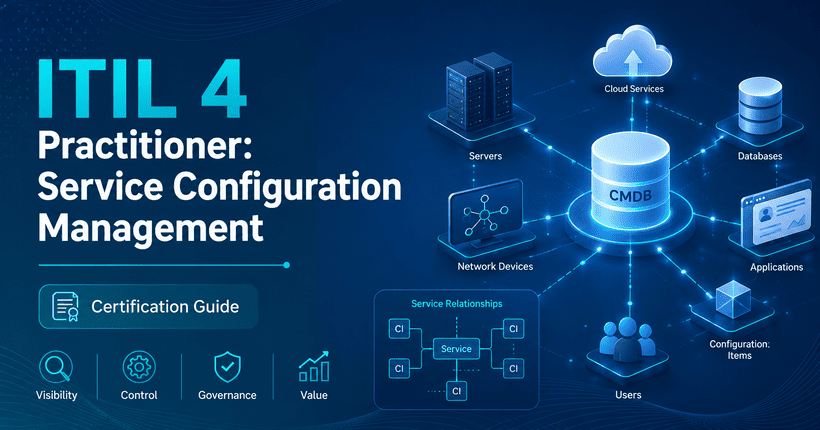
Modern IT services are rarely built from a single application running on a single server. A business service may depend on cloud platforms, virtual machines, containers, databases, APIs, network devices, software components, external suppliers, and dozens of other resources. When something changes or fails, understanding these relationships becomes essential.
This is where ITIL 4 Service Configuration Management becomes valuable. The practice focuses on making accurate and reliable information about services, configuration items, and their relationships available when people need it. Rather than treating configuration data as a simple hardware inventory, ITIL 4 encourages organizations to manage configuration information according to the value it provides to decision-making and service management.
The ITIL 4 Practitioner: Service Configuration Management certification is designed for professionals who want to develop practical expertise in this area. It is especially relevant to IT service managers, operations teams, system administrators, change specialists, service management professionals, and students who want a deeper understanding of how modern IT environments are controlled.
For project management students and junior project professionals, the subject is also useful because configuration information plays an important role when projects introduce new systems, change existing services, manage dependencies, assess risks, and hand solutions over to operational teams.
What Is ITIL 4 Service Configuration Management?
Table of Contents
ToggleService Configuration Management is an ITIL management practice concerned with ensuring that trustworthy information about service configurations and the configuration items that support those services is available when and where it is required.
A useful way to understand the practice is to imagine an online banking service. The customer sees a website or mobile application, but the actual service may depend on web servers, application services, databases, network components, security platforms, cloud resources, certificates, monitoring systems, and third-party services.
If a database server is changed, a certificate expires, or a network component fails, teams need to know which services may be affected. Service Configuration Management provides the information needed to understand those dependencies.
The objective is not to document every technical detail simply because it can be documented. A mature configuration management practice identifies which information supports useful decisions and manages that information at an appropriate level of accuracy, detail, and cost.
ITIL 4 Practitioner: Service Configuration Management Exam Overview
According to the current PeopleCert certification information, the examination is relatively short, but candidates should not mistake a short exam for an easy one. The questions are designed to test whether you understand the practice and can recognize how its principles should be applied.
Candidates preparing for the ITIL 4 Practitioner Service Configuration Management exam should be familiar with both the terminology and the practical application of configuration management concepts.
| Exam Item | Current Details |
|---|---|
| Certification | ITIL 4 Practitioner: Service Configuration Management |
| Certification Provider | PeopleCert |
| Number of Questions | 20 questions |
| Question Format | Multiple choice |
| Exam Duration | 30 minutes |
| Exam Type | Closed book |
| Passing Score | 65% |
| Minimum Correct Answers | 13 out of 20 |
| Current Exam Language | English |
| Module Type | Practice-based ITIL 4 module |
With 20 questions in 30 minutes, candidates have an average of about 90 seconds per question. This is normally enough time if the underlying concepts are familiar, but much less comfortable if you are trying to reconstruct definitions during the exam.
Certification Prerequisites and Training Requirements
One important detail about this certification is that PeopleCert currently requires candidates to satisfy both a certification prerequisite and an approved training requirement.
The official certification page states that candidates should have an ITIL v3 certification, ITIL 4 Foundation, or ITIL 4 Managing Professional certificate. Candidates must also complete training through an Accredited Training Organization or ITIL Official eLearning.
PeopleCert notes that exam results are not released without proof that the required training has been completed. Therefore, this is not simply an exam that a completely new candidate should purchase without first checking the qualification and training requirements.
What Will You Learn?
The certification goes significantly deeper than memorizing the definition of a configuration item or learning what a CMDB does. PeopleCert structures the learning around the concepts, processes, organizational responsibilities, technologies, suppliers, capability development, and practical success of the Service Configuration Management practice.
| Learning Area | What You Should Understand |
|---|---|
| Key Concepts | The purpose of Service Configuration Management and the concepts used to manage configuration information. |
| Practice Success Factors | How success factors and appropriate metrics can be used to evaluate the effectiveness of the practice. |
| Practice Processes | How configuration management activities operate and how they integrate into organizational value streams. |
| Roles and Competencies | The responsibilities and skills required to manage configuration information effectively. |
| Information and Technology | How tools, automation, repositories, and configuration information systems support the practice. |
| Partners and Suppliers | How third parties contribute configuration data and affect the quality of configuration information. |
| Capability Development | How organizations can assess and improve their Service Configuration Management capabilities. |
| Practice Success | How ITIL guiding principles can help organizations implement and improve the practice. |
Important Service Configuration Management Concepts
Configuration Item (CI)
A configuration item, commonly shortened to CI, is a component that needs to be managed in order to deliver a service.
Depending on the organization, CIs may include servers, applications, databases, network equipment, cloud resources, software components, documentation, service components, or other resources that require configuration control.
The important point is that an organization should not automatically treat every discovered object as a useful CI. The level of configuration management should support service management decisions rather than create an enormous repository of low-value data.
Service Configuration Model
A service configuration model describes relevant configuration items and the relationships between them. Relationships are often more valuable than isolated records.
Knowing that an organization operates 300 servers is useful for inventory purposes. Knowing which servers support a customer payment service, which databases those servers depend on, and which network components connect them is much more useful when assessing a failed change or a major incident.
This relationship-oriented view is one of the reasons Service Configuration Management supports many other ITIL practices.
CI Lifecycle
Configuration information must remain useful throughout the lifecycle of a CI. A CI may be planned, created, deployed, changed, operated, replaced, and eventually retired.
If configuration records are not updated as CIs move through these stages, the configuration system gradually becomes less trustworthy. For this reason, configuration management cannot operate independently from change, release, deployment, and operational activities.
Configuration Management Database (CMDB)
The Configuration Management Database, or CMDB, is probably the most familiar technology associated with configuration management. It stores configuration records and usually maintains information about relationships between configuration items.
However, passing the ITIL 4 Service Configuration Management exam requires more than understanding the acronym CMDB. A CMDB is a tool for supporting the practice; it is not the practice itself.
An organization can purchase an expensive CMDB and still have poor Service Configuration Management if the information is inaccurate, duplicated, outdated, overly complex, or not connected to real operational decisions.
Configuration Management System (CMS)
A Configuration Management System is broader than a single CMDB. It represents the tools, information, and data used to support Service Configuration Management.
In a modern enterprise, configuration information may come from several sources. These may include cloud platforms, infrastructure discovery tools, endpoint management systems, network management platforms, software repositories, deployment pipelines, asset systems, monitoring tools, and supplier platforms.
The practical challenge is therefore not always creating one enormous database. The challenge is making trusted information available in a useful and controlled way.
Baseline Configuration
A baseline represents an agreed configuration at a particular point in time. Baselines can provide a reference for comparison and help teams understand what has changed.
For example, before a major system upgrade, an organization may establish a known configuration baseline. If unexpected problems appear after the upgrade, the baseline can help teams identify differences between the previous and current states.
Configuration Verification and Audit
Configuration information only creates value when users trust it. Verification and audit activities help determine whether recorded configuration information reflects the actual environment.
This is particularly important in large environments where manual updates cannot realistically keep pace with infrastructure changes.
Automation and Modern Configuration Management
Service Configuration Management has become increasingly important as infrastructure has become more dynamic.
Traditional IT environments often contained physical servers that remained unchanged for months or years. Modern cloud and DevOps environments can create, modify, scale, and remove resources in minutes.
Containers, cloud instances, serverless services, infrastructure as code, automated deployment pipelines, and microservices can all generate configuration changes faster than a human configuration manager could manually record them.
Automation therefore plays an important role in collecting, reconciling, validating, and maintaining configuration information. Discovery tools and integration with authoritative data sources can significantly reduce manual effort.
Automation does not eliminate governance, however. Organizations still need to decide which data is valuable, which source should be trusted, what relationships should be maintained, who owns the information, and how discrepancies should be handled.
CMDB Quality Matters More Than CMDB Size
One of the easiest mistakes for beginners is to assume that more configuration data automatically means better configuration management.
In reality, a CMDB containing millions of records is not especially useful if users cannot trust them. Excessive detail also creates maintenance costs and makes it difficult to distinguish important configuration information from noise.
A practical configuration management strategy should therefore start with business and service management needs. Teams should understand which decisions depend on configuration information and then determine what data is needed to support those decisions.
This approach aligns naturally with ITIL’s emphasis on value. Configuration information should be sufficiently complete and accurate for its intended use without becoming unnecessarily expensive to maintain.
How Service Configuration Management Supports Other ITIL Practices
Change Enablement
Configuration information helps change teams understand dependencies and evaluate potential impacts. If a proposed change affects a database that supports several business services, accurate relationship information can improve risk assessment before the change is approved.
Incident Management
During an incident, configuration information can help support teams identify affected components, related services, owners, dependencies, and recent changes. This can reduce investigation time during complex incidents.
Problem Management
Problem investigations often require teams to compare incidents across infrastructure components or identify patterns associated with particular versions, models, applications, or configurations. Reliable CI information gives problem analysts more context.
Release and Deployment Management
New and changed components alter the configuration of a service. Release and deployment activities therefore need appropriate mechanisms for ensuring that configuration information remains aligned with the operational environment.
IT Asset Management
IT Asset Management and Service Configuration Management overlap, but they have different primary purposes.
IT Asset Management typically emphasizes the lifecycle, value, cost, ownership, contractual status, and financial management of IT assets. Service Configuration Management focuses more strongly on the configuration of services, relevant configuration items, and relationships needed to support service management.
The same physical server could therefore be both an asset and a configuration item, but the information required by each practice may be different.
Why This Certification Is Valuable
The ITIL 4 Service Configuration Management certification is narrower than a broad ITIL qualification, but that specialization is also its main advantage.
Organizations increasingly operate hybrid environments containing on-premises infrastructure, public cloud services, SaaS applications, containers, APIs, managed services, and external suppliers. Understanding how these components relate to business services has become increasingly important for change risk, operational resilience, incident response, security investigations, and service improvement.
The certification can be particularly useful for professionals working with ITSM platforms or CMDB technologies because it provides a management framework around the technology. Instead of seeing a CMDB as simply a database that needs to be populated, candidates learn to consider why particular information is needed and how it contributes to value.
PeopleCert currently identifies the practice as relevant to professionals working in areas such as IT operations, change, service management, and system administration.
Is It Useful for Project Managers and Students?
This qualification is an IT service management certification rather than a project management certification, so it should not be treated as a replacement for qualifications such as PRINCE2, PMP, or other project-focused credentials.
However, the knowledge can still be highly relevant to project professionals working on technology projects.
Projects frequently create or modify services that eventually need to be operated by another team. During that transition, configuration information helps answer practical questions: What components were deployed? Which versions are running? What services depend on them? Who owns each component? Which external suppliers are involved? What should the support team monitor? What has changed from the previous environment?
Understanding Service Configuration Management can therefore improve operational handover, dependency management, change planning, risk analysis, and communication between project and service management teams.
How to Prepare for the ITIL 4 Service Configuration Management Exam
Because the examination contains only 20 questions, every question matters. A candidate who understands the broad idea of a CMDB but has weak knowledge of the complete practice may find the exam more difficult than expected.
Start with the purpose of Service Configuration Management and make sure you can explain it in practical terms. Then study the relationship between configuration items, service configuration models, lifecycle information, the CMS, the CMDB, baselines, verification, inventory, and auditing.
Next, move beyond terminology. Understand how the practice operates as part of organizational value streams, how responsibilities are assigned, how technology supports configuration management, and how partners and suppliers affect configuration information.
Scenario-based thinking is particularly useful. Instead of asking only, “What is a CMDB?”, ask questions such as, “What configuration information would a change manager need before approving this change?” or “How could an operations team verify that configuration records match the real environment?”
Finally, practice answering questions under time pressure. With 30 minutes for 20 questions, spending too long debating a single item can create unnecessary pressure later in the examination.
A Practical Study Strategy
| Study Stage | Recommended Focus |
|---|---|
| Stage 1 | Review the Service Configuration Management purpose and basic ITIL terminology. |
| Stage 2 | Master CI, service configuration model, CI lifecycle, CMS, CMDB, baseline, verification, inventory, and audit concepts. |
| Stage 3 | Study practice success factors, metrics, processes, inputs, outputs, and activities. |
| Stage 4 | Understand roles, responsibilities, organizational positioning, partners, and suppliers. |
| Stage 5 | Study technology, discovery, automation, data quality, and configuration information integration. |
| Stage 6 | Review the ITIL capability model and how the ITIL guiding principles support the practice. |
| Stage 7 | Use a structured ITIL 4 Service Configuration Management study resource together with official materials, then complete sample or mock questions and review every incorrect answer. |
Common Mistakes to Avoid
A common exam mistake is treating Service Configuration Management as another name for asset management. Although the practices can share data, they exist for different reasons.
Another mistake is assuming that the goal of configuration management is to record every possible technical object. ITIL focuses more strongly on ensuring that useful and reliable configuration information is available for decisions.
Candidates should also avoid focusing exclusively on the CMDB. The exam covers the broader practice, including people, processes, technology, suppliers, measurement, organizational capability, and guiding principles.
Finally, do not rely entirely on memorized definitions. Practitioner-level learning is much easier when you understand how concepts work in realistic service management situations.
Maintaining the Certification
PeopleCert currently lists this ITIL certification under its certification renewal framework. The official Service Configuration Management page states a renewal cycle of three years and lists 60 CPD points for renewal through the applicable PeopleCert continuing professional development route.
PeopleCert also provides other options for keeping certifications current within the relevant product suite, so certification holders should review the current renewal rules before their renewal date because certification policies can change over time.
Frequently Asked Questions
Is ITIL 4 Foundation required before taking Service Configuration Management?
PeopleCert currently lists several acceptable prerequisite routes: an ITIL v3 certification, ITIL 4 Foundation, or ITIL 4 Managing Professional. Candidates must also complete approved training through an Accredited Training Organization or ITIL Official eLearning.
How many questions are on the exam?
The examination currently contains 20 multiple-choice questions.
How long is the exam?
The standard examination duration is 30 minutes.
What score do I need to pass?
The passing mark is 65%, which means you need at least 13 correct answers out of 20.
Is the ITIL 4 Service Configuration Management exam open book?
No. PeopleCert currently lists the examination as closed book.
Is the certification only for CMDB administrators?
No. CMDB technology is important, but Service Configuration Management is a broader management practice. The certification is also relevant to IT service managers, operations teams, change professionals, system administrators, ITSM specialists, and professionals responsible for service information and relationships.
Is Service Configuration Management the same as IT Asset Management?
No. IT Asset Management primarily focuses on managing the lifecycle and value of IT assets, while Service Configuration Management focuses on reliable configuration information about services, configuration items, and their relationships. The two practices often share information and work closely together.
Is this certification useful in cloud and DevOps environments?
Yes. Dynamic cloud and DevOps environments actually make trustworthy configuration information more important. Automation, discovery, APIs, infrastructure as code, and service relationships can all contribute to modern configuration management.
Final Thoughts
The value of ITIL 4 Service Configuration Management becomes clearer when you stop thinking about configuration management as a database project.
The real objective is trusted information.
When teams know what components support a service, how those components relate to one another, what has changed, and which information can be trusted, they can make better decisions. Changes can be assessed more intelligently, incidents can be investigated more efficiently, operational handovers become clearer, and service risks become easier to understand.
That is why the ITIL 4 Practitioner: Service Configuration Management certification can be valuable even for professionals who never become full-time configuration managers. It teaches a disciplined approach to understanding the structure of technology services—something that becomes increasingly important as IT environments become more distributed, automated, and complex.
For beginners, the best preparation strategy is to build a strong understanding of the practice rather than memorize isolated terminology. Learn why configuration information matters, understand how CIs and relationships support decisions, and connect the concepts to realistic service management scenarios.
External References and Official Resources
PeopleCert – ITIL 4 Practitioner: Service Configuration Management:
Official ITIL 4 Practitioner: Service Configuration Management Certification Page
PeopleCert – ITIL Certifications:
Explore Official ITIL Certifications
PeopleCert – ITIL 4 Practices:
Official ITIL 4 Practice Modules
Note: Exam formats, languages, prerequisites, pricing, and certification renewal policies may change. Candidates should always verify the latest information on the official PeopleCert website before purchasing or scheduling an exam.





