
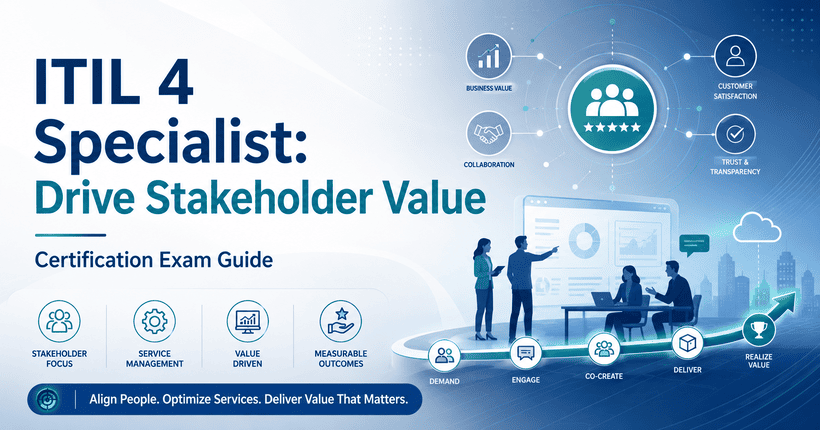
ITIL 4 Specialist Drive Stakeholder Value is an advanced ITIL certification focused on one of the most important but sometimes underestimated areas of modern service management: building productive relationships with customers, users, suppliers, partners, sponsors, and other stakeholders.
Modern IT services are rarely successful simply because the technology works. A technically excellent service can still fail if customers do not understand its value, users have a poor experience, expectations are unclear, suppliers are badly coordinated, or communication breaks down. The ITIL 4 Specialist Drive Stakeholder Value certification addresses these challenges by showing professionals how to manage the complete stakeholder and customer journey.
For students, project management beginners, service management professionals, business analysts, customer experience specialists, and IT practitioners, the certification provides a practical bridge between traditional IT service management and customer-centric digital service delivery.
This guide explains what the ITIL 4 Drive Stakeholder Value certification covers, the current exam format, important management concepts, the customer journey model, career value, study strategies, and practical tips for preparing for the PeopleCert examination.
What Is ITIL 4 Specialist: Drive Stakeholder Value?
Table of Contents
ToggleITIL 4 Specialist: Drive Stakeholder Value, usually abbreviated as ITIL 4 DSV, focuses on how service providers interact with stakeholders throughout the lifecycle of a service relationship.
The module goes beyond basic customer service. It examines how organizations identify potential markets, understand customer needs, develop value propositions, negotiate service expectations, onboard users, co-create value, measure service experience, and maintain long-term relationships.
A central idea in DSV is that value is not simply delivered by a service provider. Instead, value is co-created through interaction between the provider and the service consumer.
This makes DSV especially relevant in environments where IT teams must work closely with business units, external customers, SaaS users, suppliers, development teams, product teams, and strategic partners.
Candidates preparing for the exam can review the key subject areas through our ITIL 4 Drive Stakeholder Value exam preparation page.
Why Drive Stakeholder Value Matters in Modern IT
Traditional IT management often focused heavily on infrastructure, availability, incidents, technical performance, and operational processes. Those elements remain important, but digital services have made the stakeholder experience equally critical.
Consider a cloud-based business application. The infrastructure may achieve excellent availability, yet customers may still be dissatisfied because:
- The onboarding process is confusing.
- Service expectations were never clearly agreed.
- Support communication is slow or inconsistent.
- Users do not understand the service capabilities.
- The service does not address the customer’s actual business outcomes.
- Suppliers and internal teams provide conflicting information.
- Customer feedback is collected but rarely used.
DSV teaches candidates to view services from the perspective of the entire relationship rather than from only the technical operations perspective.
This approach is particularly important for organizations adopting cloud computing, SaaS platforms, DevOps, digital products, managed services, customer success programs, and experience-driven service delivery.
ITIL 4 DSV Exam Overview
According to the current PeopleCert certification information, the ITIL 4 Specialist Drive Stakeholder Value exam uses the following format:
| Exam Detail | Current Format |
|---|---|
| Certification | ITIL 4 Specialist: Drive Stakeholder Value |
| Abbreviation | ITIL 4 DSV |
| Exam Provider | PeopleCert |
| Number of Questions | 40 questions |
| Question Type | Multiple choice |
| Exam Duration | 90 minutes |
| Pass Mark | 70% |
| Correct Answers Required | 28 out of 40 |
| Exam Type | Closed book |
| Delivery | PeopleCert examination environment |
Because certification policies and examination administration can change, candidates should always check the official PeopleCert page before purchasing an exam or scheduling a test.
When preparing for the assessment, it is useful to combine official training material with structured ITIL 4 DSV exam preparation resources so that you can identify weak topics before exam day.
ITIL 4 Drive Stakeholder Value Prerequisites
PeopleCert currently lists prerequisite certification and training requirements for this module. Candidates are expected to hold an eligible ITIL qualification and complete approved training through an Accredited Training Organization (ATO) or ITIL Official eLearning.
This is important because DSV is not intended to be a completely independent entry-level certification. Candidates should already understand fundamental ITIL concepts such as:
- Service management
- Value and value co-creation
- Service relationships
- Service consumers and service providers
- The ITIL service value system
- The service value chain
- ITIL guiding principles
- Continual improvement
If you are new to IT service management, developing a strong understanding of ITIL Foundation concepts before studying DSV will make the advanced material considerably easier to understand.
The Customer Journey: The Core of ITIL 4 DSV
The customer journey is one of the most important concepts in ITIL 4 Drive Stakeholder Value. Instead of examining isolated service interactions, DSV encourages organizations to understand the complete sequence of experiences through which a customer develops and maintains a relationship with a service provider.
The customer journey is commonly organized around seven major steps:
- Explore
- Engage
- Offer
- Agree
- Onboard
- Co-create
- Realize
Understanding what happens at each stage is essential for both the examination and real-world application.
1. Explore
The Explore stage is about understanding markets, customers, service consumers, and potential opportunities.
Before a provider can design an appropriate service, it must understand who the stakeholders are and what outcomes they are trying to achieve.
Important areas include:
- Understanding service consumers
- Identifying target markets
- Recognizing customer needs
- Understanding internal and external market factors
- Analyzing opportunities
- Understanding the capabilities of the service provider
In practical terms, this may involve market research, interviews, surveys, customer analytics, stakeholder analysis, or discussions with business teams.
2. Engage
The Engage stage focuses on establishing and developing relationships.
Trust plays a major role here. Customers need confidence that a service provider understands their requirements and can support their objectives.
Typical topics include:
- Stakeholder communication
- Relationship management
- Building trust
- Managing expectations
- Understanding customer needs
- Managing suppliers and partners
- Maintaining engagement channels
Good engagement is not simply frequent communication. The communication must be useful, relevant, transparent, and appropriate for the stakeholder.
3. Offer
During the Offer stage, organizations translate their understanding of stakeholder needs into meaningful service offerings and value propositions.
A service provider must answer a fundamental question:
Why should the customer choose this service?
The answer should explain the expected value rather than simply listing technical features.
For example, a cloud backup service could be described technically in terms of storage capacity, encryption, and replication. However, its value proposition might focus on reducing business disruption, protecting critical data, simplifying recovery, and supporting compliance requirements.
This distinction between features and value is important throughout DSV.
4. Agree
The Agree stage is concerned with creating a shared understanding between the service provider and service consumer.
Topics may include:
- Negotiation
- Service expectations
- Service level agreements
- Experience expectations
- Responsibilities
- Service relationship management
- Communication requirements
A well-designed agreement should support the desired business outcomes rather than become a document that exists only for compliance purposes.
This is why DSV encourages professionals to think beyond traditional SLA metrics. An SLA might report 99.9% availability while users remain frustrated with the actual service experience.
5. Onboard
Onboarding is where a customer or user begins actively using the service.
Poor onboarding can damage a service relationship before the service has had an opportunity to demonstrate its value.
Successful onboarding can include:
- User registration
- Access provisioning
- Training
- Documentation
- Communication
- Setting expectations
- Providing support channels
- Helping users adopt new ways of working
DSV also considers offboarding. When users or customers leave a service, organizations need controlled processes for removing access, transferring data, terminating agreements, managing knowledge, and maintaining an appropriate final experience.
6. Co-create
The Co-create stage represents the ongoing interaction between the service provider and service consumer while the service is being consumed.
This is where value co-creation becomes visible in daily operations.
Examples include:
- Users interacting with a service
- Support teams resolving issues
- Customers providing feedback
- Providers improving functionality
- Business teams adjusting requirements
- Suppliers supporting service components
- Service managers reviewing performance
Both sides contribute to the outcome. A provider may supply excellent technology, but successful value realization can still depend on how effectively the customer uses the service.
7. Realize
The final step focuses on determining whether the expected value has actually been achieved.
Organizations need to evaluate outcomes, stakeholder satisfaction, service experience, costs, risks, and opportunities for improvement.
Realizing value therefore involves more than checking whether an SLA target was met.
Organizations may consider:
- Customer satisfaction
- User satisfaction
- Business outcomes
- Experience metrics
- Operational performance
- Financial results
- Risk reduction
- Productivity improvements
- Continual improvement opportunities
Important Technical and Management Concepts in ITIL 4 DSV
The ITIL 4 DSV certification covers several disciplines that connect service management with customer experience and business relationship management.
Stakeholder Management
Not every stakeholder has the same goals or level of influence.
A service manager may need to work with:
- Customers
- End users
- Business sponsors
- Executives
- Suppliers
- Partners
- Development teams
- Operations teams
- Compliance teams
- Service owners
Understanding stakeholder interests, influence, expectations, and communication requirements is therefore fundamental.
Customer Experience and User Experience
Customer experience (CX) and user experience (UX) have become increasingly important in digital service management.
A user may judge a service based on factors such as:
- Ease of use
- Performance
- Accessibility
- Support quality
- Communication
- Reliability
- Consistency
A customer, meanwhile, may evaluate the broader relationship, including commercial outcomes, trust, business impact, contractual performance, and strategic alignment.
DSV encourages service managers to recognize both perspectives.
Customer Journey Mapping
Customer journey mapping allows organizations to visualize how stakeholders interact with a service across different stages and touchpoints.
A journey map may identify:
- Customer objectives
- Interactions
- Communication channels
- Pain points
- Expectations
- Emotions
- Potential improvements
This technique helps organizations avoid optimizing individual interactions while ignoring problems in the overall customer experience.
Service Level Management
Service levels remain important, but DSV emphasizes that metrics should be connected to meaningful outcomes.
For example, measuring only server uptime may provide limited information about the actual experience of a user accessing an application.
Better service management combines technical metrics with business and experience indicators.
Relationship Management
Strong service relationships require mutual understanding, trust, transparency, communication, and continual interaction.
A relationship manager therefore does more than handle complaints. The role may include identifying changing needs, coordinating stakeholders, resolving misunderstandings, managing expectations, and identifying opportunities to create additional value.
Supplier and Partner Management
Modern digital services frequently depend on complex supplier ecosystems.
A customer may see only one service, while behind the scenes the service provider depends on cloud providers, telecommunications companies, software vendors, managed service providers, security partners, and other suppliers.
The service provider must coordinate these relationships so that the customer receives a consistent experience.
Demand and Value Propositions
Understanding demand helps organizations avoid designing services around assumptions.
A value proposition should clearly explain how a service helps a customer achieve desired outcomes while managing relevant costs and risks.
DSV therefore connects service management with concepts commonly found in product management, marketing, customer success, and business analysis.
Who Should Take the ITIL 4 DSV Certification?
The ITIL 4 Specialist Drive Stakeholder Value certification is relevant to professionals who interact with customers, users, suppliers, business stakeholders, or service delivery teams.
Potential candidates include:
- IT Service Managers
- Service Delivery Managers
- Project Managers
- Business Analysts
- Product Owners
- Product Managers
- Customer Experience Managers
- Customer Success Managers
- Relationship Managers
- Service Level Managers
- IT Consultants
- IT Operations Managers
- Support Managers
- Supplier Managers
- Digital Transformation Professionals
Students planning careers in IT management can also benefit because DSV introduces business-facing skills that are sometimes missing from purely technical training.
Is the ITIL 4 Drive Stakeholder Value Certification Worth It?
The value of any certification depends on your career objectives, but DSV can be particularly useful for professionals moving from technical roles into service management, project management, customer success, consulting, or leadership positions.
Its strongest advantage is that it develops skills that apply across many technologies.
Cloud platforms change. Software products change. Infrastructure architectures change. The need to understand customers, manage expectations, negotiate service requirements, build trust, and demonstrate value remains.
This makes stakeholder management a highly transferable capability.
The certification can also complement knowledge in areas such as:
- Project management
- Agile
- DevOps
- Cloud computing
- Business analysis
- Customer success
- Product management
- Service management
- Digital transformation
How Difficult Is the ITIL 4 DSV Exam?
The DSV exam is not primarily a test of memorizing definitions. Candidates need to understand how ITIL concepts should be applied in practical situations.
This can make the examination more challenging than it first appears.
A question may present several answers that all appear reasonable. The candidate must determine which option most closely reflects the ITIL guidance and the specific situation described.
Areas that often require careful study include:
- Differences between stages of the customer journey
- Stakeholder roles
- Value propositions
- Customer needs and expectations
- Relationship management
- Onboarding and offboarding
- Service level expectations
- Value realization
- CX and UX concepts
- Supplier and partner relationships
Students should focus on understanding why an approach is appropriate rather than attempting to memorize isolated statements. A good preparation strategy is to study each knowledge area and then use ITIL 4 Specialist Drive Stakeholder Value practice materials to test whether you can apply the concepts in realistic scenarios.
A Practical ITIL 4 DSV Study Plan
A structured study plan can make preparation much more manageable.
Week 1: Build the Foundation
- Review ITIL Foundation terminology.
- Review value co-creation.
- Understand service providers and service consumers.
- Study the overall customer journey.
- Learn the purpose of Explore, Engage, Offer, Agree, Onboard, Co-create, and Realize.
Week 2: Study Stakeholder Relationships
- Study stakeholder identification and analysis.
- Review customer needs and expectations.
- Understand communication techniques.
- Study relationship management.
- Review supplier and partner management.
- Understand trust and mutual readiness.
Week 3: Focus on Service Experience
- Study customer journey mapping.
- Review CX and UX concepts.
- Study value propositions.
- Understand service offerings.
- Review service level expectations.
- Study onboarding and offboarding.
- Review value realization and measurement.
Week 4: Practice and Review
- Complete official sample questions.
- Review incorrect answers carefully.
- Create short summaries of each customer journey stage.
- Practice scenario-based questions.
- Review terminology that is easy to confuse.
- Complete timed practice sessions.
During the final review stage, candidates may also use the ITIL 4 DSV course preparation resources to reinforce key areas and become more comfortable with the structure of exam-style questions.
How to Prepare Effectively for the ITIL 4 DSV Exam
1. Understand the Customer Journey Instead of Memorizing It
Knowing the seven stages is only the beginning.
You should understand the purpose of each stage and recognize activities that belong to it.
2. Think From the Stakeholder Perspective
Technical professionals often approach problems by immediately looking for a technical solution. DSV frequently requires a broader view.
Ask:
- What outcome does the customer need?
- Which stakeholder is involved?
- What expectation needs to be managed?
- What value is being created?
- How does this affect the overall experience?
3. Learn the Logic Behind ITIL Recommendations
Understanding the reasoning behind a concept makes scenario questions much easier.
If you understand why customer journey mapping is useful, for example, you will have an easier time recognizing when it should be used.
4. Practice Scenario-Based Questions
Do not limit your preparation to definitions.
Practice identifying the most appropriate action in scenarios involving:
- Unclear customer expectations
- Poor supplier coordination
- Failed onboarding
- Weak customer relationships
- Service level disagreements
- Negative user experience
- Changing customer requirements
Scenario practice is particularly useful because the ITIL 4 Drive Stakeholder Value exam requires candidates to recognize how service management principles should be applied rather than merely recalling terminology.
5. Read Every Question Carefully
Words such as BEST, MOST appropriate, FIRST, and PRIMARY can significantly change what the question is asking.
Do not choose an answer simply because it contains a familiar ITIL term.
Common Mistakes Candidates Make
Several mistakes can reduce exam performance even when a candidate understands the general subject.
- Memorizing without understanding: DSV contains many scenario-based concepts.
- Ignoring customer experience: Technical performance alone does not define service value.
- Confusing customer journey stages: Learn the purpose and activities of each stage.
- Thinking only about customers: DSV includes users, sponsors, suppliers, partners, and other stakeholders.
- Focusing only on SLAs: An SLA is only one part of the service relationship.
- Skipping ITIL Foundation review: Advanced concepts build on the fundamental ITIL vocabulary.
- Rushing scenario questions: Small details often determine the correct answer.
Real-World Example of Drive Stakeholder Value
Imagine a company introducing a new cloud collaboration platform.
During Explore, the service team identifies user groups and business requirements.
During Engage, the team meets with department leaders and users to understand concerns and build trust.
During Offer, the provider defines a service offering that explains how the platform will improve collaboration and reduce operational complexity.
During Agree, the organization establishes service expectations, responsibilities, support arrangements, and performance targets.
During Onboard, users receive accounts, training, documentation, and support.
During Co-create, users begin working with the platform while support and product teams respond to feedback and improve the service.
During Realize, the organization measures adoption, user satisfaction, productivity, support performance, and actual business benefits.
This example demonstrates why DSV should not be viewed simply as a customer service certification. It provides a framework for managing the entire service relationship.
ITIL 4 DSV and Project Management
Project managers can gain significant value from DSV because project success frequently depends on stakeholder relationships.
Both disciplines emphasize:
- Stakeholder identification
- Communication
- Expectation management
- Requirements
- Business value
- Risk management
- Supplier coordination
- Continual feedback
The major difference is perspective. Project management often concentrates on delivering a defined change or outcome, while ITIL service management considers how value continues to be created through an ongoing service relationship.
Understanding both perspectives can be especially valuable for professionals involved in digital transformation projects.
ITIL 4 DSV and Agile, DevOps, and Digital Products
Although DSV is part of the ITIL service management ecosystem, its concepts fit naturally with modern digital delivery approaches.
Agile teams depend on frequent stakeholder feedback. DevOps encourages collaboration across traditional organizational boundaries. Product teams focus on user needs and measurable outcomes.
DSV supports these approaches by strengthening:
- Feedback loops
- Customer understanding
- Cross-functional collaboration
- Experience measurement
- Relationship management
- Value-focused decision making
This is one reason the certification remains useful even for professionals working in organizations that do not follow every ITIL practice formally.
Career Benefits of ITIL 4 Specialist Drive Stakeholder Value
Passing the ITIL 4 Specialist Drive Stakeholder Value exam demonstrates more than knowledge of IT terminology. It shows that a professional has studied how service relationships, customer journeys, communication, experience, and value creation fit together.
These capabilities are relevant to positions involving:
- IT service delivery
- Customer success
- Digital product management
- Business relationship management
- IT consulting
- Service level management
- Supplier management
- Customer experience
- IT project management
- Digital transformation
The certification will not replace real-world experience, but it can provide a structured vocabulary and framework that helps professionals improve how they work with stakeholders.
Maintaining Your ITIL Certification
PeopleCert currently operates a certification renewal model for its Global Best Practice certifications. The official DSV page states that certifications are renewed on a three-year cycle and describes Continuing Professional Development (CPD) as one of the available ways to keep certifications current.
Because renewal policies can evolve, candidates and certificate holders should verify the current rules directly through their PeopleCert account and official certification pages rather than relying on older training material.
Frequently Asked Questions About ITIL 4 DSV
Is ITIL 4 Specialist Drive Stakeholder Value an advanced certification?
Yes. DSV builds on fundamental ITIL service management knowledge and concentrates specifically on stakeholder relationships, customer journeys, service experience, service expectations, and value co-creation.
How many questions are on the ITIL 4 DSV exam?
The current PeopleCert exam format lists 40 multiple-choice questions.
What score do I need to pass ITIL 4 DSV?
The current pass mark is 70%, meaning candidates need at least 28 correct answers out of 40 questions.
How long is the ITIL 4 Drive Stakeholder Value exam?
The standard exam duration is 90 minutes according to the current PeopleCert certification page.
Is the ITIL 4 DSV exam open book?
No. PeopleCert currently identifies the examination as closed book.
What are the seven stages of the DSV customer journey?
The seven customer journey stages commonly studied in DSV are Explore, Engage, Offer, Agree, Onboard, Co-create, and Realize.
Is ITIL 4 DSV useful for project managers?
Yes. Project managers regularly work with stakeholders, requirements, expectations, suppliers, communication, and business value. DSV adds a service management and customer experience perspective to those skills.
Is ITIL 4 DSV only for IT service managers?
No. It can also be relevant to project managers, product owners, business analysts, customer experience professionals, customer success managers, consultants, relationship managers, and supplier managers.
Does DSV cover customer experience and user experience?
Yes. Customer experience and user experience are important parts of understanding stakeholder value and the overall customer journey.
Should I memorize the seven customer journey steps for the exam?
You should know them, but memorization alone is not enough. You need to understand the purpose of each stage, its activities, and how the stages apply to practical scenarios.
Recommended ITIL 4 DSV Preparation Resources
Successful preparation normally combines official ITIL learning material, detailed review of the syllabus, scenario-based practice, and repeated revision of weaker knowledge areas.
If you are preparing for the certification, you can also visit our ITIL 4 Specialist Drive Stakeholder Value course page for additional exam-focused preparation information.
Official and Authoritative ITIL 4 DSV Resources
For the most accurate information about certification requirements, examination policies, training, and updates, candidates should prioritize official PeopleCert resources.
- PeopleCert – ITIL 4 Specialist: Drive Stakeholder Value:
https://www.peoplecert.org/browse-certifications/it-governance-and-service-management/ITIL-1/itil-4-specialist-drive-stakeholder-value-2812
- PeopleCert – ITIL Certification Information:
https://www.peoplecert.org/ITIL-4
- PeopleCert – IT Governance and Service Management Certifications:
https://www.peoplecert.org/browse-certifications/it-governance-and-service-management
- PeopleCert Help and Support:
https://www.peoplecert.org/help-and-support/FAQ
Final Thoughts
ITIL 4 Specialist Drive Stakeholder Value is one of the more business-oriented ITIL modules because it examines what happens between technology and the people who expect that technology to create value.
The certification teaches professionals to understand customer journeys, build stakeholder relationships, develop meaningful value propositions, negotiate expectations, improve onboarding, coordinate service relationships, and measure whether value has actually been realized.
For beginners, the terminology may initially feel abstract. The easiest way to understand DSV is to connect every concept to a real service you already use. Think about how you discovered the service, why you selected it, how you were onboarded, how support works, what expectations were established, and whether the service ultimately achieved the outcome you wanted.
Once you begin viewing services through that complete customer journey, the logic behind ITIL 4 DSV becomes much clearer.
For professionals who want to combine IT service management knowledge with stakeholder management, customer experience, relationship management, and value-driven service delivery, the certification can be a useful addition to a broader IT management career path. Candidates who are ready to move from theory into focused exam preparation can review the ITIL 4 Specialist Drive Stakeholder Value preparation course for additional study support.





