
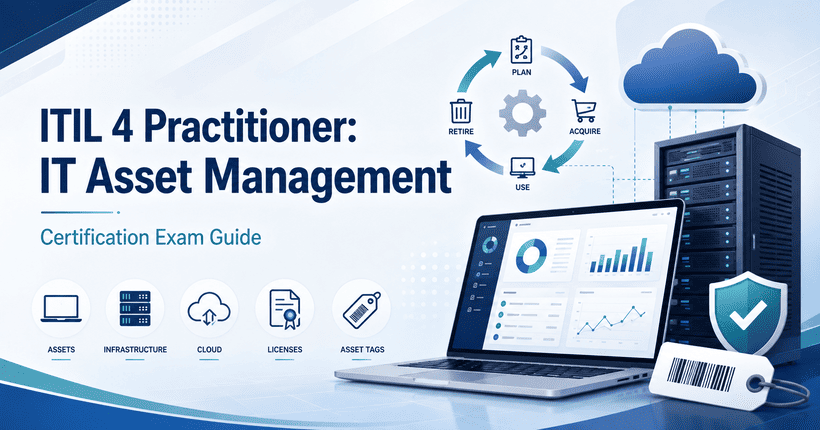
ITIL 4 Practitioner IT Asset Management is a practice-focused certification for IT professionals who want to understand how technology assets can be managed throughout their lifecycle in a controlled, cost-effective, and business-focused way. Rather than treating asset management as a simple inventory exercise, the certification looks at how organizations can maximize the value of IT assets while controlling costs, managing risks, supporting compliance, and making better decisions about acquisition, reuse, retirement, and disposal.
For students and professionals who already understand the basics of IT service management, this certification provides a useful bridge between ITIL concepts and the practical realities of managing hardware, software, licenses, contracts, subscriptions, and other technology resources.
IT Asset Management, usually abbreviated as ITAM, is also becoming increasingly important as organizations adopt cloud platforms, subscription-based software, hybrid infrastructure, remote working, and more complex technology supply chains. Knowing what assets an organization owns or uses is no longer enough. Organizations also need to understand how those assets create value, what they cost, who is responsible for them, what risks they introduce, and when they should be replaced or retired.
What Is the ITIL 4 Practitioner: IT Asset Management Certification?
Table of Contents
ToggleThe ITIL 4 Practitioner: IT Asset Management module is part of the practice-based ITIL certification portfolio from PeopleCert. It focuses specifically on the knowledge and capabilities required to establish, operate, measure, and continually improve an effective IT Asset Management practice.
The central idea behind the practice is straightforward: organizations should plan and manage the complete lifecycle of their IT assets so that those assets deliver appropriate value while financial, contractual, operational, regulatory, and security risks remain under control.
This makes ITAM much broader than maintaining a spreadsheet containing serial numbers. A mature ITAM practice may influence procurement decisions, software licensing, cybersecurity, financial planning, service configuration, supplier management, hardware refresh cycles, employee onboarding and offboarding, cloud consumption, audits, and sustainability initiatives.
The certification therefore has value for people working not only in dedicated asset management teams but also in IT operations, service management, procurement, infrastructure, security, finance, software licensing, configuration management, and technical support.
ITIL 4 Practitioner IT Asset Management Exam Details
Candidates preparing for the ITIL 4 Practitioner IT Asset Management exam should first become familiar with the exam format and then build a study plan around the official syllabus and practical ITAM scenarios.
| Certification | ITIL 4 Practitioner: IT Asset Management |
| Certification Provider | PeopleCert |
| Number of Questions | 20 questions |
| Question Type | Multiple choice |
| Exam Duration | 30 minutes |
| Passing Score | 65% |
| Minimum Correct Answers | 13 out of 20 |
| Open or Closed Book | Closed book |
| Current Exam Language | English |
| Training Requirement | Accredited training or ITIL Official eLearning is required |
| Certification Renewal | PeopleCert currently operates a three-year certification renewal cycle |
The exam is relatively short, but this should not be mistaken for an easy test. With only 30 minutes for 20 questions, candidates have an average of approximately 90 seconds per question. Understanding the terminology and knowing how ITAM concepts are applied in realistic situations is therefore more valuable than trying to memorize isolated definitions.
PeopleCert currently requires candidates for this module to hold an eligible ITIL qualification, such as ITIL 4 Foundation or another accepted ITIL credential, and to complete qualifying training. Candidates should always check the current PeopleCert requirements before purchasing an exam because certification policies can change over time.
What Does IT Asset Management Mean in ITIL 4?
IT Asset Management is concerned with managing the lifecycle and total value of IT assets. An IT asset is not important merely because it physically exists. It matters because it contributes financial or operational value to the organization and supports the delivery of products and services.
Consider a corporate laptop. From an ITAM perspective, the organization may need to know its purchase price, supplier, warranty, assigned employee, physical location, lifecycle status, depreciation information, security status, maintenance history, expected replacement date, and final disposal method.
A software subscription creates a different set of concerns. The organization may need to understand how many licenses were purchased, how many are actually being used, what contractual restrictions apply, when the subscription renews, whether unused licenses can be reclaimed, and whether the organization is exposed to a licensing or compliance risk.
Cloud technology adds another dimension. Traditional ownership is increasingly replaced by consumption-based services and subscriptions. ITAM teams therefore need to understand not only assets that an organization owns but also technology resources that it pays to access or consume.
The IT Asset Lifecycle
A practical way to understand ITAM is to follow an asset from initial demand to final disposal. Although individual organizations may design their lifecycle differently, a typical asset journey begins when a business or technical requirement is identified.
The organization first determines what type of asset is required and whether an existing asset can meet the need. If a new asset is necessary, procurement and supplier processes may be involved. The organization then purchases or subscribes to the asset under appropriate commercial terms.
Once received or activated, the asset should be identified, recorded, categorized, and assigned appropriate ownership or responsibility. Hardware may receive an asset tag, while software licenses and subscriptions require entitlement and contract records.
During the operational phase, the asset is deployed and used. Its status may change repeatedly. A laptop might move between employees, locations, departments, storage areas, and support teams. Software licenses may be assigned, reclaimed, upgraded, or transferred. Accurate lifecycle records help the organization maintain control throughout these changes.
Eventually an asset reaches the end of its useful life. It may be reused, redeployed, sold, returned to a supplier, recycled, or disposed of. Disposal must be controlled carefully because retired assets may still contain confidential information, licensed software, encryption keys, or regulated data.
The important lesson for the exam is that ITAM is a lifecycle discipline. Purchasing an asset is only one event in a much longer management process.
Hardware Asset Management
Hardware Asset Management, often called HAM, focuses on physical technology assets such as desktops, laptops, servers, mobile devices, network equipment, storage devices, peripherals, and other infrastructure components that fall within the organization’s defined ITAM scope.
Effective hardware management improves visibility and accountability. Organizations can identify what equipment exists, who is using it, where it is located, how old it is, whether it is under warranty, and whether it should be maintained, replaced, reused, or retired.
This becomes especially important in large or distributed environments. Remote work has made asset tracking more difficult because devices may remain outside corporate offices for years. Employee departures can also create risk when laptops, mobile devices, security tokens, or other equipment are not returned correctly.
A well-designed ITAM practice connects asset records with operational workflows so that asset status is updated when equipment is issued, transferred, repaired, returned, placed into storage, or disposed of.
Software Asset Management and License Compliance
Software Asset Management, or SAM, is another major area associated with ITAM. Software creates different management challenges because an organization may have contractual rights to use software without actually owning the software itself.
Licensing models can be based on users, devices, processors, cores, virtual machines, subscriptions, consumption, concurrent users, or combinations of these measurements. Cloud and SaaS platforms have made the environment even more dynamic.
One of the major objectives of Software Asset Management is to understand the relationship between software entitlements and actual software deployment or consumption.
If an organization purchases too many licenses, money may be wasted. If it uses more software than its agreements allow, the organization may face compliance and financial exposure. Effective SAM therefore helps balance cost optimization with contractual compliance.
For candidates preparing for the ITIL 4 IT Asset Management certification, it is useful to think beyond license counting. The wider goal is to make informed decisions that maximize value while controlling risk and cost.
IT Asset Management vs. Service Configuration Management
One of the most important distinctions for ITIL learners is the difference between IT Asset Management and Service Configuration Management.
These practices often share information, but they serve different purposes.
| Area | IT Asset Management | Service Configuration Management |
|---|---|---|
| Primary Focus | Value, cost, ownership, lifecycle, contractual and financial control | Configuration information needed to manage services |
| Typical Questions | What do we own or use? What does it cost? Who is responsible for it? When should it be replaced? | How is this component configured? What service depends on it? What relationships exist? |
| Typical Records | Asset records, purchase records, contracts, licenses, warranties and lifecycle status | Configuration items, attributes, relationships and configuration models |
| Business Concern | Financial, contractual, compliance, utilization and lifecycle value | Service control, impact analysis and accurate configuration information |
A physical server, for example, may be both an IT asset and a configuration item. Asset management may track its purchase price, warranty, ownership, and replacement date, while configuration management may track its operating system, network relationships, installed applications, and dependency on a business service.
Understanding this overlap without treating the two practices as identical is important both for the examination and for real-world IT service management.
Asset Registers, CMDBs, and Discovery Tools
Technology plays an important role in modern ITAM, but implementing an asset management tool does not automatically create an effective ITAM practice.
An asset repository may contain lifecycle, ownership, financial, and contractual information. A Configuration Management Database, or CMDB, may contain information about configuration items and their relationships. Discovery tools can identify hardware and software connected to a network. Endpoint management platforms can provide information about device status and installed applications.
Each source provides part of the overall picture.
The challenge is maintaining reliable information and creating appropriate integration between systems. If procurement records show 1,000 laptops but the asset management platform records only 850 and endpoint discovery identifies 910, the organization needs processes for investigating and reconciling those differences.
For this reason, data quality is a management issue rather than purely a technical issue. Roles, processes, controls, measurements, and responsibilities are required to keep asset information useful.
Why ITAM Matters for Cybersecurity
IT Asset Management and cybersecurity are closely connected. Security teams cannot effectively protect technology that the organization does not know exists.
Accurate asset information helps security teams identify unsupported hardware, outdated software, unauthorized applications, unmanaged endpoints, and assets that should already have been retired.
The relationship also works in the opposite direction. Security tools such as endpoint management systems, vulnerability scanners, network discovery platforms, and security monitoring tools can provide valuable information that improves asset visibility.
Asset disposal is particularly important from a security perspective. Before storage devices are reused or discarded, organizations need appropriate processes for data sanitization and verification. Simply marking an asset as retired in a database does not eliminate the information stored on the physical device.
Financial Management and Cost Optimization
ITAM has a strong financial dimension. Technology spending represents a significant cost for many organizations, and poor asset visibility can easily lead to duplicated purchases, unused subscriptions, unnecessary maintenance agreements, and premature replacement of usable equipment.
Good asset data supports budgeting and forecasting because decision-makers can see how many assets are approaching end of life, which contracts are about to renew, and where significant future expenditure may be required.
ITAM can also improve utilization. An organization may discover unused laptops in storage while another department is purchasing new devices. It may be paying for hundreds of inactive SaaS accounts. Servers may still have maintenance contracts even though the applications they supported have been decommissioned.
These examples illustrate an important ITIL principle: the objective is not simply to reduce spending. The objective is to optimize value. The cheapest option is not always the option that best supports organizational objectives.
ITAM Governance, Risk, and Compliance
IT assets can expose an organization to financial, operational, security, contractual, environmental, and regulatory risks. An effective ITAM practice helps identify and manage these risks throughout the lifecycle.
Software agreements may impose restrictions on where or how applications are deployed. Equipment may contain regulated or sensitive data. Assets may need to be disposed of according to environmental requirements. Suppliers may impose return conditions at the end of a lease. Warranty expiration may introduce operational risk for critical hardware.
This means ITAM requires collaboration across organizational boundaries. Procurement, finance, legal, security, operations, service management, human resources, suppliers, and business teams may all participate in different stages of the asset lifecycle.
The most effective ITAM programs therefore establish clear policies and responsibilities rather than expecting one asset manager to control every activity personally.
Roles and Responsibilities in an ITAM Practice
The exact organizational structure varies by company size and complexity. A large enterprise might employ dedicated hardware asset managers, software asset managers, licensing specialists, contract managers, analysts, and ITAM process owners. A smaller organization may distribute these responsibilities across infrastructure, procurement, finance, and service management teams.
Regardless of job titles, accountability should be clear. Someone needs to define the practice, ensure asset information is maintained, monitor performance, resolve exceptions, coordinate stakeholders, and improve the way assets are managed.
Individual users also have responsibilities. Employees who receive company equipment need to protect it, report loss or damage, and return it when required. Technical teams need to update asset information when equipment is deployed or changed. Procurement teams need to capture appropriate purchasing information. HR processes can trigger asset recovery when employees leave.
Successful ITAM is therefore a shared organizational capability rather than the responsibility of a single database administrator.
Practice Success Factors and ITAM Metrics
ITIL practice modules encourage candidates to think about whether a practice is genuinely achieving its intended outcomes. This requires more than measuring activity.
For example, counting how many asset records were created tells you something about workload but very little about the quality of asset management.
More meaningful measurements may examine inventory accuracy, the proportion of assets with known ownership, successful recovery of equipment, software utilization, compliance exposure, lifecycle exceptions, asset reuse, cost savings, disposal performance, or the reliability of data used for decision-making.
The appropriate metrics depend on organizational objectives. A company struggling with software overspending will require different priorities from an organization primarily concerned with hardware security and remote device recovery.
How IT Asset Management Works with Other ITIL Practices
ITAM rarely operates independently. It interacts with many other ITIL management practices.
Service Configuration Management provides information about configuration items and relationships. Change Enablement helps control changes that may affect assets. Deployment Management may introduce new hardware or software into operational environments. Release Management coordinates the availability of new and changed services and features. Supplier Management supports relationships with vendors and service providers.
Incident and problem teams may use asset information to identify affected equipment and warranty status. Information security teams may use asset inventories to identify risk. Service financial management and procurement processes may rely on ITAM data for budgeting and purchasing decisions.
This cross-practice relationship is one reason IT Asset Management is included alongside Change Enablement, Deployment Management, Release Management, and Service Configuration Management in the ITIL 4 Specialist: Plan, Implement and Control combined module.
Is the ITIL 4 Practitioner IT Asset Management Certification Worth It?
Whether the certification is worthwhile depends on your role and career direction. For someone who only wants a general introduction to IT service management, ITIL Foundation normally provides broader value.
For professionals who already understand ITIL and want to develop expertise in asset lifecycle management, however, the ITIL 4 Practitioner IT Asset Management certification can be a useful specialization.
It is especially relevant to professionals working with corporate hardware, software licensing, SaaS subscriptions, IT procurement, service configuration, technology finance, IT governance, endpoint operations, infrastructure lifecycle management, audit, or compliance.
The certification also gives learners a structured way to connect technical asset data with wider business questions. Instead of asking only, “Where is this device?” an ITAM professional learns to ask, “Why do we have this asset, what value does it provide, what does it cost, what risk does it create, and what should happen to it next?”
That business-oriented perspective is valuable far beyond the exam itself.
Who Should Take This Certification?
The certification can be particularly relevant for IT asset managers, ITAM analysts, Software Asset Management professionals, Hardware Asset Management professionals, IT service managers, configuration managers, IT operations specialists, procurement professionals, licensing specialists, infrastructure administrators, service desk leaders, governance professionals, and consultants.
Students preparing for an IT service management career can also benefit, particularly if they already hold ITIL Foundation and want to understand a specific operational practice in greater depth.
How Difficult Is the ITIL 4 Practitioner IT Asset Management Exam?
The exam is not particularly long, but candidates should not rely on memorization alone. Practice-based ITIL questions are designed to test whether candidates understand concepts well enough to recognize how they should be applied.
A learner who memorizes the definition of an IT asset but cannot distinguish IT Asset Management from Service Configuration Management may struggle. The same is true for someone who understands hardware inventory but has not considered contracts, licensing, lifecycle costs, risks, disposal, roles, and measurements.
The 65% passing requirement means candidates need at least 13 correct answers from 20 questions. Because the margin for error is relatively small, strong understanding across the syllabus is preferable to focusing heavily on only one topic.
Recommended ITIL 4 IT Asset Management Study Strategy
A good preparation approach begins with the official materials rather than practice questions. Read the official ITIL 4 Practitioner: IT Asset Management material and make sure you understand the purpose, terminology, practice success factors, processes, roles, supporting information, and relationships with other practices.
Next, translate each concept into a practical example. Ask yourself what would happen when a new laptop is purchased, when an employee leaves, when unused SaaS licenses are discovered, when a server reaches end of support, or when an auditor requests proof of software entitlement.
| Study Stage | Recommended Focus |
|---|---|
| Foundation Review | Refresh important ITIL 4 concepts, terminology, guiding principles, value streams, and management practices. |
| ITAM Concepts | Understand asset value, ownership, lifecycle, costs, risks, compliance, asset types, and governance. |
| Practice Application | Study processes, responsibilities, information requirements, measurements, automation, and practice integration. |
| Scenario Practice | Apply ITAM concepts to realistic hardware, software, subscription, procurement, transfer, and disposal scenarios. |
| Exam Preparation | Complete official sample questions and timed practice while reviewing the reasoning behind incorrect answers. |
When practicing questions, do not simply remember that a particular option was correct. Determine why it was correct and why the other options were weaker. This approach makes your preparation more resilient when the real examination presents the same concept through a different scenario.
After reviewing the official syllabus, candidates who want a structured place to continue their preparation can also review the ITIL 4 Practitioner IT Asset Management exam preparation resources available on our course page.
Common Mistakes When Preparing for the Exam
One common mistake is treating IT Asset Management as nothing more than hardware inventory. The practice also involves value, financial control, software, contracts, risks, lifecycle decisions, compliance, and organizational responsibilities.
Another mistake is confusing asset records with configuration records. There is significant overlap, but ITAM and Service Configuration Management have different purposes.
Candidates may also concentrate too much on tools. Discovery platforms, CMDBs, SAM tools, endpoint management systems, and asset repositories are useful, but the examination is concerned with management practice rather than expertise in a specific vendor product.
Finally, avoid studying individual terms without understanding the broader purpose of the practice. ITIL questions often become easier when you ask which answer best supports value creation, appropriate governance, reliable information, collaboration, and effective lifecycle management.
ITAM in Cloud and SaaS Environments
Modern ITAM is changing because organizations increasingly consume technology rather than purchasing permanent physical assets.
Software-as-a-Service subscriptions may be activated or removed in minutes. Cloud infrastructure can appear and disappear automatically. Employees may purchase technology through decentralized business units. Development teams can deploy large numbers of virtual resources without traditional procurement workflows.
This does not make ITAM less relevant. It makes visibility, governance, ownership, and cost management more important.
The definition of what should fall within an organization’s ITAM scope may evolve, but the underlying management questions remain familiar: What technology resources are being used? Who is responsible for them? What value do they provide? What obligations exist? What risks are associated with them? Are they still required?
ITAM and Sustainability
Asset lifecycle decisions also have an environmental dimension. Reusing equipment can reduce unnecessary purchasing. Extending the useful life of suitable hardware may reduce electronic waste. Responsible disposal can help ensure that retired equipment is handled appropriately.
Sustainability should not be considered in isolation from security and business requirements. Keeping outdated equipment indefinitely can introduce reliability or security risks. Effective ITAM helps organizations make balanced lifecycle decisions using reliable information.
ITIL 4 Practitioner IT Asset Management and the Practice Manager Path
The ITIL practice-based certification structure allows professionals to build deeper capability in specific management practices rather than studying only broad ITSM concepts.
IT Asset Management also appears within the ITIL 4 Specialist: Plan, Implement and Control combined module together with Change Enablement, Deployment Management, Release Management, and Service Configuration Management.
This grouping makes sense because these practices frequently interact. Organizations need to understand what assets and configurations exist, control changes to them, deploy technology appropriately, release new capabilities, and maintain reliable information throughout the lifecycle.
Candidates considering the wider ITIL Practice Manager path should review the latest PeopleCert certification structure before choosing between individual practice modules and combined modules, particularly because PeopleCert continues to evolve the broader ITIL certification portfolio.
Career Benefits of IT Asset Management Knowledge
ITAM expertise can support several career paths because asset information sits at the intersection of technology, finance, governance, security, and operations.
A technically focused administrator may use ITAM knowledge to improve lifecycle planning and asset visibility. A service manager may use it to integrate asset information into service workflows. A procurement professional may use it to improve technology purchasing decisions. A security professional may rely on asset inventories when evaluating vulnerability exposure.
Experienced ITAM specialists may progress toward responsibilities involving Software Asset Management, licensing optimization, technology procurement, vendor management, cloud cost governance, compliance, IT governance, or enterprise service management.
The certification alone does not replace practical experience, but it can demonstrate that a candidate understands a recognized framework for managing IT assets and can discuss ITAM in terms that connect operational activities to business value.
Final Thoughts
The ITIL 4 Practitioner IT Asset Management certification is a focused qualification for professionals who want to understand how IT assets should be managed from planning and acquisition through operation, reuse, retirement, and disposal.
Its greatest value is that it moves the conversation beyond inventory management. Effective ITAM requires organizations to consider financial value, contractual obligations, utilization, risk, security, governance, data quality, lifecycle decisions, suppliers, and collaboration with other IT management practices.
For exam preparation, candidates should focus on understanding why the practice exists and how its components work together. Learn the terminology, but also practice applying the concepts to realistic situations involving hardware, software, subscriptions, contracts, employees, suppliers, and service operations.
If you can explain how accurate asset information supports better decisions, how ITAM differs from configuration management, how assets should be controlled throughout their lifecycle, and how the practice contributes to value creation and risk reduction, you will have built knowledge that is useful both for the certification exam and for real-world IT service management.
For additional study support, you can visit our ITIL 4 Practitioner IT Asset Management course page to review related exam preparation information and resources.
Frequently Asked Questions
How many questions are on the ITIL 4 Practitioner IT Asset Management exam?
The current PeopleCert exam format contains 20 multiple-choice questions.
How long is the ITIL 4 IT Asset Management exam?
The examination duration is currently 30 minutes.
What is the passing score?
The passing requirement is 65%, which means candidates need at least 13 correct answers out of 20.
Is the ITIL 4 Practitioner IT Asset Management exam open book?
No. PeopleCert currently lists the examination as closed book.
Is ITIL Foundation required?
Candidates must meet PeopleCert’s prerequisite certification requirements. ITIL 4 Foundation is one of the accepted routes, while certain other ITIL qualifications may also satisfy the prerequisite. Candidates should verify the latest eligibility rules before registering.
Do I need official training before taking the exam?
Yes. PeopleCert currently requires qualifying training through an Accredited Training Organization or ITIL Official eLearning for this practice module.
Is IT Asset Management the same as Service Configuration Management?
No. The practices are closely related but have different objectives. IT Asset Management emphasizes asset value, lifecycle, cost, ownership, contractual obligations, and risk, while Service Configuration Management focuses on maintaining reliable information about configuration items and their relationships as required to manage services.
Does IT Asset Management cover software licenses?
Yes. Software Asset Management is an important aspect of the wider ITAM discipline. Organizations need to understand software entitlements, usage, subscriptions, contractual requirements, and licensing risks in addition to managing physical hardware.
Is the ITIL 4 Practitioner IT Asset Management certification useful for beginners?
It can be useful for learners who already understand basic ITIL concepts. Complete beginners to IT service management will generally find it easier to begin with ITIL Foundation and then specialize in IT Asset Management.
Is IT Asset Management still relevant in cloud environments?
Yes. Cloud and SaaS have changed the types of technology resources organizations manage, but they have increased the importance of visibility, ownership, cost optimization, governance, and lifecycle control. Modern ITAM increasingly works alongside cloud financial management, security, procurement, and SaaS management disciplines.
External References and Further Reading
PeopleCert – ITIL 4 Practitioner: IT Asset Management
Official certification information, learning objectives, prerequisites, and examination details.
https://www.peoplecert.org/browse-certifications/it-governance-and-service-management/ITIL-1/itil-4-practitioner-it-asset-management-3792
PeopleCert – ITIL 4 Specialist: Plan, Implement and Control
Official information about the combined ITIL module covering Change Enablement, Deployment Management, Release Management, Service Configuration Management, and IT Asset Management.
https://www.peoplecert.org/browse-certifications/it-governance-and-service-management/ITIL-1/itil-4-specialist-plan-implement-and-control-3804
PeopleCert – ITIL Certification and Support Information
PeopleCert’s official website provides current information about ITIL certification requirements, languages, renewal policies, and training options.
https://www.peoplecert.org/
ISO – ISO/IEC 19770-1 Information Technology Asset Management
International standard covering requirements for an IT Asset Management management system.
https://www.iso.org/standard/68531.html
Note: Certification formats, prerequisites, available languages, prices, and renewal policies may be updated by PeopleCert. Always confirm the latest information on the official PeopleCert website before purchasing training or scheduling an examination.





