Moving enterprise applications to the cloud is rarely as simple as creating a virtual machine and uploading application files. A successful cloud migration requires careful planning around computing resources, networking, storage, security, availability, and operating costs.
For example, an enterprise running a customer management system may need to support thousands of concurrent users while maintaining database availability, protecting sensitive information, and ensuring that business services remain accessible during infrastructure failures.
These are the kinds of challenges that cloud solutions architects are expected to solve.
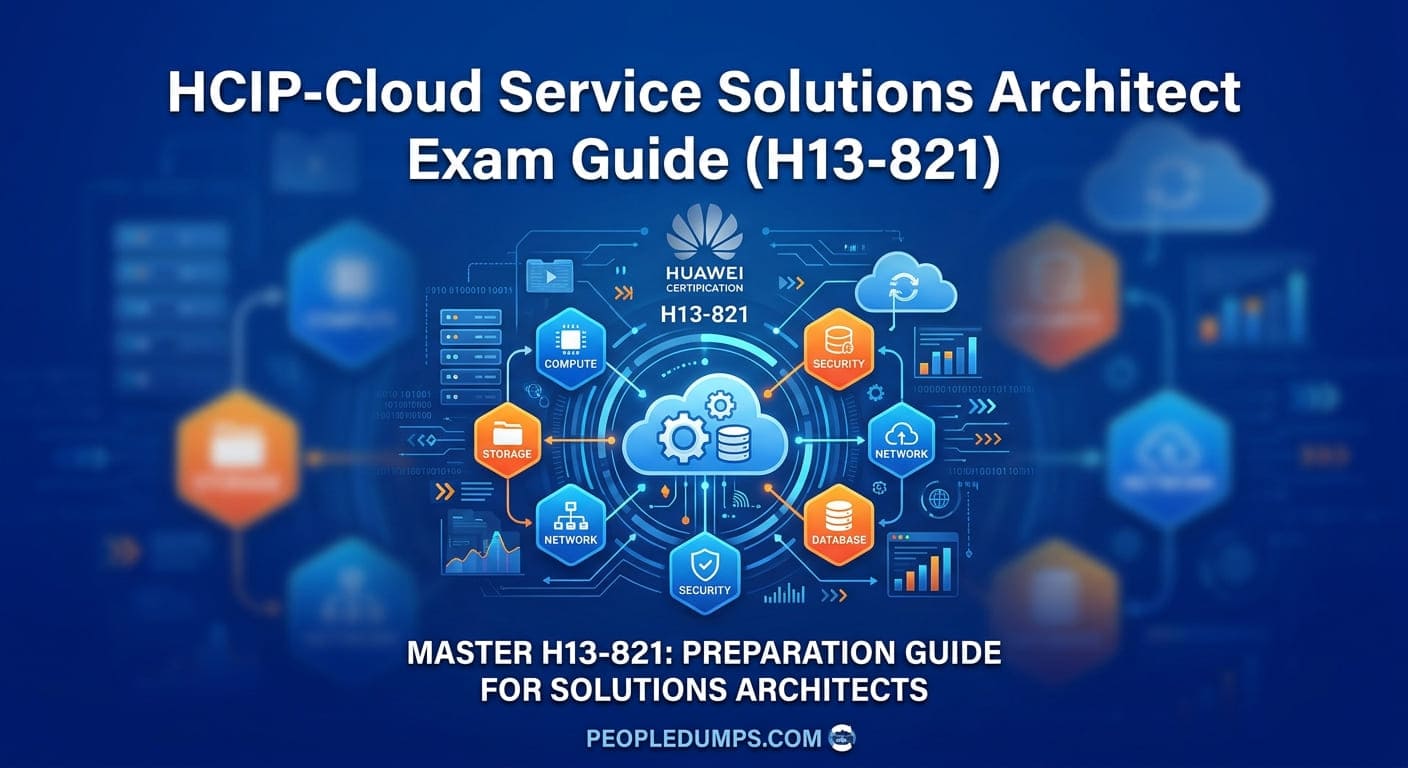
The Huawei HCIP-Cloud Service Solutions Architect (H13-821) certification focuses on the skills required to design enterprise cloud architectures using Huawei Cloud technologies. It covers traditional application migration, cloud-native architectures, networking, storage, security, operations and maintenance, and industry-oriented cloud solutions.
For students, junior cloud engineers, network professionals, and IT administrators who want to move toward solution architecture roles, H13-821 offers a structured opportunity to develop a deeper understanding of enterprise cloud design.
In this comprehensive guide, we will explore the HCIP-Cloud Service Solutions Architect certification, explain its major technical domains, examine real-world architecture scenarios, and provide a practical approach to preparing for the H13-821 examination.
What Is the Huawei HCIP-Cloud Service Solutions Architect Certification?
Table of Contents
ToggleHCIP stands for Huawei Certified ICT Professional. It represents the professional level of Huawei’s ICT certification system, positioned between associate-level and expert-level certifications.
The HCIP-Cloud Service Solutions Architect certification is intended for individuals who want to develop professional capabilities in cloud architecture planning, solution selection, enterprise application deployment, and cloud operations.
Unlike a certification focused primarily on operating individual cloud services, this certification emphasizes how multiple services can be combined to meet business requirements.
A cloud architect must consider the complete application environment, including:
- Computing resources and application workloads
- Network connectivity and traffic management
- Data storage and database requirements
- Identity management and application security
- Scalability and high availability
- Backup and disaster recovery
- Cloud-native application deployment
- Monitoring, maintenance, and operational efficiency
For example, deploying a web application on Huawei Cloud might involve Elastic Cloud Server (ECS), Virtual Private Cloud (VPC), Elastic Load Balance (ELB), Relational Database Service (RDS), and Object Storage Service (OBS).
Understanding the individual services is useful. Knowing how to combine them into a secure, resilient, and cost-effective architecture is what makes solution architecture a distinct professional discipline.
Candidates interested in developing these skills can explore the Huawei H13-821 Cloud Solutions Architect exam preparation resources alongside official documentation and practical cloud architecture exercises.
HCIP-Cloud Service Solutions Architect H13-821 Exam Overview
Huawei’s published HCIP-Cloud Service Solutions Architect V3.0 examination information provides the following specifications.
| Exam Information | Details |
|---|---|
| Certification | HCIP-Cloud Service Solutions Architect |
| Exam Code | H13-821 |
| Referenced Version | V3.0 |
| Certification Level | Professional (HCIP) |
| Exam Duration | 90 Minutes |
| Passing Score | 600 / 1000 |
| Published Exam Fee | USD 300 |
| Exam Languages | English and Chinese |
| Question Types | Single Answer, Multiple Answer, True/False, Short Answer, Drag and Drop |
| Certificate Validity | 3 Years |
Important: These specifications are based on Huawei’s published V3.0 documentation. Examination availability, languages, fees, and registration rules may change. Always verify the current requirements on Huawei’s official certification website before scheduling an exam.
Official certification information is available through the Huawei Cloud HCIP-Cloud Service Solutions Architect certification page.
Why Is the HCIP-Cloud Service Solutions Architect Certification Valuable?
Cloud adoption has changed how organizations build and operate their IT environments. Instead of purchasing physical servers for every application, businesses can provision computing, storage, networking, and managed services according to changing requirements.
However, the flexibility of cloud infrastructure introduces new architectural decisions.
1. Develop Enterprise Cloud Architecture Skills
A cloud solutions architect must translate business requirements into technical designs.
Consider an enterprise that wants to migrate its customer-facing application to the cloud.
The architect must determine:
- Which computing service is appropriate for the workload?
- How should private and public network connectivity be designed?
- What database architecture provides sufficient availability?
- How should application traffic be distributed?
- What backup and recovery strategy is required?
- How can security controls be applied consistently?
- How should the environment scale during traffic increases?
These decisions require an understanding of multiple cloud technologies and their operational trade-offs.
The H13-821 curriculum introduces the architectural principles needed to approach these problems systematically.
2. Build Skills Relevant to Enterprise Cloud Migration
Many businesses operate traditional applications that were originally designed for on-premises infrastructure.
Migrating such applications to the cloud often involves more than replacing physical servers with virtual machines.
Architects must evaluate application dependencies, data migration requirements, network connectivity, security policies, and operational continuity.
They must also decide whether an application should be migrated with minimal modification or redesigned to take advantage of cloud-native technologies.
The certification covers both conventional application architectures and modern cloud-native approaches.
3. Strengthen Your Understanding of Huawei Cloud Services
Huawei Cloud provides a wide range of infrastructure, platform, and application services.
Understanding the capabilities and limitations of these services allows engineers to design solutions that better match enterprise requirements.
For instance, Elastic Cloud Server may be appropriate for an application requiring direct operating system control, while a container-based service may be preferable for applications built around microservices.
The architect’s responsibility is to evaluate these options rather than assume that one technology is suitable for every workload.
4. Support Professional Career Development
The knowledge developed through HCIP-Cloud Service Solutions Architect preparation may be relevant to roles such as:
- Cloud Solutions Architect
- Cloud Infrastructure Engineer
- Cloud Migration Engineer
- Cloud Technical Consultant
- Pre-Sales Solutions Engineer
- Cloud Platform Engineer
- Enterprise Infrastructure Architect
Certification can demonstrate structured technical study, but it does not guarantee employment or independently establish professional competence.
Employers also evaluate practical experience, troubleshooting ability, architectural decision-making, and communication skills.
H13-821 Exam Objectives and Topic Weightings
The published HCIP-Cloud Service Solutions Architect V3.0 syllabus divides the examination into five major knowledge domains.
| Exam Domain | Weight |
|---|---|
| Enterprise Application Architectures and Cloud Technologies | 5% |
| Cloud-Based Architecture Design of Conventional Applications | 50% |
| Cloud-Native Application Architecture Design | 30% |
| Huawei Cloud Operations and Maintenance Solution | 10% |
| Huawei Cloud Innovations and Solutions | 5% |
The distribution reveals an important characteristic of the H13-821 examination: traditional application architecture and cloud-native architecture together account for 80% of the published examination weighting.
This means candidates should dedicate considerable study time to computing, networking, storage, databases, security, containers, and microservices.
Nevertheless, cloud operations, enterprise architecture principles, and innovative cloud solutions remain important parts of the complete certification curriculum.
When organizing your study schedule, consider using the HCIP-Cloud Service Solutions Architect H13-821 study guide to supplement your review of these examination objectives.
Domain 1: Enterprise Application Architectures and Cloud Technologies (5%)
Before designing a cloud solution, an architect must understand how enterprise applications are organized and how their requirements influence infrastructure design.
Understanding Enterprise Application Architecture
Traditional enterprise applications frequently use a multi-tier architecture.
A typical three-tier architecture includes:
- Presentation tier: Provides the user interface and accepts client requests.
- Application tier: Processes business logic and application workflows.
- Data tier: Stores and retrieves business information.
Separating these responsibilities makes it easier to manage security, scalability, and application maintenance.
For example, an online ordering platform may use web servers to handle customer requests, application servers to process orders, and a database to store customer and transaction records.
When migrating this architecture to the cloud, each layer may have different performance, availability, and security requirements.
Understanding Cloud Service Models
Cloud computing services are commonly categorized into three models.
- Infrastructure as a Service (IaaS): Provides computing, storage, and networking infrastructure.
- Platform as a Service (PaaS): Provides managed platforms and development environments.
- Software as a Service (SaaS): Delivers applications through managed services.
These models differ in the division of responsibilities between the cloud provider and the customer.
For example, deploying an application on an ECS instance typically requires the customer to manage the guest operating system and application configuration.
Using a managed application platform may reduce some infrastructure management responsibilities.
A solutions architect must understand these differences because service selection affects security, operations, flexibility, and cost.
Principles of Cloud Architecture Design
A well-designed enterprise cloud architecture should address several fundamental requirements:
- Availability and reliability
- Performance and scalability
- Security and compliance
- Operational efficiency
- Cost optimization
- Maintainability and disaster recovery
These requirements sometimes compete with each other.
For example, deploying redundant resources across multiple availability zones may improve resilience but increase infrastructure costs.
An architect must understand the business value of the additional resilience before recommending the design.
Domain 2: Cloud-Based Architecture Design of Conventional Applications (50%)
This is the largest domain in the H13-821 V3.0 examination.
It focuses on designing cloud infrastructure for traditional enterprise applications using computing, networking, storage, database, and security services.
Huawei Cloud Compute Services: ECS, BMS, and Auto Scaling
Computing resources form the execution environment for business applications.
Huawei Cloud offers different computing services for different workload requirements.
Elastic Cloud Server (ECS)
Elastic Cloud Server provides virtual computing resources that can host applications, operating systems, and supporting software.
When selecting ECS resources, architects should evaluate:
- CPU and memory requirements
- Application concurrency
- Storage performance
- Operating system compatibility
- Network bandwidth
- Availability requirements
- Expected workload growth
For example, a lightweight web application may require a relatively small instance, while a database-intensive application may need greater memory capacity and higher storage throughput.
Choosing unnecessarily large instances can increase costs, while insufficient resources may affect application performance.
Bare Metal Server (BMS)
Bare Metal Server provides dedicated physical computing resources.
It can be considered for workloads that require specific performance characteristics, direct access to physical server resources, or particular software licensing arrangements.
The selection between virtualized and bare-metal computing should be based on actual technical requirements rather than assumptions about performance.
Auto Scaling (AS)
Auto Scaling helps adjust computing capacity in response to workload demand or configured scaling policies.
Consider an e-commerce website experiencing higher traffic during a promotional event.
Instead of permanently maintaining a large number of application servers, an organization can design an architecture that increases capacity during busy periods and reduces it when demand declines.
However, scaling works best when the application architecture supports adding and removing computing instances safely.
Session management, application startup time, health checks, and database capacity must also be considered.
Virtual Private Cloud (VPC) and Network Planning
For students with networking backgrounds, Huawei Cloud networking is one of the most useful parts of the certification.
A Virtual Private Cloud provides a logically isolated networking environment for cloud resources.
Architects use VPC networking concepts to plan communication between applications, databases, internal systems, and external users.
Important topics include:
- VPC address planning
- Subnets and CIDR blocks
- Routing tables
- Security groups
- Network access control lists
- Elastic IP addresses
- NAT Gateway
- Virtual Private Network connectivity
- Enterprise connectivity requirements
For example, a company may deploy public-facing web servers in one subnet and private database servers in another.
The application architecture can then restrict database access to authorized application components.
This design reduces unnecessary exposure of sensitive backend systems.
Elastic Load Balance (ELB)
Elastic Load Balance distributes application traffic across multiple backend resources.
For applications that need high availability, traffic distribution can help prevent one server from becoming a single point of failure.
However, load balancing alone does not guarantee application availability.
The architecture must also account for:
- Backend health checks
- Application session management
- Availability zone placement
- Database availability
- Capacity limitations
- Network security policies
A reliable architecture considers the entire application dependency chain rather than focusing only on the frontend layer.
Huawei Cloud Storage Services: OBS, EVS, and SFS
Different workloads require different storage models.
Huawei Cloud provides object, block, and shared file storage services.
| Storage Service | Typical Use Case |
|---|---|
| Object Storage Service (OBS) | Object storage, media files, backups, and data repositories |
| Elastic Volume Service (EVS) | Block storage for supported cloud computing workloads |
| Scalable File Service (SFS) | Shared file storage for supported applications |
Consider a content management platform.
The application may use EVS for its server volumes, OBS for uploaded images and documents, and a managed database service for structured business records.
Understanding these differences helps prevent inappropriate storage selection.
Architects should evaluate performance, durability, access methods, cost, and recovery requirements before selecting a storage service.
Database Service Planning and Migration
Databases are frequently among the most challenging components to migrate because they contain critical business information and may have strict availability requirements.
Huawei Cloud provides managed database options, including Relational Database Service (RDS) and other specialized database products.
Database selection should account for:
- Application compatibility
- Expected transaction volume
- Read and write patterns
- Backup requirements
- High availability
- Database replication
- Recovery objectives
- Migration downtime
For example, a business application running a relational database may be suitable for migration to a managed relational database service.
However, the architect must first verify database engine compatibility, supported features, migration methods, and operational constraints.
Moving data successfully is only part of the migration process. Application connectivity, transaction consistency, and post-migration performance must also be validated.
Cloud Security Architecture
Security is an essential part of enterprise cloud design.
A cloud environment should not depend on one security product or firewall rule.
Instead, architects should apply multiple complementary controls according to workload risks.
Important security domains include:
- Identity and Access Management (IAM): Managing permissions and access to cloud resources.
- Network security: Controlling traffic between resources and network segments.
- Application security: Protecting applications against common attacks.
- Data security: Protecting sensitive information through appropriate access controls and encryption.
- Workload security: Reducing threats to servers and operating environments.
- Security monitoring: Detecting suspicious events and supporting incident response.
Huawei Cloud services such as Web Application Firewall (WAF), Identity and Access Management, and Host Security Service (HSS) can be considered within appropriate security architectures.
For examination preparation, candidates should understand the purpose of these controls and the scenarios in which they may be used.
Backup, Disaster Recovery, and Business Continuity
A successful cloud architecture must account for infrastructure failures and operational incidents.
Two important recovery measurements are:
- Recovery Time Objective (RTO): The target maximum time for restoring a business service after disruption.
- Recovery Point Objective (RPO): The target maximum amount of data loss measured in time.
For example, an organization with an RPO of 15 minutes must design data protection mechanisms capable of supporting that requirement under the intended failure scenarios.
Backup schedules alone do not necessarily establish an application’s achievable RPO or RTO.
Architects must also consider restore procedures, database consistency, network dependencies, and recovery testing.
High availability and disaster recovery are related but different concepts. An application may survive individual server failures while remaining vulnerable to a broader regional outage.
These infrastructure decisions are central to the H13-821 Huawei Cloud architecture certification preparation process because candidates need to understand not only service capabilities but also the architectural trade-offs between them.
Domain 3: Cloud-Native Application Architecture Design (30%)
Cloud-native architecture has become increasingly important as organizations modernize their applications.
Instead of deploying large applications as tightly coupled systems, development teams may adopt containerization, microservices, automation, and managed application platforms.
Traditional Applications vs. Cloud-Native Applications
Traditional enterprise applications often use monolithic architectures in which multiple business functions are deployed together.
This model can simplify initial development but may become difficult to scale and modify as the application grows.
Cloud-native applications commonly use independently deployable components, automated deployment pipelines, and infrastructure services designed to support elastic workloads.
However, microservices are not automatically better than monolithic applications.
They introduce additional operational challenges involving service communication, distributed tracing, data consistency, and failure handling.
An architect must determine whether the added complexity is justified by the application’s business requirements.
Containers and Kubernetes
Containers package applications with the dependencies required to run them consistently across supported environments.
Kubernetes provides orchestration capabilities for deploying, scaling, and managing containerized workloads.
Important Kubernetes concepts include:
- Pods
- Deployments
- Services
- Namespaces
- ConfigMaps and Secrets
- Ingress and traffic routing
- Persistent storage
- Health probes
- Horizontal scaling
For example, a Kubernetes Deployment defines the desired state of an application workload.
The platform works to maintain that state by managing the relevant Pods.
This declarative approach supports automated application management and reduces the need for manual deployment operations.
Huawei Cloud Container Engine (CCE)
Cloud Container Engine is Huawei Cloud’s managed Kubernetes service.
It helps organizations deploy and manage containerized applications without requiring them to independently build and operate every part of a Kubernetes management environment.
When planning a CCE architecture, consider:
- Cluster networking
- Worker node capacity
- Application resource requests and limits
- Storage integration
- Application scaling
- Service exposure
- Security and access management
- Monitoring and lifecycle management
For H13-821 candidates, understanding the relationship between Kubernetes concepts and Huawei Cloud container services is particularly useful.
Microservices Architecture
Microservices divide application functionality into independently deployable services.
For example, an online shopping platform may separate account management, product catalogs, payment processing, and order management into different services.
This design can allow individual components to evolve and scale according to their own requirements.
However, microservices also create additional networking and operational complexity.
Architects must consider service discovery, authentication, monitoring, communication reliability, and distributed transaction behavior.
These concepts are especially relevant when applications use multiple services deployed across container clusters.
Serverless Computing
Serverless computing allows developers to execute application logic without directly managing the underlying server infrastructure.
Huawei Cloud FunctionGraph is an example of a service that supports event-driven function execution.
Potential use cases include:
- Processing uploaded files
- Handling event notifications
- Running lightweight automation
- Executing scheduled application tasks
- Connecting cloud services through event-driven workflows
Serverless architectures can reduce infrastructure administration for suitable workloads.
However, architects should still evaluate execution limits, latency requirements, integration dependencies, and pricing models.
DevOps and Continuous Delivery
Cloud-native applications frequently depend on automated development and deployment workflows.
DevOps practices encourage closer collaboration between development and operations teams.
Continuous Integration and Continuous Delivery (CI/CD) pipelines can automate tasks such as:
- Source code validation
- Application building
- Automated testing
- Container image creation
- Deployment to target environments
- Release verification
Architects should understand how these processes contribute to release consistency, operational efficiency, and application reliability.
Domain 4: Huawei Cloud Operations and Maintenance Solutions (10%)
Designing an application is only the beginning of its lifecycle.
After deployment, the environment must be monitored, maintained, and optimized.
Cloud Monitoring Service (CES)
Cloud Eye (CES) provides monitoring capabilities for supported Huawei Cloud resources.
Monitoring information can help operations teams understand resource usage and identify abnormal behavior.
Important monitoring measurements may include:
- CPU utilization
- Memory utilization, where supported
- Network traffic
- Disk performance
- Application response time
- Resource availability
For example, consistently high CPU utilization may indicate that an application requires performance optimization or additional computing resources.
However, resource utilization should be evaluated alongside application response time, transaction throughput, and other service-level indicators.
Log Management Service (LTS)
Application and infrastructure logs are important for troubleshooting and security investigations.
Huawei Cloud Log Tank Service (LTS) provides centralized log management capabilities for supported environments.
Centralized logging can help engineers correlate events across multiple servers and services.
For example, when customers report intermittent application errors, engineers may examine web server logs, application logs, and related infrastructure events to identify the underlying problem.
Application Performance Management
Application Performance Management helps organizations analyze application behavior and investigate performance problems.
In distributed environments, a single user request may pass through multiple services before a response is returned.
Performance monitoring and distributed tracing can help determine which component contributes most to application latency.
Operational Cost Optimization
Cloud resource planning also affects long-term operating expenses.
Architects should evaluate resource utilization, scaling policies, storage capacity, and workload scheduling.
For example, development systems that are needed only during business hours may not require the same continuous operating schedule as production applications.
Nevertheless, cost optimization should not compromise agreed availability, security, or recovery requirements.
Domain 5: Huawei Cloud Innovations and Solutions (5%)
The final examination domain introduces broader Huawei Cloud technologies and industry-oriented solutions.
These may include cloud-based data processing, artificial intelligence, Internet of Things (IoT), and other enterprise innovation scenarios.
Artificial Intelligence and Enterprise Data Solutions
AI-related cloud services can help organizations develop intelligent applications and process large datasets.
For example, a manufacturer may analyze equipment sensor data to identify patterns associated with mechanical failures.
A cloud architecture supporting this scenario may include data ingestion, storage, processing, model development, and application integration services.
The architect must understand how data flows through the system and how the individual services meet performance and reliability requirements.
Internet of Things (IoT) Architectures
IoT solutions collect information from connected devices and sensors.
Potential applications include smart manufacturing, intelligent transportation, energy monitoring, and equipment maintenance.
IoT architecture introduces important considerations involving device connectivity, message processing, data storage, security, and system scalability.
Architects should understand how cloud services support large numbers of connected devices and the processing of incoming telemetry data.
Practical Example: Designing a Highly Available E-Commerce Architecture on Huawei Cloud
One effective way to understand cloud solution architecture is to examine a realistic business scenario.
Consider an e-commerce company preparing to migrate its online shopping platform from an on-premises data center to Huawei Cloud.
The company has several requirements:
- Support changing customer traffic levels.
- Protect customer and payment-related information.
- Maintain application availability during individual server failures.
- Provide reliable database storage.
- Store product images and media efficiently.
- Monitor application performance.
- Control unnecessary infrastructure expenses.
Step 1: Design the Network
Create a VPC with an appropriate private IP address range and separate application components into suitable subnets.
Use security groups and other relevant controls to restrict communication between different system layers.
Database resources should not be directly exposed to the public internet unless a specific, justified architecture requires external access with appropriate protections.
Step 2: Deploy the Application Tier
Deploy the application on ECS instances distributed across suitable availability zones where supported.
Configure ELB to distribute incoming traffic across healthy backend instances.
Use Auto Scaling for application components capable of safely increasing and decreasing capacity.
Step 3: Select the Database Architecture
Choose an appropriate managed database service based on application compatibility, expected transaction volume, and availability requirements.
Configure supported backup and high availability capabilities according to the company’s recovery objectives.
Step 4: Implement Object Storage
Use OBS for suitable unstructured content such as product images and downloadable files.
Where appropriate, integrate a Content Delivery Network (CDN) to improve content delivery performance for geographically distributed users.
Step 5: Apply Security Controls
Implement least-privilege access policies, protect application endpoints, control network traffic, and manage sensitive information appropriately.
Consider services such as IAM and WAF as part of a layered security strategy.
Step 6: Configure Monitoring and Recovery
Use monitoring and logging services to observe infrastructure performance and application behavior.
Establish backup policies, test recovery procedures, and document incident response responsibilities.
Step 7: Validate the Architecture
Before production deployment, test the system against its functional and non-functional requirements.
Important validation activities include:
- Load testing
- Application failover testing
- Database recovery testing
- Security configuration review
- Network connectivity verification
- Monitoring and alert validation
This example demonstrates an important principle: a successful cloud solution is not simply a collection of services.
It is an integrated architecture designed to achieve specific business outcomes.
Cloud Architecture Design: Common Mistakes to Avoid
Choosing Cloud Services Before Understanding Requirements
One common mistake is selecting technologies based on familiarity or popularity rather than business requirements.
For example, Kubernetes may be useful for a large microservices platform, but it can introduce unnecessary complexity for a simple application that would operate effectively on a managed application service or virtual machine.
Ignoring Network Address Planning
Overlapping IP address ranges can complicate hybrid connectivity and future network integration.
Network planning should therefore be considered early in the architecture process.
Confusing Backup With High Availability
Backups support recovery from certain data loss scenarios, while high availability focuses on reducing service interruptions.
A reliable enterprise architecture often requires both.
Overlooking Application Dependencies
An application may depend on external authentication, databases, storage systems, or internal services.
Migrating only the application servers without understanding those dependencies can introduce unexpected failures.
Designing Without Operational Visibility
Cloud environments require adequate monitoring, logging, and alerting.
Without operational visibility, engineers may struggle to identify failures or understand performance degradation.
Who Should Take the H13-821 Certification?
HCIP-Cloud Service Solutions Architect is particularly relevant to individuals interested in enterprise cloud architecture.
Suitable candidates include:
- Students studying cloud computing and networking
- IT administrators moving toward cloud infrastructure
- Network engineers expanding into cloud networking
- System engineers responsible for enterprise applications
- Junior cloud engineers
- Technical consultants supporting cloud transformation projects
- Developers interested in cloud-native architecture
Although beginners can work toward this certification, some prior technical knowledge is recommended.
Recommended Foundational Skills
- TCP/IP networking fundamentals
- Linux or Windows Server administration
- Virtualization and computing concepts
- Basic storage technologies
- Relational database fundamentals
- Cloud computing service models
- Fundamental security principles
Studying HCIA-Cloud Service concepts before attempting the professional-level curriculum can be helpful.
However, candidates should verify formal prerequisites through Huawei’s current certification requirements.
How to Prepare for the HCIP-Cloud Service Solutions Architect H13-821 Exam
Preparing for a professional-level cloud architecture examination requires more than memorizing service names.
The strongest approach combines theoretical understanding with practical architectural exercises.
1. Start With the Official H13-821 Exam Objectives
Download the examination outline from Huawei’s official certification resources.
Create a checklist covering all five knowledge domains.
Because conventional application architecture accounts for 50% of the published V3.0 examination, candidates should spend sufficient time understanding computing, networking, storage, databases, and security.
2. Learn Huawei Cloud Core Services
Study the purpose and key capabilities of common Huawei Cloud services.
Focus on understanding how services are selected for particular business scenarios.
For instance, be able to explain the differences between ECS and BMS, or between OBS and EVS.
3. Practice Cloud Network Design
Use network diagrams to plan VPCs, subnets, routing, external connectivity, and security boundaries.
Practice creating designs that separate public-facing services from private application and database components.
4. Study High Availability and Disaster Recovery
Review how applications can survive infrastructure failures and how organizations can recover after more serious incidents.
Understand the implications of RTO, RPO, backups, redundancy, and recovery testing.
5. Explore Cloud-Native Technologies
Learn the basic Kubernetes object model and understand how containers, microservices, and managed cloud services fit together.
If a practical environment is available, deploy a small containerized application and examine how its components communicate.
6. Work Through Architecture Scenarios
Scenario-based practice is particularly useful for solution architecture.
Consider questions such as:
- Which storage technology is best suited for application media files?
- How should a company connect its on-premises network to a cloud VPC?
- What services can help distribute application traffic?
- When is a managed database preferable to a self-managed database?
- How can an application architecture reduce single points of failure?
Try to explain the reasoning behind every decision rather than simply identifying a product name.
7. Review and Test Your Understanding
Use legitimate practice examinations, technical documentation, and laboratory exercises to identify knowledge gaps.
When an answer is incorrect, investigate the underlying architectural principle.
This approach helps develop practical skills that remain useful beyond the certification examination.
For additional structured review, explore the H13-821 exam preparation and Huawei Cloud certification study materials while continuing to practice real architecture scenarios.
Suggested Eight-Week H13-821 Study Plan
| Week | Study Focus | Learning Goal |
|---|---|---|
| Week 1 | Cloud Fundamentals and Enterprise Architecture | Understand architecture principles and cloud migration |
| Week 2 | Huawei Cloud Compute Services | Study ECS, BMS, Auto Scaling, and workload planning |
| Week 3 | Cloud Networking | Understand VPC, ELB, NAT, routing, and connectivity |
| Week 4 | Storage, Databases, and Security | Design secure enterprise application environments |
| Week 5 | Cloud-Native Technologies | Study containers, Kubernetes, CCE, and microservices |
| Week 6 | Serverless and Application Architecture | Explore cloud-native design scenarios |
| Week 7 | Cloud O&M and Enterprise Solutions | Learn monitoring, logging, and industry applications |
| Week 8 | Architecture Review and Practice | Review scenarios and address knowledge gaps |
This study plan is a suggested preparation schedule rather than an official Huawei training duration.
Candidates with limited cloud computing experience may need additional study time.
HCIP-Cloud Service Solutions Architect vs. HCIA-Cloud Service
Students often ask whether they should begin with HCIA-Cloud Service or study directly for HCIP-Cloud Service Solutions Architect.
Although both certifications relate to cloud technologies, they emphasize different levels of technical understanding.
| Comparison | HCIA-Cloud Service | HCIP-Cloud Service Solutions Architect |
|---|---|---|
| Certification Level | Associate | Professional |
| Primary Focus | Cloud fundamentals and services | Enterprise cloud architecture design |
| Technical Depth | Foundational | Professional architecture knowledge |
| Typical Learners | Beginners and students | Cloud engineers and aspiring architects |
| Learning Emphasis | Understanding cloud services | Combining services into complete solutions |
HCIA-level knowledge provides a useful foundation for understanding cloud terminology and service functions.
HCIP-level preparation builds on that foundation by emphasizing architecture planning, solution design, and enterprise application requirements.
Is HCIP-Cloud Service Solutions Architect Worth It in 2026?
Cloud architecture skills remain relevant as organizations continue to modernize applications and invest in scalable IT platforms.
Cloud-native applications, managed databases, distributed computing, automation, and hybrid infrastructure have made architectural decision-making increasingly important.
However, the value of a cloud certification should be considered in two separate ways.
The first is the value of the technical skills. Understanding compute architecture, network planning, storage design, security, and application resilience can be useful across many cloud environments.
The second is the recognition of the certification itself. This depends on the employer, region, technology ecosystem, and specific job requirements.
For professionals working with Huawei Cloud technologies, the HCIP-Cloud Service Solutions Architect curriculum can provide a structured approach to developing relevant expertise.
Candidates should verify current exam availability and version information before planning a certification attempt in 2026.
Frequently Asked Questions About H13-821
What is the HCIP-Cloud Service Solutions Architect H13-821 exam?
H13-821 is the examination code associated with Huawei’s HCIP-Cloud Service Solutions Architect certification. The published V3.0 examination covers enterprise architecture, traditional cloud application design, cloud-native architecture, cloud operations, and Huawei Cloud solutions.
How long is the H13-821 exam?
Huawei’s published V3.0 examination information specifies a duration of 90 minutes.
What is the passing score for H13-821?
The published passing score is 600 out of 1000. Candidates should verify the current scoring policy before registration.
How much does the H13-821 exam cost?
Huawei’s published V3.0 examination information lists a fee of USD 300. Actual registration pricing may depend on current policies, taxes, and applicable arrangements.
What topics are covered in the H13-821 exam?
The published V3.0 syllabus includes enterprise application architecture, computing, networking, storage, databases, cloud security, cloud-native applications, cloud operations, and Huawei Cloud industry solutions.
Does H13-821 include Kubernetes?
Yes. The cloud-native application architecture domain includes container technologies and Huawei Cloud container services. Kubernetes concepts are relevant to this knowledge area.
Is H13-821 suitable for beginners?
Beginners can work toward the certification, but prior knowledge of cloud computing, networking, virtualization, and infrastructure services is helpful.
Do I need HCIA-Cloud Service before taking H13-821?
HCIA-Cloud Service knowledge is recommended as preparation. Candidates should consult Huawei’s current certification requirements to determine whether any mandatory prerequisites apply.
Is H13-821 harder than HCIA-Cloud Service?
HCIP-level certification generally requires more detailed technical knowledge and stronger architectural decision-making skills than an associate-level certification.
Does the certification cover cloud security?
Yes. Cloud security service planning is included within the conventional application architecture domain. Candidates should understand identity management, network protection, workload security, and data protection principles.
Can H13-821 help me become a cloud solutions architect?
The curriculum provides relevant architectural knowledge, but professional readiness also depends on practical experience, technical communication, troubleshooting, and the ability to design solutions for real business requirements.
Where can I find H13-821 preparation resources?
Candidates can consult Huawei’s official certification documentation, complete hands-on cloud architecture exercises, and review HCIP-Cloud Service Solutions Architect H13-821 certification study resources to support their examination preparation.
Final Thoughts: Building Your Career as a Huawei Cloud Solutions Architect
The Huawei HCIP-Cloud Service Solutions Architect H13-821 certification provides a structured framework for understanding enterprise cloud architecture design.
Its technical scope extends beyond individual services and introduces the relationships between computing, networking, storage, databases, security, cloud-native applications, and operational management.
For students and aspiring cloud engineers, these concepts provide a useful foundation for understanding how real enterprise cloud solutions are designed.
Nevertheless, professional architecture skills cannot be developed through theoretical study alone.
Build small cloud environments. Draw infrastructure diagrams. Compare different service configurations. Test application recovery procedures. Investigate network connectivity problems. Analyze how architecture decisions influence performance and cost.
These activities help transform certification knowledge into practical engineering ability.
Ultimately, preparing for HCIP-Cloud Service Solutions Architect should not be only about passing the H13-821 examination. It should also be about developing the judgment required to design cloud environments that are secure, scalable, resilient, and appropriate for business needs.
If you are planning your certification journey, visit the HCIP-Cloud Service Solutions Architect H13-821 exam preparation page for additional study resources and combine your learning with practical Huawei Cloud architecture experience.
Official References and Additional Learning Resources
The following resources provide authoritative technical information for candidates studying Huawei Cloud architecture and related technologies.
-
Huawei HCIP-Cloud Service Solutions Architect Certification
– Official certification page containing H13-821 information, examination objectives, training resources, and examination details. -
Huawei ICT Talent and Certification
– Huawei’s official certification and professional learning portal. -
Huawei Cloud Official Website
– Information about Huawei Cloud services, technologies, and enterprise cloud solutions. -
Huawei Cloud Documentation
– Official technical documentation covering cloud services, configuration, operations, and architecture. -
Huawei Cloud Elastic Cloud Server
– Information about Huawei Cloud virtual computing services. -
Huawei Cloud Virtual Private Cloud
– Information about cloud networking, VPC isolation, and connectivity. -
Huawei Cloud Object Storage Service
– Technical information about Huawei Cloud object storage. -
Kubernetes Official Documentation
– Documentation covering container orchestration and cloud-native application deployment. -
Cloud Native Computing Foundation
– Industry resources on cloud-native technologies and architectures. -
NIST Cloud Computing Program
– Reference information about cloud computing standards and fundamental concepts.
Disclaimer: This article is an independent educational resource and is not an official Huawei certification publication. Huawei certification requirements, examination versions, fees, supported technologies, and policies may change. Always consult the latest official Huawei documentation before registering for a certification examination.