Data privacy is no longer something that can be handled only by a legal department or by adding a privacy notice to a website. Modern organizations collect, process, analyze, transfer, and store enormous amounts of personal information across cloud platforms, applications, APIs, analytics systems, mobile devices, and increasingly AI-based services.
That creates a practical challenge: privacy requirements have to be translated into working technical controls.
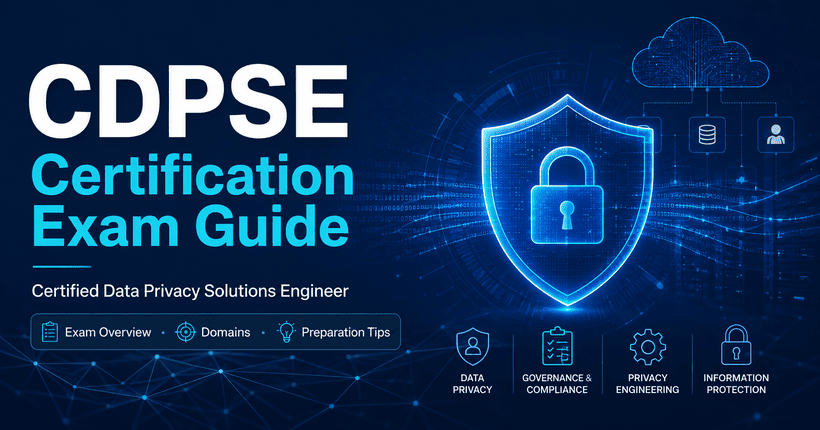
This is exactly where the Certified Data Privacy Solutions Engineer (CDPSE) certification fits. Offered by ISACA, CDPSE is designed for professionals who need to understand not only privacy principles and governance, but also how privacy requirements can actually be engineered into systems, applications, infrastructure, and business processes.
For security professionals, privacy engineers, architects, analysts, IT project managers, developers, consultants, and students planning careers around data governance or privacy technology, CDPSE provides a useful framework for connecting policy with implementation.
This guide explains what the ISACA CDPSE certification covers, how the current exam is structured, which technical skills matter most, and how candidates can build a realistic preparation strategy.
What Is the CDPSE Certification?
Table of Contents
ToggleCDPSE stands for Certified Data Privacy Solutions Engineer. It is an ISACA certification focused on the practical implementation of privacy requirements in technology environments.
One of the most important things to understand about CDPSE is that it is not simply a privacy-law certification.
A privacy professional may understand what an organization is required to do, while a CDPSE-oriented professional must also understand how those requirements can be translated into architecture, controls, system configurations, development practices, data lifecycle procedures, and operational processes.
For example, it is one thing to say that an organization should minimize unnecessary personal information. It is another thing to determine:
- which applications collect the information;
- where the information is stored;
- which users and services can access it;
- how long it should be retained;
- whether the information can be anonymized or pseudonymized;
- how consent should be recorded;
- how data subject requests can be implemented;
- how third-party processors should be controlled; and
- how the information should eventually be securely destroyed.
CDPSE sits in the middle of these questions.
It connects privacy governance, risk management, data lifecycle management, security controls, software development, architecture, and privacy engineering.
Candidates who are beginning their preparation can also review a structured CDPSE exam preparation course to become familiar with the certification objectives and major knowledge areas.
Why Is CDPSE Valuable?
The value of CDPSE comes largely from the growing overlap between privacy, cybersecurity, engineering, governance, and business operations.
Organizations increasingly need professionals who can communicate with several different groups at the same time. A privacy engineer may need to understand the requirements coming from legal and compliance teams while also working with developers, cloud architects, cybersecurity teams, data engineers, business owners, and project managers.
CDPSE helps establish a common technical framework for those conversations.
1. It Connects Privacy Requirements With Technology
Many privacy problems are ultimately implementation problems.
A company may have excellent privacy policies but still expose personal information because of excessive permissions, poorly configured APIs, insufficient logging, weak data retention controls, insecure third-party integrations, or applications that collect more information than necessary.
CDPSE focuses on turning privacy expectations into technical and operational controls.
2. It Builds Privacy-by-Design Thinking
Privacy should ideally be considered before a system is deployed rather than added after something goes wrong.
This is the idea behind Privacy by Design.
Instead of asking only, “Is this system compliant?” after development is complete, teams should ask privacy questions throughout requirements gathering, architecture, design, development, testing, deployment, operation, and retirement.
That mindset is especially valuable in cloud migrations, mobile applications, customer portals, analytics platforms, SaaS projects, AI systems, and other environments where personal information may move between many services.
3. It Complements Security Skills
Privacy and security overlap, but they are not identical.
Encryption, authentication, access control, monitoring, endpoint protection, secure development, and network security can all support privacy. However, a system can be secure and still create privacy problems if it collects unnecessary information, retains it indefinitely, uses it for an unexpected purpose, or prevents individuals from exercising applicable privacy rights.
CDPSE encourages candidates to think beyond traditional confidentiality, integrity, and availability and consider the complete use of personal information.
4. It Is Relevant to Technical and Management Roles
Although the word “Engineer” appears in the certification name, CDPSE is useful for more than software engineers.
Professionals who may benefit from the body of knowledge include:
- Privacy Engineers
- Security Engineers
- Privacy Analysts
- Privacy Managers
- Solution Architects
- Cloud Architects
- IT Risk Professionals
- Compliance Professionals
- Data Governance Specialists
- Software Developers
- IT Project Managers
- Technical Consultants
- Security Architects
- Data Engineers
Current CDPSE Exam Overview
The current ISACA CDPSE examination contains 120 multiple-choice questions. Candidates have 3.5 hours, or 210 minutes, to complete the examination.
| Exam Item | Current CDPSE Information |
|---|---|
| Certification | Certified Data Privacy Solutions Engineer |
| Acronym / Exam | CDPSE |
| Certification Provider | ISACA |
| Number of Questions | 120 multiple-choice questions |
| Exam Duration | 3.5 hours / 210 minutes |
| Passing Score | 450 or higher on ISACA’s 200–800 scaled scoring system |
| Exam Delivery | Computer-based testing through authorized PSI test centers or remote proctoring |
| ISACA Member Exam Fee | US$575 |
| Non-Member Exam Fee | US$760 |
| Certification Application Fee | US$50 after passing the exam |
One point worth emphasizing is that ISACA significantly updated the CDPSE exam blueprint in 2025. Candidates using older books, websites, videos, or study notes may still see a three-domain exam structure.
The current examination uses four domains, so your preparation materials should match the latest exam content outline.
If you are looking for structured study materials aligned with the certification topics, you can explore this ISACA CDPSE exam course while building your study plan.
Current CDPSE Exam Domains
The current CDPSE exam is divided into four domains:
| Domain | Weight |
|---|---|
| Domain 1: Privacy Governance | 20% |
| Domain 2: Privacy Risk Management and Compliance | 18% |
| Domain 3: Data Life Cycle Management | 23% |
| Domain 4: Privacy Engineering | 39% |
The weighting immediately tells you something important about the exam: Privacy Engineering is the largest domain by a significant margin.
Candidates therefore need more than a high-level understanding of privacy policies. Technical implementation is central to the CDPSE examination.
Domain 1: Privacy Governance – 20%
Privacy Governance provides the organizational foundation for an effective privacy program.
This domain covers areas such as:
- personal information;
- privacy principles;
- Privacy by Design;
- consent;
- transparency;
- privacy laws and regulations;
- privacy policies and guidelines;
- organizational privacy responsibilities;
- vendor and supply-chain management;
- privacy incident management; and
- data subject requests and notifications.
For beginners, it can be tempting to treat governance as documentation. In practice, good privacy governance determines who is responsible for privacy decisions, how requirements are communicated, how exceptions are handled, how third parties are evaluated, and how privacy obligations are integrated into normal business operations.
A project manager should pay particular attention to this domain because privacy governance often influences project requirements, stakeholder responsibilities, supplier selection, approval processes, and project risk.
Domain 2: Privacy Risk Management and Compliance – 18%
The second domain focuses on identifying, assessing, responding to, and monitoring privacy risk.
Important topics include:
- privacy risk management processes;
- risk policies;
- Privacy Impact Assessments (PIAs);
- privacy training and awareness;
- threats and vulnerabilities;
- risk response strategies;
- privacy frameworks;
- compliance evidence;
- audit and compliance artifacts; and
- privacy program metrics and monitoring.
This domain is particularly useful for candidates with backgrounds in project management, cybersecurity risk, audit, or governance.
One concept worth understanding is that privacy risk should not be assessed only from the organization’s perspective. Privacy professionals must also consider potential consequences for the individuals whose information is being processed.
For example, a data exposure might create regulatory and financial consequences for the organization while creating identity theft, discrimination, loss of confidentiality, financial harm, or reputational consequences for individuals.
Domain 3: Data Life Cycle Management – 23%
Privacy cannot be effectively managed without understanding where information comes from and what happens to it afterward.
The data lifecycle typically involves activities such as:
Collection → Processing → Use → Sharing → Storage → Retention → Archiving → Destruction
The CDPSE exam expects candidates to understand privacy controls throughout this lifecycle.
Important areas include:
- data inventories;
- dataflow diagrams;
- data classification;
- data quality and accuracy;
- use limitation;
- data analytics;
- AI-related data processing;
- data warehouses;
- data minimization;
- data disclosure;
- cross-system data transfers;
- storage;
- retention;
- archiving; and
- secure data destruction.
Why Data Mapping Matters
You cannot protect information effectively if you do not know where it exists.
A dataflow diagram may reveal that information entered into one customer application is actually processed by multiple systems:
- a web front end;
- an API gateway;
- a cloud database;
- a customer relationship management platform;
- an analytics environment;
- a logging platform;
- a backup system; and
- one or more third-party service providers.
From a privacy perspective, all of these locations may need to be considered.
This is why accurate data inventories and dataflow diagrams are foundational components of privacy engineering.
Domain 4: Privacy Engineering – 39%
Privacy Engineering accounts for 39% of the current CDPSE exam, making it the largest and arguably most important technical domain.
This section covers how privacy requirements interact with real technology stacks.
Technology Stacks
Candidates should understand privacy considerations across:
- traditional infrastructure;
- cloud computing platforms;
- devices and endpoints;
- network connectivity;
- software applications;
- APIs;
- cloud-native services; and
- secure development lifecycles.
Identity and Access Management
Identity and Access Management (IAM) is one of the most important technical areas for protecting personal information.
Privacy engineers need to think about:
- least privilege;
- role-based access;
- authentication;
- authorization;
- privileged access;
- service accounts;
- access reviews; and
- account lifecycle management.
A common privacy failure occurs when too many employees, applications, or third parties can access personal information even though they do not require it for legitimate business purposes.
Encryption and Hashing
Encryption is another major privacy-supporting security control.
Candidates should understand the purpose of protecting information:
- at rest;
- in transit; and
- where appropriate, during processing.
Do not simply memorize encryption terminology. Understand what problem a control is trying to solve, how keys are managed, and what limitations remain after encryption is implemented.
Anonymization and Pseudonymization
These two concepts are frequently confused.
Pseudonymization replaces direct identifiers with alternative values while retaining the possibility that information can be linked back to an individual using additional information.
Anonymization aims to transform information so that individuals can no longer be reasonably identified.
The distinction matters because pseudonymized information can still create privacy risk.
Consent and Tracking Technologies
Modern websites and applications frequently use cookies, SDKs, analytics tools, advertising technologies, and other tracking mechanisms.
CDPSE candidates should understand the technical side of consent management, including how consent preferences can affect which technologies are allowed to collect or process information.
Privacy Enhancing Technologies
Privacy Enhancing Technologies, commonly referred to as PETs, are increasingly important in privacy engineering.
Rather than viewing privacy only as a restriction on data processing, PETs can help organizations extract value from information while reducing unnecessary exposure of personal data.
Candidates should understand privacy-enhancing concepts and how different technical approaches can reduce privacy risk.
AI and Machine Learning Considerations
Artificial intelligence introduces new privacy engineering questions.
Teams may need to consider:
- what information enters a model or AI service;
- whether training data contains personal information;
- how data is retained;
- whether sensitive information may appear in prompts or outputs;
- how third-party AI providers process submitted information;
- how access to AI-related datasets is controlled; and
- whether existing privacy notices and governance processes appropriately address the new processing activity.
The important CDPSE mindset is not simply “AI is risky.” The goal is to identify specific privacy risks and then select appropriate technical, procedural, and governance controls.
Because this domain carries the greatest exam weight, candidates may want to spend extra time reviewing CDPSE privacy engineering exam topics and practicing scenario-based questions related to real-world technical implementation.
Privacy by Design: One of the Most Important CDPSE Concepts
If you remember only one broad idea while studying CDPSE, make it Privacy by Design.
Privacy controls should be considered throughout the system lifecycle rather than treated as a final compliance checkpoint.
Consider a new customer analytics platform.
A traditional project might first build the platform and then ask the privacy team whether it is acceptable.
A privacy-by-design project asks privacy questions much earlier:
- What personal information is actually necessary?
- Can less information achieve the same business objective?
- What is the intended purpose of processing?
- Which systems will receive the data?
- Who requires access?
- How should access be logged?
- How long should the information be retained?
- Can identifiers be pseudonymized?
- What happens when an individual makes a relevant privacy request?
- How will data eventually be deleted?
Those questions influence architecture before expensive design decisions become difficult to change.
Why CDPSE Is Relevant to Project Managers
CDPSE may appear at first to be a certification only for privacy engineers, but many of its principles are highly relevant to project management.
A modern IT project manager regularly coordinates stakeholders from business, architecture, development, cybersecurity, legal, procurement, operations, and compliance teams.
Privacy requirements can affect almost every stage of a technology project.
During Project Initiation
Project teams should determine whether the initiative will collect, process, transfer, or store personal information and whether additional privacy assessment is required.
During Requirements Gathering
Privacy requirements should become actual system requirements rather than remaining vague compliance statements.
Examples might include:
- retention requirements;
- user consent management;
- role-based access;
- audit logging;
- deletion capabilities;
- data export functionality;
- encryption requirements; and
- third-party processing restrictions.
During Vendor Selection
Project teams may need to evaluate how vendors process, protect, retain, transfer, and delete information.
During Development and Testing
Teams should verify that privacy controls actually work rather than assuming that implementation matches design documentation.
During Project Closure
Privacy responsibilities do not disappear when the project is delivered. Operational ownership, monitoring, incident response, retention, and eventual data destruction should all have defined owners.
For project managers moving into cybersecurity, governance, risk, compliance, or privacy-related roles, CDPSE therefore provides a valuable technical perspective.
CDPSE Certification Experience Requirements
You do not need to complete the full professional experience requirement before sitting for the CDPSE exam.
However, passing the examination and becoming certified are two separate steps.
To obtain the CDPSE designation, candidates must demonstrate at least three years of cumulative professional work experience performing CDPSE-related tasks.
The qualifying experience must satisfy ISACA’s applicable certification requirements and should be properly verified during the certification application process.
Candidates who pass the examination have five years from the passing date to apply for certification.
After passing the exam, candidates must also pay the applicable certification application processing fee and submit the required documentation.
Maintaining the CDPSE Certification
CDPSE is not a certification that you earn once and forget.
Certified professionals must maintain their knowledge through Continuing Professional Education.
Current ISACA requirements include:
- a minimum of 20 CPE hours per year;
- at least 120 CPE hours during each three-year reporting period;
- payment of the applicable annual certification maintenance fee; and
- continued compliance with ISACA’s professional requirements and Code of Professional Ethics.
This continuing education model makes sense for privacy professionals because technology, security risks, regulations, cloud architectures, and data-processing practices continue to change.
How Difficult Is the CDPSE Exam?
CDPSE can be challenging even for candidates with several years of professional experience because the exam crosses multiple disciplines.
A security engineer may be comfortable with encryption, IAM, network controls, and logging but less experienced with privacy governance or data subject requirements.
A privacy professional may understand policies and compliance very well but have less experience with APIs, cloud architecture, secure development, or technical security controls.
A project manager may understand governance and risk but need more time to build technical depth.
The strongest candidates develop a balanced understanding across all four domains.
The exam also requires judgment. ISACA questions often describe realistic situations and ask candidates to select the BEST, MOST appropriate, or FIRST action.
Several answer choices may sound reasonable. The challenge is deciding which one best addresses the scenario.
How to Study for the CDPSE Exam
Step 1: Start With the Current Exam Content Outline
Before opening a textbook or answering practice questions, review the current CDPSE exam domains.
Be particularly careful with older material because the CDPSE examination changed substantially in 2025.
Your study plan should be based on the current four-domain structure.
Step 2: Assess Your Existing Knowledge
Score yourself honestly across areas such as:
- privacy governance;
- privacy risk assessment;
- data classification;
- data lifecycle management;
- cloud technologies;
- IAM;
- encryption;
- logging and monitoring;
- secure software development;
- APIs;
- anonymization;
- pseudonymization;
- consent management;
- privacy-enhancing technologies; and
- AI privacy considerations.
This quickly shows where your study time should go.
Step 3: Give Extra Attention to Privacy Engineering
Because Domain 4 represents 39% of the examination, it deserves significant preparation time.
However, do not make the mistake of ignoring smaller domains. ISACA exam scenarios frequently combine governance, risk, lifecycle, and technical considerations in a single question.
Step 4: Understand Concepts Instead of Memorizing Definitions
Knowing that encryption protects information is not enough.
You should understand when encryption is appropriate, what risk it addresses, what it does not solve, and how it fits with other controls.
The same principle applies to anonymization, retention, IAM, privacy assessments, consent, logging, and data minimization.
Step 5: Practice Scenario-Based Questions
Quality practice questions help candidates learn how ISACA expects professionals to analyze situations.
When reviewing a question, do not simply check whether your answer was correct.
Ask:
- Why is the correct answer better than the alternatives?
- What concept is the question really testing?
- Which word in the scenario changes the answer?
- Is the question asking for the first action, the best control, or the long-term solution?
This method develops judgment rather than simple memorization.
Step 6: Build a Data Lifecycle Mindset
Whenever you encounter a privacy problem, ask:
What happens to this information from the moment it is collected until the moment it is destroyed?
This question connects many different parts of the CDPSE syllabus.
Step 7: Think Like a Privacy Engineer
During the exam, try to identify the underlying business and privacy objective before selecting a technical control.
The technically strongest security control is not automatically the best privacy solution.
The correct approach should support organizational requirements, reduce privacy risk, and remain practical within the scenario.
Once you understand the major concepts, completing a structured set of CDPSE exam practice and preparation materials can help reinforce the relationships between governance, risk, data lifecycle management, and technical privacy controls.
A Practical 8-Week CDPSE Study Plan
| Week | Study Focus |
|---|---|
| Week 1 | Review CDPSE exam objectives, privacy principles, and personal information concepts |
| Week 2 | Study Privacy Governance, roles, policies, vendors, incidents, and data subject processes |
| Week 3 | Study Privacy Risk Management, PIAs, risk response, frameworks, compliance evidence, and metrics |
| Week 4 | Study data inventories, dataflow mapping, classification, processing, analytics, and minimization |
| Week 5 | Study retention, storage, disclosure, transfer, archiving, and data destruction |
| Week 6 | Study infrastructure, cloud, endpoints, APIs, secure development, IAM, encryption, and logging |
| Week 7 | Study consent technologies, anonymization, pseudonymization, PETs, and AI/ML privacy considerations |
| Week 8 | Complete practice exams, review weak areas, and practice time management |
The exact schedule should depend on your background. An experienced privacy engineer may require less time for technical controls, while someone coming from project management or compliance may need additional time for architecture and security technologies.
During the final stages of preparation, candidates can use a dedicated CDPSE certification study resource to review exam objectives and identify areas that still require additional attention.
CDPSE vs. Other ISACA Certifications
ISACA offers several respected certifications, but they address different professional objectives.
- CDPSE focuses primarily on implementing privacy requirements and privacy engineering.
- CISA is oriented toward information systems auditing, assurance, and controls.
- CISM focuses on information security management.
- CRISC focuses on enterprise IT risk and information systems controls.
There is naturally some overlap among these certifications.
For example, CDPSE and CRISC both involve risk, while CDPSE and CISM both involve security-related controls. The difference is the perspective from which those controls are evaluated.
If your primary interest is translating privacy requirements into technical solutions, CDPSE is generally the most directly aligned ISACA certification.
Who Should Consider the CDPSE Certification?
CDPSE is particularly suitable for professionals who already work around technology and want deeper privacy expertise.
You should consider CDPSE if you:
- design or implement systems that process personal information;
- work with privacy or data protection teams;
- manage security controls that protect personal data;
- perform privacy or technology risk assessments;
- design cloud or application architectures;
- manage data governance initiatives;
- coordinate privacy requirements within IT projects;
- want to move from cybersecurity into privacy engineering; or
- want a technical privacy certification rather than one focused primarily on legal theory.
Is CDPSE Worth It?
For professionals working at the intersection of privacy, cybersecurity, governance, architecture, software development, cloud computing, and data management, CDPSE can be a strong certification choice.
Its main advantage is specialization.
Many professionals understand cybersecurity. Others understand privacy policy. Fewer professionals can comfortably translate privacy expectations into technical architecture and operational controls.
That combination is exactly what CDPSE is intended to validate.
However, candidates should choose the certification based on career direction rather than the certification name alone.
If your work primarily involves financial audit, another certification may be more relevant. If your career centers on security program management, CISM may align more closely. If enterprise IT risk is your main responsibility, CRISC may be a better fit.
CDPSE makes the most sense when technical privacy implementation is an important part of where you want your career to go.
If that matches your career goals, reviewing a complete Certified Data Privacy Solutions Engineer exam preparation resource can be a useful next step after becoming familiar with the exam domains.
Final Thoughts
Privacy is becoming a technical discipline as much as a governance and compliance discipline.
Organizations can no longer rely exclusively on written policies to protect personal information. Privacy requirements must be translated into architecture, IAM policies, encryption, secure development practices, data lifecycle controls, consent technologies, monitoring, anonymization, pseudonymization, cloud configurations, APIs, and increasingly AI-related safeguards.
The ISACA Certified Data Privacy Solutions Engineer (CDPSE) certification provides a structured framework for developing those skills.
For beginners, the breadth of the syllabus may initially look intimidating. The best approach is to stop treating the four domains as isolated subjects.
Instead, follow personal information throughout its entire lifecycle:
Why are we collecting it? What requirements apply? What risks exist? Where does the data travel? Who can access it? How should it be protected? How long should it remain? And how should it eventually be removed?
Once you begin thinking this way, privacy governance, risk management, data lifecycle management, and privacy engineering become parts of the same system rather than separate exam chapters.
That mindset is useful not only for passing the CDPSE exam, but also for designing technology that respects privacy in the real world.
Frequently Asked Questions About CDPSE
What does CDPSE stand for?
CDPSE stands for Certified Data Privacy Solutions Engineer, a professional certification offered by ISACA.
How many questions are on the CDPSE exam?
The current CDPSE examination contains 120 multiple-choice questions.
How long is the CDPSE exam?
Candidates have 3.5 hours, or 210 minutes, to complete the examination.
What score do I need to pass the CDPSE exam?
ISACA reports certification examination results using a scaled score from 200 to 800. A score of 450 or higher is required to pass.
What are the current CDPSE exam domains?
The current CDPSE exam contains four domains: Privacy Governance, Privacy Risk Management and Compliance, Data Life Cycle Management, and Privacy Engineering.
Which CDPSE domain has the highest weight?
Privacy Engineering is the largest domain and represents 39% of the current examination.
Do I need three years of experience before taking the CDPSE exam?
No. Candidates may take the examination before satisfying the professional experience requirement. However, the required professional experience must be demonstrated before the CDPSE certification can be awarded.
How much professional experience is required for CDPSE certification?
ISACA requires at least three years of cumulative professional experience performing CDPSE-related work before the certification can be awarded.
Is CDPSE useful for project managers?
Yes. IT project managers responsible for cloud systems, applications, data platforms, cybersecurity initiatives, or digital transformation projects increasingly need to understand privacy requirements, vendor risk, data lifecycle management, Privacy by Design, and technical privacy controls.
Is CDPSE a cybersecurity certification?
CDPSE overlaps significantly with cybersecurity but has a different primary objective. Cybersecurity controls such as IAM, encryption, logging, system hardening, and secure development support privacy, while CDPSE also addresses privacy governance, data use, consent, data minimization, retention, data subject considerations, and privacy engineering.
Editor’s Note: ISACA updated the CDPSE examination structure in June 2025. Candidates should verify that any books, courses, practice questions, or other study resources they use are aligned with the current four-domain exam blueprint.
Official References: