Cybersecurity operations has changed dramatically over the past few years. Security teams are no longer expected to simply monitor alerts and escalate suspicious activity. Modern analysts need to understand networks, endpoints, cloud environments, attack techniques, vulnerability management, threat intelligence, log analysis, and incident response while being comfortable working with real security tools.
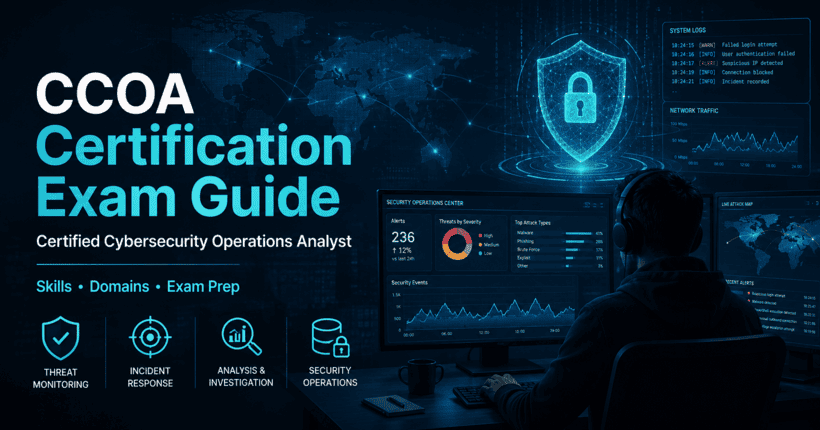
This is the environment that the ISACA Certified Cybersecurity Operations Analyst (CCOA) certification was designed to address.
Unlike cybersecurity certifications that concentrate mainly on theoretical knowledge, the CCOA certification combines traditional knowledge-based questions with performance-based tasks. Candidates are expected not only to understand cybersecurity concepts but also to demonstrate practical skills that resemble the work performed by security operations center (SOC) analysts and incident response professionals.
If you are a student, junior IT professional, cybersecurity analyst, SOC analyst, vulnerability analyst, or someone planning to move into a more technical security role, the ISACA CCOA exam is worth understanding.
This guide explains what the CCOA certification is, what appears on the exam, which technical skills matter most, what tools you should practice, how difficult the exam can be, and how to build a realistic preparation strategy.
Table of Contents
Table of Contents
Toggle- What Is the ISACA CCOA Certification?
- Who Should Consider the CCOA?
- CCOA Exam Overview
- CCOA Exam Domains
- Technical Skills Tested by CCOA
- Hands-On Tools You Should Know
- Security Operations and Incident Response
- How Difficult Is the CCOA Exam?
- How to Prepare for the CCOA Exam
- Career Value of the CCOA Certification
- CCOA vs. Other ISACA Certifications
- CCOA Certification FAQ
What Is the ISACA Certified Cybersecurity Operations Analyst Certification?
The Certified Cybersecurity Operations Analyst (CCOA) is a technical cybersecurity certification from ISACA. It focuses on the practical knowledge required to evaluate threats, identify vulnerabilities, detect suspicious activity, investigate security incidents, and recommend appropriate countermeasures.
ISACA introduced the certification to address an important problem in the cybersecurity profession: employers frequently want security analysts who already have hands-on experience, while early-career professionals often struggle to demonstrate that experience.
CCOA attempts to narrow this gap by evaluating both technical knowledge and practical ability.
For candidates who want a structured overview of the certification and preparation resources, the Certified Cybersecurity Operations Analyst CCOA course page can also be used alongside this exam guide when building a study plan.
The certification is particularly relevant to professionals involved in:
- Security operations center monitoring
- Threat detection and analysis
- Incident investigation
- Incident response
- Network traffic analysis
- Log and event analysis
- Vulnerability assessment
- Endpoint security
- Security monitoring
- Cyber threat intelligence
- Security control implementation
This operational emphasis makes CCOA different from many of ISACA’s better-known certifications, which traditionally have strong connections to areas such as information systems auditing, risk management, governance, and security management.
Who Should Consider the CCOA Certification?
ISACA positions CCOA particularly well for cybersecurity professionals who already have some practical exposure to security operations. The certification is often associated with professionals who have roughly two to three years of industry experience, although this should not be confused with a formal examination prerequisite.
The CCOA exam itself is open to anyone interested in cybersecurity. This makes the certification accessible to motivated students and early-career professionals who are building practical skills.
Potential candidates include:
- Cybersecurity Analysts investigating threats and suspicious activity
- SOC Analysts monitoring SIEM alerts and security events
- Information Security Analysts responsible for organizational security controls
- Incident Response Analysts investigating and containing security incidents
- Vulnerability Analysts identifying and prioritizing weaknesses
- Network Security Professionals moving toward security operations
- System Administrators transitioning into cybersecurity
- Students developing practical cybersecurity skills
Project management professionals who increasingly work with cybersecurity programs may also find the material valuable, especially if they want a deeper technical understanding of how threats, vulnerabilities, incidents, and security controls affect projects and business operations.
If your goal is to move toward one of these roles, reviewing the ISACA CCOA exam preparation resources can help you organize the certification objectives into a more structured learning path.
ISACA CCOA Exam Overview
One of the most important things to understand about the CCOA certification exam is that it is not simply another multiple-choice cybersecurity test.
ISACA currently uses a hybrid examination format combining traditional questions with performance-based exercises.
| Exam Detail | CCOA Information |
|---|---|
| Certification | Certified Cybersecurity Operations Analyst |
| Exam / Certification Code | CCOA |
| Organization | ISACA |
| Exam Duration | 4 Hours |
| Multiple-Choice Questions | 115 |
| Performance-Based Questions | 25 |
| Total Items | 140 |
| Exam Format | Hybrid knowledge-based and performance-based examination |
| Delivery | PSI testing centers or remote proctoring |
| Passing Score | 450 on ISACA’s 200–800 scaled scoring system |
| Exam Eligibility Period | 6 months after registration |
| Member Exam Fee* | US$399 |
| Non-Member Exam Fee* | US$499 |
*Exam pricing and policies may change. Candidates should always verify the latest details with ISACA before registering.
The inclusion of 25 performance-based questions is particularly significant. Candidates may need to work through simulated cybersecurity scenarios rather than simply recognize the correct definition from several answer choices.
That means memorization alone is unlikely to be a strong preparation strategy. Candidates should combine conceptual study with practical labs and targeted CCOA exam study resources that reflect the objectives of the certification.
CCOA Exam Domains and Weightings
The current ISACA CCOA exam content outline contains five domains.
| Domain | Weight |
|---|---|
| Domain 1: Technology Essentials | 25% |
| Domain 2: Cybersecurity Principles and Risk | 20% |
| Domain 3: Adversarial Tactics, Techniques, and Procedures | 10% |
| Domain 4: Incident Detection and Response | 34% |
| Domain 5: Securing Assets | 11% |
The weighting immediately tells us something important about the certification: CCOA is heavily focused on real security operations.
Incident Detection and Response alone accounts for 34% of the exam, while Technology Essentials represents another 25%. Together, these two areas account for more than half of the examination.
Domain 1: Technology Essentials – 25%
Cybersecurity analysts cannot investigate systems they do not understand. For this reason, the first CCOA domain establishes the underlying technical foundation required for security operations.
Topics include:
- Computer networking
- Cloud networking
- Network devices
- Ports and protocols
- Network access
- Network tools
- Network topology
- Logical and physical segmentation
- Databases
- Operating systems
- Command-line interfaces
- Virtualization
- Containerization
- Middleware
- Application programming interfaces
- Cloud applications
- Automated deployment
- Scripting and coding
This domain can be surprisingly challenging for candidates who learned cybersecurity primarily through policy, compliance, or governance courses.
You should understand what actually happens when systems communicate across a network. That includes IP addressing, common TCP and UDP services, routing concepts, DNS, HTTP/HTTPS, network segmentation, operating system processes, permissions, and command-line troubleshooting.
Domain 2: Cybersecurity Principles and Risk – 20%
Technical analysts do not operate independently from business objectives. Security decisions must ultimately reduce risk to an acceptable level while supporting organizational requirements.
This domain covers topics such as:
- Cybersecurity objectives
- Governance
- Compliance
- Risk management
- Cybersecurity roles and responsibilities
- Security models
- Application risk
- Cloud technology risk
- Data risk
- Network risk
- Supply chain risk
- Endpoint risk
- Web application risk
For a security analyst, identifying a vulnerability is only the beginning. You should also understand its context.
A vulnerability affecting an isolated laboratory computer is not necessarily equivalent to the same vulnerability affecting an internet-facing production system containing sensitive customer information.
CCOA therefore expects candidates to connect technical findings with risk.
Domain 3: Adversarial Tactics, Techniques, and Procedures – 10%
Defenders become more effective when they understand how attackers think.
This domain examines the threat landscape and common adversarial methods, including:
- Attack vectors
- Threat actors
- Threat agents
- Threat intelligence sources
- Attack types
- Cyberattack stages
- Exploitation techniques
- Penetration testing concepts
The important skill here is not memorizing a list of attack names. Candidates should learn to connect attacker behavior with observable evidence.
For example, if an attacker performs credential abuse, lateral movement, command execution, or data exfiltration, what evidence could appear in network traffic, endpoint telemetry, authentication records, or application logs?
This attacker-versus-defender perspective is fundamental to modern security operations.
Domain 4: Incident Detection and Response – 34%
Incident Detection and Response is the largest CCOA exam domain, making it one of the most important areas in your preparation.
Incident detection topics include:
- Data analytics
- Security detection use cases
- Indicators of compromise
- Indicators of attack
- Logs and alerts
- Security monitoring technologies
Incident response topics include:
- Incident handling
- Incident containment
- Forensic analysis
- Malware analysis
- Threat analysis
- Network traffic analysis
- Packet analysis
This is where candidates need to think like working analysts.
Imagine that a SIEM generates an alert showing an unusual PowerShell process followed by outbound network traffic to an unfamiliar IP address. A good analyst does not simply label the event “malware.”
The analyst asks questions:
- Which user launched the process?
- What command line was executed?
- Was the PowerShell activity encoded or obfuscated?
- What parent process launched it?
- Which destination IP and port were contacted?
- Did other endpoints contact the same infrastructure?
- Are there related authentication anomalies?
- Is containment necessary?
- What evidence must be preserved?
That analytical process is much closer to the mindset required for CCOA than simple vocabulary memorization.
Domain 5: Securing Assets – 11%
The final domain focuses on protecting systems and reducing identified weaknesses.
Major topics include:
- Security controls
- Security techniques
- Identity and access management
- Contingency planning
- Security frameworks and standards
- Industry best practices
- Vulnerability identification
- Vulnerability assessment
- Vulnerability remediation
- Vulnerability tracking
A mature vulnerability management process does not end when a scanner generates a report.
Analysts must determine whether a vulnerability is relevant, understand its potential impact, prioritize remediation, communicate findings, verify remediation, and continue tracking unresolved weaknesses.
Technical Skills You Need for the CCOA Exam
The breadth of the CCOA syllabus may look intimidating at first, but the required knowledge becomes easier to organize when you think in terms of an analyst workflow.
1. Networking Fundamentals
Network knowledge is fundamental because many attacks ultimately leave network evidence.
You should be comfortable with:
- TCP/IP fundamentals
- IPv4 addressing
- Common TCP and UDP ports
- DNS
- DHCP
- HTTP and HTTPS
- SSH
- Remote access protocols
- Firewalls
- Network segmentation
- Routing basics
- Packet structure
- Network troubleshooting tools
2. Windows Security
Windows endpoints remain common targets in enterprise environments. Analysts should understand where useful evidence is stored and how common Windows security mechanisms work.
Practice areas should include:
- Windows Event Viewer
- Authentication events
- Process execution
- Windows services
- PowerShell
- Windows Defender
- File hashes
- User and permission concepts
- Network connections
3. Linux Administration and Investigation
Linux skills are important because Linux systems appear throughout cloud environments, infrastructure platforms, security appliances, and application servers.
You should be comfortable using the command line for:
- File and directory management
- User management
- Permissions
- Process management
- Network configuration
- Remote access
- System information
- Input/output redirection
- Compression and archiving
- Log analysis
You do not need to become a Linux administrator before taking CCOA, but you should not feel lost when presented with a terminal.
4. Log Analysis
Security analysts spend a significant amount of time working with logs.
A log becomes valuable when you can answer questions such as:
- What happened?
- When did it happen?
- Which system generated the event?
- Which account was involved?
- Was the event expected?
- What happened immediately before and after the event?
Practice correlating evidence across endpoint, authentication, network, application, and security-monitoring logs.
5. Packet Analysis
Packet analysis is another highly practical skill for the CCOA candidate.
You should understand how to:
- Open and inspect packet captures
- Apply useful display filters
- Follow conversations and streams
- Identify source and destination addresses
- Recognize common protocols
- Investigate suspicious DNS activity
- Review HTTP requests and responses
- Identify unusual connection behavior
6. Threat Analysis
Threat analysis involves transforming raw indicators into useful security context.
An IP address, domain, hash, process name, or URL by itself may tell you very little.
The analyst’s role is to combine evidence and determine whether the activity represents normal behavior, a false positive, suspicious activity, or a confirmed incident.
7. Vulnerability Management
CCOA candidates should understand the complete vulnerability management lifecycle:
- Identify assets.
- Discover vulnerabilities.
- Validate findings.
- Assess risk and business context.
- Prioritize remediation.
- Apply fixes or compensating controls.
- Verify remediation.
- Track remaining vulnerabilities.
Simply learning CVSS terminology is not enough. You need to understand why two vulnerabilities with similar technical severity can have very different organizational risk.
Hands-On Tools to Practice for the ISACA CCOA Exam
ISACA publishes a list of technologies, utilities, operating systems, and security tools associated with the CCOA examination. This is one of the clearest signs that candidates should include practical laboratory work in their preparation.
Important examples include:
- Wireshark – network packet capture and traffic analysis
- Security Onion – security monitoring and network security analysis
- CyberChef – decoding, encoding, transformation, and data analysis
- Greenbone OpenVAS – vulnerability scanning and assessment
- Kibana – searching and visualizing security-related data
- Windows Event Viewer – Windows event and security log investigation
- Windows Defender – endpoint security and malware protection
- PowerShell – Windows administration and investigation
- CertUtil – certificate and file-related Windows operations
- Get-FileHash – PowerShell file hash calculation
- Linux command-line utilities – system, process, user, file, networking, and permission management
Do not make the mistake of trying to memorize every button in every application.
Instead, understand the security objective behind each tool.
For example:
- Wireshark helps answer what happened on the network?
- Event Viewer helps answer what happened on the Windows system?
- OpenVAS helps answer what known weaknesses exist?
- Kibana helps answer what events can be discovered by searching and correlating data?
- CyberChef helps answer what does this encoded or transformed data actually contain?
Learning tools in this context makes them far easier to remember. When preparing for the practical portion, it can also be useful to combine lab practice with a structured CCOA certification study guide so that your hands-on work remains aligned with the exam objectives.
Understanding Security Operations: The Core of CCOA
A strong CCOA candidate should understand how a security operations center turns raw telemetry into actionable security decisions.
A simplified workflow might look like this:
- A security control generates an alert.
- An analyst reviews the alert.
- Relevant logs and evidence are collected.
- The analyst determines whether the activity is suspicious.
- Threat intelligence and additional context are added.
- The analyst classifies and prioritizes the incident.
- Containment actions are recommended or implemented.
- Evidence is preserved for further investigation.
- Systems are remediated and restored.
- Lessons learned improve future detection and response.
The ability to move logically through this process is more valuable than memorizing isolated security definitions.
Indicators of Compromise vs. Indicators of Attack
Another useful distinction for CCOA preparation is the difference between an indicator of compromise (IOC) and an indicator of attack (IOA).
Indicators of compromise often describe observable artifacts associated with malicious activity, such as:
- Known malicious IP addresses
- Suspicious domain names
- Malware hashes
- Unexpected files
- Registry modifications
Indicators of attack focus more on attacker behavior and intent.
For example, unusual credential access followed by remote command execution and lateral movement may indicate an attack even before a known malware hash appears.
Modern analysts should therefore be capable of both artifact-based and behavior-based investigation.
Why False Positives Matter
A SOC can receive thousands or even millions of events. Not every alert represents an attack.
One of the analyst’s most important responsibilities is triage.
Consider an alert showing an administrator running PowerShell. The event itself may be legitimate. Context determines whether it becomes suspicious.
Useful questions include:
- Is this user normally an administrator?
- Was the command expected?
- Was it executed during a normal maintenance window?
- Was the command encoded?
- Did it download files?
- Did the endpoint communicate with an unusual destination afterward?
CCOA preparation should therefore emphasize analytical reasoning rather than treating every suspicious-looking event as a confirmed incident.
How Difficult Is the CCOA Certification Exam?
The CCOA exam can be challenging, especially for candidates whose cybersecurity knowledge is mostly theoretical.
The difficulty comes from three major factors.
Broad Technical Coverage
You need knowledge across networking, Windows, Linux, cloud technology, applications, cybersecurity risk, vulnerabilities, threat actors, incident response, and security controls.
Performance-Based Questions
Knowing what Wireshark does is different from examining network data and deciding which traffic is suspicious.
Similarly, knowing the definition of a vulnerability scanner is different from interpreting scan results and deciding which weakness should receive attention first.
Time Management
The exam lasts four hours, but candidates must work through both traditional multiple-choice items and hands-on tasks.
Spending too much time investigating a single practical scenario can create unnecessary pressure later in the examination.
For this reason, practical familiarity can improve both accuracy and speed.
How to Prepare for the CCOA Exam
A good CCOA study plan should combine conceptual study, question practice, and hands-on laboratories. A structured set of CCOA exam preparation materials can be useful for identifying weak areas and keeping your review aligned with the certification domains.
Step 1: Start With the Official CCOA Exam Content Outline
Before opening a textbook or watching hours of training videos, study the official exam domains.
Create a checklist based on:
- Technology Essentials – 25%
- Cybersecurity Principles and Risk – 20%
- Adversarial Tactics, Techniques, and Procedures – 10%
- Incident Detection and Response – 34%
- Securing Assets – 11%
This prevents you from spending excessive time on interesting cybersecurity topics that have little relevance to the actual examination.
Step 2: Build Your Networking Foundation
If networking is a weak area, fix it early.
At minimum, understand:
- IP addressing
- TCP and UDP
- Ports and services
- DNS
- HTTP/HTTPS
- Routing concepts
- Network segmentation
- Firewalls
- Common troubleshooting commands
Security analysis becomes much easier once normal network behavior makes sense.
Step 3: Practice Windows and Linux Commands
Do not only read command examples.
Open a laboratory environment and actually use them.
Practice:
- Finding running processes
- Checking active network connections
- Reviewing user accounts
- Checking file permissions
- Searching log files
- Calculating file hashes
- Examining system information
- Working with files and directories
Step 4: Become Comfortable With Wireshark
You do not need to become a professional packet-forensics specialist, but basic Wireshark proficiency is highly valuable.
Practice identifying:
- DNS traffic
- HTTP sessions
- TCP connections
- Source and destination addresses
- Unusual ports
- Repeated connection attempts
- Potential command-and-control behavior
Step 5: Practice Log Investigation
Take sample log data and force yourself to answer investigation questions rather than simply reading individual records.
For example:
Question: A user account generated repeated failed logins and then successfully authenticated from an unusual system. What additional evidence would you examine?
A good investigation might include:
- Source IP address
- Authentication timestamps
- Other accounts targeted by the source
- Geographic or network context
- Processes executed after login
- Endpoint activity
- Additional lateral movement attempts
Step 6: Learn Vulnerability Prioritization
A common beginner mistake is assuming that the vulnerability with the highest technical severity should always be fixed first.
Real vulnerability management considers:
- Asset importance
- Internet exposure
- Available exploits
- Attack complexity
- Business impact
- Existing security controls
- Threat intelligence
- Remediation availability
Developing this risk-based mindset will help with both CCOA questions and real security work.
Step 7: Spend Extra Time on Incident Detection and Response
Because this domain represents 34% of the examination, it deserves significant study time.
You should be able to follow an incident from initial detection through triage, investigation, containment, remediation, documentation, and lessons learned.
Step 8: Use Practice Questions Correctly
Practice questions are valuable when they teach you how to reason through a scenario. Candidates can use CCOA practice and review resources as one part of a broader preparation strategy, but every question should be used to understand the underlying security concept rather than simply memorize an answer.
After answering a question, ask:
- Why is the correct answer correct?
- Why are the other choices incorrect?
- Which technical concept is being tested?
- Could I solve a similar problem if the scenario changed?
This approach is far more effective than simply memorizing answers.
Step 9: Practice Performance-Based Scenarios
The practical portion should not be left until the final days before your exam.
Regularly practice tasks involving:
- Packet investigation
- Log searching
- File hash analysis
- Windows events
- Linux commands
- Vulnerability scan interpretation
- Security monitoring dashboards
- Incident triage
A Sample CCOA Study Schedule
The amount of preparation required depends heavily on your existing technical experience. However, a structured eight-week plan can provide a useful starting point.
| Week | Primary Focus |
|---|---|
| Week 1 | CCOA exam outline, networking fundamentals, common protocols |
| Week 2 | Windows, Linux, virtualization, cloud and application fundamentals |
| Week 3 | Cybersecurity principles, governance and risk |
| Week 4 | Threat actors, attack vectors, exploitation and attacker techniques |
| Week 5 | Security monitoring, logs, indicators and detection use cases |
| Week 6 | Incident response, network traffic and packet analysis |
| Week 7 | Vulnerability management, controls and asset protection |
| Week 8 | Practice questions, labs, weak-area review and timed scenarios |
Candidates with little practical experience may benefit from extending this schedule rather than trying to rush through the material.
Is the CCOA Certification Worth It?
The value of any cybersecurity certification depends on your career direction.
CCOA is particularly interesting because it fills a different role from certifications focused primarily on governance, management, or auditing.
Its strongest value is likely to be for professionals who want to demonstrate practical competence in areas such as:
- Security monitoring
- SOC operations
- Threat detection
- Incident response
- Security investigation
- Network analysis
- Vulnerability management
The performance-based exam format also provides a stronger practical dimension than a certification based entirely on multiple-choice questions.
However, candidates should maintain realistic expectations. A certification does not replace real experience.
The best combination remains:
Knowledge + hands-on practice + professional experience + certification.
CCOA can help validate that combination, especially for professionals in the early stages of a cybersecurity operations career.
Skills That Can Transfer Directly to the Workplace
One of the more useful aspects of preparing for CCOA is that much of the material can transfer directly into day-to-day security work.
For example, learning how to:
- Interpret network traffic
- Investigate Windows events
- Use Linux commands
- Evaluate security alerts
- Identify suspicious patterns
- Analyze vulnerability reports
- Determine incident severity
- Document investigation findings
can improve practical security capabilities even before the certification exam is attempted.
CCOA vs. CISM, CISA, and Other ISACA Certifications
People familiar with ISACA often associate the organization with CISA, CISM, CRISC, and other well-established certifications. CCOA serves a different purpose.
| Certification | Primary Focus | Typical Career Direction |
|---|---|---|
| CCOA | Technical cybersecurity operations, threat detection, incident response and vulnerability analysis | SOC analyst, cybersecurity analyst, incident response analyst |
| CISM | Information security governance, risk, security programs and management | Security manager, security leader, security program manager |
| CISA | Information systems auditing, assurance, controls and governance | IT auditor, security auditor, assurance professional |
| CRISC | Enterprise IT risk and information systems controls | Risk analyst, IT risk manager, GRC professional |
If your goal is to work directly with alerts, network traffic, endpoints, vulnerabilities, threat data, and security incidents, CCOA is more operationally focused.
If your long-term goal is security management, governance, audit, or enterprise risk, another ISACA certification may eventually complement your CCOA.
Maintaining the CCOA Certification
Passing the exam is not the end of the certification lifecycle.
ISACA currently requires CCOA holders to maintain their professional knowledge through Continuing Professional Education.
The current requirements include:
- At least 20 CPE hours each year
- At least 120 CPE hours during each three-year reporting period
- Payment of the annual certification maintenance fee
- Compliance with ISACA’s Code of Professional Ethics
- Compliance with the CPE policy and audit process when applicable
This continuing education requirement is particularly relevant in cybersecurity because tools, vulnerabilities, attacker behavior, cloud platforms, and defensive technologies change rapidly.
Common CCOA Preparation Mistakes
Mistake 1: Studying Only Definitions
Definitions are useful, but the examination expects candidates to apply concepts to realistic security situations.
Mistake 2: Ignoring the Command Line
Cybersecurity analysts frequently work with Windows and Linux systems. Avoiding command-line practice creates an unnecessary weakness.
Mistake 3: Skipping Packet Analysis
If Wireshark feels unfamiliar, start practicing early rather than hoping packet analysis will represent only a small part of your preparation.
Mistake 4: Memorizing Practice Questions
Memorized answers do not build the analytical skills required for modified scenarios or performance-based tasks.
Mistake 5: Treating Every Alert as an Incident
Real security operations requires triage. Analysts need to differentiate normal activity, false positives, suspicious activity, and confirmed incidents.
Mistake 6: Ignoring Business Context
A technically severe vulnerability does not automatically represent the organization’s highest risk.
Mistake 7: Leaving Hands-On Labs Until the End
Practical ability develops through repetition. Short, frequent laboratory sessions are generally more useful than trying to learn every tool immediately before the exam.
What Should You Be Able to Do Before Taking the CCOA Exam?
Before scheduling the examination, you should feel reasonably comfortable performing tasks such as:
- Recognizing common network protocols and services
- Interpreting basic network traffic
- Using common Linux commands
- Working with PowerShell commands
- Reviewing Windows security events
- Calculating and interpreting file hashes
- Understanding vulnerability scan results
- Identifying indicators of compromise
- Evaluating suspicious security events
- Explaining the basic incident response lifecycle
- Prioritizing vulnerabilities using risk and business context
- Documenting security investigation findings
If several of these activities are completely unfamiliar, additional laboratory preparation will probably provide more value than simply completing another round of practice questions.
Frequently Asked Questions About the CCOA Certification
What does CCOA stand for?
CCOA stands for Certified Cybersecurity Operations Analyst, a cybersecurity certification offered by ISACA.
How many questions are on the CCOA exam?
The current CCOA examination contains 115 multiple-choice questions and 25 performance-based questions, for a total of 140 exam items.
How long is the CCOA exam?
The ISACA CCOA exam currently allows candidates four hours to complete the examination.
What is the CCOA passing score?
ISACA uses a scaled scoring system ranging from 200 to 800 for its certification examinations. A score of 450 or higher is required to pass CCOA.
Does the CCOA exam include hands-on questions?
Yes. CCOA is a hybrid certification exam that includes performance-based questions in addition to traditional multiple-choice questions.
Do I need cybersecurity work experience to take CCOA?
The examination itself is open to anyone interested in cybersecurity. However, the certification is particularly relevant to professionals who already have practical cybersecurity exposure, and ISACA has positioned it toward early-career analysts with approximately two to three years of experience.
What is the largest CCOA exam domain?
Incident Detection and Response is currently the largest domain and represents 34% of the exam.
Do I need to know Wireshark for CCOA?
Wireshark appears among the technologies and tools identified by ISACA for CCOA candidates. Candidates should therefore be comfortable with fundamental network traffic and packet-analysis concepts.
Is CCOA suitable for beginners?
A motivated beginner can study for the certification, and there is no formal experience requirement to sit for the exam. However, candidates with limited technical experience should expect to spend additional time learning networking, Windows, Linux, security monitoring, and practical investigation techniques.
Is CCOA good for SOC analysts?
Yes. SOC analyst is one of the roles most closely aligned with the certification because CCOA covers security monitoring, logs, alerts, threat detection, incident triage, packet analysis, and incident response.
How should I prepare for the CCOA certification?
A strong preparation strategy combines the official exam content outline, cybersecurity theory, hands-on labs, packet and log analysis, command-line practice, and scenario-based review. You can also review the CCOA Certified Cybersecurity Operations Analyst exam preparation page when organizing your study resources.
Is CCOA better than CISM?
They serve different career goals. CCOA focuses on technical cybersecurity operations, while CISM is designed around information security management, governance, risk management, security programs, and incident management. A technical analyst may begin with CCOA and later pursue a management-focused credential as responsibilities expand.
Final Thoughts: Should You Pursue the CCOA Certification?
The ISACA Certified Cybersecurity Operations Analyst certification is an interesting addition to the cybersecurity certification landscape because it emphasizes something employers repeatedly ask for: practical security ability.
CCOA is not simply about knowing cybersecurity terminology. Candidates need to understand networks, operating systems, attack behavior, security logs, vulnerabilities, incidents, and defensive controls—and they must be prepared to apply that knowledge.
For students and early-career professionals, preparing for the CCOA exam can provide a useful framework for building skills that are directly relevant to security operations.
For working analysts, the certification can provide a structured way to validate knowledge across threat analysis, incident detection, vulnerability assessment, packet analysis, and incident response.
The most effective preparation strategy is therefore straightforward:
Study the concepts, understand the technology, practice with real tools, investigate realistic scenarios, and learn to think like an analyst rather than simply memorizing answers.
If your goal is to build a career in cybersecurity operations, SOC analysis, threat detection, vulnerability management, or incident response, the CCOA Certified Cybersecurity Operations Analyst certification deserves serious consideration as part of your professional development path.
Continue Your CCOA Exam Preparation
Once you understand the exam domains and technical requirements, the next step is to turn that knowledge into a structured study routine. Review each domain, identify your weaker technical areas, practice with relevant cybersecurity tools, and regularly test your understanding with scenario-based questions.
For additional CCOA study information and exam preparation resources, visit:
CCOA Certified Cybersecurity Operations Analyst Exam Preparation
Official CCOA References
Because certification requirements, exam fees, tools, and examination policies can change over time, candidates should verify the latest information directly with ISACA before registering.