Artificial intelligence is quickly becoming part of everyday enterprise technology. Organizations are using machine learning, generative AI, large language models, predictive analytics, and AI-assisted automation in areas ranging from cybersecurity and finance to customer service and software development.
For auditors, however, AI introduces a different set of questions. Where did the training data come from? How is a model validated? Who is accountable for an automated decision? How does the organization detect model drift? What happens when an AI system produces biased, inaccurate, or unsafe results?
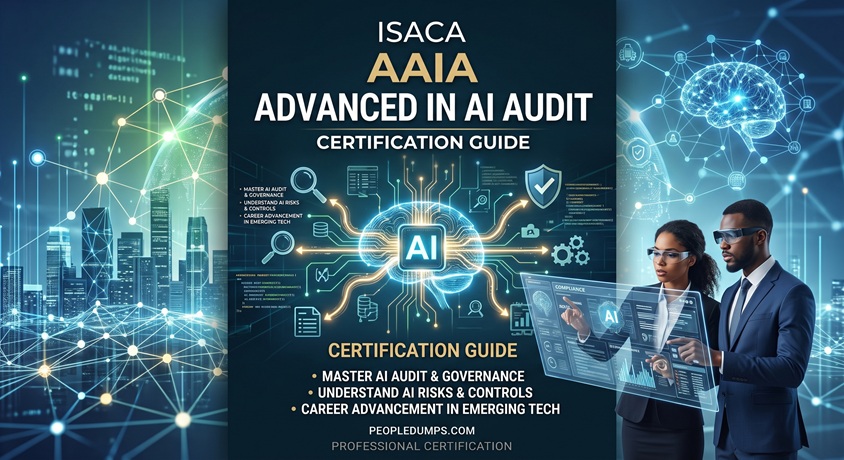
These questions have created a growing need for professionals who understand both traditional IT audit principles and the technical risks associated with artificial intelligence. The ISACA Advanced in AI Audit (AAIA) certification was developed specifically for this area.
AAIA is an advanced professional certification designed for experienced auditors and assurance professionals who need to assess AI governance, AI operations, AI risk, and the controls surrounding artificial intelligence systems. It also addresses another important development: how auditors themselves can use AI-enabled tools to improve audit planning, testing, evidence analysis, and reporting.
This AAIA exam guide explains the certification, its exam domains, eligibility requirements, technical topics, career value, and a practical approach to preparing for the exam.
What Is the ISACA Advanced in AI Audit (AAIA) Certification?
Table of Contents
ToggleThe Advanced in AI Audit (AAIA) is a specialized certification from ISACA focused on auditing and providing assurance over artificial intelligence systems.
Unlike a general AI certification that concentrates primarily on building models or writing machine learning code, AAIA looks at AI from an audit, governance, risk, compliance, and assurance perspective.
An AAIA professional should be able to evaluate questions such as:
- Does an organization’s AI strategy support its business objectives?
- Are responsibilities for AI governance clearly defined?
- Is training and operational data properly governed?
- Are privacy and security controls appropriate for AI systems?
- How is bias identified and managed?
- Are AI models properly tested before deployment?
- How does the organization detect model or data drift?
- Are AI-generated decisions appropriately supervised?
- Can management explain and document important AI decisions?
- Are third-party AI providers adequately assessed?
- Can AI tools safely improve the audit process itself?
This makes the AAIA AI audit certification particularly relevant to professionals working at the intersection of IT audit, cybersecurity, governance, risk management, compliance, privacy, data governance, and artificial intelligence.
AAIA Exam Overview
According to ISACA’s current exam information, the AAIA examination contains 90 questions covering three major professional domains.
| Exam Item | Details |
|---|---|
| Certification | Advanced in AI Audit (AAIA) |
| Provider | ISACA |
| Number of Questions | 90 questions |
| Number of Domains | 3 |
| Primary Focus | AI governance, AI operations, and AI auditing |
| Member Exam Fee | US$459 as currently listed by ISACA |
| Non-Member Exam Fee | US$599 as currently listed by ISACA |
| Certification Application Fee | US$50 |
| Exam Provider | PSI |
| Registration Eligibility Period | 6 months after registration |
| Certification Application Window | Within 5 years after passing the exam |
Exam policies, fees, eligibility requirements, and delivery options can change. Candidates should always verify the latest details on the official ISACA website before registering.
Before beginning your study plan, it is useful to review the complete ISACA AAIA exam preparation resources and compare them with the latest official exam objectives.
Who Is Eligible for the AAIA Certification?
One of the most important things to understand about AAIA is that it is not designed as an entry-level AI certification.
ISACA positions AAIA as an advanced credential. Candidates must hold an active CISA (Certified Information Systems Auditor) certification or another qualifying advanced auditing or accounting designation accepted by ISACA.
ISACA currently recognizes several professional designations, subject to its eligibility conditions, including credentials from professional auditing and accounting organizations.
For this reason, students and new IT professionals may want to think of AAIA as a longer-term career objective. Building knowledge in networking, cybersecurity, information systems, risk management, audit, and AI fundamentals first can make the advanced material much easier to understand.
If you are starting an IT audit career from the beginning, pursuing CISA before progressing to the Advanced in AI Audit certification can be a logical path.
AAIA Exam Domains
The AAIA exam is organized into three domains. Understanding their relative weight is important because almost half of the examination focuses on AI operations.
| Domain | Weight |
|---|---|
| Domain 1: AI Governance and Risk | 33% |
| Domain 2: AI Operations | 46% |
| Domain 3: AI Auditing Tools and Techniques | 21% |
A strong AAIA exam study plan should reflect these percentages rather than allocating equal study time to every topic.
Domain 1: AI Governance and Risk – 33%
The first domain examines how organizations govern artificial intelligence and manage the risks associated with it.
From an auditor’s perspective, deploying an AI application is not simply a technical project. It creates questions about accountability, ethics, privacy, security, regulation, data ownership, and business risk.
Major topics include:
- AI models, considerations, and requirements
- AI governance and program management
- AI risk management
- Privacy and data governance
- Responsible and ethical AI
- AI-related regulations
- Industry standards and leading practices
Understanding AI Governance
Good AI governance begins by defining who is responsible for AI systems and their outcomes. An organization may have data scientists, application developers, cybersecurity teams, legal departments, compliance officers, business owners, and external vendors involved in a single AI solution.
An auditor should therefore look for clearly defined accountability.
Important questions include:
- Who owns the AI system?
- Who approves its use?
- Who is responsible for model risk?
- Who reviews high-risk decisions?
- Who can modify the model or its configuration?
- Who monitors the model after deployment?
Without clearly defined ownership, important control failures can fall between organizational responsibilities.
AI Risk Management
AI risk extends beyond conventional cybersecurity.
For example, a technically secure model could still create serious business risk if its training data is biased or its recommendations cannot be adequately explained.
AI auditors therefore need to consider risks including:
- Bias and unfair outcomes
- Inaccurate model outputs
- Privacy violations
- Weak explainability
- Insufficient human oversight
- Unauthorized model access
- Data poisoning
- Model manipulation
- Regulatory non-compliance
- Third-party AI risk
- Reputational damage
This is where frameworks such as the NIST Artificial Intelligence Risk Management Framework (AI RMF) become useful. NIST structures AI risk management around functions including Govern, Map, Measure, and Manage, giving organizations a practical way to integrate trustworthiness considerations into AI systems.
Privacy and Data Governance
AI systems depend heavily on data, so weak data governance often becomes weak AI governance.
An auditor may need to investigate:
- Where data originated
- Whether the organization has permission to use it
- Whether personal data is appropriately protected
- How data quality is measured
- Whether sensitive information enters AI prompts
- How long AI-related data is retained
- Who can access training and inference data
For generative AI, organizations also need controls around prompts, uploaded documents, retrieval-augmented generation data sources, generated content, and interaction logs.
Domain 2: AI Operations – 46%
AI Operations is the largest AAIA domain, representing 46% of the exam. Candidates preparing for the ISACA AAIA certification exam should therefore spend substantial study time on this section.
This section moves deeper into how artificial intelligence systems are developed, deployed, monitored, changed, and ultimately retired.
Major topics include:
- Data management specific to AI
- AI solution development methodologies
- AI system lifecycle management
- AI-specific change management
- Supervision of AI solutions
- Testing AI solutions
- AI threats and vulnerabilities
- AI-related incident response
The AI System Lifecycle
Traditional software generally follows a relatively predictable relationship between code and output. Machine learning is different because behavior can depend heavily on training data, model parameters, external data, user prompts, and changing real-world conditions.
An auditor should therefore understand the entire AI lifecycle:
- Business requirement definition
- Data collection and preparation
- Model selection or development
- Training
- Testing and validation
- Approval
- Deployment
- Monitoring
- Change management
- Retraining or model replacement
- Decommissioning
Controls should exist throughout this lifecycle rather than being added only after a model reaches production.
Model Testing and Validation
An important AAIA concept is that an AI solution should be tested for more than simple technical functionality.
Depending on the use case, testing may consider:
- Accuracy
- Reliability
- Robustness
- Bias
- Fairness
- Explainability
- Privacy
- Security
- Performance
- Business suitability
The auditor does not necessarily need to become a machine learning engineer, but understanding how models are validated is extremely useful when assessing whether control evidence is meaningful.
Data Drift and Model Drift
A model that performs well today may not perform equally well six months later.
If the production environment changes significantly from the environment represented by the original training data, model accuracy can deteriorate.
For an auditor, this raises several questions:
- Does the organization monitor model performance continuously?
- Are thresholds established for unacceptable performance?
- Is drift detected automatically?
- Who decides whether retraining is necessary?
- Is a retrained model tested before production deployment?
This illustrates why AI auditing often requires more continuous oversight than traditional application auditing.
Threats Against AI Systems
AI creates additional attack surfaces beyond those found in traditional information systems.
Examples may include:
- Data poisoning
- Adversarial inputs
- Prompt injection
- Model extraction
- Model inversion
- Sensitive information disclosure
- Training data leakage
- Supply-chain attacks
- Unauthorized model modification
- Abuse of AI agents or excessive permissions
For professionals coming from networking or cybersecurity backgrounds, this portion of AAIA can be particularly interesting because conventional controls such as identity management, segmentation, logging, encryption, secure development, and incident response remain important but must now be combined with AI-specific controls.
Security professionals may also find resources such as MITRE ATLAS useful when studying adversarial techniques affecting AI-enabled systems.
Incident Response for AI
AI incidents can be difficult to classify.
Consider a customer-service AI assistant that begins disclosing confidential information. Is that a data incident, application security incident, privacy incident, model incident, or all four?
An effective AI incident response process should establish:
- Clear escalation paths
- Model and system owners
- Logging requirements
- Evidence preservation
- Containment procedures
- Rollback mechanisms
- Regulatory notification requirements
- Lessons-learned procedures
Auditors should determine whether existing incident management procedures genuinely cover AI-specific events rather than assuming conventional procedures are automatically sufficient.
Domain 3: AI Auditing Tools and Techniques – 21%
The third domain is what makes AAIA particularly interesting for professional auditors.
It examines not only how to audit AI but also how AI can improve auditing.
The official domain includes topics such as:
- Audit planning and design
- Audit testing
- Sampling methodologies
- Audit evidence collection
- Audit data quality
- Data analytics
- AI audit reporting
Using AI in the Audit Process
Traditional audits frequently depend on manual sampling. AI and data analytics can potentially examine much larger datasets and identify anomalies that might otherwise be missed.
Possible audit applications include:
- Transaction anomaly detection
- Continuous control monitoring
- Log analysis
- Document classification
- Contract analysis
- Risk identification
- Evidence summarization
- Fraud indicators
- Audit report drafting assistance
However, using AI does not eliminate the auditor’s professional responsibility.
If an AI tool generates inaccurate conclusions, the auditor cannot simply blame the model. Auditors must understand the reliability, limitations, data sources, security, and governance surrounding tools used in the audit process.
Important Technologies to Understand for AAIA
You do not need to become a full-time data scientist to prepare for AAIA, but a working knowledge of common AI technologies will make many AAIA exam scenarios easier to understand.
Machine Learning
Understand the basic difference between supervised learning, unsupervised learning, and other common machine learning approaches. More importantly, understand how training data, validation, testing, and model performance affect audit risk.
Generative AI and Large Language Models
Generative AI introduces risks such as hallucination, prompt injection, confidential data exposure, unreliable output, copyright concerns, and excessive reliance on automated responses.
Auditors should also understand why human validation remains important when generative AI affects significant business decisions.
MLOps
MLOps applies engineering and operational practices to machine learning development and deployment.
From an audit perspective, useful concepts include:
- Model versioning
- Data versioning
- Deployment approval
- Automated testing
- Monitoring
- Change management
- Rollback
- Access control
Explainable AI
Some AI models are difficult to interpret. This becomes particularly important when decisions affect areas such as lending, employment, healthcare, insurance, or fraud detection.
An auditor may therefore need to evaluate whether the level of explainability is appropriate for the business and regulatory risk associated with the system.
AI Frameworks and Standards Worth Studying
AAIA preparation should not be limited to memorizing terminology. Understanding several widely recognized AI governance and risk resources can help candidates develop better professional judgment.
NIST AI Risk Management Framework
The NIST AI RMF provides a structured approach for managing risks associated with artificial intelligence. Its focus on trustworthy and responsible AI makes it particularly useful when studying governance, risk assessment, measurement, and ongoing risk management.
ISO/IEC 42001
ISO/IEC 42001 specifies requirements for establishing, implementing, maintaining, and continually improving an Artificial Intelligence Management System (AIMS).
It is useful for understanding how organizations can manage AI governance systematically rather than treating individual AI projects independently.
MITRE ATLAS
MITRE ATLAS, or the Adversarial Threat Landscape for Artificial-Intelligence Systems, provides information about adversarial tactics and techniques affecting AI systems.
Cybersecurity professionals preparing for AAIA may find it useful for connecting familiar security concepts with AI-specific threats.
Why Is the AAIA Certification Valuable?
AAIA addresses a gap that is becoming increasingly important.
Organizations are investing heavily in AI, but successful AI adoption requires more than developers and data scientists. Businesses also need independent professionals capable of asking whether AI systems are controlled, compliant, secure, reliable, ethical, and aligned with organizational objectives.
The ISACA Advanced in AI Audit certification can be especially valuable for professionals working in:
- IT audit
- Internal audit
- Technology assurance
- AI governance
- GRC
- Cybersecurity
- Risk management
- Privacy
- Compliance
- Technology consulting
It can also help experienced CISA professionals extend their existing knowledge into AI assurance instead of starting with an entirely unrelated certification path.
AAIA vs. Traditional IT Audit
Many traditional IT audit principles remain valid in an AI environment. Access control, segregation of duties, change management, logging, vendor management, incident response, and data protection are still fundamental.
The difference is that AI introduces additional layers of uncertainty.
| Traditional IT Audit | AI Audit |
|---|---|
| Application logic | Algorithms, models, training data, and prompts |
| Software testing | Model validation and AI testing |
| Change management | Code, data, model, parameter, and prompt changes |
| Data integrity | Data quality, bias, representativeness, and provenance |
| Security monitoring | Traditional plus AI-specific threat monitoring |
| Application output | Probabilistic or generative output |
| User access | User, API, model, agent, and data access |
This is why experienced auditors cannot simply apply an old checklist to an AI system and expect a complete assessment.
How Difficult Is the AAIA Exam?
AAIA should be approached as an advanced professional exam rather than an introductory AI knowledge test.
Candidates already familiar with CISA-style questions may recognize ISACA’s emphasis on professional judgment. In many scenarios, several answers may appear technically possible, but candidates must identify the option that best addresses governance, risk, control, or audit objectives.
The challenge can vary significantly depending on your background.
An experienced IT auditor may be comfortable with governance and audit methodology but need additional study in machine learning and AI operations. A cybersecurity professional may understand threats and technical controls but need more practice with audit planning and evidence. Someone working with machine learning every day may understand models but still need to learn assurance, independence, governance, and professional audit principles.
Using a structured AAIA certification exam preparation plan can help identify these knowledge gaps before exam day.
How to Prepare for the ISACA AAIA Exam
1. Start With the Official Exam Content Outline
Before studying individual technologies, review the official AAIA exam domains carefully.
The domain weights immediately tell you where to spend your time. With AI Operations representing 46% of the examination, it deserves significant attention.
2. Use the Official AAIA Review Manual
ISACA offers an official AAIA Review Manual designed around the certification’s job practice areas. This should be one of the core resources in a structured preparation plan.
3. Strengthen Your AI Fundamentals
If AI is new to you, learn the fundamentals before trying to memorize audit controls.
You should be comfortable explaining concepts such as:
- Machine learning
- Training and inference
- Training, validation, and test data
- Generative AI
- Large language models
- Bias
- Model drift
- Explainability
- Hallucination
- MLOps
4. Think Like an Auditor
AAIA is not simply a vocabulary examination.
When reviewing a scenario, ask:
- What is the business objective?
- What is the most significant risk?
- Who should own that risk?
- What control should exist?
- What evidence would demonstrate that the control works?
- What should the auditor do first?
This mindset is often more useful than memorizing isolated facts.
5. Study Real AI Failures
Real-world AI incidents are excellent learning material.
When reading about an AI failure, consider what control could have prevented or detected the problem. Was the root cause poor data quality? Weak access control? Missing human oversight? Inadequate testing? Third-party risk? A privacy problem?
Thinking in this way turns current AI news into practical audit exercises.
6. Practice Scenario-Based Questions
Practice questions are most valuable when you study the reasoning behind the answer rather than simply memorizing the selected option.
For every question you miss, identify whether the problem was:
- Missing technical knowledge
- Misunderstanding the risk
- Missing an audit principle
- Reading the question too quickly
- Choosing an operational action instead of an audit action
Combining official documentation with targeted AAIA practice questions can help you become more comfortable with scenario-based exam wording and identify weak areas that need further study.
Maintaining the AAIA Certification
Passing the examination is only one part of becoming and remaining AAIA certified.
ISACA currently requires AAIA holders to complete and report 10 hours of Continuing Professional Education (CPE) in the specialized AI domain each year, beginning in the calendar year after certification.
This requirement makes sense because AI changes unusually quickly. New models, attack methods, regulations, governance practices, and assurance techniques appear continuously.
AAIA holders therefore need to maintain current knowledge rather than relying only on what they learned while preparing for the examination.
Is the ISACA AAIA Certification Worth It?
For the right professional, AAIA can be a valuable specialization.
It is especially relevant if you already work in IT audit, assurance, consulting, cybersecurity, risk, or compliance and expect AI systems to become part of your audit scope.
The certification may be less appropriate as a first credential for someone with no IT or audit experience because the eligibility requirements and exam content assume an existing professional foundation.
For beginners, a sensible career progression might look something like:
IT fundamentals → cybersecurity/networking knowledge → audit and risk fundamentals → CISA or another qualifying professional credential → AI governance and technical knowledge → AAIA.
The exact path will depend on your career goals, but understanding both technology and governance is likely to become increasingly valuable as organizations deploy more AI systems.
Final Thoughts
The ISACA Advanced in AI Audit (AAIA) certification represents an important evolution of the IT audit profession.
AI changes more than the technology being audited. It changes how risks emerge, how controls need to be designed, what evidence auditors need to examine, and even how audits themselves can be performed.
A strong AI auditor therefore needs a combination of skills: traditional audit methodology, AI governance, data management, privacy, cybersecurity, risk management, model lifecycle knowledge, and professional judgment.
If you already have a strong audit background and want to move into AI assurance, AAIA provides a structured certification path for developing and demonstrating those capabilities.
For students and early-career technology professionals, even if AAIA is still several steps away, studying its domains provides a useful roadmap for understanding where IT audit and AI governance are heading.
If you are preparing for the exam, you can also review this AAIA Advanced in AI Audit course and exam preparation page as part of your broader study plan.
Frequently Asked Questions About AAIA
What does AAIA stand for?
AAIA stands for Advanced in AI Audit, an advanced artificial intelligence audit certification offered by ISACA.
How many questions are on the AAIA exam?
The current ISACA AAIA exam consists of 90 questions.
What are the AAIA exam domains?
The exam covers three domains: AI Governance and Risk (33%), AI Operations (46%), and AI Auditing Tools and Techniques (21%).
Do I need CISA before taking AAIA?
CISA is one way to satisfy the prerequisite. ISACA also accepts certain other qualified advanced auditing and accounting designations subject to its eligibility requirements. Candidates should verify the current list directly with ISACA before registering.
Is AAIA suitable for beginners?
AAIA is primarily an advanced certification for professionals who already have an audit or assurance foundation. Beginners can still study the topics, but they will normally need to build foundational IT and audit qualifications before becoming eligible for the certification.
Does AAIA require programming?
AAIA is an audit and assurance certification rather than a software-development certification. Candidates should understand how AI and machine learning systems operate, but the primary emphasis is on governance, risk, controls, operations, testing, and auditing rather than writing machine learning code.
Is AAIA useful for cybersecurity professionals?
Yes. Cybersecurity professionals involved in GRC, assurance, AI security, technology risk, internal audit, or compliance can benefit from understanding AI-specific risks and controls. However, candidates must still satisfy ISACA’s certification eligibility requirements.
External References and Further Reading
The following official and authoritative resources are useful for learning more about AAIA, artificial intelligence governance, AI risk management, and AI security:
-
ISACA – Advanced in AI Audit (AAIA) Official Certification Page
-
ISACA – AAIA Exam Content Outline
-
ISACA – How to Get AAIA Certified
-
ISACA – Certification Exam Candidate Guides
-
NIST – Artificial Intelligence Risk Management Framework (AI RMF)
-
NIST – AI Risk Management Framework Playbook
-
ISO – ISO/IEC 42001 Artificial Intelligence Management Systems
-
MITRE – ATLAS Adversarial Threat Landscape for Artificial-Intelligence Systems
Disclaimer: ISACA and AAIA are trademarks of ISACA. This article is an independent educational guide and is not affiliated with or endorsed by ISACA. Certification requirements, exam fees, policies, and exam content may change over time. Always consult the official ISACA website for the latest information before registering for an examination.