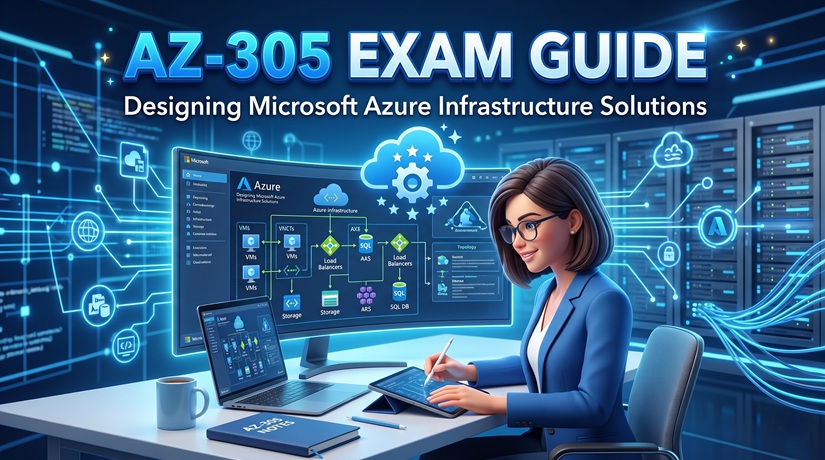
Microsoft AZ-305: Designing Microsoft Azure Infrastructure Solutions is one of the most important certification exams for IT professionals who want to move from administering Azure resources to designing complete cloud and hybrid architectures.
That distinction matters. AZ-305 is not primarily an exam about remembering commands or clicking through the Azure portal. It is an architecture exam. You are expected to look at a business requirement, identify technical constraints, compare several possible Azure services, and recommend a design that balances security, reliability, performance, operational complexity, and cost.
For students and engineers coming from networking, systems administration, virtualization, or traditional data center environments, AZ-305 is also an excellent way to understand how familiar infrastructure concepts change when they move into the cloud.
This guide explains what the AZ-305 exam covers, how it fits into the Microsoft certification path, which Azure technologies deserve the most attention, and how I would approach AZ-305 exam preparation if I were studying for the exam today.
Last reviewed: October 2026. Microsoft periodically updates role-based certification exams, so always compare your study plan with the current Microsoft study guide before scheduling the exam.
What Is the Microsoft AZ-305 Exam?
Table of Contents
ToggleThe full name of AZ-305 is Designing Microsoft Azure Infrastructure Solutions.
Microsoft positions the exam around the job role of an Azure Solutions Architect. A solutions architect does more than deploy resources. The architect works with business stakeholders, developers, administrators, security teams, and data engineers to translate requirements into a workable technical design.
That design might need to answer questions such as:
- Should an application run on Azure Virtual Machines, Azure Kubernetes Service, App Service, Container Apps, or Azure Functions?
- Should a company connect its data center to Azure using a site-to-site VPN or ExpressRoute?
- Should traffic be distributed using Azure Load Balancer, Application Gateway, Azure Front Door, or another routing technology?
- How should identities, roles, subscriptions, management groups, policies, and secrets be organized?
- Which database or storage technology provides the required scalability, availability, latency, and cost?
- How should the architecture continue operating if a virtual machine, availability zone, or entire Azure region fails?
This is the mindset behind AZ-305. In many questions, several Azure services are technically capable of solving part of the problem. Your job is to identify which design best satisfies the complete set of requirements.
AZ-305 and the Azure Solutions Architect Expert Certification
One point regularly causes confusion: passing AZ-305 and earning the full Microsoft Certified: Azure Solutions Architect Expert credential are related, but they are not exactly the same thing.
Under Microsoft’s current certification requirements, AZ-305 is the required expert-level exam. However, candidates must also hold the Microsoft Certified: Azure Administrator Associate certification to meet the prerequisite for Azure Solutions Architect Expert.
For most candidates, this means the natural path looks like this:
AZ-104 / Azure Administrator Associate → AZ-305 → Azure Solutions Architect Expert
This progression makes technical sense. AZ-104 focuses heavily on operating and administering Azure. AZ-305 assumes that foundation and asks you to move one level higher: instead of simply configuring a service, you need to decide whether that service belongs in the architecture in the first place.
If you are completely new to Azure, I would not recommend making AZ-305 your first serious Azure exam. Even if you can memorize enough concepts to answer some architecture questions, the material becomes much easier when you already understand how Azure subscriptions, virtual networks, identities, storage accounts, virtual machines, monitoring, and role-based access control work in practice.
Current AZ-305 Exam Domains
As of the Microsoft exam blueprint effective April 17, 2026, AZ-305 is divided into four major skill areas.
| Exam Domain | Approximate Weight |
|---|---|
| Design identity, governance, and monitoring solutions | 25–30% |
| Design data storage solutions | 20–25% |
| Design business continuity solutions | 15–20% |
| Design infrastructure solutions | 30–35% |
The passing score published by Microsoft is 700. The exam is available in several languages, and Microsoft currently lists no retirement date for AZ-305. Exam pricing varies by the country or region in which the exam is delivered, so the official exam registration page should be treated as the authoritative source for current pricing.
I would avoid relying on old blog posts that give a fixed number of exam questions or promise a particular question format. Microsoft can modify the delivery experience. The official exam page, study guide, and Microsoft exam sandbox are much safer references.
If you are building a structured study plan, it is useful to combine Microsoft’s official objectives with a focused AZ-305 study guide and preparation resource so that every major exam domain receives enough attention.
1. Identity, Governance, and Monitoring
This domain represents roughly a quarter of the exam, and it illustrates an important characteristic of AZ-305: architecture is not just about compute and networking.
A good Azure design needs a clear identity model, administrative hierarchy, compliance strategy, monitoring architecture, and method for protecting credentials and secrets.
Identity and Authorization
You should understand the architectural role of Microsoft Entra ID, Azure role-based access control, managed identities, workload identities, privileged access, authentication methods, and identity governance.
Pay particular attention to the difference between authentication and authorization. Authentication establishes who or what an identity is. Authorization determines what that identity is allowed to do.
For example, an application running in Azure should generally not store a permanent administrator username and password inside its source code. An architect should consider managed identity or another workload identity mechanism so that applications can access Azure resources without embedding long-lived credentials.
Governance
You should also understand the relationship among:
Management Groups → Subscriptions → Resource Groups → Resources
This hierarchy becomes particularly important in enterprise environments containing multiple departments, environments, geographical regions, or business units.
Know why an organization might use Azure Policy to enforce technical standards while using Azure RBAC to control who can perform particular actions. The two technologies are related to governance, but they solve different problems.
Tags, subscription organization, management groups, compliance requirements, identity governance, and resource standardization should all be familiar concepts.
Monitoring and Logging
Monitoring questions often require more than knowing the name Azure Monitor. Think about the entire monitoring pipeline.
Where are logs generated? Where should they be collected? How long must they be retained? Who needs access? Does the organization need centralized analysis? Which conditions should trigger an alert? What should happen after an alert is generated?
Services and concepts worth understanding include Azure Monitor, Log Analytics workspaces, Application Insights, diagnostic settings, alerts, metrics, and log routing.
2. Designing Data Storage Solutions
The data section of AZ-305 is less about becoming a database administrator and more about selecting the right data platform for a workload.
A frequent architecture mistake is choosing a database because it is familiar rather than because it matches the application’s requirements. AZ-305 tries to train you out of that habit.
Relational Data
You should be able to evaluate Azure options for relational workloads and consider factors such as:
- Compatibility requirements
- Administrative responsibility
- Scalability
- High availability
- Backup and recovery
- Compute and service tiers
- Performance requirements
- Cost
For example, moving an existing SQL Server workload to Azure does not automatically mean deploying SQL Server on a virtual machine. Depending on compatibility and operational requirements, an architect might consider Azure SQL Database, Azure SQL Managed Instance, or a VM-based implementation.
Semi-Structured and Unstructured Data
You should also understand where technologies such as Azure Blob Storage, Azure Files, Data Lake-oriented storage, and globally distributed NoSQL services fit into an architecture.
The important question is rarely, “Which Azure storage service exists?” The exam is more interested in, “Which service satisfies these requirements with the least unnecessary complexity?”
Think about access patterns, consistency, latency, replication, durability, capacity, geographic distribution, protocol requirements, and cost.
Data Integration
Modern architectures rarely keep all data inside one database. Data may need to move among SaaS platforms, operational databases, analytics platforms, storage accounts, and on-premises systems.
For this reason, the exam blueprint also expects architects to understand how to recommend data integration and data analysis solutions. You do not need to become a specialist in every data platform, but you should understand the architectural purpose of Azure’s major integration and analytics services.
3. Business Continuity, Backup, and Disaster Recovery
This is one of the most useful AZ-305 topics in real production environments.
The first concepts I would learn are RTO and RPO.
Recovery Time Objective (RTO) describes how quickly a service needs to be restored after an outage. Recovery Point Objective (RPO) describes how much data loss the business can tolerate.
Those two numbers often determine the architecture.
A workload with an eight-hour RTO is fundamentally different from an online payment platform expected to survive infrastructure failure with minimal interruption.
High Availability Is Not the Same as Disaster Recovery
This distinction is extremely important.
Availability Zones can protect a workload from certain data center-level failures within a region. A multi-region architecture can provide protection against a much larger regional outage. Backups provide another form of protection, particularly against accidental deletion, corruption, ransomware, or other data-loss scenarios.
None of these mechanisms should automatically be treated as substitutes for the others.
You should be comfortable designing availability for compute, relational databases, and unstructured or semi-structured data. You should also understand the architectural purposes of Azure Backup, Azure Site Recovery, storage replication options, database replication capabilities, availability zones, and regional designs.
4. Infrastructure Solutions: The Largest AZ-305 Domain
Infrastructure design represents approximately 30–35% of the current exam blueprint, making it the largest single skill area.
For students with a networking or systems background, this will probably feel like the most familiar part of AZ-305, but it is also broad. It includes compute, application architecture, migrations, and networking.
Choosing the Right Compute Model
Azure gives architects several ways to run applications. Understanding the differences is far more useful than memorizing product descriptions.
| Compute Approach | Typical Architectural Reason |
|---|---|
| Azure Virtual Machines | Maximum OS control, traditional workloads, custom software requirements |
| Virtual Machine Scale Sets | Scalable groups of VM-based workloads |
| Azure App Service | Managed hosting for web applications and APIs |
| Azure Kubernetes Service | Complex container orchestration and Kubernetes-based architectures |
| Azure Container Apps | Managed container workloads without managing a full Kubernetes platform |
| Azure Functions | Event-driven and serverless execution |
An architect should generally prefer the platform with the lowest operational burden that still satisfies the workload requirements.
If an application can run successfully on a managed PaaS service, deploying and maintaining several virtual machines simply because “that is how we have always done it” may create unnecessary administrative overhead.
Application Architecture
The current AZ-305 blueprint also includes messaging, event-driven architecture, API integration, caching, configuration management, and automated deployment.
You should therefore understand architectural differences between synchronous and asynchronous communication.
Imagine an e-commerce application. When a customer places an order, the application may need to process payment, update inventory, send an email, generate analytics events, and notify a shipping system.
Building all those operations into one synchronous request creates tight dependencies. Messaging and event-driven patterns can decouple services and improve scalability and resilience.
This is where services such as Azure Service Bus, Event Grid, Event Hubs, API Management, and managed caching technologies become architecturally important.
Migration Design
Cloud architecture does not always start with a brand-new application. Many real Azure projects begin with a data center full of existing servers, databases, and applications.
AZ-305 therefore expects you to evaluate migrations using the Microsoft Cloud Adoption Framework for Azure.
You should understand how to assess existing servers and applications, determine dependencies, and recommend a migration path for IaaS workloads, PaaS workloads, databases, and unstructured data.
Tools such as Azure Migrate and specialized migration services are worth studying, but do not focus only on product names. Think about the larger migration decision:
Should this workload be rehosted, modernized, replaced, redesigned, or perhaps not migrated at all?
Azure Networking for AZ-305
If your background is Cisco, Juniper, Huawei, ZTE, enterprise networking, or general network administration, this is where many traditional concepts become recognizable.
You still need to think about IP addressing, routing, segmentation, connectivity, load balancing, security boundaries, and redundancy. The difference is that these functions are increasingly implemented as cloud services rather than physical appliances.
Virtual Networks and Hybrid Connectivity
You should understand Azure Virtual Networks, subnets, peering, DNS considerations, route tables, network security groups, private connectivity, VPN Gateway, and ExpressRoute.
A classic architecture decision is VPN versus ExpressRoute.
A VPN can provide encrypted connectivity across the public internet and is often easier and cheaper to deploy. ExpressRoute provides private connectivity through a connectivity provider and is often chosen when organizations need more predictable private connectivity characteristics or have enterprise hybrid-cloud requirements.
The answer depends on the scenario rather than a simple rule that one technology is always “better.”
Load Balancing and Global Traffic
Another area worth mastering is the difference among Azure’s traffic distribution services.
Azure Load Balancer operates at Layer 4 and is suitable for TCP and UDP load-balancing scenarios.
Azure Application Gateway is an application-layer load balancer designed primarily for HTTP and HTTPS workloads and can provide web application firewall functionality.
Azure Front Door is designed for globally distributed web applications and provides edge-based application delivery capabilities.
Architectural questions may describe a requirement without naming a product. For example:
“A globally distributed web application needs users to connect to the closest healthy application endpoint while receiving web application firewall protection.”
Your job is to recognize which Azure architecture best maps to that requirement.
Network Security
Network security is not simply a matter of adding an NSG.
You should understand how technologies such as NSGs, Azure Firewall, Web Application Firewall, Private Link, private endpoints, DDoS protection, network segmentation, and identity controls can work together.
A mature Azure architecture typically uses multiple security layers rather than depending on one perimeter control.
The Most Important Skill: Learning to Make Trade-Offs
If I had to summarize AZ-305 in one sentence, it would be this:
Learn to justify architectural decisions.
Suppose two designs both work technically. One costs twice as much. Another requires more operational staff. One offers regional disaster recovery while the other protects only against a single server failure. One requires developers to modify the application while another supports the existing protocol.
Which architecture should you choose?
There is no universal answer until you know the business requirements.
This is why the Azure Well-Architected Framework is so useful for AZ-305 preparation. Microsoft organizes architecture thinking around five pillars:
- Reliability
- Security
- Cost Optimization
- Operational Excellence
- Performance Efficiency
An architecture can be technically impressive and still be the wrong design if it ignores cost, increases operational complexity without a business reason, or fails to meet availability requirements.
How Valuable Is the AZ-305 Certification?
The value of a technical certification depends heavily on what you expect it to do.
AZ-305 will not magically turn someone with no infrastructure experience into a senior cloud architect. Architecture requires experience, and production systems have a way of teaching lessons that certification books cannot.
However, the AZ-305 certification exam can still be highly valuable.
For a network engineer, system administrator, cloud engineer, DevOps engineer, or IT student, AZ-305 provides a structured way to connect many Azure technologies into a single architecture model.
Instead of learning networking, identity, storage, databases, monitoring, compute, security, and disaster recovery as isolated subjects, you begin to understand how decisions in one area affect everything else.
The Azure Solutions Architect Expert credential can also demonstrate to employers and customers that you have studied architecture at a broader level than basic cloud administration. This can be particularly useful for roles such as:
- Azure Solutions Architect
- Cloud Architect
- Cloud Infrastructure Engineer
- Senior Azure Engineer
- Cloud Consultant
- Pre-sales Cloud Architect
- Infrastructure Architect
- Cloud Migration Engineer
Certification should still be combined with hands-on labs and real implementation experience. A candidate who can explain why an architecture is appropriate is generally much more convincing than someone who can only show a certificate.
Is AZ-305 Difficult?
For a beginner, yes. But the difficulty is often misunderstood.
The exam is challenging because Azure has many overlapping services and because architecture questions contain trade-offs.
For example, you may know what Azure Functions does and know what AKS does. The harder question is deciding which one fits a workload with specific requirements for scaling, deployment, runtime control, operations, and cost.
This is why memorizing definitions alone is not enough.
A better study technique is to compare services in pairs or groups:
- VPN Gateway vs. ExpressRoute
- Application Gateway vs. Front Door vs. Load Balancer
- Azure SQL Database vs. SQL Managed Instance vs. SQL Server on Azure VM
- Virtual Machines vs. App Service vs. containers vs. serverless
- Azure Policy vs. Azure RBAC
- Availability Zones vs. multi-region disaster recovery
- Backup vs. replication
- Synchronous APIs vs. messaging and event-driven architectures
For every comparison, ask three questions:
What problem does each service solve? What requirement would make me choose it? What requirement would make me reject it?
That method develops architecture thinking much faster than simply memorizing documentation pages.
A Practical AZ-305 Study Strategy
Phase 1: Build the Azure Foundation
If you are still new to Azure, start with administrator-level skills. Create virtual networks, virtual machines, storage accounts, identities, role assignments, policies, monitoring rules, and backup configurations yourself.
You do not need to become an expert in every Azure service, but an architect should understand what operating these services actually feels like.
Phase 2: Study by Exam Domain
Use Microsoft’s current AZ-305 study guide as your checklist.
Do not simply watch a training course from beginning to end and assume every exam objective has been covered. Compare the course against the official blueprint and mark each skill as you become comfortable explaining it.
For candidates who prefer a more exam-focused review alongside Microsoft Learn, an additional Microsoft AZ-305 preparation resource can help organize revision around the technologies and architecture topics covered by the certification.
Phase 3: Build Small Architectures
Create simple architecture scenarios yourself.
For example, design a three-tier application that needs:
- Private access to a database
- HTTPS traffic from internet users
- Web application firewall protection
- Zone-level high availability
- Centralized monitoring
- Secure secret storage
- Automated deployment
Then draw the architecture and explain every Azure service you selected.
If you cannot explain why a component exists, investigate whether it should exist at all.
Phase 4: Practice Requirement Analysis
When reading a scenario, identify keywords before thinking about Azure product names.
If you see “private connectivity,” “lowest administrative overhead,” “global users,” “RPO of five minutes,” “HTTP only,” “no application changes,” “least privilege,” or “minimize cost,” those phrases are architectural constraints.
The correct service should follow from the requirements.
Phase 5: Review the Well-Architected Framework
This step is frequently underestimated.
The Azure Well-Architected Framework teaches you to evaluate an architecture rather than simply assemble Azure products. That way of thinking is directly relevant to AZ-305 and much more valuable after the exam as well.
Common AZ-305 Preparation Mistakes
Memorizing answers instead of understanding architecture. Azure services change, exam blueprints change, and memorized question banks age very quickly. Architectural principles are much more durable.
Ignoring cost. The most technically powerful architecture is not always the correct architecture. Microsoft explicitly treats cost optimization as a fundamental architecture concern.
Ignoring operations. Every service added to a design creates an operational consequence. Managed Azure services can reduce administration, but they may also introduce different limitations.
Studying networking without identity. Modern cloud security is heavily identity-driven. Traditional perimeter security remains important, but Azure architectures also rely on roles, identities, policies, secrets, private access, and workload authentication.
Confusing high availability with disaster recovery. Designing two instances in one location does not automatically protect an application against every failure scenario.
Using outdated study material. Microsoft role-based certifications are updated periodically. Always check the publication date and compare third-party training material with the current official study guide.
What Should Network Engineers Focus on?
For network engineers specifically, AZ-305 is a good bridge from traditional infrastructure into cloud architecture.
Your existing understanding of IP networking, routing, redundancy, firewalls, VPNs, DNS, and load balancing is valuable. The next step is learning where those concepts live in Azure and how cloud-native services change traditional design assumptions.
I would spend additional time on:
- Azure VNet architecture and address planning
- VNet peering and hub-and-spoke designs
- VPN Gateway and ExpressRoute
- Azure Route Server and routing concepts
- Private Link and private endpoints
- Azure Firewall
- Network Security Groups
- Application Gateway and Web Application Firewall
- Azure Front Door
- Azure Load Balancer
- DNS design
- Hybrid connectivity
- Network monitoring
- Multi-region architecture
But do not stop there. A solutions architect who understands only networking is still missing most of the architecture.
You need enough knowledge of identity, storage, databases, compute, observability, governance, application integration, backup, and disaster recovery to understand how the network supports the complete solution.
Frequently Asked Questions About AZ-305
Do I need AZ-104 before taking AZ-305?
You should have strong Azure administration knowledge before attempting AZ-305. More importantly, the current Microsoft Certified: Azure Solutions Architect Expert certification path requires the Azure Administrator Associate certification as a prerequisite. AZ-305 is the required expert-level exam.
What score do I need to pass AZ-305?
Microsoft currently specifies a passing score of 700 or greater.
Is AZ-305 mainly a networking exam?
No. Networking is important, but the exam covers identity, governance, monitoring, databases, storage, backup, disaster recovery, compute, applications, migration, and networking. It is a broad architecture exam.
Do I need programming skills for AZ-305?
AZ-305 is not primarily a programming exam. However, understanding application architecture, APIs, containers, serverless computing, messaging, deployment automation, and DevOps concepts is extremely useful.
Should I memorize every Azure SKU?
No. You should understand major service tiers and architectural limitations when they affect design decisions, but trying to memorize every SKU is inefficient. Focus first on service selection and design trade-offs.
Is AZ-305 worth taking for a network engineer?
Yes, particularly if you want to move toward cloud networking, cloud architecture, infrastructure consulting, hybrid cloud, or solution design. It forces you to think beyond connectivity and understand the complete Azure platform.
How often does Microsoft change AZ-305?
Microsoft periodically updates role-based exams to reflect changes in the skills required for the job role. The English AZ-305 exam blueprint was updated on April 17, 2026. Always check the official study guide before scheduling your exam.
Does the Microsoft certification expire?
Microsoft’s role-based associate, expert, and specialty certifications are renewable annually. Microsoft currently provides an online renewal assessment through Microsoft Learn for eligible certifications.
Final Thoughts
AZ-305 is one of the certifications where studying for the exam can be more valuable than simply passing it.
The real benefit is learning how to look at a requirement and think like an architect.
Instead of asking, “Which Azure product should I memorize?” you begin asking better questions:
What is the availability requirement? Where is the security boundary? What is the acceptable RPO? Does this workload really need virtual machines? Can a managed platform reduce operational overhead? Does traffic need Layer 4 or Layer 7 processing? Is the application regional or global? How much complexity is the business willing to operate and pay for?
If you can consistently answer those questions and defend your decisions, you are developing the skill that AZ-305 is actually designed to measure.
For students and early-career engineers, that makes AZ-305 much more than another certification exam. It is a structured introduction to the way modern enterprise cloud architecture is designed.
If AZ-305 is your next certification goal, you can also review this dedicated Designing Microsoft Azure Infrastructure Solutions (AZ-305) exam preparation page together with the official Microsoft resources below.
Official AZ-305 and Azure Architecture Resources
I strongly recommend using Microsoft’s documentation as the primary reference during your preparation, especially because Azure services and certification objectives change over time.
-
- Microsoft Learn – Exam AZ-305: Designing Microsoft Azure Infrastructure Solutions
Official AZ-305 exam page - Microsoft Learn – AZ-305 Official Study Guide
AZ-305 skills measured and exam objectives - Microsoft Certified: Azure Solutions Architect Expert
Azure Solutions Architect Expert certification requirements - Microsoft Azure Architecture Center
Reference architectures, architecture patterns, and technology guidance - Microsoft Azure Well-Architected Framework
Reliability, security, cost optimization, operational excellence, and performance guidance - Microsoft Cloud Adoption Framework for Azure
Microsoft guidance for cloud strategy, governance, migration, and adoption - Microsoft Azure Documentation
Technical documentation for Microsoft Azure services
- Microsoft Learn – Exam AZ-305: Designing Microsoft Azure Infrastructure Solutions