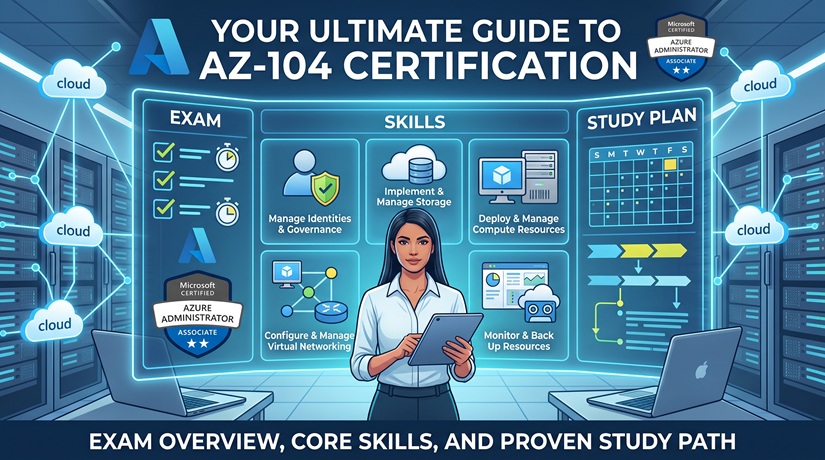
The AZ-104 Microsoft Azure Administrator certification is one of Microsoft’s main role-based credentials for IT professionals who manage cloud infrastructure. It covers practical Azure administration skills across identity, governance, storage, virtual machines, networking, monitoring, backup, and disaster recovery.
For students, junior network engineers, system administrators, technical support professionals, and IT engineers moving into cloud computing, AZ-104 provides a structured way to learn how Microsoft Azure infrastructure actually works.
Unlike a fundamentals-level certification, the AZ-104 exam goes beyond basic cloud terminology. You are expected to understand how Azure services interact, how access should be controlled, how workloads are deployed, how networks are configured, and how administrators troubleshoot problems when something does not work as expected.
If you are currently preparing for the certification, you can also use our AZ-104 Microsoft Azure Administrator exam preparation page alongside Microsoft Learn, official documentation, and your own hands-on Azure labs.
AZ-104 Exam Overview
Table of Contents
ToggleThe AZ-104: Microsoft Azure Administrator exam measures the skills required to implement, manage, and monitor Microsoft Azure environments.
Passing the required exam earns the Microsoft Certified: Azure Administrator Associate credential under Microsoft’s current certification program.
| AZ-104 Exam Information | Details |
|---|---|
| Exam | AZ-104: Microsoft Azure Administrator |
| Certification | Microsoft Certified: Azure Administrator Associate |
| Level | Intermediate |
| Primary Role | Azure Administrator |
| Exam Time | 100 minutes according to Microsoft’s current certification information |
| Passing Score | 700 or higher on Microsoft’s scaled scoring system |
| Certification Renewal | Every 12 months under Microsoft’s current renewal model |
| Exam Provider | Pearson VUE |
| Microsoft Learn During Exam | Available for eligible role-based certification exams while the exam timer continues |
Exam pricing can vary by country and region. For that reason, candidates should check the current Microsoft certification page before scheduling rather than relying on an old price mentioned in a blog or training video.
What Is the AZ-104 Microsoft Azure Administrator Certification?
The Azure Administrator Associate certification is designed around the day-to-day responsibilities of professionals who operate Microsoft Azure infrastructure.
An Azure administrator may be responsible for:
- Managing Azure subscriptions
- Managing users and identities
- Configuring Azure RBAC
- Implementing governance policies
- Managing storage accounts
- Deploying virtual machines
- Managing virtual networks
- Configuring load balancing
- Monitoring Azure resources
- Managing backup and recovery
- Troubleshooting cloud infrastructure
AZ-104 is therefore not focused on a single Azure service. A single scenario may involve several technologies at the same time.
For example, a virtual machine connectivity problem could involve a subnet, Network Security Group, route table, Azure DNS, public IP address, Azure Bastion, or the configuration of the VM itself.
The same principle applies to storage. Access to an Azure Storage account may depend on Microsoft Entra identity, Azure RBAC, storage firewall settings, private networking, Shared Access Signatures, or access keys.
This is why good
AZ-104 certification preparation
should focus on understanding how Azure technologies interact instead of memorizing isolated definitions.
Is the AZ-104 Certification Worth It?
For people interested in Azure administration, cloud infrastructure, system administration, networking, or technical support, AZ-104 can be a valuable certification because the syllabus closely follows real infrastructure tasks.
It Covers Practical Azure Administration
The exam focuses on technologies administrators regularly use, including Azure Virtual Machines, Virtual Networks, Azure Storage, Microsoft Entra ID, Azure RBAC, Azure Policy, Azure Monitor, Azure Backup, and Infrastructure as Code.
These are operational technologies rather than purely theoretical cloud concepts.
It Provides a Recognizable Microsoft Credential
Microsoft certification gives employers and technical teams a standardized way to identify candidates who have studied Azure administration at the Associate level.
However, certification does not replace production experience.
Someone who has only memorized practice questions will usually have a very different skill level from someone who has deployed Azure resources, configured networking, fixed permissions, investigated logs, and restored workloads from backup.
The strongest combination is therefore:
Certification knowledge + hands-on Azure experience.
It Builds a Foundation for Advanced Azure Skills
Many advanced Azure technologies assume that you already understand subscriptions, resource groups, Microsoft Entra ID, RBAC, virtual networking, storage, monitoring, and resource deployment.
AZ-104 can therefore provide a useful foundation for later work in:
- Cloud architecture
- Azure networking
- Cloud security
- DevOps
- Hybrid infrastructure
- Infrastructure automation
- Cloud operations
It Is Especially Relevant to Network and System Administrators
People coming from Cisco networking, Windows Server, VMware, Linux administration, or traditional data-center environments often find the Azure Administrator role familiar.
Routing, subnets, DNS, firewalls, storage, identity, high availability, monitoring, and backup all have equivalents in traditional IT infrastructure.
Azure changes how these technologies are delivered, but the underlying infrastructure principles remain important.
Current AZ-104 Exam Objectives and Domains
The current AZ-104 exam objectives are organized into five major technical domains.
| AZ-104 Exam Domain | Exam Weight |
|---|---|
| Manage Azure identities and governance | 20–25% |
| Implement and manage storage | 15–20% |
| Deploy and manage Azure compute resources | 20–25% |
| Implement and manage virtual networking | 15–20% |
| Monitor and maintain Azure resources | 10–15% |
The percentages are useful for planning study time, but they should not become your entire preparation strategy.
Azure services are interconnected, and many exam scenarios naturally cross several domains.
Candidates can use the official Microsoft exam objectives as their primary checklist and combine them with additional
AZ-104 study resources to identify weaker areas that need additional review.
1. Manage Azure Identities and Governance — 20–25%
Identity and governance are fundamental to Azure because almost every resource exists inside an administrative hierarchy and is controlled through permissions and policies.
Important areas include:
- Microsoft Entra users
- Microsoft Entra groups
- Azure RBAC
- Management groups
- Subscriptions
- Resource groups
- Azure Policy
- Resource locks
- Tags
- Cost management
Microsoft Entra Users and Groups
Candidates should understand how to create and manage users and groups, modify account properties, manage external users, work with licensing, and understand basic identity administration.
Do not think of Microsoft Entra ID as simply “Active Directory in the cloud.”
There are similarities, but cloud identity, authorization, application access, and Azure resource permissions need to be understood in their own context.
Azure Role-Based Access Control
Azure RBAC is one of the most important topics in the AZ-104 exam.
A role assignment combines three basic elements:
- A security principal
- A role definition
- A scope
Scope is particularly important.
Permissions can be assigned at levels such as:
- Management group
- Subscription
- Resource group
- Individual resource
Permissions assigned at a higher scope can be inherited by resources below that level.
Understanding inheritance is important both for certification questions and real Azure troubleshooting.
Azure Policy
Azure Policy is primarily a governance and compliance technology.
For example, Azure RBAC may determine whether an administrator is allowed to create a virtual machine.
Azure Policy can determine whether that virtual machine is allowed to use a particular region, resource type, naming standard, or configuration.
A useful rule to remember is:
RBAC controls who can perform an action. Azure Policy controls what configurations are allowed.
Resource Locks
Azure resource locks can help prevent accidental deletion or modification.
The two common lock types are:
- CanNotDelete
- ReadOnly
Resource locks should not be confused with RBAC permissions. They solve a different administrative problem.
Tags and Cost Management
Tags provide metadata that can be used to organize resources and support automation, reporting, and cost management.
You should also understand Azure budgets, cost alerts, subscription organization, and how Azure Advisor recommendations can support resource optimization.
2. Implement and Manage Azure Storage — 15–20%
Azure Storage can look simple at first, but the AZ-104 exam expects candidates to understand security, redundancy, network access, lifecycle management, and data protection.
Storage Account Security
Important concepts include:
- Storage account firewalls
- Virtual network access
- Private networking
- Shared Access Signatures
- Stored access policies
- Storage account access keys
- Identity-based authorization
- Encryption
A useful way to analyze storage access is to ask four questions:
- Who needs access?
- Where are they connecting from?
- How long should access remain valid?
- Which authentication or authorization mechanism should be used?
These questions force you to think about identity, networking, authentication, authorization, and delegated access at the same time.
Azure Storage Redundancy
Candidates should understand why different storage redundancy options exist and which failure scenarios they are designed to address.
Do not memorize redundancy acronyms without understanding where data copies are stored.
Think about whether copies exist:
- Inside one datacenter
- Across availability zones
- Across Azure regions
Blob Storage
For Azure Blob Storage, understand concepts such as:
- Containers
- Access tiers
- Blob versioning
- Soft delete
- Lifecycle management
- Access control
Azure Files
Azure Files provides managed file shares that can be accessed using familiar file-sharing technologies.
Candidates should understand how file shares are created, managed, secured, and accessed.
Storage Administration Tools
Two useful tools to know are:
- Azure Storage Explorer
- AzCopy
These tools are commonly used to manage and transfer Azure Storage data.
3. Deploy and Manage Azure Compute Resources — 20–25%
Compute is one of the largest AZ-104 exam domains.
It includes much more than creating a virtual machine through the Azure portal.
Azure Virtual Machines
Important virtual machine topics include:
- VM creation
- VM sizes
- Managed disks
- Disk configuration
- Encryption at host
- Availability sets
- Availability zones
- Virtual Machine Scale Sets
- VM networking
- Resource movement
A common beginner mistake is to focus on creating a VM and ignore what happens after deployment.
In production environments, creating the VM is usually the easy part.
Availability, monitoring, networking, backup, security, and lifecycle management are what make administration more complex.
Availability Sets and Availability Zones
Candidates should understand that high availability technologies protect against different types of infrastructure failures.
An availability set and an availability zone are not the same thing.
When studying these technologies, always ask:
What type of failure is this design intended to survive?
Virtual Machine Scale Sets
Virtual Machine Scale Sets allow administrators to deploy and manage groups of virtual machines that can scale based on application demand.
Understand their relationship with:
- Scaling
- Load balancing
- Availability
- Instance management
ARM Templates and Bicep
Modern cloud administration increasingly involves Infrastructure as Code.
AZ-104 candidates should be comfortable reading and modifying Azure Resource Manager templates and Bicep files.
You do not need to become a professional software developer, but you should understand:
- Resource declarations
- Parameters
- Dependencies
- Template structure
- Repeatable deployment
Azure Containers
The AZ-104 objectives include container-related Azure services such as:
- Azure Container Registry
- Azure Container Instances
- Azure Container Apps
Candidates should understand how container images are stored and how containerized workloads can be deployed in Azure.
Azure App Service
Azure App Service provides managed application hosting without requiring administrators to manage the underlying servers.
Topics worth studying include:
- App Service plans
- Scaling
- Custom DNS names
- TLS certificates
- Backups
- Networking
- Deployment slots
4. Implement and Manage Azure Virtual Networking — 15–20%
For candidates with a networking background, this may be the most familiar part of AZ-104.
However, cloud networking adds service relationships and platform-specific behavior that can make apparently simple problems more complicated.
Virtual Networks and Subnets
You should understand:
- VNet address spaces
- Subnets
- IP addressing
- Public IP addresses
- VNet peering
- User-defined routes
- Network troubleshooting
A useful study technique is to draw the packet path rather than memorize Azure portal screens.
When a connection fails, ask:
- Does DNS resolve the correct destination?
- Is the source using the correct IP address?
- Which route is selected?
- Does an NSG permit the traffic?
- Is another security control blocking the connection?
- Is the destination service actually listening?
This approach is useful in both the AZ-104 exam and real-world Azure troubleshooting.
Network Security Groups
Network Security Groups control inbound and outbound network traffic.
Candidates should understand:
- Inbound rules
- Outbound rules
- Rule priorities
- Effective security rules
- Subnet-level association
- Network interface association
- Application Security Groups
Pay attention to where an NSG is associated.
An NSG applied to a subnet can have a very different operational impact from one associated with an individual network interface.
Service Endpoints vs. Private Endpoints
This is an important Azure networking distinction.
A service endpoint extends VNet identity toward a supported Azure service.
A private endpoint uses Azure Private Link to provide a private IP representation of an Azure service inside your virtual network.
When an exam scenario involves private access to a PaaS service, read the requirements carefully before choosing between these technologies.
Azure Bastion
Azure Bastion provides managed RDP and SSH connectivity to Azure virtual machines.
It allows administrators to manage VMs without exposing management ports such as RDP or SSH directly to the public Internet on each VM.
Azure DNS
DNS remains fundamental in cloud networking.
Candidates should understand the role of Azure DNS and recognize that many apparent networking problems are actually name-resolution problems.
Azure Load Balancer
Important Azure Load Balancer topics include:
- Public load balancing
- Internal load balancing
- Frontend IP configuration
- Backend pools
- Health probes
- Load-balancing rules
When troubleshooting load balancing, verify both the Azure Load Balancer configuration and the health of the backend service.
5. Monitor and Maintain Azure Resources — 10–15%
Monitoring receives a smaller percentage of the exam than some other domains, but it is extremely important in real Azure administration.
Administrators spend a large amount of time answering questions such as:
- What happened?
- When did it happen?
- Why did performance change?
- Which resource generated the problem?
- Will the problem happen again?
Azure Monitor
Candidates should understand:
- Azure Monitor metrics
- Azure Monitor logs
- Diagnostic settings
- Log queries
- Alert rules
- Action groups
- Alert processing rules
- Azure Monitor Insights
Metrics vs. Logs
Metrics are optimized for numerical time-series monitoring.
Logs generally contain richer records that can be queried and correlated.
Understanding the difference helps you choose the right monitoring tool for a troubleshooting scenario.
KQL Basics
You do not need to become a Kusto Query Language expert for AZ-104.
However, you should be able to understand basic queries used to filter, select, and analyze Azure Monitor and Log Analytics data.
Azure Network Watcher
Azure Network Watcher provides tools that help administrators troubleshoot network connectivity and analyze network behavior.
Connection Monitor can also help identify connectivity problems between endpoints.
Azure Backup
Azure Backup protects workloads and data by creating recoverable backup copies.
Candidates should understand:
- Backup vaults
- Recovery Services vaults
- Backup policies
- Backup operations
- Restore operations
- Backup monitoring
Azure Site Recovery
Azure Site Recovery is focused on disaster recovery and workload continuity.
Backup and disaster recovery are related, but they are not interchangeable.
A backup protects recoverable copies of data or workloads.
Disaster recovery focuses on restoring or maintaining service when a larger infrastructure failure affects the primary environment.
Five Technical Concepts You Should Understand Before Taking AZ-104
1. Azure Resource Scope
Azure administration becomes much easier when you understand the resource hierarchy.
A simplified version is:
Management Group → Subscription → Resource Group → Resource
Azure RBAC and Azure Policy can be applied at different levels of this hierarchy.
Inheritance therefore plays an important role in both administration and troubleshooting.
2. Authentication Is Not the Same as Authorization
Authentication answers:
Who are you?
Authorization answers:
What are you allowed to do?
Microsoft Entra ID, Azure RBAC, storage permissions, managed identities, SAS tokens, and network restrictions can interact, but they are not the same thing.
3. High Availability Is Not the Same as Disaster Recovery
Availability sets, availability zones, VM Scale Sets, backups, and Site Recovery solve different problems.
Before selecting a technology, identify the failure scenario you are trying to protect against.
4. Cloud Networking Is Still Networking
Cloud platforms do not eliminate the need to understand networking.
You still need to understand:
- IP addressing
- Subnets
- Routing
- DNS
- Security filtering
- Load balancing
- Network troubleshooting
If networking is your weakest area, spend extra time building small Azure networks and intentionally breaking them.
Troubleshooting a broken route or NSG rule often teaches more than reading the same documentation repeatedly.
5. Infrastructure as Code Is Part of Modern Administration
Cloud administration is becoming increasingly automated and declarative.
Technologies such as:
- Bicep
- ARM templates
- Azure CLI
- Azure PowerShell
allow environments to be deployed repeatedly and consistently.
These are not side topics. They are part of modern Azure administration.
Tools Every AZ-104 Candidate Should Practice
A good AZ-104 preparation environment should include more than the Azure portal.
- Azure Portal — useful for resource visualization, configuration, troubleshooting, and understanding relationships between Azure services.
- Azure CLI — important for command-line administration, scripting, and automation.
- Azure PowerShell — particularly useful for administrators coming from Windows infrastructure.
- Azure Bicep — Microsoft’s Infrastructure as Code language for Azure resource deployment.
- ARM Templates — useful for understanding Azure Resource Manager deployments.
- Azure Storage Explorer — useful for managing Azure Storage data.
- AzCopy — commonly used for transferring data to and from Azure Storage.
- Azure Network Watcher — useful for diagnosing network connectivity.
- Azure Monitor — central to Azure metrics, logs, alerts, and operational visibility.
- KQL — useful for querying Azure Monitor and Log Analytics data.
A Practical 6–8 Week AZ-104 Study Plan
There is no official number of weeks required to prepare for the AZ-104 exam.
Your previous experience matters more than the calendar.
A network engineer may move quickly through virtual networking but need more time with Microsoft Entra ID, Azure Policy, and Bicep.
A Windows system administrator may have the opposite experience.
For a student or junior IT professional studying consistently, the following AZ-104 study plan provides a reasonable structure.
Week 1: Azure Fundamentals and Resource Organization
- Subscriptions
- Resource groups
- Management groups
- Azure regions
- Availability zones
- Azure Portal
- Azure CLI basics
- Azure PowerShell basics
Week 2: Identity and Governance
- Microsoft Entra users
- Microsoft Entra groups
- Azure RBAC
- Azure Policy
- Resource locks
- Tags
- Cost management
Week 3: Azure Storage
- Storage accounts
- Blob Storage
- Azure Files
- Storage security
- SAS
- Storage access keys
- Network restrictions
- Storage redundancy
- Lifecycle management
- Storage Explorer
- AzCopy
Week 4: Azure Compute
- Virtual machines
- Managed disks
- Availability sets
- Availability zones
- VM Scale Sets
- ARM templates
- Bicep
- Container Registry
- Container Instances
- Container Apps
- App Service
Week 5: Azure Networking
- Virtual networks
- Subnets
- VNet peering
- Network Security Groups
- Application Security Groups
- User-defined routes
- Service Endpoints
- Private Endpoints
- Azure Bastion
- Azure DNS
- Azure Load Balancer
- Network troubleshooting
Week 6: Monitoring, Backup and Recovery
- Azure Monitor
- Metrics
- Logs
- Log Analytics
- KQL basics
- Alerts
- Action groups
- Network Watcher
- Azure Backup
- Recovery Services vaults
- Azure Site Recovery
Weeks 7–8: Mixed Labs and Exam Review
At this stage, stop studying every service independently.
Build environments where multiple Azure technologies interact.
Then deliberately change a configuration and troubleshoot the result.
For additional review during these final weeks, you can combine Microsoft Learn with this
AZ-104 exam preparation resource
to identify areas that need more attention before scheduling the exam.
Recommended AZ-104 Hands-On Labs
Hands-on experience is one of the most useful parts of AZ-104 exam preparation.
If possible, complete the following exercises without blindly copying a tutorial.
- Create an Azure resource group.
- Deploy a virtual network with multiple subnets.
- Deploy two virtual machines and control connectivity using Network Security Groups.
- Create a custom route and observe how it changes the traffic path.
- Configure VNet peering between two virtual networks.
- Create an Azure Storage account.
- Create a Blob container and Azure file share.
- Test storage access using a Shared Access Signature.
- Configure identity-based storage access.
- Restrict storage network access and test the result.
- Create Microsoft Entra users and groups.
- Assign Azure RBAC roles at different scopes.
- Create an Azure Policy assignment.
- Apply a resource lock and test its behavior.
- Deploy an Azure resource using Bicep.
- Deploy a virtual machine using Azure CLI or PowerShell.
- Create an Azure Monitor alert.
- Configure an action group.
- Review VM metrics and logs.
- Use Network Watcher to investigate connectivity.
- Configure an Azure Backup policy.
- Perform a restore operation in a lab environment.
The goal is not simply to make the configuration work.
After completing each lab, ask yourself:
- Why does this configuration work?
- What could break it?
- How would I detect the problem?
- Which Azure tool would I use to troubleshoot it?
- How could I deploy the same configuration automatically?
That type of thinking is much closer to real Azure administration than memorizing portal screenshots.
How Difficult Is the AZ-104 Exam?
AZ-104 is manageable, but it is broad.
The difficulty usually comes from understanding relationships between Azure services rather than extremely deep knowledge of one individual technology.
A candidate may understand Network Security Groups but still answer a connectivity question incorrectly because the real problem is a route.
Someone may understand Azure RBAC but overlook an Azure Policy assignment.
Another candidate may configure a Storage account correctly but choose the wrong authentication mechanism.
This is why scenario-based study is usually more effective than memorizing individual facts.
Do You Need AZ-900 Before AZ-104?
AZ-900 is not a required prerequisite for earning the Azure Administrator Associate certification.
However, if concepts such as the following are completely new to you:
- Azure subscriptions
- Resource groups
- Cloud regions
- Availability zones
- IaaS
- PaaS
- Microsoft Entra ID
- Shared responsibility
then spending some time on Azure Fundamentals material before beginning AZ-104 can make the learning process easier.
If you already have experience with networking, servers, virtualization, system administration, or another public cloud, you may be comfortable moving directly into
Microsoft AZ-104 certification preparation.
Do You Need Programming Skills for AZ-104?
You do not need to be a professional software developer to pass AZ-104.
However, you should become comfortable with infrastructure automation.
An Azure administrator should be able to read and adapt:
- Azure CLI commands
- Azure PowerShell commands
- ARM templates
- Bicep configurations
Think of these technologies as infrastructure administration and automation rather than traditional application programming.
AZ-104 Exam Strategy
Understand the Requirement Before Looking at the Answers
Many certification questions contain several technically possible solutions.
The key is identifying which solution satisfies the exact requirement.
Pay attention to phrases such as:
- Least privilege
- Private connectivity
- Minimum administrative effort
- High availability
- Zone redundancy
- Automatic scaling
- Lowest cost
- Prevent accidental deletion
- Temporary access
- Minimum downtime
Pay Attention to Scope
When a question involves Azure RBAC, Policy, locks, or resource organization, scope is often one of the most important details.
Ask:
- Where is the configuration applied?
- Which resources inherit it?
- Does it apply at subscription, resource group, or resource level?
Learn the Differences Between Similar Azure Technologies
Candidates should be comfortable distinguishing:
- Azure RBAC vs. Azure Policy
- Authentication vs. authorization
- Service Endpoint vs. Private Endpoint
- Availability Set vs. Availability Zone
- Azure Backup vs. Azure Site Recovery
- Storage access keys vs. SAS vs. identity-based access
- Metrics vs. logs
- Resource locks vs. RBAC permissions
- App Service plan vs. App Service application
Use Microsoft Learn During the Exam Carefully
Microsoft currently provides access to Microsoft Learn during eligible role-based certification exams such as AZ-104.
However, the exam timer continues while you browse the documentation.
That means Microsoft Learn should be treated as an occasional reference tool rather than a replacement for exam preparation.
A good strategy is to know the main concepts well enough to answer most questions directly and use the documentation only when you need to confirm a specific detail.
Do Not Assume That a Score of 700 Means Exactly 70 Percent
Microsoft technical certification exams use scaled scoring.
A passing score is 700 or higher on Microsoft’s scoring scale, but this should not automatically be interpreted as answering exactly 70 percent of the questions correctly.
Common AZ-104 Study Mistakes
Memorizing Practice Questions
Memorizing answers can create the illusion of progress without improving technical understanding.
When reviewing a question, explain:
- Why the correct answer works
- Why each alternative is incorrect
- Which Azure concept the question is testing
This approach is much more useful than simply remembering answer letters.
Using Only the Azure Portal
The Azure portal is useful, but administrators should also become comfortable with:
- Azure CLI
- PowerShell
- Bicep
- ARM templates
Ignoring Networking
Even administrators who do not consider themselves network engineers need to understand:
- IP addressing
- Subnets
- Routes
- Network Security Groups
- Private access
- DNS
- Load balancing
Ignoring Identity
Cloud infrastructure security frequently begins with identity and permissions.
A well-designed network cannot compensate for excessive permissions granted at subscription scope.
Studying Without an Azure Environment
Videos and screenshots can make Azure administration look easier than it feels when you are responsible for the configuration yourself.
Whenever possible, use a controlled Azure lab environment where you can create, modify, break, troubleshoot, and remove resources.
Remember that Azure resources can generate charges.
Delete resources you no longer need and use budgets or cost alerts where appropriate.
What AZ-104 Does Not Cover Deeply
AZ-104 is broad, but it is not designed to make you an expert in every Azure technology.
The exam does not provide deep specialization in areas such as:
- Advanced enterprise cloud architecture
- Advanced cybersecurity engineering
- Complex enterprise network architecture
- Full DevOps engineering
- Application development
- Database engineering
- Advanced Kubernetes administration
- Data engineering
- Artificial intelligence
This is not a weakness of the certification.
It reflects the fact that Azure administration is a specific technical role with its own responsibilities.
Who Should Take the AZ-104 Exam?
AZ-104 is particularly relevant for:
- Students with basic networking and operating-system knowledge
- Junior cloud engineers
- System administrators moving from on-premises infrastructure to Azure
- Network engineers expanding into cloud networking
- Technical support engineers working with Microsoft cloud environments
- IT professionals responsible for Azure resources
- Engineers preparing for more specialized Microsoft cloud certifications
If you have never worked with networking, servers, virtualization, identity, or cloud computing, learning the basic Azure concepts first can make AZ-104 preparation much easier.
AZ-104 Microsoft Azure Administrator Frequently Asked Questions
What certification do I receive after passing AZ-104?
Passing the required AZ-104 exam earns the Microsoft Certified: Azure Administrator Associate credential under Microsoft’s current certification requirements.
What does the AZ-104 exam cover?
The exam covers Azure identity and governance, storage, compute, virtual networking, monitoring, backup, recovery, and related Azure administration technologies.
How long is the AZ-104 exam?
Microsoft’s current certification information lists 100 minutes for the AZ-104 assessment.
What score do I need to pass AZ-104?
Microsoft technical certification exams require a scaled score of 700 or higher.
A scaled score should not be interpreted as exactly 70 percent correct.
How long is the Azure Administrator Associate certification valid?
Microsoft currently uses a 12-month renewal cycle for eligible role-based certifications such as Azure Administrator Associate.
Can I use Microsoft Learn during the AZ-104 exam?
Microsoft currently allows Microsoft Learn access during eligible Associate and Expert role-based certification exams.
The exam timer continues while you use the documentation, so candidates should not depend on documentation searches for every question.
How long should I study for AZ-104?
The amount of preparation required depends on your existing experience.
An administrator already working with Azure may need only targeted review.
A beginner may need several months of study and practical lab work.
For someone with basic networking, operating-system, and virtualization knowledge, six to eight weeks of consistent study can be a reasonable planning target, although this is not an official Microsoft recommendation.
Do I need AZ-900 before AZ-104?
No. AZ-900 is not a required prerequisite for AZ-104.
However, Azure Fundamentals knowledge can be useful for candidates who are completely new to Microsoft Azure.
Do I need programming experience for AZ-104?
Professional software development experience is not required.
However, candidates should be comfortable reading Azure CLI, PowerShell, ARM template, and Bicep configurations.
Is AZ-104 useful for network engineers?
Yes. The exam includes VNets, subnets, Network Security Groups, routes, VNet peering, public IP addresses, Azure Bastion, service endpoints, private endpoints, DNS, load balancing, monitoring, and connectivity troubleshooting.
Can I pass AZ-104 without hands-on Azure experience?
It is possible to study the theory, but hands-on practice is strongly recommended.
AZ-104 becomes much easier to understand after you have actually deployed resources, configured networking, corrected permissions, examined monitoring data, and performed backup or restore operations.
What are the most important AZ-104 topics?
Important topics include Microsoft Entra ID, Azure RBAC, Azure Policy, Azure Storage, virtual machines, virtual networking, Network Security Groups, Azure Monitor, Azure Backup, Azure Site Recovery, Azure CLI, PowerShell, ARM templates, and Bicep.
Additional AZ-104 Exam Preparation
A strong AZ-104 study strategy should combine three things:
- Official Microsoft documentation
- Hands-on Azure practice
- Structured exam review
After working through the official Microsoft Learn modules and building your own Azure labs, you can use the
AZ-104 Microsoft Azure Administrator study and exam preparation
page as an additional resource for organizing your review.
Whichever resources you use, Microsoft’s current AZ-104 skills outline should remain your primary checklist.
Third-party material is most useful when it helps you identify weak areas and return to the underlying Azure technology for additional learning and practice.
Final Thoughts on the AZ-104 Microsoft Azure Administrator Certification
AZ-104 is useful because it forces candidates to connect several areas of cloud infrastructure that beginners often study separately.
Identity affects access.
Networking affects compute and storage.
Governance affects what administrators can deploy.
Monitoring tells you whether the environment is operating correctly.
Backup and disaster recovery determine what happens when something fails.
That is also a good description of real cloud administration.
If your only goal is to collect another certification badge, AZ-104 can become a large memorization exercise.
If your goal is to become comfortable administering Azure infrastructure, use the certification blueprint as a practical lab checklist.
Build Azure resources. Test permissions. Trace network traffic. Review logs. Automate deployments. Configure backup. Break configurations intentionally and learn how to fix them.
Before taking the exam, you can also review our AZ-104 Azure Administrator exam preparation resources alongside Microsoft’s official documentation and your own hands-on practice.
The certification is useful. The ability to explain why an Azure environment works — or why it does not — is even more useful.
Official and Authoritative AZ-104 Resources
- Microsoft Certified: Azure Administrator Associate
Microsoft Azure Administrator Associate Certification
- Official AZ-104 Study Guide
Study Guide for Exam AZ-104: Microsoft Azure Administrator
- Microsoft Learn AZ-104 Training
Microsoft Azure Administrator Training Course
- Microsoft Certification Exam Experience
Microsoft Certification Exam Duration and Exam Experience
- Microsoft Certification Exam Scoring
Microsoft Certification Exam Scoring and Score Reports
- Microsoft Certification Renewal
Renew Your Microsoft Certification
- Microsoft Azure Documentation
Azure Documentation
- Microsoft Entra Documentation
Microsoft Entra Documentation
- Azure Virtual Network Documentation
Azure Virtual Network Documentation