Getting a small application to run on AWS is usually the easy part. The interesting questions come later: What happens when a message arrives twice? Why does a function work locally but fail with an access-denied error in production? How do you deploy a fix without breaking the customers who are already using the app?
Those are the questions behind the AWS Certified Developer – Associate (DVA-C03) exam. It is not a test of how many AWS service names you can remember. It is a test of whether you understand the decisions involved in building, securing, deploying, and troubleshooting applications on AWS. The 2026 update also reflects a newer reality of software development: AI-assisted coding and the responsible use of AI services are now part of the developer’s toolkit.
Whether you are preparing for your first AWS certification or expanding your cloud development skills, having a structured learning path makes a real difference. You can also explore these AWS DVA-C03 exam preparation resources and practice questions to supplement your study with additional exam-focused learning materials.
This guide explains the exam, what changed from DVA-C02, the technical topics worth learning, and a practical route into the material if you’re a student or an early-career developer.
What Is AWS Certified Developer – Associate (DVA-C03)?
Table of Contents
ToggleDVA-C03 is the updated exam code for AWS Certified Developer – Associate, an associate-level certification focused on application development rather than infrastructure administration or enterprise architecture. AWS describes the target candidate as someone who can develop and optimize cloud applications, use SDKs and APIs, apply security controls, deploy through CI/CD workflows, and investigate application failures.
AWS recommends at least one year of hands-on experience developing and maintaining applications with AWS services. That is a recommendation, not a formal prerequisite. You can register without first earning AWS Certified Cloud Practitioner or another credential. Still, if you’ve never written an API or used Git, spend time on those basics before treating practice exams as your main learning method.
For students with a networking background, this is a useful shift in perspective. Knowing what HTTP, DNS, TLS, and private connectivity do will help. But the developer exam is more interested in how an application uses those capabilities than in having you design an entire VPC network.
DVA-C03 Exam Format, Cost, and Important Dates
| Exam detail | DVA-C03 information |
|---|---|
| Certification level | Associate |
| Registration opened | October 27, 2026 |
| First day of DVA-C03 delivery | December 1, 2026 |
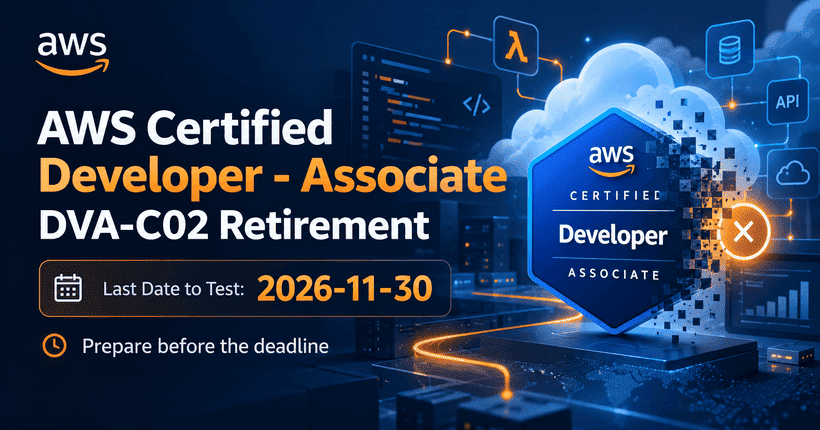
| Last day to take DVA-C02 | November 30, 2026 |
| Exam duration | 130 minutes |
| Questions | 65 total: 50 scored and 15 unscored |
| Question types | Multiple choice and multiple response |
| Passing score | 720 on a scaled 100–1,000 score |
| Exam fee | US$150, subject to applicable local taxes and pricing policies |
| Delivery | Pearson VUE test center or online proctored exam |
Two details are worth understanding before exam day. First, 720 is a scaled score, not a simple promise that 72% of the questions is enough. Second, AWS does not identify which 15 questions are unscored. Answer every question; the official guide says there is no penalty for guessing.
If you are already nearly ready for DVA-C02, AWS allows you to take it through November 30, 2026. If you are starting now, DVA-C03 materials are the better primary reference. AWS confirmed the updated dates and registration in its October 2026 certification announcement.
What’s New in DVA-C03 Compared with DVA-C02?
The foundations have not disappeared. Lambda, DynamoDB, IAM, application integration, deployment, and troubleshooting still matter. The update changes the emphasis and adds skills that are relevant to current development workflows.
- AI-assisted development: generating, reviewing, testing, and improving code with AI tools, while checking their output rather than accepting it blindly.
- AI service integration and security: working with managed AI services, controlling access to sensitive data, defending against prompt-injection risks, and securing AI agent tool use.
- Modern packaging and deployment: container images, deployment strategies, automated tests, and AI-supported delivery workflows have a clearer place in the guide.
- More emphasis on troubleshooting: the troubleshooting and optimization domain rises from 18% of scored content in DVA-C02 to 22% in DVA-C03.
The deployment domain has also been renamed Testing and Deployment. Its weight is now 22%, compared with 24% for the former Deployment domain. The Development domain moves from 32% to 30%, while Security stays at 26%.
Do not mistake this for a machine-learning engineer exam. AWS explicitly places advanced prompt engineering, designing retrieval-augmented generation (RAG) architectures, selecting foundation models, and designing AI governance frameworks outside the target candidate’s responsibilities. The focus is on using developer and AI services safely inside working applications. AWS provides a detailed DVA-C02 versus DVA-C03 comparison.
The Four DVA-C03 Exam Domains Explained
| Domain | Weight | What you need to understand |
|---|---|---|
| 1. Development with AWS Services | 30% | APIs, Lambda, event-driven applications, SDKs, data stores, AI-assisted development |
| 2. Security | 26% | IAM, authentication, encryption, secrets, presigned URLs, AI-service security |
| 3. Testing and Deployment | 22% | Testing, packaging, containers, IaC, CI/CD, rollout and rollback strategies |
| 4. Troubleshooting and Optimization | 22% | Logs, metrics, traces, root-cause analysis, concurrency, caching, performance |
Domain 1: Development with AWS Services (30%)
Start with the path of a request. An HTTP client might call Amazon API Gateway, which invokes AWS Lambda, which then reads or writes data in Amazon DynamoDB. That looks simple on a diagram. In practice, you must decide how to validate input, choose an API integration, handle exceptions, and avoid making repeated events corrupt your data.
Learn the differences among synchronous requests, asynchronous queues, and events. Amazon SQS is useful when a producer needs to hand work to a consumer that may be temporarily unavailable. Amazon SNS supports publish/subscribe fan-out. Amazon EventBridge helps route events according to rules. They are not interchangeable simply because all three move information between services.
For DynamoDB, understand partition-key choice, Query versus Scan, secondary indexes, consistency options, and conditional writes. For Lambda, understand timeouts, memory, concurrency, event source mappings, and what happens after a failed invocation. The updated domain also covers applying AI tools to code generation and reviews, and integrating managed AI services.
Domain 2: Security (26%)
Security questions often come down to one principle: give a workload the access it needs, for only as long as it needs it. A Lambda execution role is generally preferable to embedding long-lived AWS access keys in source code. Know the difference between identity-based and resource-based permissions, how temporary credentials work with AWS STS, and when Amazon Cognito helps authenticate application users.
Also study encryption at rest and in transit, AWS KMS, AWS Secrets Manager, and time-limited access through Amazon S3 presigned URLs. An API returning a presigned URL can let a client upload a file without making the whole S3 bucket public.
DVA-C03 adds a specific AI security task. Be able to reason about protecting sensitive inputs, redacting personal information, isolating agent sessions, authorizing tool calls, and requiring human approval before high-impact actions. An AI assistant that can summarize an order is one thing; an AI agent allowed to issue refunds without authorization checks is a different security problem.
Domain 3: Testing and Deployment (22%)
Being able to deploy code once is not the same as being able to deploy it repeatedly and safely. Review how AWS SAM, AWS CloudFormation, and AWS CDK represent application infrastructure; how AWS CodeBuild, AWS CodePipeline, and AWS CodeDeploy fit into a delivery workflow; and how Lambda code can be packaged as a ZIP archive or container image.
Understand the intent behind canary, blue/green, and rolling deployments. Learn how tests, application versions, aliases, monitoring signals, and rollback decisions reduce the blast radius of a release. The new guide also includes container deployment concepts using Amazon ECR, Amazon ECS, Amazon EKS, and AWS Fargate, plus AI-assisted test creation and deployment validation.
Domain 4: Troubleshooting and Optimization (22%)
This domain rewards people who have actually debugged applications. A useful mental model is to separate logs (what happened), metrics (how often and how much), and traces (where time was spent across a request). Amazon CloudWatch and AWS X-Ray help turn vague failures into observable symptoms.
Be prepared to investigate an access-denied response, a throttled Lambda function, a slow database call, or a deployment that succeeds but fails health checks. Study memory sizing, concurrency, retry behavior, caching with Amazon ElastiCache or Amazon CloudFront, and how to identify the actual bottleneck before increasing capacity. AI-based troubleshooting suggestions may help, but they still need verification against real telemetry.
The AWS Services Worth Knowing First
There is a long list of in-scope services, but beginners make faster progress when they learn how a few services interact instead of memorizing isolated product descriptions.
| Application need | Services to study | Question to ask yourself |
|---|---|---|
| Run an API | Amazon API Gateway, AWS Lambda | How does a request become a secure, validated function invocation? |
| Store data | Amazon DynamoDB, Amazon S3, Amazon RDS | What access pattern and consistency model does the app need? |
| Connect components | Amazon SQS, Amazon SNS, Amazon EventBridge | Does the consumer need a queue, fan-out, or event routing? |
| Secure an application | AWS IAM, AWS KMS, Amazon Cognito, AWS Secrets Manager | Who can do what, and where do credentials and sensitive data live? |
| Ship changes | AWS SAM, AWS CodePipeline, AWS CodeDeploy, Amazon ECR | How will the release be tested, deployed, and rolled back? |
| Find failures | Amazon CloudWatch, AWS X-Ray | Which logs, metrics, and traces reveal the cause? |
| Work with AI | Kiro, Amazon Bedrock, Amazon Bedrock AgentCore | How do we review AI-generated code and protect AI interactions? |
This is a learning priority list, not a promise that the exam tests only these services. Always cross-check the official DVA-C03 in-scope service list.
A Hands-On Project: Build a Small Order-Status API
One focused project can teach more than several evenings of flashcards. Build a tiny order-status service: a client submits an order, the application records it, and a background worker processes the next step. You do not need a full e-commerce website. A few JSON requests and a clean README are enough.
- Create the API. Put a
POST /ordersendpoint in API Gateway in front of a Lambda function. Validate required fields and return useful HTTP status codes. - Persist the order. Use DynamoDB and a unique order ID. Try a conditional write so a duplicate order request does not silently overwrite existing data.
- Decouple background work. Send a message to an SQS queue and process it with a second Lambda function. Test retries and duplicate delivery; make the worker idempotent.
- Apply least-privilege security. Give each function only the DynamoDB, SQS, or logging permissions it requires. Do not place access keys in the repository.
- Make failures visible. Add structured CloudWatch logs, a useful metric or alarm, and tracing where appropriate. Avoid logging secrets or personal information.
- Deploy repeatably. Define resources with AWS SAM or another supported infrastructure-as-code tool, then test an update and a rollback.
- Add one AI exercise. Use a development assistant such as Kiro to suggest unit tests and review its suggestions critically. If you explore Amazon Bedrock, use test data and appropriate security controls.
- Document and clean up. Explain the architecture, failures you tested, and trade-offs in a README. Delete resources after the lab and check for ongoing charges.
The lesson worth remembering is idempotency: if the same event arrives twice, your application should not charge a customer twice or create two identical orders. AWS explicitly recommends idempotent Lambda code, and DynamoDB conditional expressions are one way to protect a write. That is a practical engineering habit, not merely an exam trick.
Cost note: Some AWS resources can incur charges even during small experiments. Check current service pricing and Free Tier eligibility, configure billing alerts, and remove unused resources. A budget alert is not a substitute for monitoring and cleanup.
An Eight-Week DVA-C03 Study Plan for Beginners
This is a structured starting point, not a guarantee of exam readiness in eight weeks. If you are new to programming or cloud services, extend the schedule until you can explain the architecture and troubleshoot it without following a tutorial step by step.
| Week | Focus | Practical outcome |
|---|---|---|
| 1 | AWS basics, IAM roles, CLI, SDKs, Git, HTTP | Call an AWS service securely from a small script |
| 2 | Lambda, API Gateway, S3, event handling | Deploy a working serverless API |
| 3 | DynamoDB, SQS, SNS, EventBridge, retries | Add persistence and an asynchronous worker |
| 4 | IAM policies, Cognito, KMS, secrets, presigned URLs | Audit and reduce permissions in your project |
| 5 | SAM, CloudFormation, testing, CI/CD, containers | Deploy from version-controlled configuration |
| 6 | CloudWatch, X-Ray, concurrency, caching, debugging | Diagnose a deliberate failure and measure a fix |
| 7 | AI-assisted coding, Amazon Bedrock, AI security, review | Generate tests, inspect their quality, and apply safety controls |
| 8 | Official practice questions, weak-domain review, timed drills | Explain why the correct option fits each scenario |
My preferred study loop is straightforward: read the concept, build a small example, deliberately break it, then explain the fix. When a question asks how to handle retries, you will remember the duplicate message you tested rather than a sentence you highlighted in a PDF.
Start with the official DVA-C03 exam guide, then use the DVA-C03 Exam Prep Plan on AWS Skill Builder to identify gaps. You can also use additional AWS Developer Associate exam practice materials to reinforce your understanding of the exam topics and review your weaker areas.
Exam-Day Strategy: Avoid These Common Mistakes
- Read the constraint, not just the service name. The best answer may depend on least operational effort, secure access, decoupling, or how failures are handled.
- Know the exact response type. A multiple-response question may require more than one selection. AWS requires all correct choices for credit.
- Do not leave questions unanswered. The official guide states that unanswered questions are incorrect and guessing carries no extra penalty.
- Do not rely on outdated DVA-C02 question banks alone. They may help with fundamentals but miss the new AI security, testing, and delivery topics.
- Avoid exam dumps. Memorizing unauthorized questions is a poor substitute for technical understanding and can violate certification rules.
Before scheduling your exam, it is worth testing your readiness across all four domains. Working through a set of DVA-C03 practice tests and exam preparation questions can help you identify knowledge gaps, become familiar with scenario-based questions, and decide which technical topics deserve another round of review. Focus on understanding the explanations rather than simply memorizing answers.
Is AWS Certified Developer – Associate Worth It in 2026?
For a junior developer, computing student, or engineer moving from traditional networking into cloud application development, DVA-C03 can be a credible way to demonstrate structured AWS knowledge. It gives employers a recognizable signal that you have studied the development lifecycle, security, deployment, and troubleshooting—not just how to launch a virtual machine.
But the credential is a signal, not a substitute for experience. A certificate by itself does not prove you can maintain a production service or guarantee a job offer. Pair it with a small, documented project, a clear explanation of architectural trade-offs, and the ability to debug your own work. That combination is far more convincing in a technical interview.
There is also a practical benefit: AWS certifications remain valid for three years, so passing the exam gives you a defined credential to maintain as AWS services and development practices evolve.
Frequently Asked Questions About DVA-C03
Is AWS Certified Cloud Practitioner required before DVA-C03?
No. AWS has no mandatory prerequisite certification for DVA-C03. Cloud Practitioner can be a useful foundation if AWS is completely new to you, but it is optional.
Is DVA-C03 suitable for someone with no professional experience?
It is possible to prepare as a student, but the exam assumes practical development knowledge. AWS recommends at least a year of hands-on AWS application experience. Begin with programming, HTTP APIs, Git, and basic cloud services if those topics are unfamiliar.
Does DVA-C03 test generative AI and AI agents?
Yes, within the developer role. The updated guide includes AI-assisted code work, integrating managed AI services, and security controls for AI interactions. It does not require designing RAG systems, choosing foundation models, or building AI governance frameworks.
Can I use DVA-C02 study materials?
Yes, for shared fundamentals such as Lambda, IAM, DynamoDB, and deployment. Supplement them with the DVA-C03 exam guide and its explicit changes, especially AI-related security, testing, containers, and troubleshooting.
Is 720 a 72% passing mark?
No. AWS uses scaled scoring from 100 to 1,000; 720 is the minimum passing scaled score. It should not be interpreted as a fixed percentage of questions answered correctly.
How long is the certification valid?
Three years from the date you earn it. Check AWS’s recertification rules before your credential expires.
Final Thoughts
The best reason to study for DVA-C03 is not that it adds another line to your résumé. It gives you a reason to practice the less glamorous parts of software engineering: permissions, retries, deployment failures, logs, tests, and the awkward edge cases that only appear after an application is running.
Learn those habits, get comfortable using AI tools without trusting them blindly, and the certification becomes a useful milestone rather than the entire destination.
If you are currently preparing for the certification, combine hands-on AWS labs with structured revision and exam-style practice. These AWS Certified Developer Associate DVA-C03 study and practice resources can serve as an additional reference during your preparation.
Official References and Further Reading
- AWS Certified Developer – Associate: official certification page — exam overview and registration.
- AWS DVA-C03 official exam guide — candidate profile, exam content, and domain weights.
- AWS comparison of DVA-C02 and DVA-C03 — changes in domain weights and skills.
- AWS DVA-C03 in-scope services — services included in the current guide.
- AWS Training and Certification: October 2026 exam update — registration and rollout dates.
- AWS Skill Builder: DVA-C03 Exam Prep Plan — official study pathway.
- AWS Lambda developer best practices — idempotency, performance, and reliability guidance.
- DynamoDB condition expressions — conditional writes for safer application behavior.
- AWS Certification: before testing and recertification policy — prerequisites and validity.