Cloud development has changed considerably in recent years. Developers are no longer responsible only for writing application code and deploying it to servers. They increasingly build event-driven applications, integrate managed cloud services, automate testing and deployment, and use AI-assisted tools to improve productivity.
Amazon Web Services has updated its Developer Associate certification to reflect these changes.
The AWS Certified Developer – Associate (DVA-C03) exam represents the updated version of one of AWS’s most recognized developer-focused certifications. It evaluates practical skills in developing, testing, securing, deploying, troubleshooting, and optimizing applications on AWS.
One of the most significant changes is the inclusion of AI-assisted development workflows and security considerations for applications that interact with artificial intelligence services.
However, the certification remains firmly focused on cloud application development. Candidates still need a strong understanding of AWS Lambda, Amazon DynamoDB, AWS Identity and Access Management (IAM), API development, container technologies, deployment automation, and application observability.
If you are a student, junior developer, cloud engineer, or IT professional considering your first developer-focused AWS certification, this guide explains the DVA-C03 examination, its technical topics, certification value, and practical preparation strategies.
What Is AWS Certified Developer – Associate (DVA-C03)?
Table of Contents
ToggleThe AWS Certified Developer – Associate certification validates technical proficiency in building and maintaining applications using AWS services.
The updated DVA-C03 examination focuses on the development lifecycle, including application implementation, security, testing, deployment, monitoring, and troubleshooting.
Unlike AWS Certified Solutions Architect – Associate, which concentrates primarily on architecture design decisions, Developer – Associate focuses on the work developers perform when implementing and operating cloud applications.
For example, consider an online shopping application that processes customer orders.
A developer may need to:
- Implement business logic using AWS Lambda.
- Expose application endpoints through Amazon API Gateway.
- Store order information in Amazon DynamoDB.
- Use Amazon SQS for asynchronous order processing.
- Configure IAM roles for secure service access.
- Deploy application updates using CI/CD workflows.
- Monitor errors through Amazon CloudWatch.
- Use AI-assisted tools to review code and investigate failures.
These responsibilities illustrate the practical nature of the certification.
DVA-C03 Exam Overview
AWS announced the updated Developer – Associate examination in 2026, with registration opening on October 27 and general availability beginning on December 1.
Candidates planning their certification journey can explore the DVA-C03 exam preparation course alongside the official AWS examination guide to organize their learning and review key development topics.
| Exam Information | Details |
|---|---|
| Certification | AWS Certified Developer – Associate |
| Exam Code | DVA-C03 |
| Certification Level | Associate |
| Registration Opens | October 27, 2026 |
| First Testing Date | December 1, 2026 |
| Exam Duration | 130 minutes |
| Questions | 65 questions |
| Scored Questions | 50 |
| Unscored Questions | 15 |
| Question Types | Multiple choice and multiple response |
| Passing Score | 720 out of 1,000 (scaled) |
| Standard Exam Fee | USD 150 |
| Testing Provider | Pearson VUE |
| Testing Options | Testing center or online proctored examination |
| Languages | English, Japanese, Korean, Portuguese (Brazil), Simplified Chinese, and Spanish (Latin America) |
Important: AWS may revise examination policies, fees, scheduling availability, and language options. Candidates should verify the current details through the official AWS Certification website before registering.
Who Should Take the AWS DVA-C03 Exam?
AWS recommends that candidates have at least one year of hands-on experience developing and maintaining applications using AWS services.
However, this is a recommended experience level rather than a mandatory prerequisite.
The certification is relevant for:
- Junior Software Developers
- Backend Developers
- Cloud Application Developers
- Full-Stack Developers
- DevOps Engineers
- Serverless Application Developers
- IT Professionals Transitioning to Cloud Development
- Computer Science Students
Candidates should be comfortable using at least one programming language, such as Python, Java, JavaScript, TypeScript, Go, or C#.
Understanding APIs, application lifecycle management, and basic cloud concepts will make the advanced topics easier to study.
Why Is AWS Developer Associate Certification Valuable?
Modern applications frequently depend on managed infrastructure rather than self-hosted servers and databases.
Developers need to understand how cloud services interact, how permissions are enforced, and how software can be deployed reliably.
1. Validate Cloud Development Skills
The certification covers practical application development patterns involving AWS APIs, SDKs, serverless services, databases, messaging, and deployment tools.
These skills can help developers work more effectively with cloud-hosted applications.
2. Strengthen Application Security Knowledge
AWS developers must understand permissions, authentication, encryption, and sensitive data protection.
DVA-C03 also expands attention to security concerns associated with AI-enabled applications.
3. Learn Modern Development Workflows
Cloud development increasingly includes automated testing, application packaging, deployment pipelines, and observability.
The updated certification reflects these activities.
4. Understand AI-Assisted Development
Developers increasingly use AI tools to generate code, review implementations, suggest tests, and analyze errors.
DVA-C03 validates knowledge of these workflows while emphasizing that developers remain responsible for reviewing and securing the resulting code.
5. Support Professional Growth
The certification may help demonstrate relevant knowledge when pursuing cloud developer or software engineering roles.
However, employers also consider programming ability, engineering experience, communication skills, and completed projects.
Certification is most valuable when combined with practical development experience.
DVA-C03 Exam Domains and Weightings
The official AWS DVA-C03 examination guide divides the scored content into four major domains.
| Exam Domain | Weight |
|---|---|
| Domain 1: Development with AWS Services | 30% |
| Domain 2: Security | 26% |
| Domain 3: Testing and Deployment | 22% |
| Domain 4: Troubleshooting and Optimization | 22% |
These percentages represent the relative weighting of scored examination content.
Candidates should study all four domains rather than concentrating exclusively on the most heavily weighted section.
Domain 1: Development with AWS Services (30%)
This domain evaluates the ability to develop and optimize applications using AWS services and development tools.
It includes application integration, serverless development, database operations, and modern development workflows.
AWS Lambda and Serverless Applications
AWS Lambda allows developers to execute application code without directly managing traditional application servers.
Lambda functions can respond to events generated by services such as API Gateway, Amazon S3, Amazon DynamoDB, and Amazon EventBridge.
Important Lambda concepts include:
- Function handlers and event payloads
- Execution roles and permissions
- Environment variables
- Function versions and aliases
- Concurrency and throttling
- Synchronous and asynchronous invocation
- Error handling and retry behavior
- Performance and cost optimization
For example, an application may invoke a Lambda function whenever a customer uploads a file to an S3 bucket.
The function could validate the file, extract metadata, and write the result to a database.
Developers must understand how permissions, event configuration, and failure handling affect this workflow.
Working With AWS SDKs
AWS Software Development Kits provide programming interfaces for interacting with AWS services.
For example, Python developers commonly use Boto3 to access AWS APIs.
Developers should understand how SDKs obtain credentials through supported credential providers, perform service operations, handle exceptions, and implement suitable retry behavior.
Amazon DynamoDB
DynamoDB is a managed NoSQL database that supports key-value and document-oriented data models.
It is commonly used in serverless and event-driven applications.
Key concepts include:
- Partition keys and sort keys
- Query and Scan operations
- Global and local secondary indexes
- Conditional writes
- Read consistency
- DynamoDB Streams
- Capacity modes
- Data access patterns
A common beginner mistake is treating DynamoDB like a traditional relational database.
In DynamoDB, efficient access patterns and key design strongly influence performance and cost.
API Development With Amazon API Gateway
Amazon API Gateway provides capabilities for creating and managing APIs.
It is frequently integrated with AWS Lambda and other application services.
Developers should understand request handling, authorization, throttling, backend integrations, and error responses.
Asynchronous Messaging and Event-Driven Systems
Event-driven architectures allow application components to communicate without requiring every operation to complete synchronously.
Relevant AWS services include:
- Amazon Simple Queue Service (SQS)
- Amazon Simple Notification Service (SNS)
- Amazon EventBridge
- AWS Step Functions
For example, an order processing application might place new orders in an SQS queue.
A separate worker processes those messages independently from the customer-facing application.
This can improve resilience and decouple application components.
However, developers must account for duplicate delivery, retries, message visibility timeouts, and idempotent processing.
AI-Assisted Development: What’s New in DVA-C03?
One of the defining changes in DVA-C03 is the expanded recognition of artificial intelligence in everyday software development.
Developers increasingly use AI assistants to write code, understand existing applications, generate tests, and investigate technical problems.
But AI-assisted development introduces new responsibilities.
Generated code can contain errors, insecure dependencies, inefficient algorithms, or incorrect assumptions.
Developers must therefore evaluate the output rather than accepting it automatically.
Amazon Q Developer
Amazon Q Developer provides AI-assisted capabilities for software development and related technical workflows.
Depending on the available integration and features, developers can use AI assistance for activities such as:
- Explaining application code
- Generating implementation suggestions
- Supporting code reviews
- Generating unit tests
- Investigating errors
- Recommending improvements
For examination preparation, focus on appropriate uses of AI assistance, developer verification, security, and development workflow integration.
Kiro and AI-Assisted Workflows
Kiro is included among the development technologies introduced within the updated AWS certification scope.
Candidates should understand the general role of AI-assisted development environments and how structured requirements, implementation, testing, and review can fit into software development.
Amazon Bedrock
Amazon Bedrock provides managed capabilities for building generative AI applications.
From a developer’s perspective, relevant knowledge includes integrating AI services into applications and protecting interactions with those services.
Advanced foundation model selection, prompt engineering, and retrieval-augmented generation architecture design are outside the announced scope of DVA-C03.
Therefore, candidates do not need to approach this examination as a specialized machine learning engineering certification.
Container Development With Amazon ECS, EKS, and ECR
Modern development teams frequently package applications into containers.
A container image includes application code and the supporting components needed to run it in a compatible container environment.
DVA-C03 explicitly includes container-related development skills.
Amazon Elastic Container Registry (ECR)
Amazon ECR is a managed container image registry.
Developers can use it to store and retrieve container images that are deployed to supported AWS compute platforms.
Important concepts include image repositories, tags, authentication, image permissions, and vulnerability scanning capabilities.
Amazon Elastic Container Service (ECS)
Amazon ECS is a container orchestration service used to deploy and manage containerized applications.
Candidates should understand basic container deployment concepts and the relationship between tasks, services, and application configuration.
Amazon Elastic Kubernetes Service (EKS)
Amazon EKS provides managed Kubernetes capabilities.
Developers should understand its role in running Kubernetes applications without assuming the examination requires advanced Kubernetes cluster architecture design.
AWS Fargate
AWS Fargate provides serverless compute capacity for supported container workloads.
It reduces the need for developers to manage the underlying compute servers directly.
Understanding when to use containers rather than Lambda or traditional virtual machines is useful for application development decisions.
Domain 2: Security (26%)
Security remains one of the most important parts of AWS application development.
Developers must protect credentials, configure application permissions, encrypt sensitive information, and securely integrate managed services.
AWS Identity and Access Management (IAM)
IAM controls access to supported AWS resources through policies and roles.
Important concepts include:
- Identity-based policies
- Resource-based policies
- IAM roles
- Temporary credentials
- Least-privilege permissions
- Role trust policies
For example, a Lambda function that reads data from a particular DynamoDB table should receive only the required DynamoDB permissions rather than unrestricted administrator access.
Encryption and Sensitive Data Protection
Developers should understand encryption at rest and encryption in transit.
AWS Key Management Service (KMS) supports cryptographic key management for supported workloads.
AWS Secrets Manager can be used to manage application secrets such as database credentials and API tokens.
Hardcoding passwords or secret access keys in source code should be avoided.
Amazon Cognito
Amazon Cognito provides identity functionality for web and mobile applications.
Candidates should understand the relationship between application authentication and AWS authorization capabilities.
New AI Security Requirements in DVA-C03
The updated examination introduces a dedicated area covering security for AI-related services and interactions.
These concepts are increasingly relevant as applications use managed generative AI capabilities and autonomous tools.
Access Management for AI Services
Applications should receive only the permissions required to interact with specific AI resources.
Developers must understand how IAM permissions apply to supported AI services and integrations.
Data Privacy
Applications must protect sensitive information sent to or returned from AI services.
Important considerations include private connectivity where supported, data handling configurations, and preventing the unintended exposure of confidential information.
Prompt Injection Protection
Prompt injection occurs when untrusted content attempts to influence an AI system to behave contrary to its intended instructions or security boundaries.
For example, malicious text embedded in a document might attempt to instruct an AI-connected application to reveal information or invoke an unauthorized tool.
Developers should use appropriate authorization, input handling, output validation, and service security controls rather than relying solely on prompt wording.
AI Agent Interaction Security
AI-enabled applications may invoke tools or perform actions on behalf of users.
Secure implementations must consider:
- Tool-use authorization
- Identity and permission boundaries
- Session isolation
- Human approval for sensitive actions
- Logging and sensitive data protection
These concepts are relevant to secure AI integration without requiring candidates to design advanced AI architectures.
Domain 3: Testing and Deployment (22%)
Modern application development requires reliable testing and repeatable deployment procedures.
The updated examination places particular emphasis on testing and deployment as an integrated stage of the development lifecycle.
Unit Testing and Integration Testing
Unit tests evaluate individual components of application code.
Integration tests verify how components interact with external dependencies, APIs, databases, and services.
Developers should understand when each testing approach is appropriate.
AI-Assisted Test Generation
AI tools can help developers generate candidate unit tests and identify untested behavior.
However, automatically generated tests must still be reviewed for correctness, coverage, and reliability.
Passing a generated test does not necessarily prove that an application behaves correctly under production conditions.
Continuous Integration and Continuous Delivery
CI/CD workflows help teams build, test, package, and deploy software more consistently.
Relevant concepts include:
- Automated builds
- Test execution
- Deployment artifacts
- Environment configuration
- Deployment approvals
- Rollback strategies
- Release validation
AWS CodeBuild, CodeDeploy, and CodePipeline are examples of services that can support parts of these workflows.
The examination emphasizes using development and deployment workflows rather than advanced enterprise-wide pipeline architecture design.
AWS CloudFormation and AWS SAM
AWS CloudFormation provides infrastructure-as-code capabilities for defining and managing supported AWS resources.
AWS Serverless Application Model (SAM) simplifies the definition and deployment of serverless applications.
Understanding declarative infrastructure management helps developers avoid inconsistent manual environments.
Deployment Strategies
Developers should recognize common deployment approaches:
- All-at-once deployment
- Rolling deployment
- Blue/green deployment
- Canary deployment
- Traffic shifting
Each approach involves trade-offs involving complexity, downtime, deployment speed, and rollback capabilities.
Domain 4: Troubleshooting and Optimization (22%)
A successful deployment is only the beginning of an application’s lifecycle.
Production applications must be monitored, debugged, maintained, and optimized.
This domain focuses on root cause analysis, observability, troubleshooting, and performance improvements.
Amazon CloudWatch
CloudWatch provides monitoring and observability capabilities for AWS applications and resources.
Developers can use metrics, logs, and alarms to understand system behavior.
For example, a sudden increase in Lambda errors may indicate permission failures, application defects, or problems with downstream services.
Distributed Tracing
A single user request may cross API Gateway, Lambda, databases, and other services.
Distributed tracing helps developers analyze the request path and identify latency or failures.
Relevant technologies include AWS X-Ray and supported OpenTelemetry integrations.
Structured Logging
Structured logs provide consistent, machine-readable application information.
Including suitable identifiers, timestamps, and contextual fields can make troubleshooting more efficient.
However, application logs should not expose passwords, access tokens, or unnecessary sensitive information.
Performance Optimization
Developers should understand techniques such as:
- Reducing unnecessary API calls
- Improving DynamoDB access patterns
- Managing Lambda concurrency
- Using caching appropriately
- Optimizing retries and timeouts
- Reducing resource waste
- Identifying performance bottlenecks
AI-Assisted Troubleshooting
AI tools can help summarize logs, explain errors, and suggest possible remediation steps.
Nevertheless, recommendations should be validated against application behavior, deployment configuration, and operational evidence.
A suggested fix should not be applied blindly to a production system.
Practical Example: Building a Serverless Application on AWS
One effective way to prepare for DVA-C03 is to build a small project that combines several examination topics.
Consider a task management API that stores and retrieves task records.
A simple architecture could use:
- Amazon API Gateway for HTTP requests
- AWS Lambda for application logic
- Amazon DynamoDB for persistent records
- AWS IAM for permissions
- Amazon CloudWatch for monitoring
- AWS SAM for deployment
Example Python Lambda Function
The following example retrieves a task from a DynamoDB table using a task identifier.
import json
import os
import boto3

dynamodb = boto3.resource("dynamodb")

table = dynamodb.Table(
    os.environ["TABLE_NAME"]
)

def lambda_handler(event, context):

    task_id = event.get("task_id")

    if not task_id:
        return {
            "statusCode": 400,
            "body": json.dumps({
                "error": "task_id is required"
            })
        }

    try:
        response = table.get_item(
            Key={"task_id": task_id}
        )

        item = response.get("Item")

        if item is None:
            return {
                "statusCode": 404,
                "body": json.dumps({
                    "error": "Task not found"
                })
            }

        return {
            "statusCode": 200,
            "body": json.dumps(
                item,
                default=str
            )
        }

    except Exception:
        return {
            "statusCode": 500,
            "body": json.dumps({
                "error": "Internal server error"
            })
        }
This simplified example assumes the DynamoDB table has a string partition key named task_id and the input event directly contains that field.
A production HTTP API would also need to handle the actual API Gateway event format, validate identifiers, enforce authentication and authorization, use appropriate logging, and manage errors more carefully.
It is a useful starting point for understanding how Lambda code interacts with AWS services through SDKs and IAM permissions.
Extending the Project
Once the basic functionality works, consider adding:
- Authentication with Amazon Cognito
- Asynchronous processing through Amazon SQS
- Automated unit tests
- A SAM deployment template
- CloudWatch metrics and alarms
- Code review with AI-assisted development tools
- Least-privilege IAM policies
This type of project connects theoretical examination knowledge with practical development experience.
DVA-C03 vs. DVA-C02: What Changed?
DVA-C03 replaces the previous DVA-C02 examination version.
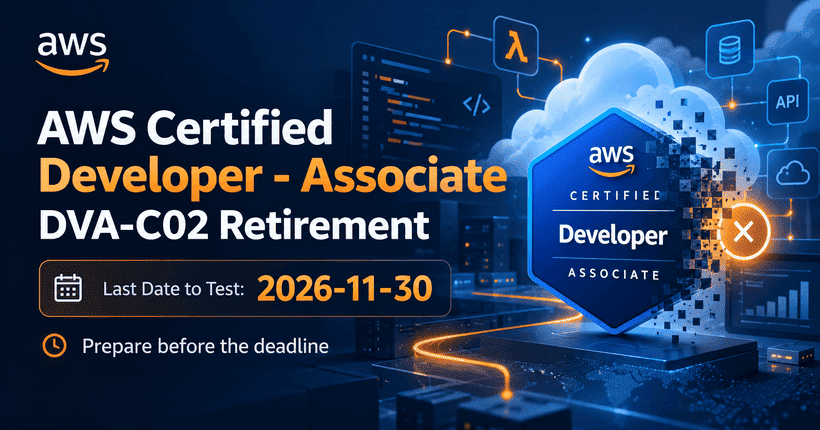
AWS announced that DVA-C02’s last testing date is November 30, 2026, while DVA-C03 testing begins December 1, 2026.
Both examination versions lead to the AWS Certified Developer – Associate credential.
| Feature | DVA-C02 | DVA-C03 |
|---|---|---|
| Examination Status | Last test date: November 30, 2026 | Begins December 1, 2026 |
| Development with AWS Services | 32% | 30% |
| Security | 26% | 26% |
| Deployment / Testing and Deployment | 24% | 22% |
| Troubleshooting and Optimization | 18% | 22% |
| AI-Assisted Development | Limited emerging-topic coverage | Integrated into exam objectives |
| AI Security | Not a dedicated scored task | Dedicated AI security task |
| Container Development | Relevant container concepts | Expanded container development coverage |
The updated examination gives more emphasis to modern development workflows, security, and troubleshooting.
However, the core AWS development fundamentals remain important across both versions.
How Difficult Is the DVA-C03 Exam?
AWS Certified Developer – Associate is an associate-level certification, but it requires more than memorizing AWS service descriptions.
Candidates need to understand practical application scenarios and the relationships between services.
For example, a question may describe a Lambda function that cannot read data from DynamoDB.
The correct troubleshooting approach depends on understanding the function execution role, IAM permissions, resource configuration, and application error messages.
Similarly, a question involving asynchronous processing may require candidates to evaluate retries, duplicate message handling, and failure recovery.
The new AI-related topics add another dimension, but they do not replace the need for strong AWS development knowledge.
How to Prepare for the AWS DVA-C03 Exam
The most effective preparation combines official documentation, structured learning, programming exercises, and realistic troubleshooting scenarios.
Step 1: Review the Official DVA-C03 Exam Guide
Begin by studying the exam objectives, domain weights, and in-scope technologies.
Use the current official guide rather than relying on materials designed exclusively for DVA-C02.
Step 2: Strengthen Programming Fundamentals
Become comfortable with one high-level programming language.
Practice working with APIs, JSON data, error handling, libraries, and automated tests.
Step 3: Build AWS Serverless Applications
Practice using Lambda, API Gateway, DynamoDB, IAM, and CloudWatch.
Focus on how the services interact and what happens when configurations are incorrect.
Step 4: Study Security and AI Integration
Review IAM roles, encryption, credentials, and application access controls.
Understand the security implications of AI-assisted development and AI service integrations.
Step 5: Learn Deployment and Container Workflows
Study application testing, deployment strategies, infrastructure as code, container image management, and common CI/CD processes.
Step 6: Practice Troubleshooting
Investigate failed Lambda invocations, API errors, permission problems, container image issues, and deployment failures.
Use logs, metrics, and traces to gather evidence.
Step 7: Review With Practice Assessments
Use AWS Skill Builder and authorized practice resources to evaluate readiness.
Candidates looking to reinforce their knowledge can also explore the AWS DVA-C03 course and practice tests to complement official AWS learning materials and hands-on projects.
For every incorrect answer, identify the underlying technical concept and practice it in a controlled environment.
Suggested Eight-Week DVA-C03 Study Plan
The following schedule is suitable for candidates with basic programming knowledge and some exposure to cloud services.
| Week | Study Focus | Practical Goal |
|---|---|---|
| 1 | AWS fundamentals, IAM, CLI, and SDKs | Connect a local application to AWS securely |
| 2 | AWS Lambda and API Gateway | Build a serverless API |
| 3 | DynamoDB and messaging services | Add persistence and asynchronous processing |
| 4 | Security and AI service integration | Review permissions, secrets, and AI security |
| 5 | Containers, ECR, ECS, and EKS concepts | Package and deploy a containerized application |
| 6 | Testing, CI/CD, CloudFormation, and SAM | Automate testing and deployment |
| 7 | CloudWatch, tracing, and optimization | Diagnose application failures |
| 8 | Comprehensive review and practice assessments | Identify knowledge gaps and evaluate readiness |
This schedule is a suggested learning framework rather than an official AWS training requirement.
Common Mistakes to Avoid During DVA-C03 Preparation
1. Studying Only DVA-C02 Materials
Previous study resources remain useful for foundational topics, but candidates must account for the updated DVA-C03 objectives.
2. Ignoring AI-Assisted Development
AI development workflows are now part of the updated certification scope.
Understand their practical uses and security considerations.
3. Memorizing Service Names
Knowing what a service does is only the beginning.
Candidates must understand why a particular service or configuration is appropriate for a given application requirement.
4. Overlooking IAM Permissions
Many real-world application problems involve missing or excessive permissions.
Practice applying least privilege rather than relying on broad administrative policies.
5. Ignoring Failure Handling
Developers should understand retries, idempotency, throttling, and failure recovery.
6. Neglecting Hands-On Practice
Practical projects help connect documentation with real application behavior.
Use a controlled learning environment and monitor AWS resource charges.
Frequently Asked Questions About AWS DVA-C03
What is the AWS DVA-C03 exam?
DVA-C03 is the updated AWS Certified Developer – Associate examination. It validates skills in developing, testing, securing, deploying, troubleshooting, and optimizing AWS applications, including AI-assisted development workflows.
When does the DVA-C03 exam become available?
DVA-C03 registration opened on October 27, 2026, and examination delivery begins on December 1, 2026.
How many questions are on DVA-C03?
The exam contains 65 questions, including 50 scored and 15 unscored questions.
How long is the DVA-C03 examination?
The examination duration is 130 minutes.
What is the passing score for DVA-C03?
The minimum passing score is 720 on a scaled range of 100 to 1,000.
How much does DVA-C03 cost?
The standard examination fee is USD 150, subject to applicable regional pricing and taxes.
Is DVA-C03 suitable for beginners?
It is accessible to motivated learners, but AWS recommends at least one year of hands-on development experience using AWS services. Beginners should first develop foundational AWS and programming knowledge.
Does DVA-C03 include generative AI?
Yes. The examination includes AI-assisted development and security considerations for AI-enabled applications. Advanced foundation model engineering and retrieval-augmented generation architecture design are outside its announced scope.
Do I need to learn Amazon Bedrock?
Candidates should understand relevant developer-oriented integration and security concepts associated with Amazon Bedrock, as described in the official exam guide.
Does DVA-C03 cover Kubernetes?
Container development is included, with relevant AWS services such as Amazon EKS, ECS, ECR, and Fargate. Advanced Kubernetes platform administration is not the primary focus.
What is the difference between DVA-C02 and DVA-C03?
DVA-C03 updates the examination objectives to include expanded AI-assisted development, AI security, modern container workflows, and revised domain weightings.
Is AWS Developer Associate worth pursuing?
It can be valuable for developers working with AWS application services and cloud deployment workflows. Its professional value is strongest when supported by practical development skills and project experience.
Final Thoughts: Preparing for the Future of AWS Development
The AWS Certified Developer – Associate (DVA-C03) certification reflects the changing responsibilities of modern cloud developers.
Building reliable AWS applications still requires strong fundamentals in programming, serverless architecture, databases, messaging, deployment, security, and observability.
What has changed is the growing importance of AI-assisted development tools and the security requirements associated with integrating AI capabilities into applications.
For candidates preparing for DVA-C03, the best approach is to combine these new competencies with a solid understanding of traditional AWS development practices.
Start with the official examination objectives, create practical projects, study how services interact, and develop a repeatable troubleshooting process.
Above all, focus on understanding why a technical solution works rather than memorizing individual examination answers.
The practical knowledge you develop during certification preparation can remain valuable long after the examination is complete.
To continue your preparation, explore the DVA-C03 AWS Certified Developer Associate course and practice tests and combine structured revision with official AWS documentation, coding exercises, and practical cloud projects.
Official References and Recommended Learning Resources
The following official AWS resources provide examination information, preparation guidance, and technical documentation.
- AWS Certified Developer – Associate – Official Certification PageOfficial certification information, registration, exam overview, and preparation resources.
- AWS DVA-C03 Official Exam GuideThe official DVA-C03 examination guide, including content domains, candidate recommendations, scoring, and examination objectives.
- AWS – September 2026 Certification UpdatesOfficial announcement explaining changes to DVA-C03, including AI-assisted development and security topics.
- AWS – DVA-C03 Registration AnnouncementOfficial confirmation of the updated examination registration and preparation resources.
- AWS Lambda Developer GuideTechnical guidance for developing and operating serverless applications.
- Amazon DynamoDB Developer GuideDocumentation covering DynamoDB data access, application integration, and database operations.
- AWS IAM User GuideReference information about roles, policies, temporary credentials, and access control.
- Amazon Bedrock User GuideOfficial documentation about integrating generative AI capabilities into applications.
- Amazon ECR User GuideDocumentation for managing container images and repositories.
- AWS Skill BuilderOfficial AWS training, hands-on learning, and certification preparation resources.