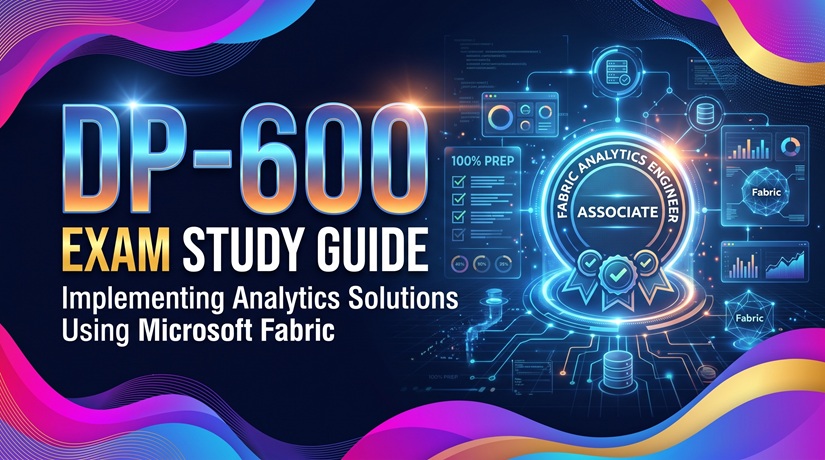
If you have been working with Power BI, SQL, data warehouses, or cloud analytics, there is a good chance that Microsoft Fabric has already appeared somewhere on your learning roadmap. Microsoft’s DP-600 exam, officially titled Implementing Analytics Solutions Using Microsoft Fabric, sits right in the middle of that transition.
Passing DP-600 earns the Microsoft Certified: Fabric Analytics Engineer Associate certification. But the exam is more interesting than the badge itself. It represents Microsoft’s increasingly unified view of enterprise analytics: data engineering, warehousing, real-time analytics, semantic modeling, governance, and business intelligence are no longer treated as completely separate worlds.
For students and people at the beginning of a data career, that can make DP-600 look intimidating. You are expected to understand SQL, DAX, KQL, lakehouses, warehouses, security, semantic models, and several Microsoft Fabric services. The good news is that you do not need to become an expert in every Fabric workload before starting.
What you do need is a solid understanding of how the pieces fit together.
Last reviewed: October 6, 2026. Microsoft has announced an update to the English-language DP-600 exam effective October 19, 2026, so always check the current Microsoft study guide before scheduling your exam.
What Is the DP-600 Exam?
Table of Contents
ToggleDP-600 is Microsoft’s role-based certification exam for analytics professionals who design, create, deploy, secure, and maintain analytical solutions with Microsoft Fabric.
The corresponding certification is:
Microsoft Certified: Fabric Analytics Engineer Associate
Microsoft describes candidates for this certification as professionals who work with analytical assets such as:
- Semantic models
- Lakehouses
- Data warehouses
- Enterprise analytics solutions
Candidates are also expected to be comfortable querying and analyzing data with SQL, Kusto Query Language (KQL), and Data Analysis Expressions (DAX).
According to Microsoft’s current certification page, DP-600 is classified as an intermediate-level exam. Candidates currently receive 100 minutes to complete the assessment. Microsoft certification exams use a scaled score, and Microsoft states that 700 or higher is required to pass.
The exam is proctored and may include interactive components in addition to traditional question formats.
Microsoft role-based certifications also have a renewal cycle. The Fabric Analytics Engineer Associate certification currently has a 12-month renewal frequency, with eligible certification holders able to renew through Microsoft’s online renewal assessment.
If you are building a structured study plan, this Microsoft DP-600 exam preparation resource can also serve as a dedicated reference page alongside the official Microsoft documentation.
DP-600 Exam Domains
The current Microsoft DP-600 blueprint organizes the exam around three major skill areas:
| Exam Domain | Approximate Weight |
|---|---|
| Maintain a data analytics solution | 25–30% |
| Prepare data | 45–50% |
| Implement and manage semantic models | 25–30% |
The percentages immediately tell you something important: DP-600 is not simply an advanced Power BI visualization exam.
Data preparation represents a major part of the assessment. At the same time, semantic modeling, DAX, security, governance, and application lifecycle management remain central to the job role.
Microsoft periodically changes certification objectives as Fabric evolves. That matters more for Fabric than for many mature technologies because the platform is developing quickly. The official DP-600 Study Guide should therefore be treated as the final authority on what you need to study.
Understanding Microsoft Fabric Before Studying DP-600
The easiest way to make DP-600 difficult is to memorize individual features without understanding the Fabric architecture.
Microsoft Fabric is an end-to-end SaaS analytics platform. Instead of treating data integration, data engineering, warehousing, real-time analytics, data science, and business intelligence as unrelated products, Fabric brings these workloads together under a common platform.
A simplified analytics flow might look like this:
Data source → ingestion → OneLake → Lakehouse or Warehouse → transformation → semantic model → Power BI report
Real projects are obviously more complicated, but this mental model is useful throughout your DP-600 preparation.
OneLake: The Storage Foundation
OneLake is one of the most important Fabric concepts to understand.
Think of OneLake as the organization-wide logical data lake behind Microsoft Fabric. Fabric workloads can use this shared storage architecture instead of forcing every analytics team to create an entirely isolated storage environment.
For a beginner, the important point is not simply remembering the term “OneLake.” You should understand why Microsoft built Fabric around it:
- Reduce unnecessary data silos
- Make data easier to discover and reuse
- Provide a consistent storage foundation for different analytics workloads
- Support centralized governance
- Reduce unnecessary duplication between engineering and BI workloads
This architecture becomes especially important when studying Lakehouse, Warehouse, semantic models, shortcuts, and Direct Lake.
Lakehouse vs. Warehouse: Know the Difference
This is one of the areas where students coming from traditional networking or general IT backgrounds may need additional study.
Fabric Lakehouse
A Microsoft Fabric Lakehouse combines characteristics of a traditional data lake and a data warehouse.
It can store structured and unstructured data while allowing analytics professionals to work with familiar technologies such as Apache Spark and SQL. Fabric Lakehouse tables use Delta Lake technology, giving the environment database-like capabilities while retaining the flexibility associated with data lakes.
A Lakehouse is particularly relevant when your architecture combines:
- Data engineering
- Spark processing
- Large analytical datasets
- Delta tables
- SQL-based analytics
- Power BI consumption
Fabric Warehouse
Fabric Warehouse is closer to the experience that SQL database and traditional data warehouse professionals already know.
If the solution is primarily relational, highly structured, and centered around SQL analytics, a warehouse may be a natural choice.
For DP-600, do not reduce this topic to “Lakehouse uses Spark and Warehouse uses SQL.” That is too simplistic.
You should be able to look at a business requirement and decide which storage and analytics pattern makes more sense.
SQL Still Matters — A Lot
Students sometimes assume a Microsoft Fabric certification will mostly test graphical tools. That is a dangerous assumption.
You should be comfortable with practical SQL operations including:
- SELECT statements
- Filtering
- JOIN operations
- GROUP BY and aggregation
- Data type conversion
- Views
- Functions
- Stored procedures where applicable
- Data transformation
- Dimensional modeling
You do not need to become a database engine developer, but SQL should not feel foreign when you enter the exam.
If you are still uncomfortable writing a JOIN without looking up the syntax, spend more time practicing before moving into advanced Fabric-specific topics.
Star Schema and Dimensional Modeling
Star schema design remains fundamental to modern analytics even when the storage technology underneath it changes.
A typical star schema includes:
- A central fact table containing measurable events
- Dimension tables containing descriptive attributes
- Relationships connecting facts to dimensions
For example, an online retail model might contain:
- FactSales
- DimCustomer
- DimProduct
- DimDate
- DimStore
DP-600 expects more than recognizing the diagram. You should understand why dimensional models usually improve analytical usability, how relationships affect calculations, and where concepts such as bridge tables or many-to-many relationships fit into the model.
Semantic Models: The Layer Between Data and Business Users
The semantic model is one of the most important subjects in DP-600.
A good semantic model translates raw technical data into something business users can actually analyze.
It defines things such as:
- Tables
- Relationships
- Measures
- Hierarchies
- Calculation logic
- Security rules
- Formatting
This is one reason DP-600 sits between the traditional roles of data engineer and Power BI specialist. You are not only preparing data. You are responsible for building an analytical layer that performs well and makes sense to users.
DAX: Learn Context, Not Just Functions
DAX is where many otherwise strong DP-600 candidates struggle.
The problem is usually not memorizing functions such as SUM, CALCULATE, FILTER, or DISTINCTCOUNT. The more difficult part is understanding how calculations behave inside a semantic model.
You should become comfortable with:
- Measures versus calculated columns
- Filter context
- Row context
- CALCULATE
- Iterators
- Variables
- Table expressions
- Filtering functions
- Time-oriented calculations
- Calculation groups
- Dynamic format strings
- Field parameters
One useful rule for studying DAX is this: do not ask only “What does this function do?” Ask “What happens to the evaluation context when this expression runs?”
That shift in thinking is what turns DAX from a collection of formulas into a modeling language.
Direct Lake: A Key Fabric Concept
Direct Lake is another technology that deserves special attention.
In Microsoft Fabric, Direct Lake is a storage mode for Power BI semantic model tables designed to work efficiently with data stored in OneLake, including Delta tables used by Fabric analytical workloads.
Traditionally, Power BI professionals frequently thought in terms of two major choices:
- Import mode — copy data into the semantic model
- DirectQuery — query the source system when required
Direct Lake introduces another architectural option for Fabric-based solutions.
For the exam, understand more than the marketing definition. Know why you might select a particular storage mode, what performance implications it has, how refresh behavior differs, and what design decisions can affect Direct Lake behavior.
The current DP-600 objectives also explicitly include configuring Direct Lake and understanding available Direct Lake architectures.
KQL: Do Not Ignore It
If your background is Power BI or traditional relational databases, KQL may initially feel like the odd language in the DP-600 syllabus.
Kusto Query Language is designed for high-performance analytical querying and is particularly useful for telemetry, logs, event data, time-series information, and other analytical workloads.
A basic KQL query might conceptually follow this pattern:
Events
| where Timestamp > ago(24h)
| summarize EventCount = count() by EventType
| order by EventCount desc
The pipe-based style makes KQL relatively readable once you understand the operators.
For DP-600, become comfortable with common operations such as:
- Filtering
- Projection
- Aggregation
- Sorting
- Grouping
- Working with time-based data
You do not necessarily need the depth of a dedicated Azure Data Explorer specialist, but skipping KQL completely is not a sensible preparation strategy.
Security and Governance in DP-600
Enterprise analytics is not useful if users can see data they should not be able to access.
Security therefore appears prominently in the DP-600 objectives.
You should understand several layers of access control, including:
- Workspace-level permissions
- Item-level permissions
- Row-level security
- Column-level security
- Object-level security
- File-level access control
- Sensitivity labels
- Content endorsement
A useful way to study this area is through scenarios rather than definitions.
Imagine that regional sales managers should see only sales records from their own territories. Which security mechanism would you use?
Now imagine that a particular group should not be able to see a salary column at all. Is that the same problem?
Thinking in requirements makes the security features much easier to remember.
Application Lifecycle Management: Fabric Is More Than a BI Tool
One of the more professional aspects of DP-600 is its emphasis on lifecycle management.
Enterprise analytics assets should be developed, tested, versioned, and deployed with discipline. Microsoft Fabric includes capabilities such as Git integration and deployment pipelines to support these processes.
Git integration allows teams to apply familiar source-control practices to supported Fabric items. Deployment pipelines can help move analytics content through environments such as development, testing, and production.
Study topics include areas such as:
- Workspace version control
- Power BI Desktop projects (.pbip)
- Git integration
- Deployment pipelines
- Impact analysis
- Dependencies between Fabric items
- XMLA endpoints
- Reusable Power BI assets
This part of DP-600 is valuable because it moves you beyond the “single analyst building a report on a laptop” mindset.
Microsoft is testing whether you understand how analytics solutions are maintained as real enterprise software assets.
Performance Optimization
A solution that produces the correct number after thirty seconds is technically correct, but it is rarely a good analytics solution.
DP-600 therefore includes performance-related concepts around enterprise semantic models.
You should understand how performance can be influenced by:
- Data model design
- Relationship design
- High-cardinality columns
- DAX expressions
- Storage mode
- Report queries
- Visual design
- Incremental refresh
- Direct Lake configuration
This is another area where hands-on testing beats reading.
Build a model, write an inefficient calculation, inspect its behavior, and then improve it. You will remember the lesson much longer than if you simply memorize a list of performance recommendations.
Is the DP-600 Certification Worth It?
For the right person, yes. But the answer needs some qualification.
DP-600 Has Strong Value for Power BI Professionals Moving Into Fabric
If you already know Power BI and want to move toward enterprise analytics architecture, DP-600 certification is a logical next step.
It forces you to expand beyond visualization into:
- Data engineering concepts
- Lakehouse architecture
- Warehousing
- Security
- Governance
- Lifecycle management
It Is Useful for Data Engineers Who Need a Stronger BI Layer
Data engineers often understand ingestion and transformation extremely well but have less experience designing semantic models for business consumption.
DP-600 helps connect those worlds.
It Can Be Valuable for Students
For students, the certification provides a structured path through several modern analytics technologies.
Just remember that certification alone is not a substitute for experience.
A candidate who has DP-600 plus a small but well-designed Fabric project will usually have a more convincing technical story than someone who has only memorized practice questions.
What DP-600 Will Not Do
No certification guarantees a job, promotion, or salary increase.
The real value comes from what the certification proves when combined with practical skills: you understand Microsoft’s enterprise analytics platform and can discuss architecture, modeling, querying, governance, and deployment using a common technical vocabulary.
Who Should Take DP-600?
DP-600 makes the most sense for:
- Power BI developers
- Data analysts
- Analytics engineers
- BI developers
- Data engineers moving into Microsoft Fabric
- SQL professionals entering modern analytics
- Cloud professionals working with enterprise data platforms
- Students planning a Microsoft data and analytics career
If you are completely new to databases, SQL, Power BI, and dimensional modeling, DP-600 may not be the best first certification.
You can still work toward it, but building the foundations first will save a considerable amount of frustration.
Recommended Prerequisites
Before serious DP-600 preparation, I would want a beginner to be comfortable with at least the following:
- Basic relational database concepts
- SELECT, JOIN, WHERE, GROUP BY, and aggregate functions in SQL
- Fact and dimension tables
- Basic Power BI data modeling
- Relationships between tables
- Basic DAX measures
- ETL/ELT concepts
- Basic cloud security concepts
You do not need expert-level knowledge in every area. You simply want enough foundation that the Fabric-specific material has somewhere to attach.
A Practical DP-600 Study Plan
If you prefer following the exam topics from a single dedicated page while working through the plan below, you can keep this Implementing Analytics Solutions Using Microsoft Fabric DP-600 resource available as a reference throughout your preparation.
Week 1: Learn the Fabric Architecture
- Create or access a Microsoft Fabric environment
- Understand workspaces and Fabric items
- Study OneLake
- Compare Lakehouse and Warehouse
- Review basic Fabric workloads
Week 2: Data Preparation and SQL
- Practice SQL queries
- Load data into Fabric
- Create transformations
- Build a basic star schema
- Practice cleaning duplicate and null data
Week 3: Semantic Models and DAX
- Create a semantic model
- Build relationships
- Create measures
- Practice CALCULATE and FILTER
- Understand evaluation context
- Review calculation groups and field parameters
Week 4: Direct Lake, Performance, and KQL
- Compare Import, DirectQuery, and Direct Lake
- Study Direct Lake architecture
- Practice model optimization
- Learn common KQL operators
- Work with simple event or telemetry data
Week 5: Security and Lifecycle Management
- Configure workspace permissions
- Practice row-level security
- Review column and object-level security
- Study sensitivity labels
- Explore Git integration
- Understand deployment pipelines
Week 6: Review and Practice
- Take the official Microsoft Practice Assessment
- Review incorrect answers by technical domain
- Use the Microsoft Exam Sandbox
- Revisit weak areas in the official Study Guide
- Repeat hands-on exercises without following step-by-step instructions
Build One End-to-End Project
If I could give a DP-600 beginner only one preparation recommendation, it would be this: build one complete analytics solution instead of creating twenty disconnected demos.
For example, download a public retail dataset and build the following:
- Ingest the raw data into Fabric.
- Store and transform it in a Lakehouse or Warehouse.
- Clean missing and duplicate data.
- Create fact and dimension tables.
- Build a star schema.
- Create a semantic model.
- Write DAX measures.
- Build a Power BI report.
- Add row-level security.
- Test performance.
- Put supported project assets under source control.
- Practice moving content through a deployment process.
One project like this will connect most of the exam objectives into a single mental model and make your DP-600 exam study much more practical.
Common DP-600 Preparation Mistakes
1. Treating DP-600 as a Power BI-Only Exam
Power BI knowledge helps tremendously, but DP-600 covers a broader analytics engineering role.
2. Memorizing DAX Without Understanding Context
Knowing function names is not enough. Learn how relationships and filters change the result of a calculation.
3. Ignoring KQL
You do not have to become a Kusto specialist, but you should be able to read and write straightforward analytical queries.
4. Avoiding Hands-On Fabric Work
Reading architecture documentation without using the platform leaves too many concepts abstract.
5. Ignoring Security and Governance
Enterprise analytics is not only about getting data into a chart. Permissions and governance are part of the solution.
6. Using Outdated Exam Dumps
Fabric changes quickly, and Microsoft updates its certification exams. Even ignoring the ethical and certification-policy issues surrounding dumps, memorizing old questions is a poor way to learn a platform whose features and terminology continue to evolve.
How I Would Approach the Exam
I would not try to memorize every Fabric menu or every DAX function.
Instead, I would repeatedly ask four questions when studying a feature:
- What problem does this feature solve?
- When would I choose it instead of another Fabric feature?
- What security or governance implications does it have?
- What happens to performance and maintainability at enterprise scale?
That approach works well for questions involving Lakehouse versus Warehouse, Import versus Direct Lake, workspace permissions, semantic model design, deployment options, and data transformation strategies.
Role-based Microsoft exams are easier when you think like the person responsible for the solution rather than the person trying to remember a documentation page.
DP-600 vs. Learning Microsoft Fabric Without Certification
You do not need a certification to become good at Microsoft Fabric.
Likewise, passing DP-600 does not automatically make someone a senior analytics engineer.
The best reason to pursue DP-600 is that it provides a structured learning target.
Without an exam objective, it is easy to spend months jumping between Power BI videos, Spark tutorials, SQL examples, Fabric announcements, and random blog posts without developing a coherent skill set.
The DP-600 blueprint forces you to connect those subjects.
That is arguably the certification’s greatest educational value.
Final Thoughts: Is DP-600 Difficult?
DP-600 is not an easy certification for a complete beginner because it combines several technical disciplines.
At the same time, it is very manageable if you break it into layers:
Fabric architecture → data preparation → modeling → querying → semantic models → security → performance → lifecycle management.
Do not try to memorize Microsoft Fabric as a collection of product names.
Build a solution. Move data through it. Break something. Fix it. Compare different storage modes. Write SQL, KQL, and DAX. Configure security. Deploy the solution again.
Once you can explain why each part of the architecture exists, the DP-600 exam starts to feel much less like a certification test and much more like a review of work you already know how to do.
If you are preparing to take the exam, you can also review the dedicated DP-600 Implementing Analytics Solutions Using Microsoft Fabric exam page for additional exam-focused information.
And that is exactly where you want to be before clicking Start Exam.
Frequently Asked Questions About DP-600
What certification do I receive after passing DP-600?
Passing DP-600 satisfies the exam requirement for the Microsoft Certified: Fabric Analytics Engineer Associate certification, subject to Microsoft’s current certification requirements.
Is DP-600 a Power BI certification?
Not exactly. Power BI and semantic modeling are important parts of the exam, but DP-600 also covers Microsoft Fabric data preparation, OneLake, lakehouses, warehouses, SQL, KQL, governance, security, deployment, and lifecycle management.
Do I need SQL for DP-600?
Yes. Candidates should be comfortable querying and transforming analytical data with SQL.
Do I need DAX for DP-600?
Yes. DAX is particularly important for designing and optimizing Power BI semantic models.
Is KQL included in DP-600?
Yes. Microsoft’s DP-600 audience profile explicitly expects candidates to be able to query and analyze data using KQL in addition to SQL and DAX.
What score do I need to pass DP-600?
Microsoft’s DP-600 Study Guide states that a score of 700 or greater is required to pass.
How long is the DP-600 exam?
The current Microsoft certification page states that candidates have 100 minutes to complete the assessment. Exam policies and timing can change, so verify this again when you schedule your test.
How should I prepare for DP-600?
A good strategy combines Microsoft Learn, hands-on Fabric experience, SQL and DAX practice, semantic model design, security configuration, and scenario-based review. You can also use this DP-600 preparation guide as an additional exam-focused reference while working through the official objectives.
How often does the DP-600 exam change?
Microsoft updates role-based exams periodically as job roles and technologies change. This is especially relevant for Microsoft Fabric because the platform evolves rapidly. Check the official DP-600 Study Guide immediately before beginning your final review.
Official and Authoritative DP-600 Resources
The following resources are the ones I recommend checking first. Microsoft documentation should always take priority when a third-party course or practice question disagrees with the official exam objectives.
- Microsoft Certified: Fabric Analytics Engineer Associate
— Official certification page, exam registration information, practice assessment, and exam resources. - Official DP-600 Study Guide
— The most important resource for checking current exam objectives and changes. - What Is Microsoft Fabric?
— Microsoft’s overview of the Fabric platform and architecture. - Microsoft Fabric Lakehouse Overview
— Official documentation explaining the Fabric Lakehouse architecture. - Microsoft Fabric Data Warehouse Documentation
— Documentation covering warehouses, SQL analytics, security, ingestion, and related functionality. - Direct Lake Overview
— Recommended reading for understanding Direct Lake storage mode and its role in Fabric semantic models. - Microsoft DAX Overview
— Official documentation for Data Analysis Expressions. - Kusto Query Language (KQL) Documentation
— Microsoft’s official KQL reference and learning material. - Microsoft Fabric CI/CD Documentation
— Documentation for Git integration, deployment pipelines, and Fabric application lifecycle management.