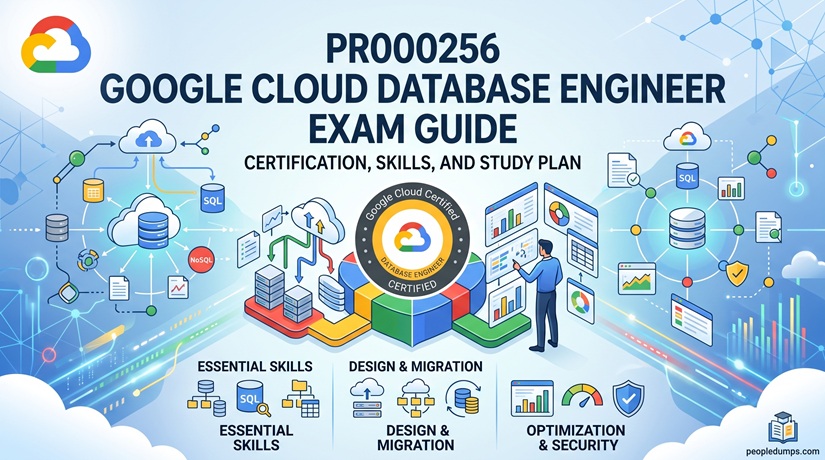
The PR000256 Google Cloud Database Engineer certification, officially known as Google Cloud Certified – Professional Cloud Database Engineer, is one of Google’s more specialized professional-level cloud certifications. It focuses on the practical skills required to design, deploy, migrate, secure, manage, monitor, and troubleshoot database solutions running on Google Cloud.
Unlike a traditional database certification that concentrates mainly on one database engine, this exam expects you to understand how several database technologies fit into a broader cloud architecture. You need to know when to use Cloud SQL, AlloyDB, Spanner, Firestore, Bigtable, and other services, but you also need to understand networking, IAM, high availability, disaster recovery, migration, monitoring, performance, and cost.
For database administrators moving into cloud computing, cloud engineers taking on more data responsibilities, and students who want to understand modern database infrastructure, the PR000256 Google Cloud Database Engineer exam provides a useful technical roadmap.
This guide explains what the certification covers, how valuable it can be, which Google Cloud database technologies matter most, how to approach the major exam domains, and how to build an effective study plan.
PR000256 Google Cloud Database Engineer Exam Overview
The Professional Cloud Database Engineer exam is designed to validate whether a candidate can make sound technical decisions about database systems in Google Cloud. It is not simply a product-feature test. Many questions are based on scenarios in which several solutions appear technically possible, but one option better satisfies the workload, reliability, migration, security, or operational requirements.
| Item | Exam Information |
|---|---|
| Certification | Google Cloud Certified – Professional Cloud Database Engineer |
| Exam Code | PR000256 |
| Exam Length | 2 hours |
| Number of Questions | 50–60 |
| Question Types | Multiple choice and multiple select |
| Registration Fee | USD $200, plus applicable taxes |
| Languages | English and Japanese |
| Delivery | Online proctored or onsite at a testing center |
| Formal Prerequisites | None |
| Recommended Experience | 5+ years of database/IT experience, including about 2 years of hands-on experience with Google Cloud database solutions |
| Professional Certification Validity | 2 years |
The absence of a formal prerequisite can be misleading. You do not need to pass Associate Cloud Engineer or another Google Cloud exam first, but this is still a professional-level certification.
Google’s recommended experience gives a much better indication of the expected difficulty. If concepts such as IAM, VPC networking, replication, RTO, RPO, point-in-time recovery, query plans, locking, read replicas, failover, and horizontal scaling are completely new to you, it is worth building those fundamentals before attempting the exam.
If you are preparing specifically for the certification, the PR000256 exam page can also be used alongside Google’s official exam guide and documentation as an additional exam-focused reference.
Is the PR000256 Google Cloud Database Engineer Certification Worth It?
The value of the certification comes from the combination of database engineering and cloud architecture. Traditional database certifications often concentrate deeply on one database engine. The Google Cloud Database Engineer exam instead expects you to understand how different database technologies solve different categories of problems.
That makes the certification relevant to roles such as:
- Cloud Database Engineer
- Database Administrator
- Database Reliability Engineer
- Cloud Infrastructure Engineer
- Data Platform Engineer
- Cloud Engineer
- Database Migration Engineer
- Cloud Solutions Architect
- Database Modernization Consultant
A modern database engineer is increasingly expected to understand much more than SQL administration. Production databases exist inside networks, security boundaries, application architectures, monitoring systems, disaster recovery plans, and cost controls.
This certification therefore has value even if your day-to-day role is not titled “Database Engineer.” Developers, DevOps engineers, infrastructure engineers, and cloud architects can all benefit from understanding how managed database systems behave.
At the same time, a certification should not be viewed as a replacement for practical experience. Its strongest value comes when the credential is combined with hands-on work such as deploying Cloud SQL, creating replicas, configuring IAM, testing recovery procedures, monitoring query performance, and migrating workloads.
What Does the PR000256 Exam Actually Test?
The current PR000256 Professional Cloud Database Engineer exam is organized around four major technical domains. Understanding their approximate weighting helps you decide where to spend your study time.
| Exam Domain | Approximate Weight |
|---|---|
| Design innovative, scalable, and highly available cloud database solutions | 32% |
| Manage a solution that can span multiple database technologies | 25% |
| Migrate data solutions | 23% |
| Deploy scalable and highly available databases in Google Cloud | 20% |
1. Design Scalable and Highly Available Database Solutions – About 32%
This is the largest exam domain. It is also the section that most clearly separates a professional-level database engineer from someone who simply knows how to create a database instance in the Google Cloud Console.
You are expected to translate business and technical requirements into database architecture decisions.
Important topics include:
- Capacity planning
- Compute and storage sizing
- Workload growth forecasting
- Performance requirements
- Cost optimization
- Zonal architectures
- Regional architectures
- Multi-region architectures
- High availability
- Disaster recovery
- Maintenance requirements
- Database connectivity
- Security architecture
- Encryption and key management
- Auditing
- SQL versus NoSQL selection
- Managed versus self-managed database platforms
- Compliance requirements
- Hybrid database architectures
The key skill is not memorizing which Google Cloud product has which feature. You need to recognize which architectural characteristic matters most in a scenario.
For example, a traditional PostgreSQL application that must move to Google Cloud with minimal code changes may point you toward one solution, while a globally distributed transactional application requiring horizontal scalability and strong consistency may point you toward something completely different.
The latest exam objectives also recognize the growing role of database technologies in generative AI and large language model applications. Candidates should understand why vector data and vector search have become relevant to modern database design.
2. Manage Solutions Across Multiple Database Technologies – About 25%
After a database has been deployed, someone still has to operate it. This domain combines traditional DBA skills with cloud operations.
You should understand:
- IAM and database permissions
- User authentication
- Authorization
- Database-level privileges
- Slow-query troubleshooting
- Indexing
- Locking and contention
- CPU monitoring
- Memory utilization
- Storage utilization
- I/O performance
- Audit logging
- Database quotas
- Alerting
- Automated backups
- Import and export workflows
- Point-in-time recovery
- RTO and RPO
- Retention policies
- Vertical scaling
- Horizontal scaling
- Replication
- Cost optimization
- Database automation
- SLA and SLO monitoring
This part of the exam is a useful reminder that a technically correct SQL query can still create a serious production problem. A query may scan too much data, hold locks for too long, overload storage, consume excessive memory, or create too many database connections.
A professional database engineer needs to identify where the bottleneck actually exists before changing infrastructure.
3. Migrate Data Solutions – About 23%
Database migration is one of the most practical sections of the PR000256 exam. Most organizations do not begin their cloud journey with an empty environment. They already have databases running on physical servers, virtual machines, private clouds, or other cloud providers.
Those workloads may include:
- MySQL
- PostgreSQL
- Microsoft SQL Server
- Oracle
- Other commercial and open-source database systems
The exam expects you to reason about migration strategies rather than simply recognize migration-product names.
Important migration concepts include:
- Offline migration
- Online migration
- Low-downtime migration
- Near-zero-downtime migration
- Initial data loading
- Continuous replication
- Cutover planning
- Fallback planning
- Rollback planning
- Reverse replication
- Schema conversion
- DDL compatibility
- DML compatibility
- Application dependency analysis
- Migration validation
- Migration tool selection
Google Cloud’s Database Migration Service is especially important. Do not treat DMS as a simple “copy database” button. Understand the entire migration lifecycle: connectivity, initial load, ongoing replication, validation, application cutover, monitoring, and fallback.
4. Deploy Scalable and Highly Available Databases – About 20%
This domain takes database architecture and turns it into implementation.
You may know that an application needs high availability, but the exam can ask whether you understand how to deploy the actual architecture required to meet that goal.
Topics include:
- Provisioning highly available database systems
- Configuring replicas
- Read replicas
- Multi-region replication
- Automated provisioning
- Failover
- Disaster recovery testing
- Monitoring highly available systems
- Validating recovery procedures
Do not overlook testing. A disaster recovery plan that has never been tested is not the same thing as a proven disaster recovery capability.
Google Cloud Database Technologies You Should Understand
A common preparation mistake is learning Google Cloud database services as separate product pages. The PR000256 exam becomes much easier when you compare those products according to workload requirements.
Cloud SQL
Cloud SQL is Google Cloud’s managed relational database service for familiar engines including MySQL, PostgreSQL, and SQL Server.
Cloud SQL is often a natural candidate when an organization already uses a conventional relational database and wants to reduce the operational burden associated with managing database servers.
Typical workloads may include:
- Web applications
- Business applications
- SaaS platforms
- Internal enterprise applications
- ERP-style applications
- Existing MySQL migrations
- Existing PostgreSQL migrations
- Existing SQL Server migrations
For the exam, study more than instance creation. Understand backups, high availability, read replicas, point-in-time recovery, maintenance, monitoring, connectivity, IAM-related access patterns, storage growth, and performance troubleshooting.
AlloyDB for PostgreSQL
AlloyDB for PostgreSQL is a fully managed PostgreSQL-compatible database designed for demanding enterprise workloads.
The important question is not simply “What is AlloyDB?” The useful exam question is: When should I choose AlloyDB instead of another PostgreSQL deployment option?
Consider factors such as:
- PostgreSQL compatibility
- Performance requirements
- Availability requirements
- Scalability
- Enterprise workload characteristics
- Operational complexity
- Analytical or hybrid workload requirements
AlloyDB is also increasingly relevant to AI-oriented application architectures, making it useful to understand how PostgreSQL-compatible systems can participate in vector and generative AI workloads.
Spanner
Spanner is a distributed relational database designed for workloads that need relational semantics together with horizontal scalability and strong consistency.
Do not choose Spanner simply because an application uses SQL.
Instead, consider Spanner when requirements include:
- Very large scale
- Horizontal scaling
- High availability
- Distributed transactional workloads
- Strong consistency
- Regional or multi-region deployment
The key is understanding when those requirements justify a distributed relational architecture.
Firestore
Firestore is a document-oriented database designed for application-friendly, managed data storage.
For exam scenarios, pay attention to requirements involving:
- Document data
- Flexible application data structures
- Serverless application patterns
- Application-centric access
- Automatic scaling
Firestore is not a replacement for every relational database. Its strengths are associated with a different data model and different application access patterns.
Bigtable
Bigtable is designed for extremely large datasets and high-throughput workloads that use key-based access patterns.
Typical use cases can include:
- Time-series data
- IoT telemetry
- Large operational datasets
- High-throughput applications
- Low-latency key-based access
The important distinction is that Bigtable does not exist to provide conventional relational joins and transactional application behavior. It solves a different scaling problem.
Memorystore and In-Memory Workloads
In-memory services solve problems such as caching, application sessions, transient data, and extremely latency-sensitive access.
This reinforces one of the most important lessons for the exam: not every data requirement belongs in the same database.
A production architecture may legitimately use a relational database for transactions, an in-memory system for caching, and another database technology for large-scale operational data.
How to Choose the Right Google Cloud Database
Professional-level certification questions frequently describe business requirements instead of directly asking which product provides a particular feature.
A useful strategy is to identify the strongest requirement first.
| Workload Requirement | Technology to Investigate |
|---|---|
| Traditional MySQL, PostgreSQL, or SQL Server application with minimal application change | Cloud SQL |
| Demanding PostgreSQL-compatible enterprise workload | AlloyDB for PostgreSQL |
| Massively scalable relational workload requiring strong consistency | Spanner |
| Document-oriented application data | Firestore |
| Huge key-based or wide-column workload with very high throughput | Bigtable |
| Low-latency caching or transient in-memory data | Memorystore |
This comparison is only a starting point. Real database decisions also depend on:
- Geographic distribution
- Latency
- Consistency
- Transaction requirements
- Application compatibility
- Migration complexity
- Security
- Compliance
- Operational expertise
- Cost
The exam often rewards the solution that satisfies the requirements with the least unnecessary complexity.
High Availability, Disaster Recovery, RTO, and RPO
If there is one reliability concept every PR000256 candidate should understand, it is this: high availability and disaster recovery are related, but they are not the same thing.
High availability focuses on keeping a database service operational when components fail.
Disaster recovery focuses on restoring an acceptable level of service after a significant failure or disaster.
RTO – Recovery Time Objective
RTO answers the question:
How long can the service remain unavailable?
If the business requires a very short RTO, restoring a large backup manually may not be sufficient. The architecture may require automatic failover, a standby system, or another ready-to-use database environment.
RPO – Recovery Point Objective
RPO answers a different question:
How much recent data can the business afford to lose?
If the RPO is close to zero, a backup taken once every 24 hours will obviously not satisfy the requirement. Continuous replication, transaction logs, or other recovery mechanisms may be necessary.
Point-in-Time Recovery
Point-in-time recovery (PITR) is especially important when the infrastructure itself is healthy but the data has been accidentally modified or deleted.
For example, an administrator may accidentally delete thousands of records at 2:10 PM. If the database itself remains available, traditional failover does not solve the problem. PITR can potentially restore the database to a point immediately before the unwanted change.
For exam questions, always identify the actual failure mode before choosing a recovery mechanism.
Security and Database Connectivity
Database security questions often involve several layers at the same time. An application may be able to reach a database through the network, but network connectivity alone does not mean it should have permission to access every database or table.
Be prepared to reason about:
- IAM roles
- Least privilege
- Database-native users
- Database privileges
- Service accounts
- Private connectivity
- Public connectivity
- VPC architecture
- Encryption
- Key management
- Audit logging
- Organizational policies
- Regulatory requirements
- Compliance requirements
Professional cloud architecture generally favors reducing unnecessary exposure. If an application does not need a publicly accessible database endpoint, there is little reason to create one.
Similarly, assigning excessively broad IAM permissions because it is easier during initial deployment may create long-term security risks.
The exam often favors solutions that are secure, operationally simple, and aligned with the principle of least privilege.
Database Performance Troubleshooting and Cost Optimization
One of the most common beginner mistakes in cloud database performance is assuming that increasing instance size automatically solves performance problems.
Sometimes it does. Often it does not.
A poorly designed query can remain poorly designed even after you give it more CPU.
Before scaling infrastructure, investigate:
- Slow queries
- Missing indexes
- Ineffective indexes
- Full table scans
- Lock contention
- Connection pressure
- CPU saturation
- Memory pressure
- Storage throughput
- Storage latency
- I/O bottlenecks
- Read versus write patterns
- Replica utilization
- Database quotas
- Unexpected workload growth
Performance and Cost Are Connected
Database performance and cloud cost should not be studied separately.
Oversized instances cost more money. Too many replicas cost more money. Inefficient queries may require unnecessarily large machines. Poor storage choices can also create unnecessary expenses.
The objective is not to choose the cheapest possible solution. The objective is to satisfy business, performance, availability, and reliability requirements at a reasonable total cost.
Database Migration: Think Beyond Copying Data
Database migration questions become easier when you divide the migration into stages.
- Discover the existing database environment.
- Identify application dependencies.
- Assess database compatibility.
- Select the destination database.
- Choose an online or offline migration strategy.
- Establish secure connectivity.
- Move the initial dataset.
- Replicate ongoing changes when required.
- Validate the destination.
- Prepare application cutover.
- Monitor the new environment.
- Maintain a fallback strategy until the migration is proven successful.
Offline Migration
An offline migration may be relatively simple when the application can tolerate a long maintenance window.
You stop writes, export the database, move the data, import it into the new environment, validate the result, and then start the application again.
The problem is downtime.
Online or Low-Downtime Migration
For business-critical systems, several hours of downtime may not be acceptable.
A low-downtime migration may therefore require:
- An initial bulk data load
- Continuous replication
- Replication-lag monitoring
- Validation
- A controlled application cutover
- A fallback procedure
Google Cloud’s Database Migration Service is an important technology for this exam because it supports migration workflows involving common database platforms and managed Google Cloud database destinations.
When studying PR000256 exam preparation material, focus on the migration decision process rather than memorizing a single migration workflow. The correct design depends heavily on acceptable downtime, compatibility, data volume, network connectivity, and rollback requirements.
Why Generative AI Appears in a Database Certification
One of the more interesting developments in modern database engineering is the increasing connection between databases and generative AI applications.
Many large language model applications use embeddings, which represent text, images, or other information as numerical vectors.
An application may then use vector similarity search to find information that is semantically related to a user’s request.
This is commonly used in retrieval-augmented generation, usually abbreviated as RAG.
A simplified RAG workflow can look like this:
- A document is converted into embeddings.
- The embeddings are stored in a database or vector-capable data platform.
- A user’s question is converted into an embedding.
- The application searches for similar vectors.
- Relevant information is retrieved.
- The retrieved context is provided to a large language model.
- The model generates a response using that additional context.
You do not need to become a machine learning engineer to prepare for PR000256. However, you should understand:
- What vector data represents
- Why vector search exists
- How similarity search differs from conventional filtering
- Why operational and vector data may coexist
- How AI requirements can influence database selection
The broader lesson is that databases are becoming an increasingly important part of the AI application stack.
PR000256 Google Cloud Database Engineer Study Plan
There is no universal study schedule, but an eight-week plan works well for candidates who already understand basic SQL, networking, and cloud concepts.
Week 1 – Google Cloud and Database Fundamentals
- Google Cloud projects
- Regions and zones
- IAM
- Service accounts
- VPC fundamentals
- SQL versus NoSQL
- Transactions
- Consistency
- Vertical scaling
- Horizontal scaling
Week 2 – Cloud SQL and AlloyDB
- Provision Cloud SQL instances
- Review supported database engines
- Configure backups
- Study PITR
- Review HA architecture
- Create read replicas
- Study maintenance behavior
- Compare Cloud SQL with AlloyDB
- Review AlloyDB architecture
Week 3 – Spanner, Firestore, and Bigtable
- Study distributed relational databases
- Understand strong consistency
- Learn Spanner scaling concepts
- Review Firestore document modeling
- Understand Bigtable access patterns
- Compare relational and NoSQL architectures
- Practice service-selection scenarios
Week 4 – High Availability and Disaster Recovery
- RTO
- RPO
- Backups
- PITR
- Replication
- Zonal architectures
- Regional architectures
- Multi-region architectures
- Failover testing
- Disaster recovery planning
Week 5 – Security, Monitoring, and Troubleshooting
- IAM roles
- Database privileges
- Private connectivity
- Audit logging
- Monitoring concepts
- Slow queries
- CPU utilization
- Memory utilization
- Storage and I/O
- Indexing
- Database locking
Week 6 – Database Migration
- Database Migration Service
- Offline migration
- Online migration
- Continuous replication
- Schema compatibility
- DDL and DML compatibility
- Migration validation
- Cutover planning
- Fallback planning
Week 7 – Cost, Automation, and Operations
- Database sizing
- Performance versus cost
- Scaling strategies
- Automated provisioning
- Database maintenance
- SLA concepts
- SLO concepts
- Capacity planning
Week 8 – Exam Review and Scenario Practice
- Read the official exam guide again
- Review every exam objective
- Complete official sample questions
- Identify weak topics
- Compare similar database services
- Practice architecture scenarios
- Review migration strategies
- Review HA and DR scenarios
During the final week, avoid spending all your time memorizing individual facts. Spend more time answering questions such as:
- Why would I choose Cloud SQL instead of Spanner?
- Why would I choose AlloyDB instead of Cloud SQL?
- When does a read replica help?
- When does a backup fail to satisfy the RTO?
- What happens if the migration allows only a few minutes of downtime?
- Which solution minimizes operational overhead?
Hands-On Practice Matters More Than Memorization
Google recommends significant practical experience for this certification for a reason. Many database concepts become much easier to understand after you have implemented them yourself.
At minimum, try to complete several hands-on exercises.
- Create a Cloud SQL instance.
- Connect to the database from a client.
- Create database users.
- Configure permissions.
- Review private connectivity options.
- Enable backups.
- Study point-in-time recovery.
- Create a read replica.
- Review database monitoring metrics.
- Generate a slow query and investigate it.
- Create an alerting policy.
- Test database recovery.
- Explore Database Migration Service.
- Review the network path between an application and its database.
Even a small laboratory environment changes the way you read certification questions. Instead of merely remembering that a feature exists, you begin to understand the problem it solves and the operational trade-offs involved.
How to Approach PR000256 Exam Questions
The PR000256 exam frequently uses scenario-based questions. These questions can initially appear complicated because they contain a large amount of information.
The easiest way to simplify them is to identify the constraints.
1. Identify Compatibility Requirements
Can the application be modified?
If the business requires minimal application changes, compatibility with the existing database engine may become one of the strongest constraints.
2. Identify Downtime Requirements
Can the application be offline for several hours?
If yes, an offline migration may be acceptable. If the business can tolerate only a few minutes of downtime, the migration architecture becomes very different.
3. Identify RPO
How much data loss is acceptable?
Do not recommend a backup frequency that cannot satisfy the required RPO.
4. Identify RTO
How quickly must the service recover?
A technically valid backup strategy may still be incorrect if restoring that backup takes longer than the business can tolerate.
5. Identify Scale
Is the workload small and regional, or extremely large and globally distributed?
Do not select a distributed global database if the workload does not need one. At the same time, do not select an architecture that cannot scale to the stated requirements.
6. Identify Consistency Requirements
Does the application require strong transactional consistency?
This requirement can significantly affect database selection.
7. Identify Operational Requirements
Does the company want to minimize DBA administration?
If so, a managed database service may be more appropriate than a self-managed database running on virtual machines.
8. Identify Security Requirements
Does the organization require private connectivity, encryption controls, auditing, or specific compliance requirements?
These details can eliminate otherwise valid answers.
9. Identify Cost Constraints
The most technically powerful architecture is not automatically the best answer.
If a simpler solution meets every requirement with lower cost and operational complexity, that may be the better engineering decision.
When reviewing PR000256 study resources, concentrate on understanding why an answer is correct rather than memorizing an answer without context.
Common PR000256 Preparation Mistakes
Memorizing Product Names Without Understanding Trade-Offs
Knowing that Spanner is horizontally scalable or that Firestore stores documents is only the beginning.
The exam expects you to understand why those characteristics matter in a particular application architecture.
Ignoring Networking
A database does not exist in isolation.
Applications need network paths to databases, services need private or public connectivity, and network design affects both security and availability.
Ignoring IAM
Cloud database engineers need to understand both cloud-level permissions and database-level privileges.
Do not assume that network connectivity and authorization are the same problem.
Studying Only SQL
SQL knowledge is valuable, but PR000256 is not primarily a SQL syntax certification.
Migration, architecture, reliability, networking, monitoring, security, and cost are equally important.
Ignoring Migration
Migration represents a substantial portion of the exam.
You should be comfortable comparing offline migration, low-downtime migration, continuous replication, cutover planning, and fallback strategies.
Ignoring Disaster Recovery
Backups alone do not automatically provide a complete disaster recovery architecture.
Always connect recovery mechanisms to RTO and RPO requirements.
Memorizing Answers Without Understanding the Architecture
Memorizing isolated answers is risky because cloud products, features, and certification objectives change over time.
Scenario-based questions require you to understand the engineering decision behind the answer.
A stronger preparation method combines:
- Official Google Cloud documentation
- The official exam guide
- Hands-on labs
- Architecture scenarios
- Practice questions used as learning tools
- Independent technical research
Should Students and Beginners Take PR000256?
Students can absolutely use the PR000256 curriculum as a structured database learning roadmap, but there is an important difference between learning the material and being ready for the professional certification exam.
If you are new to cloud computing, first build a foundation in:
- Basic Linux
- Command-line tools
- TCP/IP
- Private networking
- Relational databases
- SQL
- Indexes
- Transactions
- Database backups
- Basic cloud computing
- Google Cloud projects
- IAM
- VPC networking
- Regions and zones
An Associate-level Google Cloud learning path can be useful preparation even though another certification is not a formal prerequisite for PR000256.
Build a Portfolio Project
For students, one practical project can be more valuable than reading another hundred pages of theory.
For example, build a simple application that:
- Runs on Google Cloud.
- Uses a managed relational database.
- Connects to the database securely.
- Uses separate application credentials.
- Creates automated backups.
- Supports point-in-time recovery.
- Collects monitoring metrics.
- Uses an alerting policy.
- Tests recovery after a simulated failure.
Document the architecture and explain why you selected each service. That exercise forces you to think like a cloud database engineer rather than someone studying only for an exam.
Final Verdict: Is PR000256 Worth Studying?
The PR000256 Google Cloud Database Engineer certification is specialized, and that specialization is one of its strengths.
It does not attempt to make you an expert in every Google Cloud product. Instead, it focuses on an important technical problem: how to design, migrate, secure, deploy, troubleshoot, recover, and scale production database systems in a cloud environment.
For experienced DBAs, the certification can provide a structured path into cloud-native database engineering.
For cloud engineers and architects, it forces deeper thinking about database technology and data-platform decisions.
For students, the objectives provide a useful map of the skills increasingly required in modern database infrastructure roles.
The most effective way to prepare is not to memorize the Google Cloud product catalog. Learn how to translate a business requirement into technical constraints, compare multiple database technologies, understand failure modes, and justify the trade-offs behind your architecture.
That way of thinking will remain valuable long after the certification exam is over.
PR000256 Google Cloud Database Engineer FAQ
What is the PR000256 Google Cloud Database Engineer certification?
The PR000256 Google Cloud Database Engineer exam is associated with the Google Cloud Certified – Professional Cloud Database Engineer certification. It evaluates a candidate’s ability to design, deploy, manage, migrate, secure, monitor, and troubleshoot database solutions on Google Cloud.
What is the PR000256 exam code?
The exam catalog code is PR000256. The official certification name is Google Cloud Certified – Professional Cloud Database Engineer.
How many questions are on the PR000256 exam?
The exam currently contains approximately 50–60 multiple-choice and multiple-select questions.
How long is the PR000256 exam?
Candidates currently have two hours to complete the Professional Cloud Database Engineer exam.
How much does the PR000256 exam cost?
The current standard registration fee is USD $200, plus applicable taxes. Always confirm the current price on the official Google Cloud certification page before registering.
Are there prerequisites for the Google Cloud Database Engineer certification?
There are currently no formal certification prerequisites. However, Google recommends substantial database and IT experience, including practical experience with Google Cloud database technologies.
How long is the Professional Cloud Database Engineer certification valid?
Google Cloud Professional certifications are currently valid for two years.
Which Google Cloud databases should I study for PR000256?
You should understand the characteristics and use cases of major Google Cloud database technologies, including Cloud SQL, AlloyDB for PostgreSQL, Spanner, Firestore, Bigtable, and relevant supporting database services.
Should I study Database Migration Service for PR000256?
Yes. Database migration is a major exam area, so candidates should understand Google Cloud Database Migration Service as well as concepts such as online migration, offline migration, replication, cutover, compatibility, validation, and fallback planning.
Does PR000256 include high availability and disaster recovery?
Yes. High availability, backups, replication, disaster recovery, RTO, RPO, failover, and point-in-time recovery are important topics throughout the certification.
Does the PR000256 exam include generative AI topics?
The current exam objectives include database technologies that support generative AI and large language model use cases. Candidates should understand concepts such as vector data, vector search, and the role databases can play in retrieval-oriented AI architectures.
How should I prepare for the PR000256 Google Cloud Database Engineer exam?
A strong preparation plan combines the official Google Cloud exam guide, official documentation, hands-on database labs, architecture scenarios, migration practice, troubleshooting exercises, and PR000256 exam preparation resources.
Is the PR000256 exam difficult?
It is a professional-level exam. The main challenge is not memorizing individual Google Cloud features. The difficulty comes from evaluating realistic scenarios and choosing the database architecture that best satisfies technical and business requirements.
Where can I find additional PR000256 study resources?
In addition to Google’s official certification documentation, you can review the PR000256 Google Cloud Certified Professional Cloud Database Engineer resource page for additional exam-focused information and study resources.
Official and Recommended PR000256 References
- Google Cloud – Professional Cloud Database Engineer Certification
- Official Professional Cloud Database Engineer Exam Guide
- Official Professional Cloud Database Engineer Sample Questions
- Google Skills – Cloud Database Engineer Learning Path
- Google Cloud Database Products
- Google Cloud Database Migration Service
- Cloud SQL Documentation
- AlloyDB for PostgreSQL Documentation
- Spanner Documentation
- Firestore Documentation
- Bigtable Documentation
- Google Cloud Certification FAQ
Additional PR000256 Exam Resources
If you are preparing specifically for the Professional Cloud Database Engineer certification, you can also visit the PR000256 Google Cloud Database Engineer exam resource page for additional certification-focused information and preparation materials.